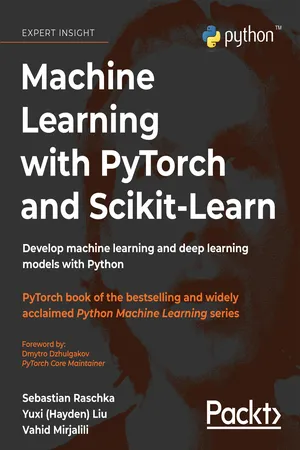
Machine Learning with PyTorch and Scikit-Learn
eBook - ePub

Machine Learning with PyTorch and Scikit-Learn

Develop machine learning and deep learning models with Python

  1. 770 pages
  2. English
  3. ePUB (mobile friendly)
  4. Available on iOS & Android
eBook - ePub

Machine Learning with PyTorch and Scikit-Learn

Develop machine learning and deep learning models with Python

About this book

This book of the bestselling and widely acclaimed Python Machine Learning series is a comprehensive guide to machine and deep learning using PyTorch s simple to code framework. Purchase of the print or Kindle book includes a free eBook in PDF format.

Key Features

  • Learn applied machine learning with a solid foundation in theory
  • Clear, intuitive explanations take you deep into the theory and practice of Python machine learning
  • Fully updated and expanded to cover PyTorch, transformers, XGBoost, graph neural networks, and best practices

Book Description

Machine Learning with PyTorch and Scikit-Learn is a comprehensive guide to machine learning and deep learning with PyTorch. It acts as both a step-by-step tutorial and a reference you'll keep coming back to as you build your machine learning systems. Packed with clear explanations, visualizations, and examples, the book covers all the essential machine learning techniques in depth. While some books teach you only to follow instructions, with this machine learning book, we teach the principles allowing you to build models and applications for yourself. Why PyTorch? PyTorch is the Pythonic way to learn machine learning, making it easier to learn and simpler to code with. This book explains the essential parts of PyTorch and how to create models using popular libraries, such as PyTorch Lightning and PyTorch Geometric. You will also learn about generative adversarial networks (GANs) for generating new data and training intelligent agents with reinforcement learning. Finally, this new edition is expanded to cover the latest trends in deep learning, including graph neural networks and large-scale transformers used for natural language processing (NLP). This PyTorch book is your companion to machine learning with Python, whether you're a Python developer new to machine learning or want to deepen your knowledge of the latest developments.

What you will learn

  • Explore frameworks, models, and techniques for machines to learn from data
  • Use scikit-learn for machine learning and PyTorch for deep learning
  • Train machine learning classifiers on images, text, and more
  • Build and train neural networks, transformers, and boosting algorithms
  • Discover best practices for evaluating and tuning models
  • Predict continuous target outcomes using regression analysis
  • Dig deeper into textual and social media data using sentiment analysis

Who this book is for

If you have a good grasp of Python basics and want to start learning about machine learning and deep learning, then this is the book for you. This is an essential resource written for developers and data scientists who want to create practical machine learning and deep learning applications using scikit-learn and PyTorch. Before you get started with this book, you'll need a good understanding of calculus, as well as linear algebra.

]]>

Frequently asked questions

Yes, you can cancel anytime from the Subscription tab in your account settings on the Perlego website. Your subscription will stay active until the end of your current billing period. Learn how to cancel your subscription.
No, books cannot be downloaded as external files, such as PDFs, for use outside of Perlego. However, you can download books within the Perlego app for offline reading on mobile or tablet. Learn more here.
Perlego offers two plans: Essential and Complete
  • Essential is ideal for learners and professionals who enjoy exploring a wide range of subjects. Access the Essential Library with 800,000+ trusted titles and best-sellers across business, personal growth, and the humanities. Includes unlimited reading time and Standard Read Aloud voice.
  • Complete: Perfect for advanced learners and researchers needing full, unrestricted access. Unlock 1.4M+ books across hundreds of subjects, including academic and specialized titles. The Complete Plan also includes advanced features like Premium Read Aloud and Research Assistant.
Both plans are available with monthly, semester, or annual billing cycles.
We are an online textbook subscription service, where you can get access to an entire online library for less than the price of a single book per month. With over 1 million books across 1000+ topics, weโ€™ve got you covered! Learn more here.
Look out for the read-aloud symbol on your next book to see if you can listen to it. The read-aloud tool reads text aloud for you, highlighting the text as it is being read. You can pause it, speed it up and slow it down. Learn more here.
Yes! You can use the Perlego app on both iOS or Android devices to read anytime, anywhere โ€” even offline. Perfect for commutes or when youโ€™re on the go.
Please note we cannot support devices running on iOS 13 and Android 7 or earlier. Learn more about using the app.
Yes, you can access Machine Learning with PyTorch and Scikit-Learn by Sebastian Raschka,Yuxi (Hayden) Liu,Vahid Mirjalili,Dmytro Dzhulgakov in PDF and/or ePUB format, as well as other popular books in Computer Science & Computer Science General. We have over one million books available in our catalogue for you to explore.

Index

Symbols
5ร—2 cross-validation 192
7-Zip
URL 248
A
accuracy
versus classification error 57
action-value function 682
estimation, with Monte Carlo 688
greedy policy, computing from 689
activation function, for multilayer neural network
selecting 400
activation functions, torch.nn module
reference link 406
activations
computing, in RNNs 504, 505
AdaBoost
applying, with scikit-learn 233-236
comparing, with gradient boosting 237
AdaBoost recognition 229
Adam optimizer 479
adaptive boosting
weak learners, leveraging 229
working 229-233
Adaptive Linear Neuron (Adaline) 35-37, 278
algorithm 337
implementation, converting into algorithm for logistic regression 66-68
implementing, in Python 39-43
advanced graph neural network literature
pointers 669, 670
agent 6, 674, 675
agglomerative clustering
applying, via scikit-learn 327, 328
AI winters
reference link 336
Ames Housing dataset 272
loading, into data frame 272-274
nonlinear relationships, modeling 297-299
Anaconda 15
reference link 15
Anaconda Python distribution
using 15, 16
artificial intelligence (AI) 1, 19, 336, 452
artificial neural networks
training 360
used, for modeling complex functions 335, 336
artificial neuron 20
attention mechanism
for RNNs 540, 542
attention weights
computing 544
autoencoders 590, 591
automatic differentiation 363, 416
autoregression 53...

Table of contents

  1. Preface
  2. Giving Computers the Ability to Learn from Data
  3. Training Simple Machine Learning Algorithms for Classification
  4. A Tour of Machine Learning Classifiers Using Scikit-Learn
  5. Building Good Training Datasets โ€“ Data Preprocessing
  6. Compressing Data via Dimensionality Reduction
  7. Learning Best Practices for Model Evaluation and Hyperparameter Tuning
  8. Combining Different Models for Ensemble Learning
  9. Applying Machine Learning to Sentiment Analysis
  10. Predicting Continuous Target Variables with Regression Analysis
  11. Working with Unlabeled Data โ€“ Clustering Analysis
  12. Implementing a Multilayer Artificial Neural Network from Scratch
  13. Parallelizing Neural Network Training with PyTorch
  14. Going Deeper โ€“ The Mechanics of PyTorch
  15. Classifying Images with Deep Convolutional Neural Networks
  16. Modeling Sequential Data Using Recurrent Neural Networks
  17. Transformers โ€“ Improving Natural Language Processing with Attention Mechanisms
  18. Generative Adversarial Networks for Synthesizing New Data
  19. Graph Neural Networks for Capturing Dependencies in Graph Structured Data
  20. Reinforcement Learning for Decision Making in Complex Environments
  21. Other Books You May Enjoy
  22. Index