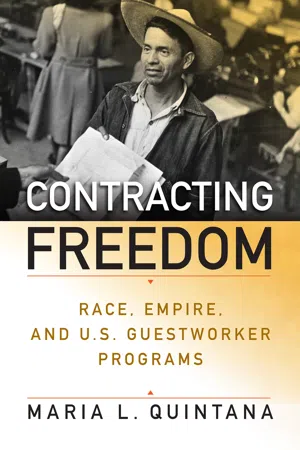
Contracting Freedom is the first relational study of the origins of twentieth-century U.S. guestworker programs from Mexico and the Caribbean, focusing on their shared origins. It investigates these government-sponsored programs as the unexplored consequence of the history of enslaved labor, Japanese American incarceration, the New Deal, the long civil rights movement, and Caribbean decolonization.
In the World War II era, U.S. lawmakers and activists alike celebrated guestworker agreements with Mexico and the Caribbean as hallmarks of anti-imperialism and worker freedom. A New Deal-based conception of racial liberalism inspired many of these government officials and labor advocates to demand a turn toward state-sponsored labor contracts across the hemisphere to protect migrant workers' welfare and treatment in the postwar world. Their view of liberalism emphasized the value of formal labor contracts, bilateral agreements between nation-states, state power, and equal rights, all of which they described as advances beyond older labor arrangements forged under colonialism and slavery. Eighty years later, their conceptions of guestworker programs continue to shape political understandings of the immigration debate, as these programs are often considered a solution to offset the deportation regime, and as a response to increasingly rigid racist measures to close U.S. borders to migrants.
Maria Quintana's compelling history shifts the focus on guestworker programs to the arena of political conflict, revealing how fierce debates over the bracero program and Caribbean contract labor programs extended and legitimated U.S. racial and imperial domination into the present era. It also unearths contract workers' emerging visions of social justice that challenged this reproduction of race and empire, giving freedom new meanings that must be contemplated.
- 328 pages
- English
- ePUB (mobile friendly)
- Available on iOS & Android
eBook - ePub
About this book
Information
Publisher
University of Pennsylvania PressYear
2022Print ISBN
9780812253887
9780812253887
eBook ISBN
9780812298499
Chapter 1
Free or Slave?: A Genealogy of Labor Contract Coercion and Freedom
Labor activists and supporters have long insisted that contract guestworker programs are “close to slavery,” if not the epitome of slavery itself. In the 1963 words of Henry Anderson, farm labor union organizer, activist, and apprentice of Mexican American civil rights activist Dr. Ernesto Galarza: “The distinguishing characteristic of the bracero system is that it is a captive labor system. . . . [except] we no longer buy slaves; we rent them.” Anderson’s language mirrored that of the writer Truman E. Moore, who referred to agricultural migrant labor in the United States as a new form of slavery in his 1965 book, The Slaves We Rent. And it also influenced Galarza’s thinking, when he wondered aloud, “Is this indentured alien—an almost perfect model of the economic man, an ‘input factor’ stripped of political and social attributes that liberal democracy likes to ascribe to all human beings and ideally—is this bracero the production man of the future?”1 This characterization of guestworker programs as a form of slave labor continues even today with the work of scholars and of civil rights organizations like the Southern Poverty Law Center, an agency that published a report titled Close to Slavery: Guestworker Programs in the United States.2
Though aiming to evoke sympathy for the workers, the use of slavery and concentration camps as metaphors has had the effect of constructing braceros as a foreign element completely and entirely outside of the U.S. labor force and liberal modernity.3 It also had the unintended consequence of turning (mostly white) U.S. citizen agricultural workers into “free laborers,” producing freedom in the United States much as early nineteenth-century antebellum arguments over slavery and freedom had. In constructing the bracero labor contract as an instrument of unfreedom in the 1960s, Galarza and others produced freedom as a racial project, turning citizens into “free” laborers and noncitizen/nonwhite workers into potential “slaves.”4 While these pronouncements seem in direct opposition to how U.S. officials originally conceived the World War II labor programs as antiracist and anti-imperial efforts toward freedom, they were part and parcel of a long history of debates over slavery and freedom that demonstrate that the slave/free dialectic has long served as a rhetorical device to maintain the racial boundaries of coercion among workers, whether in the legitimization or prohibition of the labor contract.
The slave/free dialectic that emerged out of slavery has repeatedly been used to resolve tensions in capitalism and recreate coercive systems of labor, in the continued production of people as commodities.5 The 1940s–1960s debates progressives engaged over the inherent “freedom” or “slavery” of the bracero program were not new, but rested in a specific legal genealogy, arising from slave emancipation and nineteenth-century laws regarding Asian contract labor in the British Caribbean colonies. Since the initial development of Asian contract labor after abolition, a growing faith in the state to regulate labor migration to advance the cause of freedom led to countless laws, agencies, and government hearings that would do the work of connecting migrant labor with slavery or freedom. The importation of contract or indentured labor from Asia to Europe and the Americas gave rise to multiple debates over the inherent free or coercive nature of the labor contract. In the United States, these nineteenth-century debates resulted in the growth of state power over labor regulation, while also contributing to a racial genealogy that categorized nonwhite workers as unfree, as slaves, as “peons,” or as “coolies,” with the state designated the regulator of freedom.
Arguments about the supposed “freedom” of the labor contract originated during the period of slave emancipation among the Spanish, British, Portuguese, and U.S. governments in the nineteenth century, as these states vacillated between guaranteeing the freedoms and protections of the labor contract and critiquing the labor contract as a new form of enslavement. The opposition between capital and liberalism that manifested during slavery had generated several very real tensions—how could one espouse the liberal ideals of equality and universality of rights along with the state-endorsed labor extraction, exploitation, and racial exclusion that were required for capitalism to function? The fuzziness of what it meant to be “slave” and what it meant to be “free” as overlapping signifiers (and epistemological terms rooted in classical liberalism) made them readily available as linguistic tools to overcome the contradictions that emerged. Whether through the employment of imported contract laborers as an attempt to alleviate labor coercion, or through various U.S. immigration acts in the 1860s through the 1920s designed to protect the nation against “slavery,” the slave/free dialectic resolved the dissonance between liberalism and capitalism.6
This genealogy is reflected in the U.S. immigration restriction acts from the 1860s to the 1920s, including the Chinese Exclusion Act (1882) and the Foran Act (1885) banning imported contract labor. Each U.S. immigration restriction act during this period framed imported contract and immigrant labor as either “slave” or “free” during a specific moment in the growth of state power over labor regulation. The Foran Act, also known as the Alien Contract Labor Law, specifically prohibited foreign Asian imported contract labor as a form of slavery in 1885. In the 1910s and 1940s, the U.S. government allowed for the importation of Mexican contract workers during the bracero program. More than fifty years after the Foran Act had forbidden foreign contract labor in the United States, a renewed acceptance of the foreign labor contract emerged with the bracero program, revealing a revived faith in the ability of the state to regulate labor migrations for the cause of “freedom.”7 Through numerous laws and agencies, 1940s U.S. federal officials guaranteed that imported contract labor from Mexico and the Caribbean would serve as a form of voluntary—not slave—labor. Nonetheless, contract labor importation programs were the product of the state’s increased efforts to control labor migration and regulate its borders, just as the immigration restriction acts had been. What made the 1940s focus on labor contracts different from immigration restriction is that the contract turned the state into a potential regulator of freedom, with the state protecting migrants’ rights so as to gain broad political legitimacy.
Placing the U.S. contract labor program agreements within the context of nineteenth-century slavery, indentured servitude, and efforts toward immigration restriction can help us to understand how, by the 1930s and 1940s, the contract came to be (re)interpreted anew by activists, government officials, and laborers in the United States. As much as the architects of the 1940s guestworker programs wished to distance themselves from the colonial origins of the labor contract, the context of slavery and emancipation dictated and guided the discursive shifts that resulted in the labor programs. Underlying each of these shifts was a set of values that assumed the liberal nation-state was the ultimate guarantor of freedom and equality, thus fueling the growth of government regulation over migrant labor in the twentieth century.
Since the 1960s, state officials, labor activists, historians, and scholars have routinely characterized migrant contract labor as a form of voluntary or free labor, as a form of slavery, or as something in between freedom and slavery.8 Viewing the Mexican and Caribbean labor programs of the twentieth century through the historical lens of the debates over the inherent slavery or freedom of the labor contract can expose how the labor programs were not necessarily a form of “imported colonialism,” but rooted in a long history of liberalism and empire. Whether imagined as a form of “slavery” or “freedom,” the contract became, in different historical moments, a means to exclude foreign contract laborers from U.S. citizenship, while transforming them into resources or commodities to be transferred from one nation-state (or colony) to another.
This perspective suggests that instead of relying on the slave/free dialectic to renew or critique the labor programs, we should give greater attention to how the logics of that paradigm have sustained and advanced colonial practices into the twentieth century. And, rather than turn to the liberal state to resolve the inequalities created by guestworker labor contracts, we should critique and disrupt the role of the state as an arbiter of freedom. Official debates surrounding “contract” not only deepened and muddled the divide between slavery and freedom, but they also resolved, clarified, and reproduced that divide, with lasting historical implications, as similar debates are used even today to sustain guestworker programs into the twenty-first century.
How “Contract” Was Materially Rooted in the Slave/Free Divide
Today the contract is so prevalent as a binding agreement that it is natural to assume that it has always existed. Yet the notion of a contract was originally tied to the British Empire and only emerged in the context of British colonialism in the eighteenth and nineteenth centuries. The notion of “contract” arose from the political philosophy of liberalism, the catchword of which was “freedom” or “liberty,” and was grounded in the notion that all people are born with individual rights. Liberal social contract theory of the late seventeenth century was conceived as a means to justify political authority and the state through the free consent of individuals, creating a new type of political community based on the voluntary actions of individuals during the Enlightenment.9 Of their own volition, individuals exchanged autonomy for the protection of the political community by the state, which would ensure their “freedom.” This was, according to Locke, the “Social Contract.”10 The ideal of the contract was also modeled on classical political economy’s rule of market exchange. A “contract” expressed obligations arrived at through competition between formally equal and autonomous individuals—not dominion and dependence. The contract functioned to impose social order through personal choice as a material emblem of human relations in free-market transactions. As the historian Amy Dru Stanley argues, “In the eyes of most Americans it was the abolition of slavery that assured the ascendance of the contract. Emancipation apocalyptically achieved the transition from status to contract, appearing to destroy all traces of bondage . . . by affording free slaves the right to own themselves and enter into voluntary relations of exchange.”11 The contract stood as the legal paradigm of liberalism, and it became, in the age of slave emancipation, a symbol of freedom.
The notion of contract rights that sprouted out of the liberalism of the Enlightenment was imagined in the context of debates over slavery; slavery did not contradict contract but underwrote its existence. Under classical liberal theory, the individual consented to state authority in exchange for certain rights and freedoms. Property rights were the foundation of the liberal theory of political order, as these rights upheld that human labor was invested in the individual as property-in-oneself, that property rights could be purchased in others (slaves) outright, or that they might enter the labor market themselves and temporarily trade some of their own rights-in-persons for wages. In other words, both slavery and the concept of “rights” included the rights to the labor of oneself and others. Western systems of slavery and freedom thus had the same roots, such that “freedom” implied the freedom to enslave others and the two were co-constitutive.12
With British abolition of the slave trade in 1807, slavery had become morally objectionable as the epitome of a lack of self-ownership and property-in-oneself through wages. Adam Smith stated in The Wealth of Nations, “A person who can acquire no property can have no other interest but to eat as much and to labour as little as possible.” His arguments for free trade and free labor became an article of faith among British abolitionists, as they argued that free laborers doubled the output of slaves and deemed slave laborers in the Caribbean colonies unfit to compete with free laborers.13 Abolitionists welcomed the end of the slave trade, but as historians have shown, Black workers themselves engaged in a number of slave rebellions that contributed to the end of slavery.14 Slavery was officially abolished in the British Empire on August 1, 1834, but Caribbean planters continued to command full rights to the labor of ex-slaves, who were bound in a form of apprenticeship for a period of six years. In response to Black workers’ resistance to the apprenticeship system, it ended in 1838, around the same time East Indian workers began to be brought into the British West Indies as contract laborers under individual labor contracts. These contract laborers were racially referred to as “coolies.” As historian Hugh Tinker has shown, the British government sought to adapt and replace colonial (slave) labor and apprenticeship with migrant (wage) labor via the labor contract in an attempt to create safeguards to prevent the perpetuation of slavery in new forms.15
In 1813, Britain had already dissolved its monopoly trading companies in India, moving away from strict mercantilism to expanded worldwide trade, signaling the conversion in Britain from mercantilism to modern “free trade” capitalism and from colonial practices of slavery to new forms of labor governance.16 What made free trade possible was not deregulation but increased state regulation of “free labor.” As the anthropologist Sidney Mintz has observed, so-called free trade emerged simultaneously with the gradual emancipation of enslaved labor and the migration of state-regulated indentured Asian labor. The enjoined logics of free trade and free labor meant an increase in the power of various colonial governments to define and advance freedom, and the power to distinguish between free and unfree.17 In the case of Britain, when planters desired access to Asians as a new source of labor, the British Colonial Office attempted to reconcile the inequalities resulting from “free labor” and “free trade” through the creation of a state-regulated contract labor importation program between India and the British West Indies. With the labor contract, imported workers rhetorically became the subjects of a regulatory state. European colonial officials used the labor contract to legitimize this new form of state management, marking it as the hallmark of “free labor” through a discourse of regulation, protection, and voluntary consent. Colonial labor became naturalized and extended through the foreign labor contract, refiguring the state regulation of foreign workers as a means to “free labor” even as it expanded the power of states to manage the global structure of colonial labor. Protecting contract laborers provided justification for all governments to intervene at every level of migration, from medical inspections to health and safety provisions on the ship.
When contract labor from India began to be imported by plantation owners in the British Caribbean, the main subject of political debate among British colonial officials was the extent to which government ought to regulate and inspect these new workers, so as to enforce their “freedom.” The debates focused on improved ship conditions, measures to ensure all laborers departed willingly, and the assurance that the colonies to which migrants went would be “suitable for free men.” There would be a colonial “protector” at the ports where emigration was permitted as well as at the work site, to give advice, listen to worker grievances, and secure the workers’ contract rights. In spite of these new regulations, Caribbean plantation owners were able to draw upon a new pool of cheap labor with the minimum restrictions from the 1840s to the 1920s.18
While some members of the British colonial state turned the contract into a universal emblem of freedom, labor advocates and colonial officials simultaneously made it a marker for slavery, spurning the wage contract as a form of compulsion.19 By 1840, critics of the “coolie” labor importation system in the British West Indies considered it a “new system of slavery.” As British colonial statesman Lord John Russell stated on February 15, 1840, “I should be unwilling to adopt any measure to favour the transfer of labourers from British India to Guiana. . . . I am not prepared to encounter the possibility of a measure which may lead to a dreadful loss of life on the one hand, or, on the other, to a new system of slavery.”20
A similar process took place in the United States, where the ability to participate in the marketplace without competition from foreign workers came to define freedom. From the 1850s to the1870s, the labor contract became a means to conspicuously blur the difference between free and unfree labor relations as it was interpreted variously as either the essence of freedom or a vestige of slavery at different moments.21 U.S. political debates over Chinese “coolies” in the 1850s and 1860s demonstrate this ambiguity, revealing how “contract” could embody both slavery and freedom. Initially, Southern plantation owners introduced Chinese contract labor as “free labor” improvements on slave labor, much as East Indian “coolies” had been introduced in the British Caribbean. In 1852, the New York Times depicted coolies as an alternative to African slave labor and a vehicle to free labor: “a medium between forced and voluntary labor.” Intense political debates on the need to protect “free labor” in the United States made it such that Chinese contract labor came to embody the backwardness of slavery, with one U.S. diplomat in China referring to it as...
Table of contents
- Cover
- Title Page
- Copyright Page
- Dedication
- Contents
- List of Abbreviations
- Introduction: Freedom Struggles and the Labor Contract
- 1. Free or Slave? A Genealogy of Labor Contract Coercion and Freedom
- 2. Good Neighbors? Contract Labor and the Limits of Freedom During the New Deal
- 3. Japanese Braceros: The Co-Constitution of the Bracero Program and Japanese American Incarceration
- 4. From Civil Rights to Immigration Restriction: The Search for U.S. Labor Rights in the 1950s
- 5. Boricua Braceros: The New Deal and the U.S.-Puerto Rican Farm Labor Program
- 6. Empire and Nation: Caribbean Independence and the Farm Labor Programs in the British West Indies
- Epilogue: Civil Rights for Whom? U.S. Civil Rights and the Labor Importation Programs
- Notes
- Bibliography of Primary Sources
- Index
- Acknowledgments
Trusted by 375,005 students
Access to over 1.5 million titles for a fair monthly price.
Study more efficiently using our study tools.
Frequently asked questions
Yes, you can cancel anytime from the Subscription tab in your account settings on the Perlego website. Your subscription will stay active until the end of your current billing period. Learn how to cancel your subscription
No, books cannot be downloaded as external files, such as PDFs, for use outside of Perlego. However, you can download books within the Perlego app for offline reading on mobile or tablet. Learn how to download books offline
Perlego offers two plans: Essential and Complete
- Essential is ideal for learners and professionals who enjoy exploring a wide range of subjects. Access the Essential Library with 800,000+ trusted titles and best-sellers across business, personal growth, and the humanities. Includes unlimited reading time and Standard Read Aloud voice.
- Complete: Perfect for advanced learners and researchers needing full, unrestricted access. Unlock 1.5M+ books across hundreds of subjects, including academic and specialized titles. The Complete Plan also includes advanced features like Premium Read Aloud and Research Assistant.
We are an online textbook subscription service, where you can get access to an entire online library for less than the price of a single book per month. With over 1.5 million books across 990+ topics, we’ve got you covered! Learn about our mission
Look out for the read-aloud symbol on your next book to see if you can listen to it. The read-aloud tool reads text aloud for you, highlighting the text as it is being read. You can pause it, speed it up and slow it down. Learn more about Read Aloud
Yes! You can use the Perlego app on both iOS and Android devices to read anytime, anywhere — even offline. Perfect for commutes or when you’re on the go.
Please note we cannot support devices running on iOS 13 and Android 7 or earlier. Learn more about using the app
Please note we cannot support devices running on iOS 13 and Android 7 or earlier. Learn more about using the app
Yes, you can access Contracting Freedom by Maria L. Quintana in PDF and/or ePUB format, as well as other popular books in History & North American History. We have over 1.5 million books available in our catalogue for you to explore.