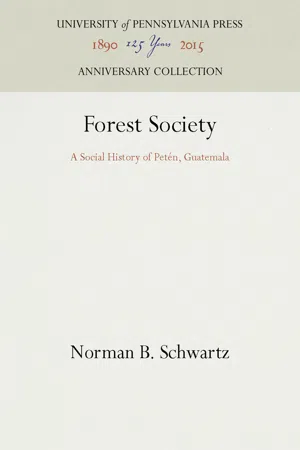
In recent years, Mesoamerican anthropologists have been shifting the focus of their research from structural-functional analyses of small communities to studies of communities as the products of the interaction of microsocial and macrosocial processes. Greater attention is being given to relationships between ecology and society; between state power and local community culture; and among world economics, regional politics, and subregional sociocultural patterns. Forest Society examines the social history of Peten, in the lowlands of Northern Guatemala, in the context of these changing relationships. The author contends that, for 250 years, roughly from the 1720s to the 1970s, the sociocultural system of Peten endured with remarkable continuity, not in spite of changes in the hinterland region but, to an important degree, because of them. During that time, there was relatively little change in the socioeconomic composition of and the relationships between Peten's various social sectors and ethnic groups.Norman B. Schwartz argues that relationships between the material base (ecology,
technology, and economy) of society in Peten demography and the struggle of individuals and groups to control resources gave Peteneros an opportunity, and, at the same time, compelled them gradually to build a stable, moderate society, marked by continuity of social status and commutative connections between ethnicity, community, and social class. He also discusses the new colonization of the 1970s and the disastrous civil war of the1980s and the reasons why these changes are finally eroding the stability of Peten's society. Forest Society will interest scholars and students working in the fields of anthropology, history, and Latin American studies.
- 384 pages
- English
- PDF
- Available on iOS & Android
eBook - PDF
About this book
Information
Table of contents
- Contents
- Illustrations
- Preface
- Acknowledgments
- Introduction
- Chapter One. Physical Environment and Population
- Chapter Two. Conquest, Depopulation, and Colonization, 1697–1821
- Chapter Three. Social Continuity and Economic Stagnation, 1821–1890s
- Chapter Four. La Chiclería: An Extractive Economy
- Chapter Five. The Impact of Oro Blanco
- Chapter Six. Conclusion: Continuity, Change, and a New Turn
- Appendix: Status Continuity in Petén, Eighteenth to Twentieth Centuries
- Notes
- Glossary
- Bibliography
- Index
Trusted by 375,005 students
Access to over 1.5 million titles for a fair monthly price.
Study more efficiently using our study tools.
Frequently asked questions
Yes, you can cancel anytime from the Subscription tab in your account settings on the Perlego website. Your subscription will stay active until the end of your current billing period. Learn how to cancel your subscription
No, books cannot be downloaded as external files, such as PDFs, for use outside of Perlego. However, you can download books within the Perlego app for offline reading on mobile or tablet. Learn how to download books offline
Perlego offers two plans: Essential and Complete
- Essential is ideal for learners and professionals who enjoy exploring a wide range of subjects. Access the Essential Library with 800,000+ trusted titles and best-sellers across business, personal growth, and the humanities. Includes unlimited reading time and Standard Read Aloud voice.
- Complete: Perfect for advanced learners and researchers needing full, unrestricted access. Unlock 1.5M+ books across hundreds of subjects, including academic and specialized titles. The Complete Plan also includes advanced features like Premium Read Aloud and Research Assistant.
We are an online textbook subscription service, where you can get access to an entire online library for less than the price of a single book per month. With over 1.5 million books across 990+ topics, we’ve got you covered! Learn about our mission
Look out for the read-aloud symbol on your next book to see if you can listen to it. The read-aloud tool reads text aloud for you, highlighting the text as it is being read. You can pause it, speed it up and slow it down. Learn more about Read Aloud
Yes! You can use the Perlego app on both iOS and Android devices to read anytime, anywhere — even offline. Perfect for commutes or when you’re on the go.
Please note we cannot support devices running on iOS 13 and Android 7 or earlier. Learn more about using the app
Please note we cannot support devices running on iOS 13 and Android 7 or earlier. Learn more about using the app
Yes, you can access Forest Society by Norman B. Schwartz in PDF and/or ePUB format, as well as other popular books in Social Sciences & Anthropology. We have over 1.5 million books available in our catalogue for you to explore.