This book is a volume in the Penn Press Anniversary Collection. To mark its 125th anniversary in 2015, the University of Pennsylvania Press rereleased more than 1, 100 titles from Penn Press's distinguished backlist from 1899-1999 that had fallen out of print. Spanning an entire century, the Anniversary Collection offers peer-reviewed scholarship in a wide range of subject areas.
eBook - PDF
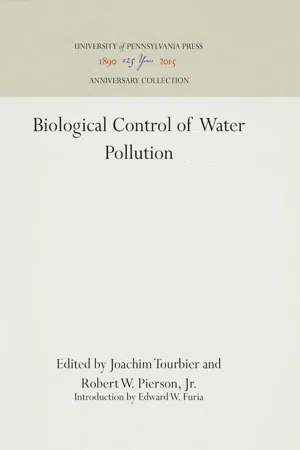
Biological Control of Water Pollution
- 352 pages
- English
- PDF
- Available on iOS & Android
eBook - PDF
Biological Control of Water Pollution
About this book
Information
Table of contents
- Contents
- Introduction
- Part I. A Rationale for the Biological Approach
- 1. Biological Alternatives to Water Pollution
- 2. The Economy, Energy, and Clean Water Legislation
- 3. The Safe Drinking Water Act of 1974: A Call for Action
- 4. The Protection and Improvement of the World's Drinking Water Quality
- 5. An Environmental Overview
- Part II. Limnological Overview
- 6. Overview of Aquatic Ecosystems
- 7. Nutrient Cycles in Natural Systems: Microbial Involvement
- 8. The Role of Aquatic Plants in Aquatic Ecosystems
- Part III. Drinking Water Problems
- 9. Carcinogenic Organic Chemicals in Drinking Water
- 10. Potential Carcinogenic Hazards Due to Contaminated Drinking Water
- 11. Groundwater: Fact, Fiction, and Future
- 12. Comments on the History and Economics of Micropollutants in Drinking Water
- 13. Sudanese Native Methods for the Purification of Nile Water During the Rood Season
- Part IV. Biological Treatment of Wastewater
- 14. Macrophytes and Water Purification
- 15. The Potential of Submersed Vascular Plants for Reclamation of Wastewater in Temperate Zone Ponds
- 16. The Purification of Wastewater with the Aid of Rush or Reed Ponds
- 17. Application of Vascular Aquatic Plants for Pollution Removal, Energy, and Food Production in a Biological System
- 18. Land Treatment of Wastewater by Overland Flow for Improved Water Quality
- 19. Experimental Use of Emergent Vegetation for the Biological Treatment of Municipal Wastewater in Wisconsin
- 20. The Potential Use of Freshwater Tidal Marshes in the Management of Water Quality in the Delaware River
- 21. The Use of Bulrushes for Livestock Feed
- 22. The Use of Sawgrass for Paper Product Manufacture: An Examination of Properties
- 23. Waste Reclamation in an Integrated Food Chain System
- 24. Aquaculture as an Alternative Wastewater Treatment System
- 25. A Proposed Integrated Biological Wastewater Treatment System
- 26. Sewage Treatment by Controlled Eutrophication Using Algae and Artemia
- 27. Interference by Blue-Green Algae with Nutrient Recovery in Water Quality Control Schema: Management Implications
- 28. The Use of Bacteria to Reduce Clogging of Sewer Lines by Grease in Municipal Sewage
- 29. The Use of the Oxidation Ditch in the United States as a Means of Treating Liquid Waste
- Part V. Biological Treatment and Aquifer Recharge
- 30. Improvement of Wastewater Quality by Movement Through Soils and Aquifers
- 31. Renovation of Municipal Wastewater for Groundwater Recharge by the Living Filter Method
- 32. Numerical Models in Groundwater Management
- 33. The Combination of Biological and Chemical Treatment at the Krefeld Water Treatment Works
- 34. Water Quality Aspects of Well Recharge with Reclaimed Water, Bay Park, New York
- Part VI. Implementation of Alternatives
- 35. EPA's Response to the Need for Encouragement of Alternative Waste Treatment Techniques
- 36. Notes on the Implementation of Alternatives
- 37. Legal and Political Restraints to Implementation of Novel Systems
- 38. Implementation of Water Quality Plans
- 39. Implications of Biological Control of Water Pollution Proposals to the Developing Countries
- Acknowledgments
- Index
Trusted by 375,005 students
Access to over 1.5 million titles for a fair monthly price.
Study more efficiently using our study tools.
Frequently asked questions
Yes, you can cancel anytime from the Subscription tab in your account settings on the Perlego website. Your subscription will stay active until the end of your current billing period. Learn how to cancel your subscription
No, books cannot be downloaded as external files, such as PDFs, for use outside of Perlego. However, you can download books within the Perlego app for offline reading on mobile or tablet. Learn how to download books offline
Perlego offers two plans: Essential and Complete
- Essential is ideal for learners and professionals who enjoy exploring a wide range of subjects. Access the Essential Library with 800,000+ trusted titles and best-sellers across business, personal growth, and the humanities. Includes unlimited reading time and Standard Read Aloud voice.
- Complete: Perfect for advanced learners and researchers needing full, unrestricted access. Unlock 1.5M+ books across hundreds of subjects, including academic and specialized titles. The Complete Plan also includes advanced features like Premium Read Aloud and Research Assistant.
We are an online textbook subscription service, where you can get access to an entire online library for less than the price of a single book per month. With over 1.5 million books across 990+ topics, we’ve got you covered! Learn about our mission
Look out for the read-aloud symbol on your next book to see if you can listen to it. The read-aloud tool reads text aloud for you, highlighting the text as it is being read. You can pause it, speed it up and slow it down. Learn more about Read Aloud
Yes! You can use the Perlego app on both iOS and Android devices to read anytime, anywhere — even offline. Perfect for commutes or when you’re on the go.
Please note we cannot support devices running on iOS 13 and Android 7 or earlier. Learn more about using the app
Please note we cannot support devices running on iOS 13 and Android 7 or earlier. Learn more about using the app
Yes, you can access Biological Control of Water Pollution by Joachim Tourbier, Robert W. Pierson, Jr., Joachim Tourbier,Robert W. Pierson, Jr. in PDF and/or ePUB format, as well as other popular books in Biological Sciences & Environmental Science. We have over 1.5 million books available in our catalogue for you to explore.