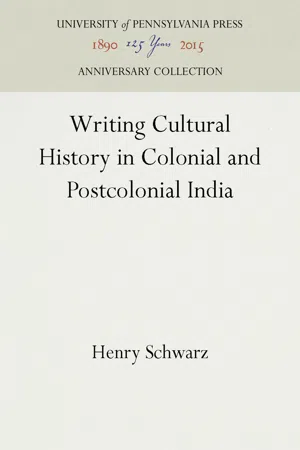
During the colonial period in India, English historians portrayed the British conquest and domination of India as the realization of a historic destiny, absorbing the particular history of India into the overarching narrative of the Empire. When Indian scholars educated in the British system began to write their own histories of the period, they had to struggle to reclaim their past and to make the Indian people the subject of their history.
Henry Schwarz explores this struggle through an analysis of Indian cultural histories written between 1870 and the present. Focusing on English-language texts written by Bengali historians on the subjects of literature and culture, Schwarz critically analyzes landmark works of the genre and compares Indian writing about cultural heritage to the dominant forms of European historiography prevalent during the colonial period.
Indian historians incorporated European aesthetic standards and theories of history into their writing, yet they managed to transform these ideas in ways that challenged British ideological domination. Schwarz shows how, in writing a distinctly Indian history of India, they produced a unique historiographical style of great complexity deploying brilliant reconfigurations of the dominant themes, styles, ideologies, and tropes that characterize acceptable modes of history writing in the West.
Moving from the late nineteenth century to the present, Schwarz identifies six distinct modes of translation and transformation produced by these writers, ranging from liberal-nationalist text to those of writers associated with the Subaltern Studies project. He analyzes the narrative modes employed during the period and traces the movement toward the metaphoric and ironic styles of the post-Independence era.
Writing Cultural History in Colonial and Postcolonial India provides a needed counterweight to the emphasis on colonial discourse that has come to dominate recent postcolonial scholarship. By examining how the colonized interpreted and transformed the experience of oppression through their own work, this book represents postcolonial studies written from the other side.
- 212 pages
- English
- PDF
- Available on iOS & Android
eBook - PDF
Writing Cultural History in Colonial and Postcolonial India
About this book
Information
Table of contents
- Contents
- Acknowledgments
- Introduction: The Ruse of Progress
- 1. Liberal Nationalist Histories
- 2. Radical Nationalist Histories
- 3. Marxist/Materialist Histories
- 4. Transitions: Mediation and Irony
- 5. Subaltern Studies: Radical History in the Metaphoric Mode
- 6. Conclusion: Irony as Tragedy
- Notes
- Bibliography
- Index
Trusted by 375,005 students
Access to over 1.5 million titles for a fair monthly price.
Study more efficiently using our study tools.
Frequently asked questions
Yes, you can cancel anytime from the Subscription tab in your account settings on the Perlego website. Your subscription will stay active until the end of your current billing period. Learn how to cancel your subscription
No, books cannot be downloaded as external files, such as PDFs, for use outside of Perlego. However, you can download books within the Perlego app for offline reading on mobile or tablet. Learn how to download books offline
Perlego offers two plans: Essential and Complete
- Essential is ideal for learners and professionals who enjoy exploring a wide range of subjects. Access the Essential Library with 800,000+ trusted titles and best-sellers across business, personal growth, and the humanities. Includes unlimited reading time and Standard Read Aloud voice.
- Complete: Perfect for advanced learners and researchers needing full, unrestricted access. Unlock 1.5M+ books across hundreds of subjects, including academic and specialized titles. The Complete Plan also includes advanced features like Premium Read Aloud and Research Assistant.
We are an online textbook subscription service, where you can get access to an entire online library for less than the price of a single book per month. With over 1.5 million books across 990+ topics, we’ve got you covered! Learn about our mission
Look out for the read-aloud symbol on your next book to see if you can listen to it. The read-aloud tool reads text aloud for you, highlighting the text as it is being read. You can pause it, speed it up and slow it down. Learn more about Read Aloud
Yes! You can use the Perlego app on both iOS and Android devices to read anytime, anywhere — even offline. Perfect for commutes or when you’re on the go.
Please note we cannot support devices running on iOS 13 and Android 7 or earlier. Learn more about using the app
Please note we cannot support devices running on iOS 13 and Android 7 or earlier. Learn more about using the app
Yes, you can access Writing Cultural History in Colonial and Postcolonial India by Henry Schwarz in PDF and/or ePUB format, as well as other popular books in Literature & Indian & South Asian History. We have over 1.5 million books available in our catalogue for you to explore.