A postcolonial study of the conceptualization of nineteenth- and twentieth-century Latin America as medieval and oriental
If Spain and Portugal were perceived as backward in the nineteenth century—still tainted, in the minds of European writers and thinkers, by more than a whiff of the medieval and Moorish—Ibero-America lagged even further behind. Originally colonized in the late fifteenth century, Chile, Argentina, and Brazil were characterized by European travelers and South American elites alike as both feudal and oriental, as if they retained an oriental-Moorish character due to the centuries-long presence of Islam in the Iberian Peninsula. So, Nadia R. Altschul observes, the Scottish metropolitan writer Maria Graham (1785-1842) depicted the Chile in which she found herself stranded after the death of her sea captain husband as a premodern, precapitalist, and orientalized place that could only benefit from the free trade imperialism of the British. Domingo F. Sarmiento (1811-1888), the most influential Latin American writer and statesman of his day, conceived of his own Euro-American creole class as medieval in such works as Civilization and Barbarism: The Life of Juan Facundo Quiroga (1845) and Recollections of a Provincial Past (1850), and wrote of the inherited Moorish character of Spanish America in his 1883 Conflict and Harmony of the Races in America. Moving forward into the first half of the twentieth century, Altschul explores the oriental character that Gilberto Freyre assigned to Portuguese colonization in his The Masters and the Slaves (1933), in which he postulated the "Mozarabic" essence of Brazil.
In Politics of Temporalization, Altschul examines the case of South America to ask more broadly what is at stake—what is harmed, what is excused—when the present is temporalized, when elements of "the now" are characterized as belonging to, and consequently imposed upon, a constructed and othered "past."
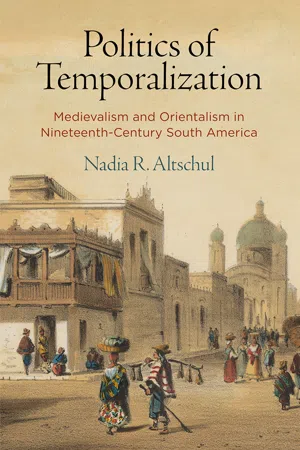
eBook - ePub
Politics of Temporalization
Medievalism and Orientalism in Nineteenth-Century South America
- 288 pages
- English
- ePUB (mobile friendly)
- Available on iOS & Android
eBook - ePub
Politics of Temporalization
Medievalism and Orientalism in Nineteenth-Century South America
About this book
Information
Publisher
University of Pennsylvania PressYear
2020Print ISBN
9780812252279
9780812252279
eBook ISBN
9780812297201
Table of contents
- Cover
- Title Page
- Copyright
- Dedication
- Contents
- Introduction. Iberian Premodern Conquests and Postcolonial Multiple Temporalities
- Chapter 1. Medieval Belonging and Oriental Otherness in Figurations of Iberia
- Chapter 2. Maria Graham’s Premodern Chile: British Neocolonialism and Creole Government
- Chapter 3. Maria Graham’s Oriental Chile: India, Spain, and Moorish Civilizational Remains
- Chapter 4. The Chronopolitics of Medieval Argentina in Domingo Sarmiento’s Thought
- Chapter 5. Facundo’s Afterlife: Feudal Temporalization from Dualism to Modernization to Dependency
- Chapter 6. Orientalism and Self-Orientalization in Domingo Sarmiento’s South America
- Chapter 7. Divided by Time: Medieval Brazil in Euclides da Cunha’s Os Sertões
- Chapter 8. The Shadow of the Moor: Gilberto Freyre’s Moorish Brazil
- Coda. Medieval Now
- Notes
- Bibliography
- Index
- Acknowledgements
Trusted by 375,005 students
Access to over 1.5 million titles for a fair monthly price.
Study more efficiently using our study tools.
Frequently asked questions
Yes, you can cancel anytime from the Subscription tab in your account settings on the Perlego website. Your subscription will stay active until the end of your current billing period. Learn how to cancel your subscription
No, books cannot be downloaded as external files, such as PDFs, for use outside of Perlego. However, you can download books within the Perlego app for offline reading on mobile or tablet. Learn how to download books offline
Perlego offers two plans: Essential and Complete
- Essential is ideal for learners and professionals who enjoy exploring a wide range of subjects. Access the Essential Library with 800,000+ trusted titles and best-sellers across business, personal growth, and the humanities. Includes unlimited reading time and Standard Read Aloud voice.
- Complete: Perfect for advanced learners and researchers needing full, unrestricted access. Unlock 1.5M+ books across hundreds of subjects, including academic and specialized titles. The Complete Plan also includes advanced features like Premium Read Aloud and Research Assistant.
We are an online textbook subscription service, where you can get access to an entire online library for less than the price of a single book per month. With over 1.5 million books across 990+ topics, we’ve got you covered! Learn about our mission
Look out for the read-aloud symbol on your next book to see if you can listen to it. The read-aloud tool reads text aloud for you, highlighting the text as it is being read. You can pause it, speed it up and slow it down. Learn more about Read Aloud
Yes! You can use the Perlego app on both iOS and Android devices to read anytime, anywhere — even offline. Perfect for commutes or when you’re on the go.
Please note we cannot support devices running on iOS 13 and Android 7 or earlier. Learn more about using the app
Please note we cannot support devices running on iOS 13 and Android 7 or earlier. Learn more about using the app
Yes, you can access Politics of Temporalization by Nadia R. Altschul in PDF and/or ePUB format, as well as other popular books in Literature & European Literary Criticism. We have over 1.5 million books available in our catalogue for you to explore.