A renowned historian offers novel perspectives on slavery and abolition in eighteenth-century Jamaica
Between the start of the Seven Years' War in 1756 and the onset of the French Revolution in 1789, Jamaica was the richest and most important colony in British America. White Jamaican slaveowners presided over a highly productive economic system, a precursor to the modern factory in its management of labor, its harvesting of resources, and its scale of capital investment and ouput. Planters, supported by a dynamic merchant class in Kingston, created a plantation system in which short-term profit maximization was the main aim. Their slave system worked because the planters who ran it were extremely powerful.
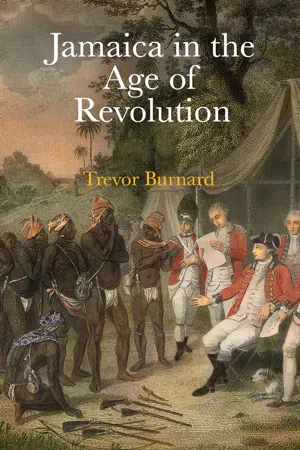
In Jamaica in the Age of Revolution, Trevor Burnard analyzes the men and women who gained so much from the labor of enslaved people in Jamaica to expose the ways in which power was wielded in a period when the powerful were unconstrained by custom, law, or, for the most part, public approbation or disapproval. Burnard finds that the unremitting war by the powerful against the poor and powerless, evident in the day-to-day struggles slaves had with masters, is a crucial context for grasping what enslaved people had to endure.
Examining such events as Tacky's Rebellion of 1760 (the largest slave revolt in the Caribbean before the Haitian Revolution), the Somerset decision of 1772, and the murder case of the Zong in 1783 in an Atlantic context, Burnard reveals Jamiaca to be a brutally effective and exploitative society that was highly adaptable to new economic and political circumstances, even when placed under great stress, as during the American Revolution. Jamaica in the Age of Revolution demonstrates the importance of Jamaican planters and merchants to British imperial thinking at a time when slavery was unchallenged.
- 400 pages
- English
- ePUB (mobile friendly)
- Available on iOS & Android
eBook - ePub
Jamaica in the Age of Revolution
About this book
Information
Publisher
University of Pennsylvania PressYear
2020Print ISBN
9780812251920
9780812251920
eBook ISBN
9780812296952
Table of contents
- Cover
- Title Page
- Copyright
- Contents
- Introduction
- Chapter 1. Planter Politics and the Fear of Slave Revolt
- Chapter 2. Edward Long’s Vision of Jamaica and the Virtues of a Planned Society
- Chapter 3. A Brutal System: Managing Enslaved People in Jamaica
- Chapter 4. Tacky’s Revolt and Its Legacies
- Chapter 5. The Ambiguous Place of Free People in Jamaica
- Chapter 6. The Somerset Decision and the Birth of Proslavery Arguments in the British West Indies
- Chapter 7. The Zong, Jamaican Commerce, and the American Revolution
- Chapter 8. Loyalism and Rebellion in Plantation Societies
- Chapter 9. Slavery and Industrialization: The “New History of Capitalism” and Williams Redux
- Epilogue: Jamaica and the State in the Age of the American Revolution, 1760–88
- Notes
- Index
- Acknowledgments
Trusted by 375,005 students
Access to over 1.5 million titles for a fair monthly price.
Study more efficiently using our study tools.
Frequently asked questions
Yes, you can cancel anytime from the Subscription tab in your account settings on the Perlego website. Your subscription will stay active until the end of your current billing period. Learn how to cancel your subscription
No, books cannot be downloaded as external files, such as PDFs, for use outside of Perlego. However, you can download books within the Perlego app for offline reading on mobile or tablet. Learn how to download books offline
Perlego offers two plans: Essential and Complete
- Essential is ideal for learners and professionals who enjoy exploring a wide range of subjects. Access the Essential Library with 800,000+ trusted titles and best-sellers across business, personal growth, and the humanities. Includes unlimited reading time and Standard Read Aloud voice.
- Complete: Perfect for advanced learners and researchers needing full, unrestricted access. Unlock 1.5M+ books across hundreds of subjects, including academic and specialized titles. The Complete Plan also includes advanced features like Premium Read Aloud and Research Assistant.
We are an online textbook subscription service, where you can get access to an entire online library for less than the price of a single book per month. With over 1.5 million books across 990+ topics, we’ve got you covered! Learn about our mission
Look out for the read-aloud symbol on your next book to see if you can listen to it. The read-aloud tool reads text aloud for you, highlighting the text as it is being read. You can pause it, speed it up and slow it down. Learn more about Read Aloud
Yes! You can use the Perlego app on both iOS and Android devices to read anytime, anywhere — even offline. Perfect for commutes or when you’re on the go.
Please note we cannot support devices running on iOS 13 and Android 7 or earlier. Learn more about using the app
Please note we cannot support devices running on iOS 13 and Android 7 or earlier. Learn more about using the app
Yes, you can access Jamaica in the Age of Revolution by Trevor Burnard in PDF and/or ePUB format, as well as other popular books in History & African American History. We have over 1.5 million books available in our catalogue for you to explore.