International scholars offer ethnographic analyses of the relations between transnationalism, law, and culture
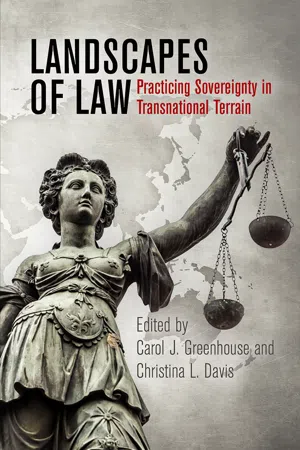
The recent surge of right-wing populism in Europe and the United States is widely perceived as evidence of ongoing challenges to the policies and institutions of globalization. But as editors Carol J. Greenhouse and Christina L. Davis observe in their introduction to Landscapes of Law, the appeal to national culture is not restricted to the ethno-nationalisms of the developing world outside of industrial democracies nor to insurgent groups within them. The essays they have collected in this volume reveal how claims of national culture emerge in the pursuit of transnationalism and, under some circumstances, become embedded within international law. The premise that there is inherent tension between nationalism and globalism is misleading. Whether asserted explicitly as state sovereignty or implicitly as cultural community, claims of national culture mediate how governments assert their interests and values when engaging with transnational law. Landscapes of Law demonstrates how nationalism operates in the contested zone between borderless capital and bordered states.
Drawing from the fields of anthropology, international relations, law, political science, and sociology, the book's international contributors examine the ways in which claims of national differences are produced within transnational institutions. Insights from case studies across a wide range of topics reveal how such claims may be worked into policy prescriptions and legal arrangements or provide ad hoc bargaining chips. Together, they show that expressions of national culture outside of state boundaries consolidate claims of sovereignty. The contributors offer innovative frameworks for analyzing the relationships among transnationalism, law, and cultural claims at various levels and scales. They demonstrate how overlapping communities use law to define borders and shape relationships among actors rather than to generate a single social ordering.
Landscapes of Law traces the theoretical implications generated by an understanding of transnational law that challenges the conventional separation of individual, community, society, national, and international spaces.
Contributors: Katayoun Alidadi, Tugba Basaran, Rachel Brewster, Sandra Brunnegger, Christina L. Davis, Sara Dezalay, Marie-Claire Foblets, Henry Gao, Carol J. Greenhouse, David Leheny, Mark Fathi Massoud, Teresa Rodríguez-de-las-Heras Ballell, Gregory Shaffer, Mariana Valverde.
eBook - ePub
Landscapes of Law
Practicing Sovereignty in Transnational Terrain
- 352 pages
- English
- ePUB (mobile friendly)
- Available on iOS & Android
eBook - ePub
Landscapes of Law
Practicing Sovereignty in Transnational Terrain
About this book
Information
Publisher
University of Pennsylvania PressYear
2020Print ISBN
9780812252224
9780812252224
eBook ISBN
9780812297119
CHAPTER 1

A Journey Through Law’s Landscapes
Close Encounters of the Scalar Kind
Tugba Basaran
Trapped in the International
The journey of the Amuur siblings started in Somalia and led over Kenya and Syria to the Paris-Orly Airport in France. Mahad, Lahima, Abdelkader, and Mohammed Amuur, all Somali nationals in their late teens and early twenties, arrived at the Paris-Orly Airport on 9 March 1992 and sought to apply for refugee status. The airport and border police, however, refused to admit the Amuur siblings (to the French territory). They fell under a special procedure, requiring them to apply for a “leave to enter the territory on asylum grounds.” They also petitioned the French Office for the Protection of Refugees and Stateless Persons (OFPRA) to grant them refugee status, pursuant to the Geneva Convention of 1951, but the OFPRA ruled that it lacked jurisdiction, as they had not yet entered the territory. On 29 March, after the Minister of the Interior had refused their entry to the French territory, they were sent back to Syria. According to France, from 9 March until 29 March, the Amuurs were legally not in France (based on Amuur v. France, ECtHR, 19776/92, 25 June 1996). But, where were they then?
How does this case help us capture legal landscapes? How does it illustrate scalar politics as a modern form of governing? This chapter engages with visions and practices of law. First, I engage with scalar visions, which provide for a neat separation and hierarchy of scales (i.e., divisions into national, international, and transnational), counterpose these to the complex and messy practices of governing, and demonstrate how legal landscapes are too messy to be confined to scalar classifications. Second, I elucidate how scalar classifications authorize a particular form of politics, divisions, and discriminations. Third, I demonstrate how the messiness of practices combined with the orderly scalar visions is a precondition for powerful, as well as questionable, modern forms of governing.
Searching for France
A decree from 1982, known as “asylum at the border,” mandated a permit, issued at the border, to (legally) enter French territory, pass by the border controls, and then apply for refugee status. Waiting for the permit to be issued or being denied the permit meant being restrained to the international zone. This led to a number of people waiting in the international zone of airports (in many aspects visually similar to Tom Hanks in the movie The Terminal). While French NGOs denounced this situation on humanitarian grounds, the French government insisted that the international zone is outside French territory and hence responsibility. It was only following lengthy struggles over almost fifteen years through national and regional courts that the French government had to acknowledge with Amuur v. France (1996) that the international zone (and its expansion through the waiting zone) is indeed within its territory and responsibility.
This prelude of the Amuurs illustrates how law’s territory is distinct from physical territory, how inside and outside are susceptible to changes, and how borders shift through law. We could put the Amuurs and the international zone aside, if this was a singular case, an outlier, so to speak. The distinction between physical and legal presence is paramount, however, when applied at various ports of entry, including international airports, seaports, train stations, and even occasionally in territorial waters and land territories (under various names as reception, transit, or detention centers, see Basaran 2010). Here, mere physical presence on the territory is insufficient and only lawful entry amounts to entry, and by implication, access to constitutional protection (Hathaway 2005). We could even contend that scalar distinctions to some extent do not do their work, but paradoxically at the same time do more than their work through messy legal practices. Entering the spheres of the national, international, and transnational becomes dependent on a legal matrix of status and location. In some sense, this is new, and in other senses, not so. It goes against our vision of politics, scales, and divisions, but affirms what we have long known about their practices.
Statist and Scalar Visions
The political map has become our mental image of the state. The political map reflects states as neat formations of territorial pieces separated through flawless lines. Here landscapes of the state are arrested into particular spatiotemporal configurations, into static, stagnant, and lucent borders and boundaries. Law, sovereignty, and state are rendered visible through territory and geography, and these simplifications are generalized, popularized, vulgarized. This map also provides us also with rehearsed, trodden narratives and simplified visualizations of the boundaries, jurisdictions, and formations of law. Here, the image of territorial jurisdiction solidifies landscapes of law, makes them appear to be visible and enduring, contained and exclusive. Therefore, the map visually employs, first, the politics of congruence, where state, territory, law, and politics appear to be congruent and inseparable one from the other, identical in their scope, contained in a visible geographical materiality (Agnew 1994). The politics of congruence invokes and relies on, second, the politics of limits (Walker 2010), that is, strong legal and political delimitations. Creating the legible state requires that we pretend as if state power, politics, and law end at the state’s territorial border. This vision is integral to international law and crucial to the principle of sovereign equality (UN Charter, Art. 2.1): Every sovereign state has their own part of the territorial puzzle of the world and may not overstep their borders.
Hereby, territory takes an important role. Territory renders power visible and legible. It simplifies, materializes, and geographically traces the borders of uncontested supreme rule, inviolable spaces of authority, or, in other words, state sovereignty. In modern political thought, the state is inherently a product of its material geography, its territory (Bodin and Franklin 1992; Hobbes [1651] 2006). The very definition of sovereignty as “supreme authority within a territory” reveals the search for a congruence of natural, legal, and political landscapes, an effort to make politics and law derivative of territory. Territory is also a fundamental attribute of statehood under public international law (Montevideo Convention 1933, Art. 1). We may even claim that the territorial principle is the ultimate principle of (inter)national law, in relation to which all jurisdictional questions arise. The absolute nature of territorial jurisdiction, inscribed into international law, is so much taken for granted that exemptions hereof, immunities and extraterritorial jurisdiction, ultimately serve to confirm its very significance. Territorial jurisdiction is a foundational authority of the state, providing the state with the highest form of political and legal authority within a particular territory and confirming it as the locus of politics (Walker 2010). In return, the definition of sovereignty as supreme authority is dependent on the very existence of territory.
This vision prescribes a particular mode of seeing. It provides us with the statist vision that emphasizes the state as the locus of politics and along with that the significance of sovereignty as the starting point for conceptualizing the world. This vision fulfills an ideological function by inscribing (not describing) states on the map, and through that very act legitimating state sovereignty and the sovereign’s law, making things legible, orderly, simplified through geometrical design (Scott 1998). Here, the state becomes the predominant political unit, the sovereign. The politics of congruence, visibility, and legibility based on territory allow states to be arrested into particular spatiotemporal configurations, appear static, inert, and permanent. Landscapes of law are here, just like other modern accounts, “predicated on a specific topology of point, line and plane” (Walker 2010: 18) that enable and authorize modern techniques of governing. In its search for visibility, law is also simplified and rendered legible; materialized and geographically traced through lines, boundaries, and borders; contained by territory; molded into territorial jurisdiction. Nothing is more indicative of this than the political map, and nothing is more inadequate to portray political and legal landscapes.
This vision of the state has important implications for scalar orders. It results in a scalar vision of the world, the division into local, national, and international (and by extension also transnational). It is important to point out that the starting point for the scalar vision is the state, which then opens up possibilities of moving either down to the local or up to the international. Scalar conceptions of the world that separate the national from transnational and international are often perceived as the natural order of things and common to academic as well as everyday understandings of the world. Even disciplines such as international relations and international law reaffirm scales through a distinction between the national and international. A world without these scales is now unthinkable. Who can avoid writing about the national, even if only in contraposition to the international or transnational? Even the most vehement critics of scalar conceptions are struggling to find words and worlds beyond them. Certainly, this is not the first critique of this vision, nor the first effort to deconstruct scales through practices of law, sociology, or power (Basaran et al. 2017; Basaran and Olsson 2018).
Counter-Scalar Practices
If the scalar vision is misleading, however, what do we see when we investigate global landscapes? Practices of governing are complex and messy. The dispersion of power in practice is subsumable neither geographically nor institutionally in the form of the state. Many are “painfully aware of the tension that exists between the traditional view of sovereignty as an indivisible and discrete condition of possible statehood, and the actual dispersion of political power and legal authority” (Bartelson 2006). In an effort to deconstruct the conventional edifice of sovereignty, a variety of disciplines have targeted its symbolic conjunctures: They have fragmented the (symbolic) territory and state and explored multiple deterritorialized and dehomogenized formations of governing and sovereignties. In seeking to rethink statist visions, they have cultivated a grammar of global pluralities and fragmentations, along with innumerable analyses of transnational and global relations. Many have pointed to pluralities of governing and governance and the variety of dynamic landscapes that are produced as a result thereof. They have paid attention to movements, shifting boundaries, and historical roots of a great diversity of social configurations and formations. In particular, three approaches advanced by scholars focusing on (1) globalization, (2) geography and borders, and (3) law are of relevance here for deconstructing a scalar vision through practice.
First, in an effort to move beyond conventional accounts of the state, sociologies, geographies, and anthropologies of globalization and governance have emphasized complex political geographies, transnational geographies, heterogeneous landscapes, and how state practices, conceived of as domestic, take place beyond states’ territorial limits. The emphasis on new forms of governance has also led to contemporary representations of the state and forms of governance: visions of hyperstates, fragmented states, and neoliberal states (Harvey 2005); sites of “effective sovereignty” (Agnew 2009); and globalizing “scapes” (Appadurai 1990). Along with a renewed interested in fragmented forms of analyzing and mapping sovereignties, these different approaches to deterritorializing governing and government have contributed to an understanding that territory and political authority are not congruent, that the state’s jurisdiction is not limited to its territory and requires new forms of analysis to overcome outdated ways of seeing.
Second, the grammar of pluralities and fragmentation has also been significant in questioning geographies and borders, especially the understanding of borders as territorial borders, that they must somehow be located at the outer limit of the territory. Just like territory, borders are not presocial or prepolitical, but historically and spatially contingent, reflecting relations of power (Lefebvre 1991; Rumford 2006; Soja 1989). In fact, it was no longer the search for borders, but bordering as a process that has provided a complex view of state borders and their characteristics. With the detachment of borders from territorial borders, concepts of borders have multiplied to include a variety of geographical and nongeographical borders; borders have become mobile, temporal, and shifting; and selective, confirming distinction in mobility (Basaran 2010). Analyzing borders, not as boundary lines between sovereign states, but from the perspective of governing techniques, illustrates how borders and boundaries have been created through daily practices.
Third, in law, these developments have equally led to a questioning of conventional understandings of law. Counterposed to a statecentric notion of law along with an emphasis on formal law, legal pluralists have underlined the plurality of normative orders and contestations between legal regimes as well as legal scales. More specifically, a focus on global, transnational, and international practices of law, including their interaction with public and private legal orders, has emphasized the multiplicity and fragmentation of legal formations, within which the state, itself only one among multiple formations, exists (see, e.g., Koskenniemi 2009; Raustiala 2004). This has also led to the questioning of the concept of the state, its powers and scope of jurisdiction, the legal geographies of the state and the multiplicity of legal formations interacting with and within what we refer to as the state, and of statist visions of law and the spatiality of the state (Blomley, Delaney, and Ford 2001; Braverman et al. 2014).
A variety of approaches from different disciplines have profoundly contested scalar thinking. In order to rupture scalar visions, analytically they have often focused on practices, underlined interconnectivity, interactions and interconnections between different scalar levels, and interpenetrations of global and local (see, e.g., “glocalization” in Latour 1993; Swyngedouw
1997) , moving from geometry to topology (Latour 1993: 117). Through the grammar of multiplicities and fragmentations, they have sought to break through scalar analysis (focused on a particular level, i.e., local, national, and international). Some have also sought to render social configurations (to a large extent) independent of scalar classification by emphasizing relations, fields, and flows to transgress scalar thinking and provide transversal lines (Basaran et al. 2017). With the intent of disrupting scales, these various approaches have often emphasized process, relations, singularities, and interconnectivities instead of structures, systems, and scales.
Even if we know that practices cannot be contained in scales, claims to scales prevail, and effectively so. This is because scales possess a useful authority. Like Hobbes’s iconic image of the Leviathan, which symbolizes modern state authority, as well as its presumed foundations of consent and contract (Hobbes [1651] 2006: title page), statist visions produce perceptions of the political, the social, and legal. Territory and territorial borders become fundamental for producing territorial jurisdiction and the symbolic (b)order of law through “sharp distinctions” (Walker 2017: x) and divisions between here and there, inside and outside, order and chaos, just and unjust, liberal and illiberal, citizen and foreigner, national and international, within law and outside of law, the normal and the exception, the territorial and extraterritorial. These distinctions are crucial for our legal and political imagination. They inscribe statist visions of law, restrict and align our vision to the lenses of the Leviathan (see also Scott 1998). They shape our legal vision through statist imaginaries.
Scalar Authority, Divisions, and Governing
Scalar distinctions are not only of a technical and analytical nature, but these divisions carry authority and important normative functions, three of which I underline in the following.
First, a distinction between the inside and outside of law is drawn. Pl...
Table of contents
- Cover
- Title Page
- Copyright
- Contents
- Introduction. Mapping Culture onto Transnational Law
- Chapter 1. A Journey Through Law’s Landscapes: Close Encounters of the Scalar Kind
- Chapter 2. Intersecting Legal Spaces: International Trade Law and Anticorruption Law
- Chapter 3. Changing Internally to Engage Externally: China and the WTO Legal System
- Chapter 4. The “Africa Bar” of Paris: A Microcosm of Interconnected Histories of Legal Globalization
- Chapter 5. Cultural Difference as Legal Resolution: The Raising of the Ehime Maru
- Chapter 6. Landscapes of Law in War-Torn Societies
- Chapter 7. Uncertain Sovereignties: Indigenous-State Relations in Colombia
- Chapter 8. Between Sovereignty and Transnationalism: The European Union as an Incomplete “Transnational Legal Space”
- Chapter 9. The Emergence of Digital Communities: Generating Trust, Managing Conflicts, and Regulating Globality … Digitality
- Chapter 10. Landscapes of Actually Existing Liberalism: Some Thoughts on the Historical Dialectic of Liberty and Philanthropy
- List of Contributors
- Index
- Acknowledgments
Trusted by 375,005 students
Access to over 1.5 million titles for a fair monthly price.
Study more efficiently using our study tools.
Frequently asked questions
Yes, you can cancel anytime from the Subscription tab in your account settings on the Perlego website. Your subscription will stay active until the end of your current billing period. Learn how to cancel your subscription
No, books cannot be downloaded as external files, such as PDFs, for use outside of Perlego. However, you can download books within the Perlego app for offline reading on mobile or tablet. Learn how to download books offline
Perlego offers two plans: Essential and Complete
- Essential is ideal for learners and professionals who enjoy exploring a wide range of subjects. Access the Essential Library with 800,000+ trusted titles and best-sellers across business, personal growth, and the humanities. Includes unlimited reading time and Standard Read Aloud voice.
- Complete: Perfect for advanced learners and researchers needing full, unrestricted access. Unlock 1.5M+ books across hundreds of subjects, including academic and specialized titles. The Complete Plan also includes advanced features like Premium Read Aloud and Research Assistant.
We are an online textbook subscription service, where you can get access to an entire online library for less than the price of a single book per month. With over 1.5 million books across 990+ topics, we’ve got you covered! Learn about our mission
Look out for the read-aloud symbol on your next book to see if you can listen to it. The read-aloud tool reads text aloud for you, highlighting the text as it is being read. You can pause it, speed it up and slow it down. Learn more about Read Aloud
Yes! You can use the Perlego app on both iOS and Android devices to read anytime, anywhere — even offline. Perfect for commutes or when you’re on the go.
Please note we cannot support devices running on iOS 13 and Android 7 or earlier. Learn more about using the app
Please note we cannot support devices running on iOS 13 and Android 7 or earlier. Learn more about using the app
Yes, you can access Landscapes of Law by Carol J. Greenhouse, Christina L. Davis, Carol J. Greenhouse,Christina L. Davis in PDF and/or ePUB format, as well as other popular books in Law & International Law. We have over 1.5 million books available in our catalogue for you to explore.