An examination of the Farm Security Administration's migrant camp system and the people it served
Today's concern for the quality of the produce on our plates has done little to guarantee U.S. farmworkers the necessary protections of sanitary housing, medical attention, and fair labor standards. The political discourse on farmworkers' rights is dominated by the view that migrant workers are not entitled to better protections because they are "noncitizens," as either immigrants or transients. Between 1935 and 1946, however, the Farm Security Administration (FSA) intervened dramatically on behalf of migrant families to expand the principles of American democracy, advance migrants' civil rights, and make farmworkers visible beyond their economic role as temporary laborers. In more than one hundred labor camps across the country, migrant families successfully worked with FSA officials to challenge their exclusion from the basic rights afforded by the New Deal.
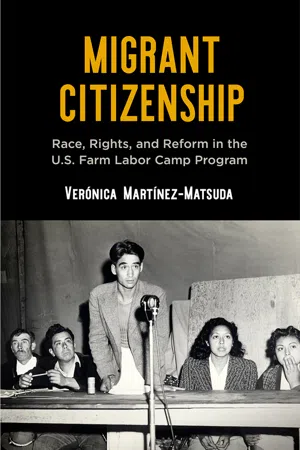
In Migrant Citizenship, Verónica Martínez-Matsuda examines the history of the FSA's Migratory Labor Camp Program and its role in the lives of diverse farmworker families across the United States, describing how the camps provided migrants sanitary housing, full on-site medical service, a nursery school program, primary education, home-demonstration instruction, food for a healthy diet, recreational programing, and lessons in participatory democracy through self-governing councils. In these ways, she argues, the camps functioned as more than just labor centers aimed at improving agribusiness efficiency. Instead, they represented a profound "experiment in democracy" seeking to secure migrant farmworkers' full political and social participation in the United States. In recounting this chapter in the FSA's history, Migrant Citizenship provides insights into public policy concerning migrant workers, federal intervention in poor people's lives, and workers' cross-racial movements for social justice and offers a precedent for those seeking to combat the precarity in farm labor relations today.
eBook - ePub
Migrant Citizenship
Race, Rights, and Reform in the U.S. Farm Labor Camp Program
- 376 pages
- English
- ePUB (mobile friendly)
- Available on iOS & Android
eBook - ePub
Migrant Citizenship
Race, Rights, and Reform in the U.S. Farm Labor Camp Program
About this book
Information
Publisher
University of Pennsylvania PressYear
2020Print ISBN
9780812252293
9780812252293
eBook ISBN
9780812297157
CHAPTER 1
Securing (Re)productive Labor
State Intervention in Migrant Housing and Farmworkers’ Rights
In 1939 John Steinbeck’s publication of The Grapes of Wrath brought national attention to, in his words, “the great wave of dust bowl migration [that] was displacing many, though by no means all, of the immigrant, non-white laborers in the California fields.” Two other prominent publications appearing that year—Dorothea Lange and Paul S. Taylor’s An American Exodus and Carey McWilliams’s Factories in the Field—helped expose the severity of the “migrant problem” at hand. As McWilliams, who was head of the California Division of Immigration and Housing between 1938 and 1942, explained, “With the arrival of the dust-bowl refugees a day of reckoning approaches for the California farm industrialists. The jig, in other words, is about up.” All of the authors emphasized this point. According to Steinbeck, these migrants were “white and American labor” who would “refuse to accept the role of field peon, with its attendant terrorism, squalor and starvation.” “These despised ‘Okies’ were not another minority alien racial group,” McWilliams similarly contended, “but American citizens familiar with the usages of democracy.”1
As Steinbeck’s novel gained popularity, federal officials working on behalf of President Franklin D. Roosevelt’s agrarian New Deal reminded the nation that the grapes of wrath were also stored in the South’s sharecropper country.2 The National Emergency Council’s 1938 Report on Economic Conditions of the South revealed that in 1934 the average yearly net income on cotton farms in eleven areas surveyed was $417 for tenants, $312 for croppers, and $180 for wage laborers (for an average of $309 per family), while the average net income of the plantation operator was $2,572.3 The vast inequities in southern farming were aggravated by long-established practices of political disenfranchisement and violent racial subjugation, especially against African Americans. The Great Depression worsened the chronic poverty many experienced and introduced a number of changes, as Lange and Taylor explained, “dealing the old system a series of heavy blows.”4 These developments included a significant drop in cotton prices, a rise in large-scale corporate farming, disparity in crop reduction benefits, and increased mechanization. By the mid-1930s it was evident that these issues contributed to sharecroppers’ and tenant farmers’ rapid displacement. Indeed, most of the white migrants who traveled to California hailed from the South’s western region—primarily Oklahoma, Texas, Arkansas, and Missouri—and not the central Dust Bowl area consisting of the Texas and Oklahoma panhandle and bordering parts of New Mexico, Colorado, and Kansas.
For this reason, federal agents working under the Resettlement Administration (RA), and later the Farm Security Administration (FSA), warned those concerned with California’s migrant problem that although a dramatic development—with more than three hundred thousand migrants arriving between 1935 and 1938 in search of work—it was hardly an anomaly.5 What they were seeing in California, wrote Laurence I. Hewes, assistant administrator for the RA, were “the effects of the migrant problem, rather than its causes, although the mechanization and industrialization of agriculture, which is definitely one cause, is to be seen here more obviously than in other regions.” Various elements in a national process especially evident in the South—including, as Hewes explained, “drought, soil exhaustion, lack of free land, poor methods of farming, and indebtedness”—were fueling the migrant problem. Agriculture was changing, he argued; no longer could the majority of rural Americans draw from it any “semblance of a way of life; or in an increasing number of cases, even a livelihood.”6 As sharecroppers and tenants fell down the proverbial agricultural ladder and became destitute migrant laborers, the RA stepped in to help solve a national crisis.7 Yet the mythology surrounding the agricultural ladder reinforced federal officials’ mistaken notion that the migrant stream was a new phenomenon produced by the economic crisis of the Great Depression.
To best understand the origins of the migratory labor camp program, and why federal efforts to house farmworkers became so contested, one must consider how the depression shaped rural society beyond creating greater economic instability. Beginning in 1933, the New Deal advanced a liberal political agenda allowing progressive reformers, farm labor advocates, and organized workers to demand state intervention to correct the socioeconomic injustices in agriculture. This chapter begins by tracing some of the nation’s most volatile agricultural strikes during the early 1930s, to situate the role that noncitizen and nonwhite migrant farmworkers played in demanding federal protection against their repressive employers.8 Although the 1933 National Industrial Recovery Act and Federal Emergency Relief Administration denied farmworkers the right of collective bargaining and federal aid, such setbacks did not stop migrants from mobilizing. Through farmworkers’ activism, housing emerged as a central site of struggle over migrants’ labor and civil rights. In 1935 the RA developed the first government-built camps in California to provide emergency relief that would temper existing labor strife and alleviate migrants’ suffering, especially their poor health and hunger.
The RA’s approach to the migrant camp program seemed initially rather conservative and largely influenced by relief efforts in the South and Midwest where it focused on stabilizing dislocated farmers. Rexford G. Tugwell, who headed the RA until shortly before it became the FSA in 1937, appeared sympathetic to migrant workers’ labor unrest. In establishing the camp program, however, the RA remained focused on rehabilitating the nation’s “landless farmers.” This view, combined with progressive appeals that the federal government intervene in California because the majority of migrants were white American citizens, initially limited the program’s radical intervention by maintaining the existing racial biases in agriculture.
As the camp program continued under the FSA through the late 1930s and early 1940s, it increasingly served the nonwhite farmworker families who traditionally followed the crops. The program expanded largely against growers’ wishes. While the agency believed that growers would come to realize the program’s benefits, most growers felt deeply threatened. The central reason stemmed from the FSA’s commitment to social reform, which threatened the status quo. The FSA’s camps offered farmworkers critical amenities while encouraging migrants’ empowerment through the formation of community councils and cooperative enterprises. Consequently, federal intervention threatened growers’ control over farm labor by freeing families from the dependency they had on their employer for subsistence. The camps also undermined the deference migrants were expected to show growers as expendable, racialized workers. For this reason, growers claimed that the camp program disrupted well-established employer-employee relations, facilitated labor militancy, and fostered socialist principles by encouraging idleness and dependency on government largesse.
Migrant housing came to symbolize more than just a concern over the nature of workers’ shelter. For migrant families, the camps represented an extension of their identity as citizens worthy of federal protection and equal representation in society. Yet despite the camp program’s promising potential to advance migrants’ civil rights, FSA officials drew on strictly gendered and racialized understandings of democratic inclusion. For as advanced as they were in their agrarian vision to provide farmworkers with various protections they were denied under the New Deal, FSA reformers maintained gender-bound conceptions of work that only recognized male breadwinners and affirmed women’s status as dependents rather than as central contributors to the nation’s (and their household’s) economy. They also did not recognize nontraditional family models and partnerships beyond immediate blood relatives. The FSA’s limited perspective compromised their efforts to foster migrants’ collective action and reinforced a false notion of separate spheres that was especially problematic for migrant workers fighting against more than just poor wages.
Establishing the Migratory Labor Camp Program: California’s Agricultural Labor and Social Crisis
John Steinbeck’s depiction of the “Weedpatch Camp” in The Grapes of Wrath provided most Americans with their first understanding of the government-sponsored migrant camps. In his widely read novel, Steinbeck depicted California’s migrant workers as abject and in need of federal intervention in order to “restore the dignity and decency that had been kicked out of [them] by their intolerable mode of life.” Steinbeck warned readers that farmworkers would continue to experience some of the worst abuses imaginable in living and working conditions, and that eventually the “present system of agricultural economics” would be destroyed, unless the federal government intervened.9 To garner support for the camp program, he described Weedpatch rather idyllically as a place where the Joad family found hot showers, indoor privies, and free medical care. The 1940 Hollywood production of Steinbeck’s Pulitzer Prize–winning novel further dramatized migrant workers’ plight in the minds of most Americans. Consequently, Steinbeck’s work resulted in much-needed mainstream publicity for the camp program, which played a critical role in building the political support necessary for the program’s expansion in the early 1940s. In a telling statement, Garrett Eckbo, one of the FSA’s camp architects, recalled, “The Grapes of Wrath was our bible.”10
Carey McWilliams’s Factories in the Field was more cautious in celebrating the camp program and federal intervention in farm labor reform, though the study was equally critical to the Popular Front movement hoping to realize the New Deal’s social democratic potential.11 Although he favored the program’s development, McWilliams reminded readers that it was merely palliative, reaching only a small percentage of those in need, and not altering the present system of agriculture fueled by what he termed “farm fascism.” “The solution of the farm-labor problem,” McWilliams contended, “can only be achieved through the organization of farm workers. The chief significance of the migratory camps is that they provide an agency through which organization can be achieved.”12
Steinbeck supported migrants’ self-empowerment, but his approach to realizing better conditions centered on what the government should do on their behalf. He collected the research necessary for his novel while working under the aegis of the RA’s Information Division, which partly explains his perspective. In 1936 Steinbeck was hired by editor George West of the San Francisco News to publish a series of articles on the Dust Bowl migrants, which appeared as The Harvest Gypsies in October. In 1938 they were reprinted by the Simon J. Lubin Society as a pamphlet, Their Blood Is Strong. To complete the initial task, RA officials gave Steinbeck access to the agency’s files and invited him to stay in the government’s newly opened demonstration labor camp in Arvin, California. Steinbeck won the confidence of RA officials as someone who understood farm labor relations mainly through his 1936 publication of In Dubious Battle, a novel based on the 1933 Tagus Ranch peach strike and San Joaquin Valley cotton strike in California.
This background helps underscore a significant difference in the approach McWilliams and Steinbeck took to advocate for farm labor reform. In In Dubious Battle Steinbeck supports the need for a unified working class to fight the repressive agricultural system, but he portrays all of the striking workers as native-born whites when the reality was that more than 75 percent of the workers engaged in the 1933 strikes were Mexican. He also avoids the more complicated truth that most of the Dust Bowl migrants involved in the strikes actually entered the picture as strikebreakers.13 In The Grapes of Wrath Steinbeck again chooses to call his reader’s attention to the plight of the white Dust Bowl migrant. Demographically speaking, his 1939 account was more accurate. By 1936 white migrants accounted for 90 percent of the agricultural workforce in California.14 Steinbeck’s focus was aimed not simply at revealing the transformation under way but at emphasizing how these new migrants were different from the mostly Mexican and Filipino workers in the fields before them. Unlike “the earlier foreign migrants [that] have invariably been drawn from a peon class,” he explained, “they are small farmers who have lost their farms, or farm hands who have lived with the family in the old American way.”15
In contrast, McWilliams’s Factories in the Field begins by confronting “the violent history of racial exploitation which has long existed” in California to link the Dust Bowl migration to a longer record of capitalist exploitation of foreign farm labor. In this way, McWilliams affirms the new migrants’ status as oppressed workers who must organize collectively to achieve agriculture’s true social democratic reform.16 Despite McWilliams’s effort to build greater worker solidarity, however, he too positions the Dust Bowl migrants distinctly by stating that they, as white American citizens, are “of an entirely different character.” By the time McWilliams publishes Ill Fares the Land in 1941, he cements the notion that there are “two types of agricultural migrants: the depression or removal migrants—those who, like the Joads, have been displaced from agriculture and set adrift on the land; and the habitual migrant or migratory worker who, for years, has been following an established migratory route.”17 Although they were both victims of the industrial revolution in agriculture, McWilliams, like Steinbeck, did not view them as equals.
The agricultural economist Paul S. Taylor and photographer Dorothea Lange established a similar claim to McWilliams’s by demonstrating in American Exodus how the “American white migrants” were simply part of a “long succession of races: Chinese, Japanese, Hindustanis, Mexicans, Filipinos, [and] Negroes” performing “stoop labor” in California.18 Yet they also contributed to building a national narrative that positioned the Dust Bowl arrivals as “refugees.” In narrating the Dust Bowl migrants’”exodus,” Lange and Taylor highlight their quintessential Americanness, or “stock,” to argue that the migrants represented a long tradition of frontiersmen migrating west for improved opportunity. Taylor first introduced this claim in an article for Survey Graphic titled “Again the Covered Wagon” (1935), which Steinbeck built on for Harvest Gypsies and Their Blood Is Strong, using Lange’s photographs. These early camp proponents touted the Dust Bowl migrants as latter-day pioneers to garner support for federal intervention by claiming that more was at stake than the simple well-being of a new wave of harvest hands who happened to be white. The camp program was necessary, they suggested, in order to rescue the American dream that was eroding along with the Dust Bowl people and their land.19
Many popular misconceptions about the so-called Dust Bowl migration prevailed when the “migrant hysteria” reached its peak in 1938. For example, only about 6 percent of the migrants actually came from regions most affected by the period’s damaging dust storms. Also, many were neither farm owners nor tenants prior to migration. As one FSA official complained in 1940, “tabulators like to lump the whole kit and caboodle under the head of ‘migrants’—meaning...
Table of contents
- Cover
- Title Page
- Copyright
- Dedication
- Contents
- Introduction
- Chapter 1. Securing (Re)productive Labor: State Intervention in Migrant Housing and Farmworkers’ Rights
- Chapter 2. Planning Migrant Communities: The Camps’ Built Environment and the Formation of a New Socioeconomic Order
- Chapter 3. Traversing the Boundaries of Camp Life: Migrants’ Community Within and Beyond the Federal Camps
- Chapter 4. “A Chance to Live”: The Fight for Migrant Health and Medical Reform Under the Farm Security Administration
- Chapter 5. The Contested Meaning of Migrant Citizenship: Farmworkers’ Education, Politicization, and Civil Rights Claims
- Chapter 6. The Demise of the Camp Program: Industrial Farming and the Embattled Welfare State
- Epilogue
- Appendix
- Notes
- Index
- Acknowledgments
Trusted by 375,005 students
Access to over 1.5 million titles for a fair monthly price.
Study more efficiently using our study tools.
Frequently asked questions
Yes, you can cancel anytime from the Subscription tab in your account settings on the Perlego website. Your subscription will stay active until the end of your current billing period. Learn how to cancel your subscription
No, books cannot be downloaded as external files, such as PDFs, for use outside of Perlego. However, you can download books within the Perlego app for offline reading on mobile or tablet. Learn how to download books offline
Perlego offers two plans: Essential and Complete
- Essential is ideal for learners and professionals who enjoy exploring a wide range of subjects. Access the Essential Library with 800,000+ trusted titles and best-sellers across business, personal growth, and the humanities. Includes unlimited reading time and Standard Read Aloud voice.
- Complete: Perfect for advanced learners and researchers needing full, unrestricted access. Unlock 1.5M+ books across hundreds of subjects, including academic and specialized titles. The Complete Plan also includes advanced features like Premium Read Aloud and Research Assistant.
We are an online textbook subscription service, where you can get access to an entire online library for less than the price of a single book per month. With over 1.5 million books across 990+ topics, we’ve got you covered! Learn about our mission
Look out for the read-aloud symbol on your next book to see if you can listen to it. The read-aloud tool reads text aloud for you, highlighting the text as it is being read. You can pause it, speed it up and slow it down. Learn more about Read Aloud
Yes! You can use the Perlego app on both iOS and Android devices to read anytime, anywhere — even offline. Perfect for commutes or when you’re on the go.
Please note we cannot support devices running on iOS 13 and Android 7 or earlier. Learn more about using the app
Please note we cannot support devices running on iOS 13 and Android 7 or earlier. Learn more about using the app
Yes, you can access Migrant Citizenship by Verónica Martínez-Matsuda in PDF and/or ePUB format, as well as other popular books in History & North American History. We have over 1.5 million books available in our catalogue for you to explore.