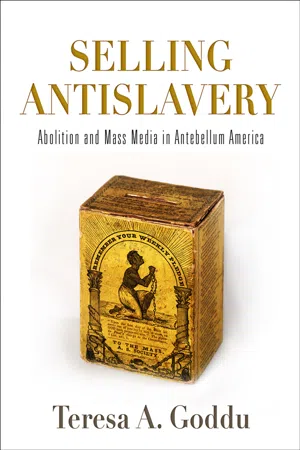
Beginning with its establishment in the early 1830s, the American Anti-Slavery Society (AASS) recognized the need to reach and consolidate a diverse and increasingly segmented audience. To do so, it produced a wide array of print, material, and visual media: almanacs and slave narratives, pincushions and gift books, broadsides and panoramas. Building on the distinctive practices of British antislavery and evangelical reform movements, the AASS utilized innovative business strategies to market its productions and developed a centralized distribution system to circulate them widely. In Selling Antislavery, Teresa A. Goddu shows how the AASS operated at the forefront of a new culture industry and, by framing its media as cultural commodities, made antislavery sentiments an integral part of an emerging middle-class identity. She contends that, although the AASS's dominance waned after 1840 as the organization splintered, it nevertheless created one of the first national mass markets.
Goddu maps this extensive media culture, focusing in particular on the material produced by AASS in the decade of the 1830s. She considers how the dissemination of its texts, objects, and tactics was facilitated by the quasi-corporate and centralized character of the organization during this period and demonstrates how its institutional presence remained important to the progress of the larger movement. Exploring antislavery's vast archive and explicating its messages, she emphasizes both the discursive and material aspects of antislavery's appeal, providing a richly textured history of the movement through its artifacts and the modes of circulation it put into place.
Featuring more than seventy-five illustrations, Selling Antislavery offers a thorough case study of the role of reform movements in the rise of mass media and argues for abolition's central importance to the shaping of antebellum middle-class culture.
- 344 pages
- English
- ePUB (mobile friendly)
- Available on iOS & Android
eBook - ePub
About this book
Information
Publisher
University of Pennsylvania PressYear
2020Print ISBN
9780812251999
9780812251999
eBook ISBN
9780812296969
Chapter 1

Antislavery Inc.
In the 1830s, the founding decade of the American Anti-Slavery Society, the antislavery movement transformed itself from a small, heterogeneous, unpopular band of gradualists and radicals into an organized mass social movement that spread across the North and the West. Between its establishment in 1833 and its fragmentation in 1840, the AASS’s grassroots membership coalesced into a national reform organization. Vertically arranged, with state and local auxiliary chapters nested within a “federated structure,” and managerially directed by a centralized administration, the executive committee headquartered in New York City, the 1830s AASS resembled a modern business enterprise.1 Its goal was to open the nation’s eyes, heart, and mind to the problem of slavery and the cause of freedom. Through pioneering business structures and publishing strategies, it created the infrastructure and tactics necessary for the mass communication of its message. It spread its ideology of reform by manufacturing an array of media products and circulating them widely through a coordinated distribution system. Both the number of the AASS’s auxiliaries and its media output rose dramatically through the 1830s. In 1837, The Philanthropist computed the rise in antislavery societies at about “one society daily” and in 1836 the AASS’s Third Annual Report counted the total number of publications as “nine times as great as those of last year.”2 By the end of the decade, the national society consisted of 1,650 auxiliaries and disseminated 725,000 copies of its publications yearly.3 Each propelled the other: the AASS’s institutional structure created mechanisms for mobilizing antislavery media on a mass scale, while its popular media forms generated interest in and won converts to the cause. The AASS drove the rise of new media in the 1830s and those media in turn facilitated the spread of antislavery reform.
This chapter shows how the AASS’s business model in the 1830s—its centralized bureaucracy and alternative publishing system—was integral to its creation of mass media. By capitalizing on innovative organizational structures, new technologies of reproduction and publicity, and systematized distribution, the AASS grew its base and popularized its argument. A media powerhouse, the AASS manufactured abolition as a compelling brand in the 1830s. Even after the society’s dissolution in 1840, the institutional identity and distinctive set of publication practices and media types it created and consolidated in the 1830s continued to shape the antislavery argument as the movement evolved. The 1830s AASS established the foundation upon which future forms of abolition would build.
* * *
The 1830s AASS patterned its media enterprise on several models: early British and U.S. antislavery movements, black abolitionism and print culture, and evangelicalism. Many of its texts and publishing tactics were drawn from British propaganda campaigns against the slave trade (1787–1807) and slavery (1823–34). From 1787 forward, British antislavery established itself as a national network, with coordinated petition campaigns and “cheap promotional literature that could be distributed in large quantities” through local agents.4 The AASS adopted British antislavery’s organizational structure as well as its multimodal media, such as Josiah Wedgwood’s medallion of the kneeling slave (1787), which operated as a visual icon as well as a consumer good, and its publicity methods, such as distribution of free publications.5 Similarly, the 1830s AASS was indebted to U.S. abolition’s first wave—less the republican strategies of the elite Pennsylvania Abolition Society (founded in 1775) than the grassroots organizing of the AASS’s immediate predecessor, the New England Anti-Slavery Society (NEASS, founded in 1832). As described by Richard Newman, the NEASS “incorporated mass action strategies into its organizational framework”: it “inaugurated the agency system by appointing four traveling lecturers in 1832 and 1833,” established its own “official organ,” The Abolitionist (1833), and disseminated publications.6 The AASS would employ all these tactics and more.
The 1830s AASS was also indebted to black abolitionism’s organizing strategies and print practices. Black resistance and activism, as Manisha Sinha argues, lay at the heart of the antislavery movement.7 Black antislavery activists organized in the 1820s through independent associations, such as churches, fraternal associations, vigilance committees, and literary societies. Antislavery societies like the Massachusetts General Colored Association (1826–32), the “first antislavery society in New England,” formed the institutional matrix out of which the NEASS and AASS would emerge.8 The NEASS first met in Boston at “the African Church on Joy Street,” and the AASS assembled in Philadelphia’s Adelphi Hall, which “belonged to a black benevolent society.”9 The black conventions of 1830–35, the only “national antislavery gatherings” before the AASS’s founding, laid the groundwork for the emergence of a national antislavery network.10
Black abolitionist print culture also shaped the AASS’s argument and media practices. Although black writers and activists, such as Phillis Wheatley and Olaudah Equiano, participated in transatlantic print culture as early as the eighteenth century, the black response to the colonization debate of the 1820s produced a more coordinated culture of print.11 The first African American periodicals, Freedom’s Journal (1827–29) and Rights of All (1829), not only deployed a range of appeals, but also established broad distributional networks that extended “throughout the United States, Canada, Haiti, and the United Kingdom”: Freedom’s Journal, as Gordon Fraser shows, “built a network that included forty-seven authorized agents and extended from Waterloo, Ontario, to rural North Carolina, from Port-au-Prince to Liverpool to Richmond, Baltimore, and New Orleans.”12 Similarly, David Walker forged a militantly discursive and “typographically radical” argument in his Appeal to the Coloured Citizens of the World (1829), which he circulated through the mail and with the help of sympathetic black sailors traveling to the South.13 Black abolitionists’ innovative use of the press in the 1820s shaped the national debate over slavery and pushed the antislavery argument toward immediatism. The AASS would later duplicate their publishing tactics.
In the 1830s, black abolitionists operated both inside and outside of the AASS’s institutional structures. They were members and part of its leadership structure: “six black abolitionists” were named to its board of managers in 1833, and Theodore Wright, a Presbyterian minister, Peter Williams, an Episcopal priest, and Samuel Cornish, founder of Freedom’s Journal, all served on its executive committee.14 Yet the AASS remained “white-dominated.”15 Although its aim, according to its constitution, was to “elevate the character and condition of the people of color,” its main focus was conversion to the cause.16 The dissolution of southern slavery rather than the promotion of northern equality was its central concern.17 Hence, African American activists continued to chart their own course in the 1830s, focusing on improving the condition of northern blacks, creating vigilance committees to aid and protect fugitive slaves, holding state and national conventions to form political coalitions to demand racial equality, and establishing educational societies to support literacy.18 Black cultural producers fostered the black press with new periodicals, such as the Weekly Advocate (1837), the Colored American (1837–41), the Mirror of Liberty (1838–40), and the National Reformer (1838–39), and developed their own distributional networks, such as David Ruggles’s bookstore and reading room.19 With the dissolution of the AASS’s centralized institutional structure in 1840 and the broadening of the movement, African Americans took on an even more visible role.
Besides the influence of earlier abolitionist groups, institutional antislavery developed out of and in tandem with benevolent reform movements, especially evangelicalism. As David Paul Nord asserts, the evangelical movement, institutionalized as the American Bible Society (1816), the American Sunday School Union (1824), and the American Tract Society (1825), was foundational to formulating the “organizational structures and publication strategies” of later reform movements, including abolition.20 Evangelical societies were the first to create national networks of auxiliaries directed by a centralized board of managers. By arranging themselves hierarchically (from executive committee through department heads and regional managers down to grassroots volunteers), with systematized procedures that facilitated the flow of information between center and periphery (record-keeping forms, cards of instruction, in-house newsletters), they operated as “large-scale business firm[s].”21 In the 1820s, they built their own publishing houses, taking advantage of modern industrial technologies, such as stereotyping, steam-powered presses, and machine-made paper.22 Committed to the widespread circulation of Bibles and religious tracts, they not only created regional distributional networks of depositories and paid agents but also relied on local labor, turning every church into a book depository and every member into a tract disseminator. Through the pioneering use of bureaucratic organization, centralized publishing, and coordinated distribution, the evangelical movement produced the first mass media in the United States.23
Evangelicalism strongly shaped abolition. Many abolitionist leaders were drawn from the evangelical movement: Arthur Tappan bankrolled the American Tract Society before funding the AASS, and members of the AASS’s executive committee, Elizur Wright and Joshua Leavitt, worked as colporteurs for the Tract Society. The AASS adopted similar organizational structures, publishing procedures, and distributional strategies.24 Like later business corporations, it was a “vertically integrated, horizontally diversified, managerially coordinated enterprise.”25 By making its “chief business” to “organize Anti-Slavery societies, if possible, in every city, town and village, in our land,” the AASS established auxiliaries at the level of the state and county as well as the town and school district.26 While these franchises had separate memberships, they understood themselves to be part of a larger, hierarchical system: county societies were auxiliaries to their state societies, which in turn were ancillary to the AASS.27 In return for forwarding a copy of their constitution, a list of their officers, and the number of their members to the national office, auxiliaries were sent official acknowledgment of their incorporation into the parent society: first a letter of recognition, later an engraved diploma of membership.28 In turn, by listing societies that were “founded on the same principles, and seek the same object in the same way” at the end of each annual report, the AASS advertised itself as the sum of its proliferating parts.29 Even as the AASS fixated on spreading—its annual reports puffed the exponential increase of auxiliaries—it worked to connect its multiplying parts into a unified whole.
The vertical integration required for national organization occurred through the AASS’s centralized management structure. The 1830s AASS was run by an executive committee and a paid staff of professional managers, headquartered in New York City—the geographic center of the moral nation, according to executive committee member Henry Stanton.30 They hired and trained agents, planned national legislative action, organized petition campaigns, raised money, and produced publications. During its period of intense organizing in the mid-to late 1830s, the leadership included prominent businessmen like...
Table of contents
- Cover
- Title Page
- Copyright
- Dedication
- Contents
- Introduction
- Chapter 1. Antislavery Inc.
- Part I. Antislavery Print Culture
- Part II. Antislavery Material Culture
- Part III. Antislavery Visual Culture
- Notes
- Index
- Acknowledgments
Trusted by 375,005 students
Access to over 1.5 million titles for a fair monthly price.
Study more efficiently using our study tools.
Frequently asked questions
Yes, you can cancel anytime from the Subscription tab in your account settings on the Perlego website. Your subscription will stay active until the end of your current billing period. Learn how to cancel your subscription
No, books cannot be downloaded as external files, such as PDFs, for use outside of Perlego. However, you can download books within the Perlego app for offline reading on mobile or tablet. Learn how to download books offline
Perlego offers two plans: Essential and Complete
- Essential is ideal for learners and professionals who enjoy exploring a wide range of subjects. Access the Essential Library with 800,000+ trusted titles and best-sellers across business, personal growth, and the humanities. Includes unlimited reading time and Standard Read Aloud voice.
- Complete: Perfect for advanced learners and researchers needing full, unrestricted access. Unlock 1.5M+ books across hundreds of subjects, including academic and specialized titles. The Complete Plan also includes advanced features like Premium Read Aloud and Research Assistant.
We are an online textbook subscription service, where you can get access to an entire online library for less than the price of a single book per month. With over 1.5 million books across 990+ topics, we’ve got you covered! Learn about our mission
Look out for the read-aloud symbol on your next book to see if you can listen to it. The read-aloud tool reads text aloud for you, highlighting the text as it is being read. You can pause it, speed it up and slow it down. Learn more about Read Aloud
Yes! You can use the Perlego app on both iOS and Android devices to read anytime, anywhere — even offline. Perfect for commutes or when you’re on the go.
Please note we cannot support devices running on iOS 13 and Android 7 or earlier. Learn more about using the app
Please note we cannot support devices running on iOS 13 and Android 7 or earlier. Learn more about using the app
Yes, you can access Selling Antislavery by Teresa A. Goddu in PDF and/or ePUB format, as well as other popular books in Social Sciences & North American Literary Criticism. We have over 1.5 million books available in our catalogue for you to explore.