In 1822, the Mary departed Philadelphia and sailed in the direction of the Spanish colony of Puerto Rico. Like most vessels that navigated the Caribbean, the Mary brought together men who had served under a dozen different flags over the years. Unlike most crews, those aboard the Mary were in a different line of commerce: they exported revolution. In addition to rifles and pistols, the Mary transported a box filled with proclamations announcing the creation of the "Republic of Boricua." This imagined republic rested on one principle: equal rights for all, regardless of birthplace, race, or religion. The leaders of the expedition had never set foot in Puerto Rico. And they never would.
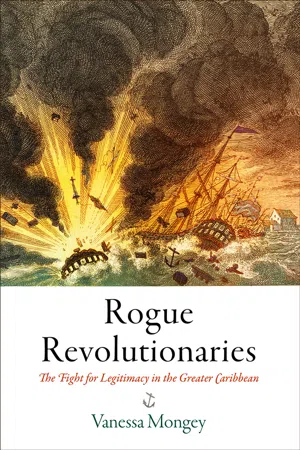
When we think of the Age of Revolutions, George Washington, Robespierre, Toussaint Louverture, or Simón Bolívar might come to mind. But Rogue Revolutionaries recovers the interconnected stories of now-forgotten "foreigners of desperate fortune" who dreamt of overthrowing colonial monarchy and creating their own countries. They were not members of the political and economic elite; rather, they were ship captains, military veterans, and enslaved soldiers. As a history of ideas and geopolitics grounded in the narratives of extraordinary lives, Rogue Revolutionaries shows how these men of different nationalities and ethnicities claimed revolution as a universal right and reimagined notions of sovereignty, liberty, and decolonization.
In the midst of wars and upheavals, the question of who had the legitimacy to launch a revolution and to start a new country was open to debate. Behind the growing power of nation-states, Mongey uncovers a lost world of radical cosmopolitanism grounded in the pursuit of material interests and personal prestige. In demonstrating that these would-be revolutionaries and their fleeting republics were critical to the creation of a new international order, Mongey reminds us of the importance of attending to failures, dead ends, and the unpredictable nature of history.
- 288 pages
- English
- ePUB (mobile friendly)
- Available on iOS & Android
eBook - ePub
About this book
Information
Publisher
University of Pennsylvania PressYear
2020Print ISBN
9780812252552
9780812252552
eBook ISBN
9780812297577
CHAPTER 1

Ghostly Governments
Statehood and Sovereignty
Every step of Louis-Michel Aury’s career had led to this moment. In July 1818, a mere week after landing on the island of Providencia in the western Caribbean, Aury announced the creation of his new headquarters to the rest of the world. In an address republished in newspapers across the Americas, he invited “gallant foreigners” and other “friends wandering without a country” to join his crusade to bring liberty and independence to the world. “Come amongst us as brothers,” he promised, “to enjoy that political and religious liberty, of which the ferocity of the despots and fanaticism wanted to deprive you.”1 As he wrote these words, a hurricane had struck the island, supplies ran low, and his “gallant legions” were dying of hunger and disease.
Aury “always dreamed of republic,” wrote one of his collaborators.2 Providencia was Aury’s third attempt at revolution launching and state making: he had previously carried the banner of liberty to the islands of Galveston in Texas and Amelia in Florida. At his side stood Sévère Courtois, a free man of color from Saint-Domingue who took over the Providencia government after Aury passed away. Lasting four years, the establishment in Providencia was Aury and Courtois’s longest accomplishment and the crowning achievement of their state-entrepreneurial careers. It ended in June 1822, when the town council adopted the Cúcuta Constitution, turning Providencia into a territory of Gran Colombia.
What existed in Providencia during these four years is a riddle waiting to be solved: a contested state-like entity that achieved de facto control over its claimed territory and was self-governing with a republican at the head of a military government. Both Aury and Courtois used the name “government” for the polities they set up across the Greater Caribbean.3 Contemporaries called them “criminal” and “fraudulent.”4 The concept of a popularly legitimated sovereignty slowly replacing a dynastically legitimated sovereignty was the beginning of modernity, scholars argue, but Aury and Courtois’s ghostly governments reveal the tensions deeply embedded in this transition.5 If people had a right to create a state (the famous opening phrase of the U.S. Constitution “We the People”), then anybody could initiate their own government. As numerous new political entities sprang into existence in the Atlantic world, no consensus existed on what entities qualified as sovereign, independent states.

Map 2. The political projects in which Louis-Michel Aury and Sévère Courtois participated, 1810–1822.
Aury and Courtois’s floating governments were mere blips on the historical radar, standing on a spectrum between exotic lures or piratical nests. Even the best biographies of Louis-Michel Aury brush over his political ambitions, choosing to focus instead on his tribulations and adventures.6 Most historians focus on other countries’ reactions to Aury’s actions, explaining how the U.S. government invaded Amelia, paving the way for the treaty with Spain that ceded Florida to the United States, or they focus on how Providencia became part of Gran Colombia.7 However, connecting Aury and Courtois’s governments solely to “recognized” countries such as the United States and Colombia reproduces a preordained narrative that alternative entities were bound to fail, framing them as preludes to U.S. or Colombian national expansion. This chapter instead places these ghostly governments at the center of its analysis, focusing on the ways their leaders engaged with the wider world in their quest for legitimacy. It does not consider these governments anarchical anomalies or “forgotten islands of international disorder” but argues that Aury and Courtois deftly scripted governments that could and did pose as legitimate—even for just a few months or years.8
Aury and Courtois’s ghostly governments give us insight on the debate around the importance of foreign recognition in the creation of states. A traditional and constitutive approach to sovereignty holds that recognition has “provided the imprimatur of statehood to seceding entities for over two hundred years” and legitimized certain states as members of the wider international community.9 Although the revolutionaries of Providencia failed to gain formal diplomatic recognition, they actively traded and negotiated with other countries and colonies. By focusing on the factors that enabled these state-like entities to exist and how these entities enabled their creators to pursue their political and pecuniary ambitions, this chapter demonstrates that sovereignty and statehood were not indivisible, one-size-fits-all concepts. People claimed, asserted, and acknowledged them in pieces or in fragments but rarely as a whole. The concepts of sovereignty and statehood were extremely elastic and malleable.
The Quest for Fortune
“Since chance brought me to this country, fortune, which had before been against me, has started to be favorable.” Louis-Michel Aury wrote these words in Cartagena in 1814, anxious to share some good news with his relatives in Paris, including his beloved younger sister. The following year, chance brought him to befriend a fellow restless soul, Sévère Courtois, born in Ouanaminthe, in northeastern Saint-Domingue. One of the most important ports in the Spanish Caribbean, Cartagena seceded from Spain and became an independent republic in 1811. Aury’s expertise and enthusiasm helped him rise through the ranks. As he explained to his family, “I have had different engagements with the corsairs that I have commanded, which have won me marks of distinction from the government I serve.”10 Then twenty-six years old, Aury had been searching for these “marks of distinction” for the past ten years.
Aury lived most of his life at sea, and this experience shaped his vision of the world. He entered the French navy at the age of thirteen after his father passed away. Life as a sailor was not for the faint-hearted. Wages were low, working conditions were harsh, and diseases were frequent. The letters he wrote his family conveyed his loneliness. An adolescent in a world of adults, Aury earnestly reported every growth spurt (“I am now five feet three inches,” he happily wrote in January 1804).11 Money was a constant problem; he did not have enough to buy proper clothing, and he clung to any book on which he could get his hands. A novice sailor, he had to perform the most unpleasant tasks. Aury remained silent about the other sailors—except one who promised to teach him mathematics. When he learned of the death of his mother, he became concerned about the future of his sister. He effusively thanked his relatives for providing for her—”until I am able to help her myself,” he promised.12 Providing for his only sister would become Aury’s life goal.
Rivalries between Britain, France, and Spain gave Aury the opportunity to make a name for himself. A corsair took him prisoner in 1803 in Guadeloupe; he stayed onboard eleven months before jumping ship and swimming back to liberty.13 He never rejoined the French navy. One of Aury’s collaborators, Agustín Codazzi, described Napoléon’s coronation in 1804 as a turning point: “Educated in the principles of the revolution, he had been suckled in such feelings of liberty that he abandoned the service of his patrie when Napoléon crowned himself emperor…. He preferred to live among free people than among his compatriots, who had so quickly forgotten the bloodshed for liberty.”14 Despite this public repudiation of Napoléon, Aury was happy to take advantage of the opportunities offered by the Napoleonic wars and received privateer commissions to attack Spanish and British ships from Guadeloupe until the British invaded the French colony in 1810.15
Privateering was the prerogative of sovereign monarchs, princes, and states according to the treatise Droit des Gens or Laws of Nations (1758) by the Swiss jurist Emer de Vattel—the dominant theoretical framework for understanding international law and for implementing it into diplomatic practice. Sovereigns issued privateer commissions, or letters of marque, a piece of paper that extended the sovereign state’s jurisdiction, laws, and protection into the ocean.16 Privateers acted under the authority of a sovereign and, in return, received that sovereign’s protection against criminal proceedings. Aury associated privateering and patriotism: “Corsairs,” he reassured his relatives, “wage war as loyally as the ships of his imperial majesty.”17
Privateering shaped U.S., British, and Spanish war efforts, but in Aury’s case, privateering shaped his ambitions. A shy sailor no more, Aury grew into a leader of men. He became a ship captain. He learned to tap into and exploit other people’s longing for adventure. He persuaded investors to finance his expeditions and talked men of sundry backgrounds into joining his ranks. Aury equipped his first vessel around 1805, attacked British and Spanish ships, and brought seized goods to Charleston, Baltimore, and New Orleans. The British navy captured the ship into which he had invested 2,500 gourds. When fortune eluded him, he moved to Louisiana. There, he bought and repaired a small boat.18 Aury targeted Spanish slave ships and sold enslaved Africans in Louisiana, contravening the 1808 U.S. slave trade ban.19 Aury’s list of enemies continued to grow when U.S. authorities apprehended his new ship in 1810, killing and wounding twelve of his sailors. With a tinge of melancholy, he wrote his sister that he hoped that “[Fortune] will not always persecute me.”20
Fortune appeared in the shape of hundreds of men, most of them free people of African descent, pressuring the junta of Cartagena to sign a declaration of independence in November 1811.21 The following year, a constitution secured suffrage for male heads of households and property owners, regardless of color or birth. The government soon turned to privateering, and President Manuel Torices invited foreigners to come to Cartagena, filling the city streets with foreign sailors and soldiers.22 Torices also sent a copy of the constitution to U.S. president James Madison, asking that vessels flying the Cartagena flag be allowed to enter U.S. ports.23 This news reached Aury, and he embarked with Juan Antonio Hernandez, a Haitian sailor, to Cartagena in December 1812.24 Aury’s embrace of Spanish American independence allowed him to reconcile the ideals of the French Revolution and his hatred of monarchies with his naval expertise.
In Louisiana, Sévère Courtois certainly heard about what was happening on the Colombian coast but decided to place his bets with the U.S. republic. Courtois was born into a prominent land-owning family in Saint-Domingue. The military career was a family tradition; his grandfather was a recipient of the royal and military order of Saint Louis and his older brother, Joseph, was an officer in the Napoleonic army.25 As one brother faced the British Empire in Europe, the other fought the same enemy in the Americas. In December 1814, Sévère joined a battalion of free men of color from Saint-Domingue led by Major Joseph Savary and fought in the Battle of New Orleans against the British. Listed a sergeant major, Courtois probably had previous military experience. He later claimed that he had been working for the “just cause of America” since 1812; it is there...
Table of contents
- Cover
- Title Page
- Copyright
- Contents
- List of Key Figures
- Introduction. Foreigners of Desperate Fortune
- Chapter 1. Ghostly Governments: Statehood and Sovereignty
- Chapter 2. Traveling Words: Communication Circuits
- Chapter 3. American Freedom Fighters: The Struggle for Equality
- Chapter 4. Revolutionary Dreams: Diplomatic Games and International Politics
- Chapter 5. Crocodiles and Country Houses: Revolutionary Memories
- Conclusion. Monitoring the Contagion of Revolution
- List of Abbreviations
- Notes
- Index
- Acknowledgments
Trusted by 375,005 students
Access to over 1.5 million titles for a fair monthly price.
Study more efficiently using our study tools.
Frequently asked questions
Yes, you can cancel anytime from the Subscription tab in your account settings on the Perlego website. Your subscription will stay active until the end of your current billing period. Learn how to cancel your subscription
No, books cannot be downloaded as external files, such as PDFs, for use outside of Perlego. However, you can download books within the Perlego app for offline reading on mobile or tablet. Learn how to download books offline
Perlego offers two plans: Essential and Complete
- Essential is ideal for learners and professionals who enjoy exploring a wide range of subjects. Access the Essential Library with 800,000+ trusted titles and best-sellers across business, personal growth, and the humanities. Includes unlimited reading time and Standard Read Aloud voice.
- Complete: Perfect for advanced learners and researchers needing full, unrestricted access. Unlock 1.5M+ books across hundreds of subjects, including academic and specialized titles. The Complete Plan also includes advanced features like Premium Read Aloud and Research Assistant.
We are an online textbook subscription service, where you can get access to an entire online library for less than the price of a single book per month. With over 1.5 million books across 990+ topics, we’ve got you covered! Learn about our mission
Look out for the read-aloud symbol on your next book to see if you can listen to it. The read-aloud tool reads text aloud for you, highlighting the text as it is being read. You can pause it, speed it up and slow it down. Learn more about Read Aloud
Yes! You can use the Perlego app on both iOS and Android devices to read anytime, anywhere — even offline. Perfect for commutes or when you’re on the go.
Please note we cannot support devices running on iOS 13 and Android 7 or earlier. Learn more about using the app
Please note we cannot support devices running on iOS 13 and Android 7 or earlier. Learn more about using the app
Yes, you can access Rogue Revolutionaries by Vanessa Mongey in PDF and/or ePUB format, as well as other popular books in History & Early American History. We have over 1.5 million books available in our catalogue for you to explore.