Militarization and nuclearization were the historical developments most essential to the creation of the rural New Right.
Both North Dakota and South Dakota have long been among the most reliably Republican states in the nation: in the past century, voters have only chosen two Democrats, Franklin Roosevelt and Lyndon B. Johnson, and in 2016 both states preferred Donald Trump by over thirty points. Yet in the decades before World War II, the people of the Northern Plains were not universally politically conservative. Instead, many Dakotans, including Republicans, supported experiments in agrarian democracy that incorporated ideas from populism and progressivism to socialism and communism and fought against "bigness" in all its forms, including "bonanza" farms, out-of-state railroads, corporations, banks, corrupt political parties, and distant federal bureaucracies—but also, surprisingly, the culture of militarism and the expansion of American military power abroad.
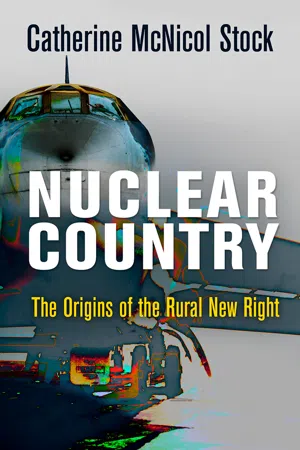
In Nuclear Country, Catherine McNicol Stock explores the question of why, between 1968 and 1992, most voters in the Dakotas abandoned their distinctive ideological heritage and came to embrace the conservatism of the New Right. Stock focuses on how this transformation coincided with the coming of the military and national security states to the countryside via the placement of military bases and nuclear missile silos on the Northern Plains. This militarization influenced regional political culture by reinforcing or re-contextualizing long-standing local ideas and practices, particularly when the people of the plains found that they shared culturally conservative values with the military. After adopting the first two planks of the New Right—national defense and conservative social ideas—Dakotans endorsed the third plank of New Right ideology, fiscal conservativism. Ultimately, Stock contends that militarization and nuclearization were the historical developments most essential to the creation of the rural New Right throughout the United States, and that their impact can best be seen in this often-overlooked region's history.
- 312 pages
- English
- ePUB (mobile friendly)
- Available on iOS & Android
eBook - ePub
About this book
Information
Publisher
University of Pennsylvania PressYear
2020Print ISBN
9780812252453
9780812252453
eBook ISBN
9780812297386
CHAPTER 1
“UNDER GOD, THE PEOPLE RULE”
IN 1883 HAMLIN GARLAND left Dakota Territory, putting its harsh climate and windswept towns behind him. He had seen too many men and women broken—killed, driven mad, or bankrupted—trying to carve a farm from the deep-rooted, arid soil. Yet the land and its people called Garland back. Soon he put pen to paper, blurring the line between literature and politics to communicate what life on the “middle border” was really like—and why. He hoped someday that his stories and novels, rather than just achieve artistic “beauty,” could help “spread the reign of justice.”1
In “Under the Lion’s Paw,” Garland recounted the struggles of Tim Haskins, who, with his ailing wife, newborn baby, and two young children, fled his Kansas farm after grasshoppers destroyed what little he owned. Homeless, the Haskins family wandered the roads until they stopped at a farm where an older couple, the Councils, took them in. Steve Council finally arranged for Haskins to negotiate a two-year tenancy with a local landowner who in turn agreed to sell Haskins the land for $3,000 when the lease expired. It seemed like a dream come true: hard work, thrift, and some luck with the weather assured Haskins of becoming a property-owning member of the middle class, a virtuous yeoman-citizen in the true Jeffersonian tradition. Yet it was not to be. Haskins worked “ferociously” on the land and saved every penny he could.2 But after two years the landlord, Jim Butler, claimed that the improvements Haskins made to the land had made it more valuable. He demanded $5,000 instead. Enraged, Haskins nearly attacked Butler with his pitchfork, but after seeing his baby daughter, hung his head and returned to work. He remained a landless—and powerless—tenant.3
Garland read “Under the Lion’s Paw” at the 1892 Omaha convention of the People’s Party, already generally known as the Populist Party. It brought the audience to tears. Like many small farmers and tenants, the Haskins family did not realize that the system was rigged against them by landowners, bankers, corporations, and politicians.4 At one time Jim Butler had owned a store and “earned all he got.” But he discovered that speculating on land and extending credit to poor farmers was an easier way to make money. He could take fishing trips and sit “around town on rainy days smoking and ‘gassin’ with the boys’ ” while tenants like Haskins worked themselves “nearly to death” in the hope of “pushing the wolf of want a little farther from [the] door.”5
In the late nineteenth and early twentieth centuries, tens of thousands of farmers like Haskins, and their wives, decided they had had enough. They joined radical agrarian movements that swept across the rural United States like a “political prairie fire.”6 The best known was the Populist movement, which had coalesced in the region but gained widespread national prominence in Omaha in 1892. Its members stretched from the cotton fields of the Southeast, up and down the Great Plains, and into the Mountain West. In some of these states, historian Lawrence Goodwyn contends, Populism was more “moment” than movement.7 But on the Northern Plains, commitment to the ideals of Populism—expanded access to economic opportunity and political decision-making—lasted far longer than the initial insurgency. With controversial political leaders and famously persuasive barnyard organizers, they carried forward the goals of Populism, enhanced at times by socialist and communist strategies, into many aspects of progressive Republicanism, the Nonpartisan League (NPL), and Depression-era organizations such as the Farmers Holiday Association.8 Together these movements made up an inspiring chapter in the history of the American left, as they put ordinary people first and honored the productive work they performed.
But Garland revealed even more about the political culture of the Northern Plains. Radical agrarian organizations, however fondly recalled, never held a monopoly on political ideas or ambitions. To the contrary, plenty of landowners, bankers, politicians, and small businesspeople like Garland’s antihero, Jim Butler, held power in the small towns of the region. They actively opposed the reforms proposed by radical farmers, year after year. These conservatives did not fear the concentration of economic and political power as much as they feared the diminution of their own. As they fought back against the “upstart” farmers through the business-friendly wing of the Republican Party, they prepared the political landscape for a future generation that would, during the Cold War era, try to extinguish the region’s political prairie fires for good.
The roots of the Rural New Right on the Northern Plains lay not only in how agrarian radicals and small-town conservatives saw the world differently but also in how they saw it the same way. In the 1960s and 1970s, cultural issues would come to dominate political debate nationwide, creating deep, seemingly intractable, divisions between Republicans and Democrats. But in an earlier era, a “common logic” around religion, gender, and race could instead form the glue that bound members of diverse white ethnic groups together, even when they disagreed vehemently on party politics.9 For example, the vast majority of Euro-American Dakotans, immigrants or native-born, Populist or conservative, tenants or landlords were Christian; like Garland’s Good Samaritan, Steve Council, they believed that Christianity’s moral principles made it the “only religion” there was.10 Furthermore, many people on the Northern Plains belonged either to doctrinally conservative denominations like Roman Catholicism or to one of the more conservative sects of larger Protestant denominations like Lutheranism, Methodism, and Presbyterianism.11 Consequently, even some Dakotans who supported women’s suffrage believed in the patriarchal heterosexual family where men were the sole proprietors and authorities.12
Most fundamental to social order in the Dakotas, as in the rest of the United States, was a racialized hierarchy predicated on the idea that whites were superior to all nonwhites and, most immediately, that whites “deserved” to settle on Native land and extract profits from it.13 For all their enmity, Haskins and Butler did not argue about whether the land should be plowed and its crop sold, just to whom the profits belonged, which of the two white men who claimed it. Furthermore, they surely agreed that homelessness and dependence on the charity of others was a fate even worse than tenancy. It threatened to equate poor white farmers with Native people, whom most Americans believed were incapable of citizenship and were going to “die out” within a few decades.14 In an era where whiteness “conferred both citizenship and the right to own property,” Populists fought not just for their right to earn a living, but for their right to be white.15
* * *
Few homesteaders new to the Northern Plains expected the task ahead to be easy. Whether they traveled from nearby states like Iowa or Minnesota or distant communities in Canada, Germany, Scandinavia, or Russia, they were far from home and often on their own.16 Plowing the deeply rooted and arid sod of the plains and building homes where few trees grew tested their physical and emotional limits. Added to those challenges were cycles of wet and dry years, prairie fires, grasshopper plagues, tornadoes, blizzards, and an endlessly blowing wind. For all living creatures these conditions could prove fatal. In the winter of 1886 to 1887, snow came early and never quit. By its end hundreds of thousands of cattle had frozen to death. Just two years later, the temperature dropped sixty degrees in less than an hour and snow fell so fiercely it was hard to see your hand in front of your face. By its end, dozens of schoolchildren and their young teachers, 235 people in all, had died. Some were found frozen in haystacks and snowdrifts. A few died only feet from their homes.17
But it wasn’t nature, or nature alone, that radicalized farmers. It was also that the prices they received for crops and livestock were increasingly dependent on a globalizing economy far outside their control. At the same time, the concentrated power of big corporations, big banks, and big political parties squeezed them for every last cent.18 This rapid economic transformation shifted the center of power from rural to urban areas, deepening regional inequalities. South Dakota Populist Henry Loucks put it bluntly: in 1830, farmers had owned 75 percent of the nation’s wealth; by 1880, less than 25 percent.19 Historian R. Alton Lee writes, “In coming to the plains, [farmers] had hoped to find a utopia of relatively free, rich land, but they came at a time when modern America was emerging and attaching increasingly less importance to the agrarian way of life.”20
Inequitable railroad fees radicalized Dakota farmers first. In many small towns on the Northern Plains, there was only one railroad to bring crops or livestock to market. And there were no regulations, not even “reasonable maximum” rates, to limit the monopoly these railroads enjoyed—even as they neglected to pay taxes they owed to the state.21 Farmers were literally captive to the out-of-state corporations: they could pay railroad fees or let their crops rot. Incredibly, Jon K. Lauck writes, “From certain points in Dakota, it was cheaper to ship wheat to Liverpool than to Chicago or Minneapolis.”22 The “middlemen” who represented large creameries, mills, or storage facilities also had unassailable power over farmers’ livelihoods. An agent could lie, for example, when he graded a crop’s quality and thus lower its price. And farmers’ problems did not end trackside. If the only local bank provided the terms for a loan, how could a farmer negotiate better terms? If politicians from both parties were being wined and dined by the same corporate executives; and senators were appointed, not elected, how could a farmer create change?23
The challenge of making ends meet on a farm was not new in the late nineteenth century. The inequity between farmers and the institutions of economic and political power, however, certainly was. When a drought and recession in the 1880s further multiplied farmers’ troubles, Charles Macune founded the Farmers’ Alliance in Texas, a model for cooperation rather than competition in agriculture that quickly spread north. The Alliance encouraged farmers to band together, extending their traditional “habits of mutuality” like barn-raisings and quilting bees, to larger economic organizations like stores and storage facilities.24 He also encouraged them to demand support from the state. Soon some Alliance members advocated third party political action. Among the economic reforms they demanded were: an increase in the money supply through the coinage of silver; the creation of a long-term “sub-treasury” system so farmers could store crops until the price had risen; crop insurance; and state ownership of banks and utilities. In politics they advocated for the direct election of senators, the more secret “Australian ballot,” and implementation of the initiative and referendum system, which allowed voters to decide on new legislation directly. They believed that as a third party, the People’s Party, their candidates could withstand the corrupting forces of the current political system. At first the idea seemed to work well. In the 1892 presidential election, the People’s Party candidate James Weaver of Iowa received over a million votes and won five states in the West; the party also won six governorships.25 Even so they did not win the White House.
In 1896, the Populist Party abandoned its third-party strategy at the national level and “fused” with the Democratic Party. To some this was the compromise that changed an authentic democratic insurgency, full of possibility for radical change, into a mere “moment.”26 Even so the Populists found their best-known champion: William Jennings Bryan of Nebraska. While he may have only been fully committed to the silver issue, throughout 1896 Bryan used his considerable oratorical gifts to advocate for the central place of farming in American life. “Burn down your cities and leave our farms, and your cities will spring up again as if by magic; but destroy our farms and the grass will grow in the streets of every city in the country.”27 Meanwhile, his opponent, William McKinley, sat on his front porch in Canton, Ohio, giving press conferences and listening to the advice of business leaders.
While Bryan failed to win the nation’s highest office in three tries, the ideas and ideals that he endorsed so enthusiastically endured in many rural places. On the Northern Plains they even thrived. As Howard Lamar writes, Populist efforts “established a precedent for political flexibility that made it easier for … future third-party movements …to be heard.”28 Dakota farm leaders created innovative practices to fit their local circumstances. In South Dakota, where farmers had organized the first Farmers’ Alliance in a northern state, the charismatic newspaper editor Henry Loucks publicized its successes in every issue of the Dakota Ruralist. His colleague, Alonzo Wardell, experimented with a form of cooperative crop insurance that the national movement soon called “the Dakota system.”29 South Dakota Populists also enacted the initiative and referendum which has remained an essential part of the state’s political culture for over a century.
But the Populist Party’s success in South Dakota may have also been its curse; it had never fully dominated state politics and when rumors of corruption and opponents and money from outside the state targeted its leaders, the magic began to fade. In 1892, for example, South Dakotans elected their first governor, the Populist Andrew Lee, by only 319 votes. Though reelected in 1896, Lee lost a 1900 election for Congress in a landslide after his rural credit scheme failed. Likewise Senator Richard Pettigrew, a leading voice for Populism and anti-imperialism, lost his reelection bid in 1900. In a preview of the New Right’s campaign to defeat George McGovern in 1980, the national Republican Party spent an astounding half million dollars to push Pettigrew out of the Senate. Marcus Hanna, President McKinley’s top adviser and chair of the Republican Party, traveled across the state attacking Pettigrew. From the “viciousness” of his attacks, it was hard to tell...
Table of contents
- Cover
- Title Page
- Copyright
- Dedication
- Contents
- Preface
- Introduction
- Chapter 1. “Under God, the People Rule”
- Chapter 2. “Humanity Gone Mad”
- Chapter 3. “100% Against Communists”
- Chapter 4. “An Entire World in Khaki Brown and Olive Green”
- Chapter 5. Secrets and Lies
- Chapter 6. George McGovern’s “Lost World”
- Chapter 7. Wounded Knee, 1973, and the War at Home
- Chapter 8. “The Companies You Keep”
- Appendix. Methodology: Total Population of Military Personnel and Dependents Stationed in the Dakotas, 1955–1995
- Notes
- Index
- Acknowledgments
Trusted by 375,005 students
Access to over 1.5 million titles for a fair monthly price.
Study more efficiently using our study tools.
Frequently asked questions
Yes, you can cancel anytime from the Subscription tab in your account settings on the Perlego website. Your subscription will stay active until the end of your current billing period. Learn how to cancel your subscription
No, books cannot be downloaded as external files, such as PDFs, for use outside of Perlego. However, you can download books within the Perlego app for offline reading on mobile or tablet. Learn how to download books offline
We are an online textbook subscription service, where you can get access to an entire online library for less than the price of a single book per month. With over 1.5 million books across 990+ topics, we’ve got you covered! Learn about our mission
Look out for the read-aloud symbol on your next book to see if you can listen to it. The read-aloud tool reads text aloud for you, highlighting the text as it is being read. You can pause it, speed it up and slow it down. Learn more about Read Aloud
Yes! You can use the Perlego app on both iOS and Android devices to read anytime, anywhere — even offline. Perfect for commutes or when you’re on the go.
Please note we cannot support devices running on iOS 13 and Android 7 or earlier. Learn more about using the app
Please note we cannot support devices running on iOS 13 and Android 7 or earlier. Learn more about using the app
Yes, you can access Nuclear Country by Catherine McNicol Stock in PDF and/or ePUB format, as well as other popular books in History & North American History. We have over 1.5 million books available in our catalogue for you to explore.