Was it the Titanic of its age?
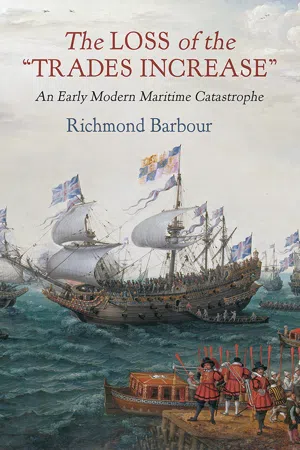
Christened by an optimistic King James I in December 1609, the Trades Increase was the greatest English merchant vessel of the Jacobean era—a magnificent ship embodying the hopes of the nascent East India Company to claim a commanding share of the Eastern trade. But the ship's launch failed when it proved too large to exit from its dock, an ill-fated start to an expedition that would end some three years later, when a dangerously leaking Trades Increase at last reached the shores of Java. While its smaller companion vessel would sail home with handsome profits for investors, the rotting hull of the great ship itself was beyond repair. The Trades Increase and nearly all who sailed it perished wretchedly on the far side of the world.
The terrible pattern proven by this voyage, with profits to an elite few in London stained by catastrophic losses in equipment and personnel abroad, ignited rancorous controversy in England over the human, moral, and economic costs of such commerce. In The Loss of the "Trades Increase" Richmond Barbour has written an engrossing account of the tragic expedition and of global capitalism at its hour of emergence.
Its sources fragmented among journals, minutes, and letters in the archives of the East India Company, the full story of the Trades Increase is told here for the first time. Earlier writers minimized the loss as a temporary setback and necessary sacrifice on the road to empire. In a work informed by corporate history and postcolonial theory, Barbour sees the saga of the voyage, and all that produced and justified it, differently: as an expression of the structural conflicts, operational risks, and material incapacities that haunted and ultimately unraveled the British Empire—and that destabilize multinational corporations, global markets, and our common biosphere to this day.
- 352 pages
- English
- ePUB (mobile friendly)
- Available on iOS & Android
eBook - ePub
About this book
Information
Publisher
University of Pennsylvania PressYear
2021Print ISBN
9780812252774
9780812252774
eBook ISBN
9780812297744
CHAPTER 1

The Construction and Launch of the Trades Increase, 1609
A decade after Queen Elizabeth I chartered the East India Company, the corporation mounted its most ambitious venture to date, the Sixth Voyage, set forth in the spring of 1610 with great expectations and capital investments of over £80,000. The costliest of the twelve separate voyages organized before the creation of an ongoing joint stock, the expedition distilled the ambitions of the Company’s founding generation. The London merchants and their supporters in Whitehall Palace conceived the Sixth Voyage as a spectacular affirmation of England’s growing presence in the eastern trade. Under the command of the veteran Sir Henry Middleton, who had earned a knighthood as the general of the Second Voyage (1604–6), the Sixth Voyage (1610–13) launched the Company’s first two custom-built ships. Actively contemplated since 1607, the vessels were the Peppercorn, a modest 340 tons, and the massive Trades Increase, at nearly 1,300 tons the greatest merchant vessel built in Jacobean England.1 Prince Henry christened the former, King James the latter, as they dined aboard the great ship at Deptford on the afternoon of the launch, 30 December 1609. The vessels and voyage were designed to prove England’s fitness to rival Portugal and Holland in the practice of a militant European innovation: cannon-equipped commerce in the Indian Ocean. Sailing south by the Cape of Good Hope into seas trafficked since antiquity, the dominant ships were now platforms for heavy artillery—for smashing other hulls at a distance—not ramming machines or mobile castles for archers and harquebusiers.2 Gums and aloes from Arabia, silks from Persia, spices from Java and the Moluccas, calicoes from India, satins and porcelains from China, “orient” pearls and jewels, and other exotica fueled elite markets throughout Europe. To access these commodities directly by sea removed the expenses of overland transport into the Ottoman Levant and brought substantial profits to enterprising investors, then called “adventurers,” in major port cities of western Europe.
A belated contender for such access, in the early years London’s East India Company met daunting difficulties marginalized in most overviews of the corporation that later ruled India. Characterizing the achievements of the first generation as more “rewarding and exciting” than those of the leaner 1620s and 1630s, Philip Lawson, for instance, overstates the precocity of Sir Thomas Smythe’s London office, which, he maintains, “soon mastered the fundamental business skills of trading-company capitalism.” The governor and his fellow directors, Lawson maintains, established institutions that “permitted speedy executive decisions” and enabled “the executive … always [to] be in touch with the most mundane Company activity.”3 But decisions often failed to yield desired outcomes, and managerial surveillance was never comprehensive. As this chapter will demonstrate, the governance of the first generation, though determined and resourceful, was beset by myriad contingencies beyond its control. Its operations were often cumbersome and inconclusive, its functions more prolific than its capacities, and its command of circumstance fitful. Furthermore, the challenges of central governance metastasized with distance from London. While the more robust Portuguese and Dutch consortia pursued imperial projects on land, the East India Company’s charter generation, staggered by low investments and slow returns, struggled to maintain an oceanic presence.
The London merchants met resistance from rivals abroad and critics at home, who objected to their monopoly and decried the export of bullion as a drain on the nation’s treasure. From the start, the eastern trade engendered division and controversy—within the corporation, around the country, transnationally—that intensified with the Company’s growth. Moreover, the Crown’s support sometimes wavered. To be retained, monopoly privileges compelled the traders to generate substantial revenues in royal customs and provide generous loans at the Crown’s need. A cash-hungry monarch might abrogate the charter or invite interlopers to proceed, as King James did for Sir Edward Michelborne in 1604 and a Scottish East India Company in 1618, undermining East India Company interests.4
For her part, Queen Elizabeth honored the terms of the December 1600 charter. Yet, ten months into the experiment, she chided the London merchants for their slackness, declaring through her Privy Council that she expected them to send out multiple ships annually: that is, to conduct themselves more like the Dutch, who “prosecute their voyages with a more honourable resolution.”5 To date, the East India Company had dispatched but one fleet of five ships (1601–3) and awaited its return before mounting another. Committed in principle to a separate levy of stock for each voyage, yet short of funds, in the early years they were twice compelled to apply investments from one venture to another: from the First to the Second, and the Third (1607–10) to the Fifth (1609–11). Between these, the Fourth Voyage (1608–11) failed catastrophically: the Ascension foundered in the Gulf of Cambay, and the undermanned Union wrecked on the coast of Brittany, its cargo pillaged. But the returns of the Third Voyage, whose first ship, the Consent, reached England in January 1609 and whose flagship, the Dragon, arrived in September, were substantial: the combined profit of the Third and Fifth Voyages reached 234 per cent.6 For the time being, these heady earnings stabilized the business. King James renewed the charter in May 1609, confirming the East India Company’s “right … to be a body, politic and corporate, forever, with perpetual succession” (Bruce, 1:156–57). From 1610, the pace of investment and voyaging quickened, with two expeditions in 1611, four in 1612, and the introduction of an ongoing joint stock in 1613—a capital consolidation that marked a decisive advance in corporate vitality. The East India Company, finds Theodore K. Rabb, grew rapidly between 1609 and 1615, and that quickening expressed a larger trend: this interval marked the highest percentage of total admissions to all English trading companies between 1575 and 1630, at 36.5 percent (Rabb, 90–91, 76).
Sixteen nine, that is, was an unprecedentedly big year for London’s joint-stock companies. Chronically short of funds, the East India Company invited numerous new “brothers” into its fellowship to raise money for the Sixth Voyage. The decisive factor in overall admissions that year was recruitment into the Virginia Company (chartered in 1606): 812 investors. Shares were alluringly affordable: £12 10s entitled one, in theory, to one hundred acres of land in the New World (Rabb, 32). As news of the great hardships the initial colonists suffered dimmed London’s hopes for quick profits in Virginia, the Company’s directors orchestrated and quickly printed an extraordinary cluster of sermons in 1609–10 promoting Virginia as a western Canaan set aside for Protestantism and England: an unclaimed land whose natives might be saved for Christ, unlike their unfortunate counterparts in Mexico and Peru, enthralled to the devil or the Papal Antichrist.7 Enrollment surged as the Company renewed its charter in May 1609 and the fleet carrying an interim governor to precede Lord De La Warre to Jamestown, Sir Thomas Gates, prepared to sail (Rabb, 90, 82–84). He departed at the start of June in the Sea Venture, the story of whose ensuing wreck percolated into Shakespeare’s The Tempest.8 In the event, while the Sea Venture’s passengers and crew recuperated and factionalized in Bermuda, most who reached Jamestown perished miserably. The winter of 1609–10 devolved into the most horrible in that settlement’s history, “the starving time,” when the besieged population plummeted from perhaps three hundred to sixty, and some persons, archaeologists have confirmed, resorted to cannibalism to survive.9 But in London that year, investment in Virginia—“a Territory … so rich, fertile, and fruitful,” declared the preacher Richard Crakanthorpe at Paul’s Cross on 24 March 1609 (Wright, Religion, 97)—looked to be a patriotic, pious, and in the long run, probably lucrative wager. East and west, the prospects seemed compelling. In Rabb’s table of admissions to trading companies from 1575 to 1630, 1609 stands out spectacularly, with 1,294 enrollments, seconded by 1611, with 794 (Rabb, 84, 74–75). The terrible distance that year between enthusiasms in London and material conditions in Jamestown engendered tragic loss. Soon enough, a similar irony ensnared the Sixth Voyage.
The year 1609 was also marked by ambitious building projects in greater London and beyond. In the seventeenth-century’s opening decade, as late Elizabethan factionalism played out and the Stuarts’ arrival stimulated fresh jostling for precedence, “all the great court figures were building,” Lawrence Stone has observed. Major families constructed mansions in London and, on their country estates, houses fit to receive the court on annual progress: “The Howard clan set the pace with Northampton House at Charing Cross, Greenwich House, and Audley End in Essex, while the Earl of Dorset was building at Knole. But Robert Cecil was not far behind with Chelsea House, Salisbury House, and the New Exchange in the Strand, Cranborne House in Dorset, and finally Hatfield House in Hertfordshire” (Stone, 63). Robert Cecil, the Earl of Salisbury, was born in Westminster, a district grown fashionable as the aristocracy took townhomes near Whitehall Palace. In this neighborhood, he built the New Exchange, a luxurious mall for chinoiserie and assorted fineries, to expand the retail opportunities for his friends in the eastern trade. The edifice rivaled Sir Thomas Gresham’s Royal Exchange in the City of London. Claiming imperial functions for the new facility, and honoring King James’s will to unify England, Scotland, and Wales in a greater Britain, Cecil named the building “Britain’s Burse.” The royal family attended the opening festivities on 19 April 1609, and the king performed the rite of naming. The event took vivid expression in a rediscovered work by Ben Jonson, The Entertainment at Britain’s Burse (ed. Knowles).
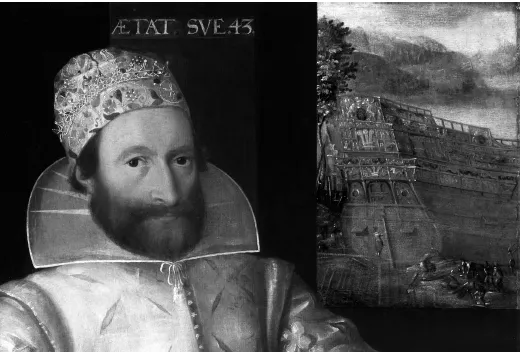
In the spring of 1609, Sir Hugh Middleton, Sir Henry’s cousin, oversaw the commencement of the enormous New River project, completed in 1613: a canal nearly forty miles long that brought fresh water to the metropolis through Islington—the most important improvement in London’s waterworks until the nineteenth century.10 Below London Bridge along the Thames, the two greatest ships of the Jacobean era were under construction. While the East India Company’s master shipwright William Burrell built the Trades Increase at Deptford, his friend the royal shipbuilder Phineas Pett constructed an equally grand and more ornate vessel at Woolwich for Prince Henry: the Prince Royal (fig. 3). The two shipbuilding projects and Cecil’s sumptuous emporium brought together many of the same personnel—the royal family, aristocratic and mercantile elites, groups of skilled and common laborers—in projects expressing London’s rites of public ostentation, cultures of personal and corporate adventurism, lavish consumption, and maritime power. Together these construction projects, culminant instances of the decade’s building boom, expressed the nascent imperial zeitgeist that animated the launch of the Trades Increase: the emulous will to assert the dignity of England, a small nation environed by the sea, as a player of consequence in an increasingly globalized world whose remote oceans other European powers presumed to dominate. It was a time of anxious optimism, disruptive ambition, sophisticated showmanship, quickened production, and extremely hazardous investment.
New Ships, New Investors
Multiple concerns converged at meetings of the Court of Committees in Sir Thomas Smythe’s house. Pressures peaked late in 1609 as the Trades Increase and Peppercorn neared completion at Deptford. The directors advanced oft-revisited plans, contended with outcomes of prior and ongoing initiatives, read reports and heard testimony from agents abroad and in London, reviewed debts, heard grievances, received and paid off returning mariners, hired new personnel, inducted new investors, negotiated with agents of the Crown over nautical supplies and sales of pepper, and monitored the construction projects. Two of the three ships of the Third Voyage returned in 1609: the Consent in January and the Dragon [aka Red Dragon] in September. The former carried a rich cargo of cloves and reports of great promise in the Moluccas; the latter lingered, damaged, with a weakened crew at Plymouth, where the security of its cargo provoked managerial anxieties and interventions. The sometimes-daily Courts of Committees and the less frequent General Courts met in distinct yet overlapping constellations of the several groups of investors created since the Company’s inception: “adventurers” in the “old,” Third, Fourth, and Fifth Voyages. The last were recast as Sixth Voyage adventurers after the Fifth Voyage departed in April as an offshoot of the Third; the Fourth Voyage was eventually written off as a total loss. A vestige of privateering, the system of single-voyage investment aggravated problems of financial and material record-keeping, complicated the sharing of information among East India Company members, multiplied occasions for error and confusion, and perplexed long-range strategies for corporate growth. Each voyage was a new—and as its departure neared, hastily consummated—invention.
The Trades Increase and Peppercorn were the initial two of six ships built by the East India Company between 1609 and 1612.They were followed by the Clove and the Thomas of the Eighth Voyage, the James of the Ninth, and the Hosiander of the Tenth (Birdwood, xiv). The East India Company’s first flagship, the Dragon, was purchased in 1600 from a charter member of the yet-unlicensed company, George Clifford, the Earl of Cumberland. Clifford was a leading Elizabethan privateer, and the ship, christened the Malice Scourge by Queen Elizabeth at Deptford in 1595, was his most formidable: a redoubtable vessel, variously rated at six hundred to nine hundred tons, with thirty-eight guns. Richard T. Spence places it among the great ones of the age, “because no other ship straddles those twin peaks of Elizabethan success, the sea-war against Imperial Spain and the company’s nascent Far Eastern trade.”11 It served the Company dependably as the flagship of the First, Second, Third, and Tenth Voyages, and, after the East India Company stopped numbering its voyages, of the 1615 fleet that carried England’s first royal ambassador to India, Sir Thomas Roe—a service that should have fallen to the Trades Increase, had the latter survived. If the entries allegedly extracted from General William Keeling’s lost Third Voyage journal are genuine, the Dragon was also the stage for shipboard productions of Hamlet and Richard II outbound off Africa.12 Nevertheless, as a refitted privateer, it did not hold the purpose-built grandeur fit to embody the Company’s ascendant ambitions.
Throughout the first three voyages (1601–7), the East India Company awaited the return of one fleet before dispatching another, reoutfitting the same core group of vessels. The Dragon and the Hector served on all three voyages; the Susan survived the First and disappeared on the Second; the Ascension served on the First, Second, and foundered on the Fourth Voyage (Birdwood, xiv). The initial fleets embodied the East India Company’s descent from the Levant Company and the privateering industry. A durable vessel of eight hundred tons, in 1599 the Hector carried the master artificer Thomas Dallam to Constantinople with the mechanical organ he built for the Levant Company as a gift to the sultan. On the East India Company’s Third Voyage, the Hector became the first English ship to reach India. Also a former Levant trader, the 240-ton Susan was purchased from Alderman Paul Banning, a charter East India Company member, for £1,600. The 260-ton Ascension was a former privateer purchased from another charter member, William Garraway, in 1600.13 Yet, as the Third Voyage prepared to sail in 1607, the directors resolved to dispatch another voyage the following spring. That initiative obviously necessitated more ships.
Determining to raise money “for the setting forth of two ships” on the Fourth Voyage, a General Court of 27 February 1607 pondered whether to hire “or otherwise prepare” them: should they subcontract, buy, or build (Court Book, B/3, f22)? The ensuing resolution of 15 May 1607 that “certain ships and goods for the next year” be prepared by Christmas (f...
Table of contents
- Cover
- Title Page
- Copyright
- Contents
- A Note on the Title
- Abbreviations of Major Primary Sources
- Introduction. The Charter Generation of the London East India Company
- Chapter 1. The Construction and Launch of the Trades Increase, 1609
- Chapter 2. From England to Arabia Felix
- Chapter 3. Captivity in Yemen
- Chapter 4. To India and Back Again
- Chapter 5. Corporate Strife in the Red Sea
- Chapter 6. The Final Transit
- Chapter 7. Catastrophe in Bantam
- Chapter 8. Controversy over the East Indian Trade, 1615
- Notes
- Bibliography
- Index
- Acknowledgments
Trusted by 375,005 students
Access to over 1.5 million titles for a fair monthly price.
Study more efficiently using our study tools.
Frequently asked questions
Yes, you can cancel anytime from the Subscription tab in your account settings on the Perlego website. Your subscription will stay active until the end of your current billing period. Learn how to cancel your subscription
No, books cannot be downloaded as external files, such as PDFs, for use outside of Perlego. However, you can download books within the Perlego app for offline reading on mobile or tablet. Learn how to download books offline
Perlego offers two plans: Essential and Complete
- Essential is ideal for learners and professionals who enjoy exploring a wide range of subjects. Access the Essential Library with 800,000+ trusted titles and best-sellers across business, personal growth, and the humanities. Includes unlimited reading time and Standard Read Aloud voice.
- Complete: Perfect for advanced learners and researchers needing full, unrestricted access. Unlock 1.5M+ books across hundreds of subjects, including academic and specialized titles. The Complete Plan also includes advanced features like Premium Read Aloud and Research Assistant.
We are an online textbook subscription service, where you can get access to an entire online library for less than the price of a single book per month. With over 1.5 million books across 990+ topics, we’ve got you covered! Learn about our mission
Look out for the read-aloud symbol on your next book to see if you can listen to it. The read-aloud tool reads text aloud for you, highlighting the text as it is being read. You can pause it, speed it up and slow it down. Learn more about Read Aloud
Yes! You can use the Perlego app on both iOS and Android devices to read anytime, anywhere — even offline. Perfect for commutes or when you’re on the go.
Please note we cannot support devices running on iOS 13 and Android 7 or earlier. Learn more about using the app
Please note we cannot support devices running on iOS 13 and Android 7 or earlier. Learn more about using the app
Yes, you can access The Loss of the "Trades Increase" by Richmond Barbour in PDF and/or ePUB format, as well as other popular books in History & Early Modern History. We have over 1.5 million books available in our catalogue for you to explore.