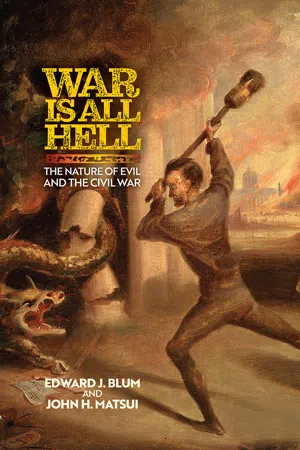
During his first inaugural address, Abraham Lincoln expressed hope that the "better angels of our nature" would prevail as war loomed. He was wrong. The better angels did not, but for many Americans, the evil ones did. War Is All Hell peers into the world of devils, demons, Satan, and hell during the era of the American Civil War. It charts how African Americans and abolitionists compared slavery to hell, how Unionists rendered Confederate secession illegal by linking it to Satan, and how many Civil War soldiers came to understand themselves as living in hellish circumstances.
War Is All Hell also examines how many Americans used evil to advance their own agendas. Sometimes literally, oftentimes figuratively, the agents of hell and hell itself became central means for many Americans to understand themselves and those around them, to legitimate their viewpoints and actions, and to challenge those of others. Many who opposed emancipation did so by casting Abraham Lincoln as the devil incarnate. Those who wished to pursue harsher war measures encouraged their soldiers to "fight like devils." And finally, after the war, when white men desired to stop genuine justice, they terrorized African Americans by dressing up as demons.
A combination of religious, political, cultural, and military history, War Is All Hell illuminates why, after the war, one of its leading generals described it as "all hell."
- 256 pages
- English
- ePUB (mobile friendly)
- Available on iOS & Android
eBook - ePub
About this book
Information
Publisher
University of Pennsylvania PressYear
2021Print ISBN
9780812253047
9780812253047
eBook ISBN
9780812299526
CHAPTER 1

Slavery, Secession, and Satan
In 1861, just as the Civil War began, G. W. Henry, a blind Methodist preacher from the North, published a novel with a sentient cloth named “Tell Tale” as the main character. Tell Tale was made from southern cotton, lovingly cultivated and birthed by the laboring hands of African American slaves. Throughout his life, he became a rag, a piece of paper, and eventually one square of a missionary’s garment. Tell Tale Rag, and Popular Sins of the Day was zany and comical, and it circulated widely in the North and in Britain. Although it was intended for children, Henry used the anthropomorphized Tell Tale to make religious, social, and political points. He also wanted to make money, as he sold the novel to fund his ministerial travels.
Tell Tale explored the most pressing matters of American society. In 1861, he began “a search for the initiative of SECESSION.” Disunion had become the drama of the day, and Tell Tale hunted for answers. In response to Abraham Lincoln’s victory in the presidential election, hundreds of white men throughout the southern states convened to debate whether to remain within the Union. Seven Deep South states determined to disunite formally. They based their decisions upon fears of emancipation, assertions of states’ rights, and claims of social differences between the sections. They presented themselves as descendants of the American revolutionaries of the 1770s who chose independence over what they considered dependence. They understood their actions as preemptive strikes against servile insurrections and race wars, such as those that had occurred decades earlier in Haiti. Republicans and Democrats in the North rallied to stop secession. For them, disunion at this moment violated the contracts of civil society. Losing an election was no grounds for dissection.1
Tell Tale believed he had unearthed the seeds of secession below the time and space of the United States. He located its roots before the Constitutional Convention of 1787 or the Declaration of Independence of 1776. The origins reached back before human existence. “The first secessionist that history gives any account of was once a bright star in the galaxy of heaven,” Tell Tale explained. The rag grafted stories from the Bible onto recent events in the United States, using the language of American politics to reconceptualize sacred Christian history. Tell Tale claimed that long ago the angel Michael was a “Free-Soiler” with “abolitionist friends.” Their love for “liberty” enraged Lucifer, who became “the first secessionist.” Lucifer and one third of the angelic host rebelled and endeavored to make “poor slaves” of humans. Michael intervened for freedom, constructing an “under-ground railroad from the brick yards of Pharaoh to the free soil of the spiritual Canaan.” According to Tell Tale, secession “is the ancient landmark of the order of slaveholders.” Satan is “their secession prince and leader.” Tell Tale concluded that “a striking resemblance exists between the secessionist, Lucifer, and his Southern children.”2
In the realm of nonfiction, Henry understood Satan to be both an active force and a useful analogy. In his autobiography, he discussed his travels throughout the United States, his work in the South among slaves, and his spiritual journey. Time and again, he experienced the devil in “whispers.” Satan could speak through other people or within Henry himself. At the individual level, the devil focused on dissuading Henry from “trying to get religion.” Beyond personal salvation, the powers of hell worked principally in the domain of slavery. After reading Uncle Tom’s Cabin in the 1850s, the same novel that led C. R. Milne to imagine devils invading the United States, Henry became convinced that human bondage “comes from the devil, that’s the short of it.”3
As Tell Tale linked slavery, secession, and Satan, he tangled economic, social, political, and legal branches. He rooted all of them collectively in satanic soil. Radical evil served as the primary vehicle for Henry to explain through Tell Tale the pressing problems of this American moment. What followed during the next four years—the destruction and death, the liberation and exaltation, the puzzles solved and the conundrums concocted—originated with Satan. Just as Tell Tale began as a seed and came to life through cultivation so too did the conflict—irrepressible or not—that overtook the United States in 1861. If the Christian God had a manifest destiny for the United States, then disunited states could be explained by something, or someone, else: the devil.
Before 1861, Americans conjured the devil into a wide array of their circumstances, but in no place was Satan more omnipresent than in discussions over slavery and secession.4 During the 1850s, the United States became the devil’s playground because of what future generations would call the nation’s original sin: slavery. Former slaves, white abolitionists, and Republican Congressmen sought to effect moral, social, economic, political, and legislative change through references to evil. Some southern whites and their northern conservative allies fired back that those who endeavored to overturn slave-holding were tools of the devil. The election of 1860 and its aftermath ignited even more mutual demonization. The Republican Party was branded “black”; while among Unionists, the notion that Satan inspired and sustained secession emerged as a central element of moral politics and Union loyalty.
In the run-up to the Civil War, Americans birthed and put into play an increasing number of devils. They attached them to social groups rather than individuals: slaveholders, abolitionists, and Republicans. The place of evil escalated from religion and culture to politics and governance and finally to violence and militarism. At every point of this trajectory, demons and devils helped Americans to make money, as a growing number of men and women capitalized literally on radical evil. At the start of the Civil War, Satan became a commodified political power as pro-Union forces used the devil to sell the war and their wares.
The Civil War saw a subtle but meaningful shift in the place of evil in American discussions. Pro-Unionists emphasized Satan’s role in secession and minimized his links to slavery. This turn from a social economy to governmental politics moved the focus of debate from exorcising the evils of racial injustice to maintaining the glory of national union. That shift helped the Union win the war, but lose the revolution for equality.
The Atmosphere of Hell
In 1859, sculptor and abolitionist John Rogers endeavored to cash in on antislavery moralism and the growing divide between the North and the South through a small piece he called The Slave Auction. It featured four slaves for sale. A man stood tall and proud with his arms folded in defiance. A woman cuddled a baby, while a child hid behind the woman’s dress. In the center, the auctioneer held a gavel in his right hand and leaned forward to hear bids.
Viewed from the front, the scene seemed wholly of the natural and material world: humans being sold by a human; families enduring pain; men making money from the bodies of other men, women, and children. The back of the sculpture revealed a darker reality, one where otherworldly forces had invaded this world. The auctioneer’s hair protruded in two areas to “give the impression of horns,” as Rogers himself acknowledged. Below, a short tail bulged from under the auctioneer’s coat. He masqueraded as a man. His animalistic features revealed his authentic identity: a devil in disguise.5
When Rogers used clay to deform a man into a demon, he followed recent trends in abolitionist culture and African Americans’ depictions of slavery. Beginning in the 1830s, a number of black writers utilized references to devils, demons, and hell in order to explain what they endured in enslavement. Their work set the tone and stage for the 1850s when evil moved from the periphery of American political culture to its center. There, it helped fracture the nation.
Before the nineteenth century, antislavery whites and writers in the black Atlantic rarely invoked supernatural evil when discussing slavery. Neither Britton Hammon in his life story published in 1760, nor Olaudah Equiano in his “interesting narrative” published in the late 1780s, charged slaveholders with demonic activities. When African Americans in Massachusetts petitioned for freedom during the 1770s, they described themselves as living in the “bowels” of a “Christian country.” They claimed that “nonexistence” would be preferable to what they experienced. At no point did they use the direct language of hell, devils, or demons.6
The individuals who most often labeled slavery an “evil” were those who put it into practice. In the years following the American Revolution, many whites who owned slaves or who justified the institution did so by calling it a “necessary evil.” Throughout Thomas Jefferson’s long life, he routinely criticized slavery as an “evil” social structure. In Notes on the State of Virginia from the 1780s, he referred to slavery as a “great political and moral evil.”7 One of his protégés, James Monroe, who owned hundreds of slaves himself, wrote in 1829 that slavery was “one of the evils still remaining” since the ratification of the Constitution.8
This shifted in the 1830s. A group of writers and activists began assaulting enslavement by using the language of religious evil. It became central to their rendering the social system of slavery. David Walker, a free black man in Boston, led the way. In 1829, he published an Appeal to the Coloured Citizens of the World, where he made direct and unequivocal proclamations against slavery and slaveholding. He attacked whites as “unjust, jealous” and “unmerciful.” “We see them acting more like devils than accountable men,” he charged. He referred to the actions of slavery as “infernal” and whites as behaving like “tyrants and devils.” Their “hellish deeds” had created “hell upon earth.” Overall, Walker used the word infernal on nine occasions, a form of hell six times, and variants of devil or demon eighteen times.9
Walker seemed to initiate a paradigm shift in the rhetorical struggle against slavery. After him, an increasing number of black writers routinely likened slavery to hell and slaveholders to demons. Henry “Box” Brown claimed in his autobiography, “It is true in more senses than one, that slavery rests upon hell.” Their physical, emotional, and spiritual experiences in bondage led these writers to portray slavery as a comprehensive social organization best understood in terms of religious evil. “My sufferings I can compare to nothing else than the burning agonies of hell!” wrote Samuel Northrop. Sexual abuse and the selling of children from their parents led William Anderson to exclaim, “If there is anything like a hell on earth, New Orleans must be the place.” Harriet Jacobs put the point succinctly, probably quoting white anti-slavery poet John Greenleaf Whittier: “Somebody has called it ‘the atmosphere of hell’; and I believe it is so.”10
African Americans demonized the bodies of slaveholders, just as John Rogers did later with his sculpture The Slave Auction. They called owners and traders “devils incarnate,” “hellish fiends,” and “demons in human form.” Black writers also compared them to serpents. In so doing, they not only associated white men and women with evil but also with animals. William Walter discussed one particularly hated slaveholder, Dick Fallon, as “a demon” whose “glittering eyes … seemed to sit too far back in his head.” This “made them glitter like the eyes of a deadly serpent.”11 Lewis Clarke viewed slave catchers “going about like Satan, seeking whom they might devour,” and mistresses as “snake-eyed, brawling women, which slavery produces…. Of all the animals of the face of the earth, I am most afraid of a real mad, passionate, raving, slaveholding woman.”12
Frederick Douglass leveraged this rhetorical analogy when describing Edward Covey, the “slave breaker” he made infamous. He “seldom approached the spot where we were at work openly, if he could do it secretly,” Douglass remembered. “Such was his cunning, that we used to call him, among ourselves, ‘the snake.’” Covey, at least in Douglass’s rendering, contorted his body to mimic that of a serpent. “When we were at work in the cornfield, he would sometimes crawl on his hands and knees to avoid detection, and all at once he would rise nearly in our midst, and scream out, ‘Ha, ha! Come, come! Dash on, dash on!’”13
For many African Americans, what slaveholders produced on earth followed them to times and spaces beyond. In the future, they would get what they gave: hell. These black writers concluded that slaveholding meant a oneway ticket to hell. Henry Box Brown came to believe that “every slaveholder will infallibly go to hell, unless he repents.” Frederick Douglass maintained, “Slaves know enough of the rudiments of theology to believe that those go to hell who die slaveholders.”14
When African Americans analogized enslavement as hell and insisted that slave ownership determined an afterlife of eternal damnation, they redefined Christianity and its connections between earth, heaven, and hell. Rather than focus upon how a person received salvation—whether through righteous works or through faith in Christ or through baptism—they emphasized the roads to hell. Slave ownership became the polar opposite of faith or works. It became a composite of evil—action and attitude—that destined one for the domain of demons.
Several social and cultural streams merged to facilitate African Americans’ turn to the language of evil. A few of those streams flowed from one lake: liberty. When earlier writers of the black Atlantic like Equiano challenged slavery, there were few, if any, locations of liberty outside of Africa for people of African descent. All the British colonies had slaves, and so did the other European empires. When the American revolutionaries heralded “liberty” and some new states outlawed slavery, spots of freedom opened for African Americans. Then Britain ended slavery throughout its empire in the 1830s. With domains and denizens now on record against slavery, black writers could attack the institution directly. There were audiences that agreed: liberty was godly; slavery was wrong.
Another type of liberty made the turn to the Christian language of evil possible: religious liberty. Under the Constitution, the federal government refused to privilege any particular religious organization. Then the states detached church organizations from the operations of the government. In this milieu, Americans pursued their religious agendas. African Americans and many others formed their own religious congregations, published their own materials, and became active audiences for religious concepts. Wi...
Table of contents
- Cover
- Title Page
- Copyright
- Contents
- Preface
- Introduction
- Chapter 1. Slavery, Secession, and Satan
- Chapter 2. An Earthly Hell
- Chapter 3. Masks and Faces
- Chapter 4. To Fight Like Devils
- Chapter 5. Hell Let Loose
- Chapter 6. The God of This World
- Epilogue
- Notes
- Index
Trusted by 375,005 students
Access to over 1.5 million titles for a fair monthly price.
Study more efficiently using our study tools.
Frequently asked questions
Yes, you can cancel anytime from the Subscription tab in your account settings on the Perlego website. Your subscription will stay active until the end of your current billing period. Learn how to cancel your subscription
No, books cannot be downloaded as external files, such as PDFs, for use outside of Perlego. However, you can download books within the Perlego app for offline reading on mobile or tablet. Learn how to download books offline
Perlego offers two plans: Essential and Complete
- Essential is ideal for learners and professionals who enjoy exploring a wide range of subjects. Access the Essential Library with 800,000+ trusted titles and best-sellers across business, personal growth, and the humanities. Includes unlimited reading time and Standard Read Aloud voice.
- Complete: Perfect for advanced learners and researchers needing full, unrestricted access. Unlock 1.5M+ books across hundreds of subjects, including academic and specialized titles. The Complete Plan also includes advanced features like Premium Read Aloud and Research Assistant.
We are an online textbook subscription service, where you can get access to an entire online library for less than the price of a single book per month. With over 1.5 million books across 990+ topics, we’ve got you covered! Learn about our mission
Look out for the read-aloud symbol on your next book to see if you can listen to it. The read-aloud tool reads text aloud for you, highlighting the text as it is being read. You can pause it, speed it up and slow it down. Learn more about Read Aloud
Yes! You can use the Perlego app on both iOS and Android devices to read anytime, anywhere — even offline. Perfect for commutes or when you’re on the go.
Please note we cannot support devices running on iOS 13 and Android 7 or earlier. Learn more about using the app
Please note we cannot support devices running on iOS 13 and Android 7 or earlier. Learn more about using the app
Yes, you can access War Is All Hell by Edward J. Blum,John H. Matsui in PDF and/or ePUB format, as well as other popular books in History & American Civil War History. We have over 1.5 million books available in our catalogue for you to explore.