It was an unlikely convergence of events. A 9.0 magnitude earthquake, the largest in Japanese memory and the fourth largest recorded in world history; a tsunami that peaked at forty meters, devastating the seaboard of northeastern Japan; three reactors in meltdown at the Daiichi nuclear power plant in Fukushima; experts in disarray and suffering victims young and old. It was, as well, an unlikely convergence of legacies. Submerged traumas resurfaced and communities long accustomed to living quietly with hazards suddenly were heard. New legacies of disaster were handed down, unfolding slowly for generations to come.
The defining disaster of contemporary Japanese history still goes by many different names: The Great East Japan Earthquake; the 2011 Tōhoku Earthquake and Tsunami; the Fukushima Daiichi Nuclear Disaster; the 3.11 Triple Disaster. Each name represents a struggle to place the disaster on a map and fix a date to a timeline. But within each of these names hides a combination of disasters and legacies that converged on March 11, 2011, before veering away in all directions: to the past, to the future, across a nation, and around the world. Which pathways from the past will continue, which pathways ended with 3.11, and how are these legacies entangled?
Legacies of Fukushima places these questions front and center. The authors collected here contextualize 3.11 as a disaster with a long period of premonition and an uncertain future. The volume employs a critical disaster studies approach, and the authors are drawn from the realms of journalism and academia, science policy and citizen science, activism and governance—and they come from East Asia, America, and Europe. 3.11 is a Japanese legacy with global impact, and the authors and their methods reflect this diversity of experience.
Contributors: Sean Bonner, Azby Brown, Kyle Cleveland, Martin Fackler, Robert Jacobs, Paul Jobin, Kohta Juraku, Tatsuhiro Kamisato, Jeff Kingston, William J. Kinsella, Scott Gabriel Knowles, Robert Jay Lifton, Luis Felipe R. Murillo, Başak Saraç-Lesavre, Sonja D. Schmid, Ryuma Shineha, James Simms, Tatsujiro Suzuki, Ekou Yagi.
eBook - ePub
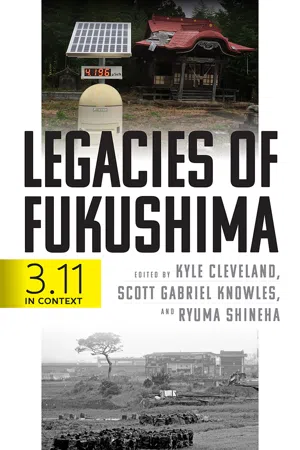
Legacies of Fukushima
3.11 in Context
- 344 pages
- English
- ePUB (mobile friendly)
- Available on iOS & Android
eBook - ePub
Legacies of Fukushima
3.11 in Context
About this book
Information
Publisher
University of Pennsylvania PressYear
2021Print ISBN
9780812252989
9780812252989
eBook ISBN
9780812298000
PART I

Learning from Disaster
CHAPTER 1

What Was Learned from 3.11?
Scott Gabriel Knowles
When a disaster occurs, it immediately unleashes a wave of inquiry that is generally described as a process of “learning from disaster.” But what is actually being learned? Are the lessons of disaster fundamental? Do they have the force to change long-standing patterns of capital investment, land use, human settlement, or governance? Or are the lessons mostly operational, fine-tuning disaster response plans and reminding homeowners to update their postdisaster policies?
Considering the rapidity with which postdisaster reconstruction begins, it is reasonable to ask whether or not anything at all important is learned from disasters. This is especially true in the case of high-risk technological systems, where the inability to fix and restart a system threatens public trust in technology and in the experts who govern it. Indeed, learning lessons fits into an ongoing process in a knowledge-hungry, technocratic, and technoscientific time. If experts do not learn something, then a valuable commodity—information in and about the wreckage—has been lost.
The authoritative realm for postdisaster learning is the formal disaster inquiry or investigation. Major disaster events often initiate multiple disaster investigations, sometimes ranging widely in scale and scope. Disaster investigations provide the venues through which chronology, causality, and blame are allocated. The earthquake-resistant building codes, the levees, the backup generators—none can be restored to normalcy or profitability without the formal study and closure that an investigation provides.1 In such investigative moments we also find an open-mindedness about change not usually present among the public and policy makers. The mood is right in such moments for paradigm-shifting learning, but the moment does not last long.
The Fukushima “triple disaster” presented experts with the data and the public attention necessary to expand their investigations beyond narrowly technical limits. Fukushima also occurred against the backdrop of emerging historical trends that appear to be opening the way for postdisaster learning that is broader and has a greater impact. This chapter employs a disaster studies methodology to examine Fukushima investigations as venues for expert deliberation and sense making. Technical findings were determined and policy prescriptions made, but the investigations simultaneously served as venues for political dispute. The wide variety of ideological perspectives, methods used, and conclusions drawn suggests that postdisaster investigations should be seen less as objective sites of knowledge production and more as highly contingent sites of dispute over disasters and their meanings. Like other authors in this part of the book, especially Kohta Juraku, I see the wave of immediate post-Fukushima investigative reports in Japan as a critical literature that can be used to understand exactly how technical experts and government officials sought to shape the public imagination of the triple disaster. I expand on the Japanese case by comparing investigations there with those in the United States, and I close with a synopsis of new trends in disaster investigation that have crystalized since 3.11.
The Fukushima Investigations in Japan
According to Yotaro Hatamura, an emeritus professor of engineering at the University of Tokyo, “They should have been saying that nuclear energy was dangerous. Instead they said that nuclear power was safe.”2 This is the conclusion he reached after directing Japan’s first major investigation—of the four that were conducted—into the Fukushima nuclear disaster. Organized by the government, Hatamura’s committee—the Investigation Committee on the Accident at the Fukushima Nuclear Power Stations—released an interim report in December 2011 confirming the generally understood narrative of the disaster. A 9.0 magnitude earthquake and subsequent tsunami on March 11, 2011, badly damaged the Fukushima Daiichi complex and cut its power supply; three of the six reactors melted down; and hydrogen explosions damaged three reactor buildings, releasing a massive amount of radiation. On-site technicians from the Tokyo Electric Power Company (TEPCO) lacked the equipment and training to handle the multiple simultaneous failures, and in the worst moments of the crisis leadership from Japan’s Nuclear and Industrial Safety Agency, TEPCO executives, and top government officials was halting at best and devastatingly slow at worst.
In a lengthy 2012 interview, Hatamura emphasized the point that TEPCO had no plan for a complete loss of power at the plant, despite the known seismicity of the region and the evidence that the site of the plant was also vulnerable to tsunami. How is such an oversight to be explained? The governmental regulatory bodies responsible for nuclear safety apparently did not require such planning, and so it was never done—as simple as that. Hatamura pointed out that this type of failure to plan for a horrible, yet still foreseeable, disaster rests not only in the narrow calculations of profit for TEPCO but more broadly in the fact that the Japanese government had for decades taken great pride in the resiliency of its electric power grid.
The authority of the Hatamura investigation was questionable. All interviews were voluntary, “without compelling legal force,” and according to Hatamura, “determining responsibility wasn’t one of our goals.”3 The inquiry also focused narrowly on Fukushima. As the New York Times noted, Hatamura “also said the panel’s findings should not affect debate on the safety of Japan’s four dozen other nuclear reactors.”4
This is precisely the point at which most disaster investigations end. Systematic failures in high-risk technological systems are documented. Systematic failures in regulation and political leadership are mourned. Lessons are learned, there is a regulatory shake-up (in this instance, the moving of nuclear safety oversight from one agency to another), and it is time to move along. This is the point at which the US government’s “Failure of Initiative” investigation into Hurricane Katrina found lots of flawed policies and bad communication, shrugged its shoulders, and called it a day—with only the director of the Federal Emergency Management Agency forced out of his post. This is the point at which the 9/11 Commission found flawed policies and bad communication and ordered a wrong-headed reorganization of American disaster policy to focus entirely on terrorism.
Though the Hatamura investigation was designed to restore both Japanese and international faith in the nation’s technical and regulatory abilities, he also emphasized that he wanted a final report “that would meet the approval of someone looking at it 100 years from now, and that they would be able to say that we had truly learned an important lesson from that time.”5 In other words, this inquiry was also aimed at impressing future scholars of technological failure, a pitch into the far future tense for the efficiency and evenhandedness of this investigation—trapped as it was in the heat of the political moment and the raw memory of the worst cascading disaster ever to strike an industrialized nation.
On December 1, 2011, Kiyoshi Kurokawa coauthored an editorial in the Japan Times characterizing the Fukushima disaster as the country’s “third opening” (the Meiji Restoration and the Allied occupation after World War II being the first two). In the view of Kurokawa and his coauthor, Hiromi Murakami, it was the moment when a society collectively woke up:
While the authorities failed to deliver substantive action, individuals started to act. Many donated money for the first time and participated in voluntary activities; scientists gathered to offer credible information and explanations via Twitter; voluntary individuals in various regional areas monitored radioactivity levels and gathered data through the Internet that they immediately made public; and parents organized and demanded that the authorities measure ground and food radioactivity levels in kindergartens and schools, which quickly became the norm. Japanese citizens now strongly demand transparency, so that they can judge how to protect themselves.6
To Kurokawa and Murakami, the disaster opened the way for tired traditions of one-party rule and faith in bureaucracy to subside and to create government transparency and a robust civil society.7 An independent-minded doctor, science policy expert, and education reformer who had taught at the University of Tokyo and the University of California, Los Angeles, Kurokawa was known not to be afraid to decry what he saw as a dangerous adherence to rigid tradition in Japanese business and government. One week after his and Murakami’s article was published, he was named by the Japanese Diet to head an investigation that was unprecedented (a second government-chartered Fukushima inquiry) and the first to be charged by the Diet to have a membership fully independent of the government. In fact, anyone with a connection to TEPCO, the government, or a regulatory agency was barred from participation.
The National Diet of Japan Fukushima Nuclear Accident Independent Investigation Commission (NAIIC) was conceived of quite differently from its predecessor, the Hatamura investigation, primarily in that the Diet granted the commission subpoena power and that it was charged with providing concrete recommendations on preventing future nuclear accidents. At the time, it was understood that it was not out of the realm of possibility that Kurokawa would take this opportunity to transform his broad-based call for government reform into a forceful rebuke of TEPCO and an indictment of Japan’s flawed nuclear regulatory process.
How do you evacuate the world’s most populous city? That scenario, a complete removal of thirty million people from metropolitan Tokyo, was on the table in March 2011, as political leaders scrambled to understand what might happen if a large release of radiation and unfavorable wind conditions put Tokyo directly in harm’s way. “I think that’s mission impossible,” said Yoichi Funabashi, head of the third major Fukushima investigation—this one sponsored by a private policy think tank, the Rebuild Japan Initiative Foundation (RJIF). Funabashi said, “Even though they came up with this worst-case scenario, actually they could not do anything to respond to this worst-case scenario because to evacuate thirty million people from [the] Tokyo metropolitan area is simply impossible.”8 This leaves us with two chilling images: of Tokyo’s residents bathed in radiation, a post–Cold War apocalyptic nightmare; and of how little the country’s political leaders could have done to prevent such a disaster.
In 2011 Funabashi was the former editor of the Asahi Shimbun, and his investigative team leveraged its freedom from the government and its public intellectual status to gain perhaps unexpected access to top government officials—including Naoto Kan, who was prime minister at the time of the disaster. It was Kan who ordered the TEPCO workers (and ultimately national defense forces) to stay at the Fukushima site and take whatever steps necessary to keep the reactors cool and avoid an even more catastrophic event.9 The major conclusions of the RJIF report were thus as follows: the possibilities of technical failure were never fully realized through clear planning, technical skill was in short supply at TEPCO, communication breakdowns between central TEPCO management and Fukushima were evident as the disaster unfolded, and ultimately the government lost faith in TEPCO and took decisive action to order the cooling of the reactors and spent-rod cooling facilities. These findings corroborated those of the Hatamura commission.
However, Funabashi’s team took the broadest view of the three major investigations thus far discussed, focusing not only on the narrative of the disaster itself but going well beyond it to evaluate Japan’s system of government-business interaction. According to Funabashi,
The relevance of these accidents and related damages are not restricted solely to the technical and operational collapse of nuclear reactors and nuclear power plants. They also highlight a governance crisis involving corporations along with municipal and central government agencies, as well as something inherent in the way Japanese citizens think. We believe it is important to carry out a rigorous review of these points and thus draw lessons in order to rebuild Japan’s “national foundation” in areas such as future energy policies and national security policies, as well as with regard to national governance and leadership.10
At the core of this critique was a strong challenge to the nation’s “myth of absolute safety,” a long-propagandized mantra of risk-free nuclear power. Along with their like-minded allies on NAIIC, the RJIF investigators may very well have been poised to recommend that Japan not restart its still-shuttered nuclear reactors. This would have meant continued hardship in a nation that had struggled with draconian conservation measures since the disaster struck. It might also, as the NAIIC and RJIF seemed to indicate, have led to meaningful government and business reforms and an invigorated, grassroots movement for a new Japan—more open to new ideas, less bureaucratic, more sensitive to local politics, and less trusting in the mythical infallibility of high-risk technology.
It is worth noting that although the NAIIC and RJIF investigations focused in part on matters of technical explanation, they were not conducted by technical experts with strong commitments to the sociotechnical status quo of so-called big nuclear Japan. At times in modern history, technological disaster investigations have mirrored (perhaps even provoked) societal unrest that was fomenting a break with tradition and designing a new way forward. Such was the case with the investigations following New York City’s Triangle Shirtwaist Factory fire in 1911 and with the Kemeny Commission after the Three Mile Island accident in 1979. In the first case, the United States was beginning to finally reckon with the need for a more humane industrialization, and in the second, the nation was about to turn its back (which is still turned) on the construction of new nuclear power plants. If NAIIC and RJIF had been even more populist in their educational, media, and direct civic engagement efforts, they might very well have fallen into line with these historical precedents. In other words, they might have broken out of the more common mode of disaster investigations, in which the investigation calms the public so it returns to high-risk business as usual. As time has elapsed since these investigations ended, though, such hopes ha...
Table of contents
- Cover
- Title Page
- Copyright
- Contents
- Foreword. Fukushima’s Special Message
- List of Abbreviations
- Introduction
- Part I. Learning from Disaster
- Part II. Public Knowledge and Public Trust
- Part III. Possible Futures
- Notes
- Bibliography
- List of Contributors
- Index
- Acknowledgments
Trusted by 375,005 students
Access to over 1.5 million titles for a fair monthly price.
Study more efficiently using our study tools.
Frequently asked questions
Yes, you can cancel anytime from the Subscription tab in your account settings on the Perlego website. Your subscription will stay active until the end of your current billing period. Learn how to cancel your subscription
No, books cannot be downloaded as external files, such as PDFs, for use outside of Perlego. However, you can download books within the Perlego app for offline reading on mobile or tablet. Learn how to download books offline
Perlego offers two plans: Essential and Complete
- Essential is ideal for learners and professionals who enjoy exploring a wide range of subjects. Access the Essential Library with 800,000+ trusted titles and best-sellers across business, personal growth, and the humanities. Includes unlimited reading time and Standard Read Aloud voice.
- Complete: Perfect for advanced learners and researchers needing full, unrestricted access. Unlock 1.5M+ books across hundreds of subjects, including academic and specialized titles. The Complete Plan also includes advanced features like Premium Read Aloud and Research Assistant.
We are an online textbook subscription service, where you can get access to an entire online library for less than the price of a single book per month. With over 1.5 million books across 990+ topics, we’ve got you covered! Learn about our mission
Look out for the read-aloud symbol on your next book to see if you can listen to it. The read-aloud tool reads text aloud for you, highlighting the text as it is being read. You can pause it, speed it up and slow it down. Learn more about Read Aloud
Yes! You can use the Perlego app on both iOS and Android devices to read anytime, anywhere — even offline. Perfect for commutes or when you’re on the go.
Please note we cannot support devices running on iOS 13 and Android 7 or earlier. Learn more about using the app
Please note we cannot support devices running on iOS 13 and Android 7 or earlier. Learn more about using the app
Yes, you can access Legacies of Fukushima by Kyle Cleveland, Scott Gabriel Knowles, Ryuma Shineha, Kyle Cleveland,Scott Gabriel Knowles,Ryuma Shineha in PDF and/or ePUB format, as well as other popular books in Social Sciences & Global Development Studies. We have over 1.5 million books available in our catalogue for you to explore.