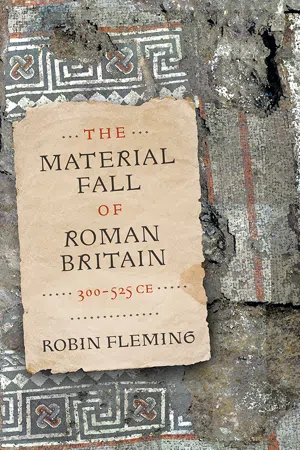
Although lowland Britain in 300 CE had been as Roman as any province in the empire, in the generations on either side of 400, urban life, the money economy, and the functioning state collapsed. Many of the most quotidian and fundamental elements of Roman-style material culture ceased to be manufactured. Skills related to iron and copper smelting, wooden board and plank making, stone quarrying, commercial butchery, horticulture, and tanning largely disappeared, as did the knowledge standing behind the production of wheel-thrown, kiln-fired pottery and building in stone. No other period in Britain's prehistory or history witnessed the loss of so many classes of once-common skills and objects. While the reasons for this breakdown remain unclear, it is indisputable the collapse was foundational in the making of a new world we characterize as early medieval.
The standard explanation for the emergence of the new-style material culture found in lowland Britain by the last quarter of the fifth century is that foreign objects were brought in by "Anglo-Saxon" settlers. Marshalling a wealth of archaeological evidence, Robin Fleming argues instead that not only Continental immigrants, but also the people whose ancestors had long lived in Britain built this new material world together from the ashes of the old, forging an identity that their descendants would eventually come to think of as English. As with most identities, she cautions, this was one rooted in neither birth nor blood, but historically constructed, and advanced and maintained over the generations by the shared material culture and practices that developed during and after Rome's withdrawal from Britain.
- 296 pages
- English
- ePUB (mobile friendly)
- Available on iOS & Android
eBook - ePub
The Material Fall of Roman Britain, 300-525 CE
About this book
Information
Publisher
University of Pennsylvania PressYear
2021Print ISBN
9780812252446
9780812252446
eBook ISBN
9780812297362
CHAPTER 1

The World the Annona Made
The most crucial result of this for the question of how and why Roman Britain ceased to exist was the removal of the revenue/payment cycle and its associated activities.
—Simon Esmonde Cleary, The Ending of Roman Britain
We need to understand the broad contours of wealth and power in the late Roman period and the ways in which the state and elite actors together shaped the world in which everyone else operated in order to understand how, why, and for whom the period’s material culture was produced, a subject that will concern us for much of the rest of this book. The success of the imperial enterprise depended on the state’s ability to collect for itself much of the surplus created by those living within the empire. Its ability to extract wealth rested, in turn, on the cooperation of elite actors, who played a central role in agricultural production, extraction, and collection, and who, alongside the state, were entitled to a generous share of the spoils generated by these activities. To get a sense of how many people profited from this system and how many supported it with their labor, this chapter begins by laying out evidence concerning the broad demographic contours of late Roman Britain. The chapter also explores the ways people and things moved to and from Britain, and how its people and things were connected to the broader Roman world. As we will see, Rome’s political economy and its dizzying inequalities were critical in the creation of Roman Britain’s material culture. Because of this, the withdrawal of the Roman state from Britain in the early fifth century, and the difficulties experienced by those people whose livelihoods had been most closely bound to it, had profound ramifications for the production of whole categories of material culture. This overview will serve as a backdrop for investigating how the material culture dealt with in the rest of the book was made and consumed, and how and why it disappeared after Britain lost its place within the empire.
The Haves and the Have-Nots in Late Roman Britain
All population statistics for late Roman Britain are derived from piecemeal evidence cobbled together from texts written elsewhere in the empire, so even the best are really just back-of-the-envelope estimates. Still, there is broad consensus that a reasonable figure for Roman Britain’s population in the fourth century lies somewhere between two million and three million.1 Perhaps seventy-five thousand were soldiers and their dependents, most of whom could be found in the northern frontier zone. Another 150,000 or so lived in urban or semiurban communities, making up a very broad middling group of members of the households of craftsmen, peddlers, merchants, builders, minor functionaries, and low-status state employees, people such as teamsters and warehousemen. Another fifteen thousand or so could be counted among the fortunate few, members of the households of high-ranking imperial administrators or major landholders. By the fourth century, most of the people just described, even villa owners, administrators, and soldiers, would have descended from local British families. In total these groups—numbering under a quarter of a million and encompassing very wide economic and social spectra—had two things in common: they dined daily on food raised for the most part by people other than themselves, and they lived above subsistence and relied on the market or the state for many of their basic needs. It was this group that produced and consumed a good portion of the Roman-style objects found in Britain, and it was these people whose worlds were most shaped by and whose lives most benefitted from Rome’s presences in Britain. The remaining 85 percent of the population were farmers, agricultural laborers, and rural specialists such as woodcutters and reapers.2 Most would have been free and lived on somewhere between one and two times minimum subsistence,3 and their daily needs, for the most part, were met without engaging in the market economy.4 There is evidence to suggest that this segment of the population may have been considerably less healthy than those in the 15 percent, an indication of the price of the period’s high levels of inequality.5 Although these bald generalizations paint a picture of a homogeneous agrarian mass, in reality rural populations on the ground were as socially and economically variegated as urban ones—wealthy villa proprietors, semi-industrial salt workers and potters, village headmen, and landless laborers all resided in the countryside and helped to constitute one another’s worlds. They would have been linked by many of the same “small politics,” enmities, and obligations described in texts that survive from elsewhere in the Roman world, but that are impossible to reconstruct from archaeology alone.6 And different rural communities in different regions within Britain, although obliged in various ways to the Roman state and their social betters, developed quite different engagements with and attitudes toward Romanstyle pottery, architectural forms, coinage, and foodways, as well as burial and other ritual practices.7
Wherever they were and whatever their relationship was to Roman material culture, the late Roman tax system systematically disadvantaged this 85 percent. Although together these people created the bulk of Roman Britain’s wealth, something on the order of two-thirds of what they produced would have been taken from them by the state or their landlords for taxes, tributes, and rents.8 Most taxes, after the reforms of Diocletian and Constantine—which were paid in kind, in labor levies, and in cash—were land taxes assessed by skilled professionals;9 and the bulk of the land tax was paid one way or another by the bottom 85 percent.10 A number of the people included among the more fortunate 15 percent, moreover—retired state officials, veterans, and members of the senatorial order—were exempted from various taxes, making the tax-paying burdens of the poor all the heavier.11
Not only did various individuals in the 15 percent of the population whose well-being was most closely bound to the Roman state implement, maintain, and reinforce the social and economic inequalities of imperial society, but they increased such inequalities over time. By the turn of the fourth century, local elites and agents of the state (two often-inseparable groups) controlled production, because by this time, they exercised considerable power over labor, transportation, and information, which helped them shape the world in which the 85 percent worked to feed their families and meet their obligations. Members of low-status rural communities, particularly in Britain’s “South East” and “central zone,”12 where provincial elites, urban communities, and state administrators were thickest on the ground, were disadvantaged by these asymmetrical relationships, and they owed a significant share of their labor and surplus to the colonial regime and its facilitators, who together built, rebuilt, and improved on a culture of social inequality that both molded labor regimes and habitually reminded rural people of their powerlessness to do much about them.13 As Michael Given reminds us: “The most direct involvement of ordinary people with imperial rule is when their hard-won food is removed from in front of them and taken right out of their family, their community, and often their country. As well as the loss of livelihood, there is the personal humiliation, the knowledge that they are being cheated, if not by the tithe collector then certainly by the regime.”14 The annual tax cycle and the seasonal accountings by landlords, their bailiffs, and state functionaries would have reminded many in the bottom 85 percent that life was not fair and never would be, and that each year part of what they produced would be taken from them.
Still, most rural households in lowland Britain had not only enough after harvest to meet their obligations and hold back enough seed and stock for next year’s farming, but a little to spare for pots, iron tools, shoes, or brooches made by craft workers. Economies of scale were such in the fourth century that low-value, mass-produced goods were within the reach of quite humble people. The proliferation of durable material culture on rural sites in fourth-century Britain mirrors a similar development in North Africa, where rural settlement sites are much more visible in the archaeological record at just this time because their inhabitants, too, were now regularly using coins and wheel-thrown pottery.15 Because of the availability and ubiquity of a wide array of such objects, many rural, low-status households acquired these goods and incorporated them into their daily practices of life.
Although the institutions and individuals standing behind taxes and rents were inefficient and wasteful, they were nonetheless able to collect astonishing amounts of revenue each year. Many landlords in Britain would have spent their cut on extending their landed interests and bankrolling conspicuously grand lives, propped up by expensive Mediterranean-style material culture—things such as mosaics, bath houses, and plastered interiors. The state for its part used what it collected to fund an array of eye-wateringly expensive undertakings—a large, professional standing army; patronage of a new religion; a new imperial capital; and guaranteed low-cost food for the empire’s most important urban populations.16 Taxes also paid for the staff, bureaucratic machinery, and enforcement mechanisms needed to collect and keep account of state revenues, and to oversee the transportation of its in-kind bounty to the imperial court, the army, and the empire’s hungry capitals. State bureaucrats received salaries of foodstuffs, fodder, and clothing as well as cash, so their cut of the annual in-kind tax had to be accounted for, moved, and distributed as well.17
The empire’s monetary system also worked against the interests of the bottom 85 percent. There were essentially two parallel monetary systems operating within the empire in the fourth century. One, a low-value currency, was made up of small bronze coins, sometimes called nummi, and was widely used by the lower orders in the late Roman period. Its value was eaten away by inflation, a curse of the period, with annual rates hovering around 13 percent. At the same time, however, there were precious-metal coins, and their value was extremely stable.18 The best guess for the relative value of these currencies in c. 364 is that a gold solidus was worth eighty silver siliquae, and a siliqua was valued at thirty-six bronze nummi.19 The high-value, precious-metal, inflation-proof coinage was the only currency accepted by the state for taxes, and it was used to pay the salaries of imperial officials. Gold and silver were also distributed by the state to groups whose loyalties it deemed essential (Figure 1).
Soldiers were one such group. Although they got most of their wages in kind, they received gold donatives from the state fairly regularly.20 Between 364 and 378 they might have been due as many as eight donatives, totaling fifty-two solidi over the course of fourteen years. Because the late antique state was rife with corruption and freely made exaggerated promises, it is unlikely that soldiers were given all that was pledged to them, but even if most during these years only received forty-two solidi, their gold payouts would have averaged almost three solidi a year.21 In the mid-fourth century, thirty-five modii of wheat—considerably more than three hundred liters—cost a single solidus, so suc...
Table of contents
- Cover
- Title Page
- Copyright
- Dedication
- Contents
- Introduction. Down a Rabbit Hole?
- Chapter 1. The World the Annona Made
- Chapter 2. The Rise and Fall of Plants, Animals, and Places
- Chapter 3. Why Pots Matter
- Chapter 4. The Afterlife of Roman Ceramic and Glass Vessels
- Chapter 5. Pragmatic, Symbolic, and Ritual Use of Roman Brick and Quarried Stone
- Chapter 6. Metal Production Under and After Rome
- Chapter 7. Living with Little Corpses
- Chapter 8. Who Was Buried in Early Anglo-Saxon Cemeteries?
- Chapter 9. The Great Disentanglement
- Notes
- Index
- Acknowledgments
Trusted by 375,005 students
Access to over 1.5 million titles for a fair monthly price.
Study more efficiently using our study tools.
Frequently asked questions
Yes, you can cancel anytime from the Subscription tab in your account settings on the Perlego website. Your subscription will stay active until the end of your current billing period. Learn how to cancel your subscription
No, books cannot be downloaded as external files, such as PDFs, for use outside of Perlego. However, you can download books within the Perlego app for offline reading on mobile or tablet. Learn how to download books offline
We are an online textbook subscription service, where you can get access to an entire online library for less than the price of a single book per month. With over 1.5 million books across 990+ topics, we’ve got you covered! Learn about our mission
Look out for the read-aloud symbol on your next book to see if you can listen to it. The read-aloud tool reads text aloud for you, highlighting the text as it is being read. You can pause it, speed it up and slow it down. Learn more about Read Aloud
Yes! You can use the Perlego app on both iOS and Android devices to read anytime, anywhere — even offline. Perfect for commutes or when you’re on the go.
Please note we cannot support devices running on iOS 13 and Android 7 or earlier. Learn more about using the app
Please note we cannot support devices running on iOS 13 and Android 7 or earlier. Learn more about using the app
Yes, you can access The Material Fall of Roman Britain, 300-525 CE by Robin Fleming in PDF and/or ePUB format, as well as other popular books in History & British History. We have over 1.5 million books available in our catalogue for you to explore.