Four years before the publication of the First Folio, a group of London printers and booksellers attempted to produce a "collected works" of William Shakespeare, not in an imposingly large format but as a series of more humble quarto pamphlets. For mysterious reasons, perhaps involving Shakespeare's playing company, the King's Men, the project ran into trouble. In an attempt to salvage it, information on the title pages of some of the playbooks was falsified, making them resemble leftover copies of earlier editions. The deception worked for nearly three hundred years, until it was unmasked by scholars in the early twentieth century. The discovery of these "Pavier Quartos," as they became known, was a landmark success for the New Bibliography and played an important role in establishing the validity and authority of that method of analysis. While more recent scholars have reassessed the traditional narrative that the New Bibliographers wrote, no one has gone back to look at the primary evidence: the quartos themselves.
In Ghosts, Holes, Rips and Scrapes Zachary Lesser undertakes a completely fresh study of these playbooks. Through an intensive bibliographical analysis of over three hundred surviving quartos, Lesser reveals evidence that has gone entirely unseen before: "ghosts" (faint, oily impressions produced when one book is bound next to another); "holes" (the tiny remains of the first simple stitching that held pamphlets together); and "rips and scrapes" (post-production alterations of title pages). This new evidence—much of it visible only with the aid of enhanced photographic methods—suggests that the "Pavier Quartos" are far more mysterious, with far more consequential ramifications for book history and Shakespeare scholarship than we have thought.
eBook - ePub
Ghosts, Holes, Rips and Scrapes
Shakespeare in 1619, Bibliography in the Longue Durée
- 232 pages
- English
- ePUB (mobile friendly)
- Available on iOS & Android
eBook - ePub
About this book
Information
Publisher
University of Pennsylvania PressYear
2021Print ISBN
9780812252941
9780812252941
eBook ISBN
9780812297928
Topic
LiteraturaSubtopic
Crítica literaria inglesaCHAPTER 1

Ghosts
—What is a ghost? Stephen said with tingling energy. One who has faded into impalpability through death, through absence, through change of manners…. Who is the ghost from limbo patrum, returning to the world that has forgotten him?
—James Joyce, Ulysses
The ghost who returns to the world that has forgotten him comes from limbo patrum, the space reserved for the patriarchs of the Hebrew Bible, sanctified but living before Christ and hence unable to enter heaven until the harrowing of hell. Punningly, for Joyce, the limbo patrum is the limbo of the father, Stephen Dedalus’s father, Hamlet’s father, Shakespeare the literary father. The ghost who returns to haunt the Pavier Quartos is the ghost of “Shakespeare,” the author function, the principle of collection. Here the author has faded into impalpability through change of manners: we risk misrecognizing this figure and seeing what we already think we know, the author Shakespeare as we understand him after the First Folio and after centuries of collecting, studying, and editing his books and texts.
What is a ghost? A residue of the linseed oil in which lampblack, soot produced by burning oil, is suspended to create printer’s ink. Linseed oil that has somehow reacted with a facing page because of the acidity of that adjacent paper.1 A faint image of the ink imprinted on one page that appears on another page once bound alongside it but that has since been separated from it—in the auction house, in the bookbinder’s shop, in the rare book library. A bibliographic ghost returns to the world that has forgotten it to reveal lost collections, lost sammelbands, lost histories.
Jeffrey Todd Knight first brought this kind of bibliographic evidence to wide attention in a brief, groundbreaking article with major ramifications for our study of books.2 While the meaning of these ghosts is clear, their origins remain mysterious. Ghosts appear on some pages and not others; they sometimes show the impression of formerly adjacent leaves, and often do not, even in cases where we know there was once a neighboring book. The acid content of early paper varied according to the amount of alum added, as a preservative, to the gelatin sizing applied to paper to allow it properly to absorb ink. Because this animal-based gelatin spoiled rapidly, alum was typically added daily to the same batch of sizing made in the paper mill on Monday or Tuesday. Hence paper that was sized later in the week was more acidic than paper sized earlier in the week.3 The variability of the acidity of paper may help to explain why these ghosts appear only occasionally.
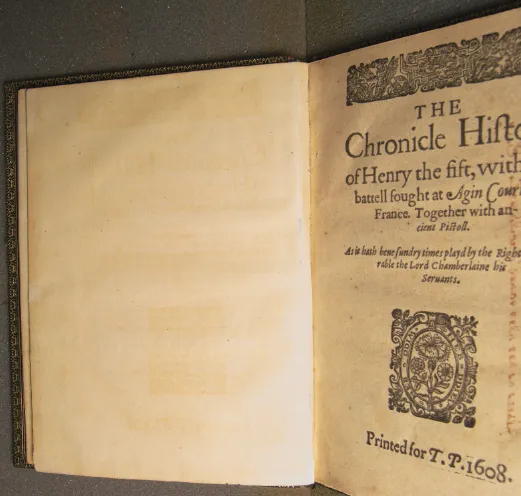
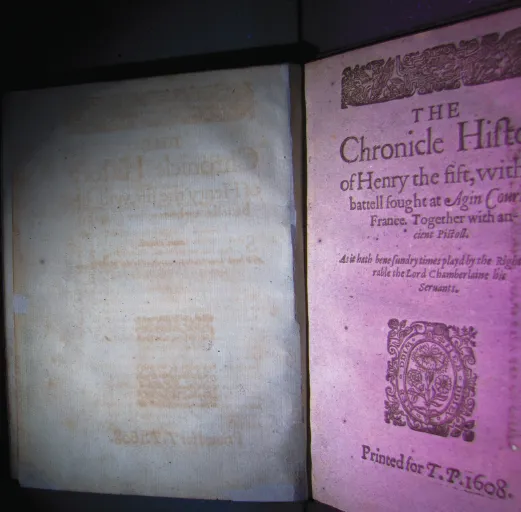
Figure 1.1 Front flyleaf and title page of a copy of Henry V, showing ghosting under normal and ultraviolet light. Courtesy of the Kislak Center for Special Collections, Rare Books, and Manuscripts, University of Pennsylvania, PR2812.A1 1619 copy 1.
Paper produced in the ensuing centuries is even more acidic, as more alum was added in the production process, and chemicals involved in the production of wood-pulp paper introduce still higher acidity. Not surprisingly, then, the new endpapers added in the nineteenth century when many Shakespeare quartos were rebound as precious relics have produced ghost images far more frequently and strongly than the early quartos themselves. Ghosts are easiest to see on these endpapers, although the more forceful reaction can paradoxically make it difficult to read the ghostly text itself (Figure 1.1). Those wishing to see a ghost in person should simply look at the Victorian endpapers of early printed books. Once you have seen one, you begin to notice them everywhere—including, more rarely and more intriguingly, on the early pages themselves.
These ghosts can tell us a great deal about how the Pavier Quartos were originally sold in bookshops in 1619. They can also tell us about what happened to them in the years between their initial sale and our encounters with them in libraries today. And they can undo some of the scholarly assumptions about the Pavier Quartos that have helped, retroactively, to determine how these books appear to us today. Along the way, these ghosts, and some other forms of ghostly evidence, will help to build a new census of bound volumes of the 1619 quartos: there were many more of them than we have suspected.
Greg was undoubtedly right that several plays by or attributed to Shakespeare were being sold together in 1619. And the bibliographic evidence that Neidig provided for the order in which the plays were printed is likewise strong, although R. Carter Hailey has slightly modified that order, based on his analysis of the paper stocks used in the printing, suggesting that the first gatherings of Merry Wives (including the title page) may have been printed ahead of Merchant.4 (Hailey’s theory would explain the seeming anomaly, in the traditional understanding of the order of printing, that Merry Wives was correctly dated 1619 after the falsification had begun with Merchant, dated 1600.) But our belief that the New Bibliographers essentially “solved” the mystery of the printing of these plays, and our consequent neglect of the bibliographic evidence in the quartos themselves, has led us too easily to accept an ideal version of the order in which the plays were bound, above all with Whole Contention and Pericles beginning the collection, since they have continuous signatures. Indeed, the bibliographical code that Greg and Neidig established has been so powerful that it has often overridden the physical evidence of the books themselves.5 Despite being the librarian in charge of Capell’s collection at Trinity College, Greg could write of the “false order” of the plays in that set, since “it is clear that ‘Pericles’ ought to follow the ‘Contention,’” but in fact Pericles appears third in the second volume and Whole Contention fourth. In the same breath, however, Greg could add that he believed “the present false order … to be original.”6 The ordering of plays in Capell’s volume is both true (historically) and false (formally), faithful (unchanged by later collectors) and unfaithful (failing to adhere to its signatures). From the beginning of the modern study of the Pavier Quartos there is this tension between what we might think of as a prescriptive and a descriptive understanding of the “correct” order of these plays.
The long-standing Folger catalogue record for Gwynn’s volume is a perfect example: “Contains The whole contention pts. 1–2 and Pericles. MS. table of contents. Bound with seven other 1619 Shakespeare quartos…. Mis-bound: the first five works after STC 26101 are bound between Q4 and chi1.”7 The description of the Gwynn volume both adheres to and obscures its physical appearance. In the Short-Title Catalogue (STC) and as a Folger shelf mark, STC 26101 refers to the combination of Whole Contention and Pericles, in which Whole Contention ends on signature Q4, and signature chi1 is the title page of Pericles (chi or χ being the bibliographer’s code for an unsigned internal leaf).8 The Folger record thus implies that Whole Contention and Pericles should be bound first in Gwynn’s volume, based on their continuous signatures, followed by the seven other plays. But, in fact, the “MS. table of contents” records the true order of binding, in which Whole Contention appears first and Pericles seventh (Figure 1.2). The disjuncture between the manuscript contents list and the bibliographic code established by Greg and Neidig leads to the note in the catalogue record that claims the Gwynn volume is “mis-bound.”
In his essay on the unheimlich, or uncanny, Freud writes that “the unheimlich is what was once heimisch, familiar; the prefix ‘un’ … is the token of repression.”9 We can say the same of the prefix mis- in “mis-bound.” On the one hand, the Gwynn copy is prized for its early and authentic binding, which guarantees the unity of the Pavier Quartos as an early modern pre-Folio Shakespeare collection and explains why Henry Folger chose this book to hold in his official portrait. On the other hand, the Gwynn binding is critiqued for failing to conform to modern theories of what it should have been. Modern bibliographic theory here represses the facts of the physical book to make it conform to expectations.
Like many libraries, the Folger catalogues copies of Pericles under the heading of Whole Contention, since from the perspective of the New Bibliography, Pericles is a continuation of the same single book, due to its continuous signatures. This has some strange consequences: the Folger lists sixteen copies of Whole Contention between the two Famous Houses, Lancaster and Yorke in its catalogue, but five of these are classified as “imperfect” simply because they do not include Pericles, even though nothing is missing from Whole Contention itself. Another five are “imperfect” because they are copies of Pericles alone, even though that play is not part of the title of the item as listed in the catalogue. A more extreme case: the University of Pennsylvania library catalogue records two copies of Whole Contention, but the details reveal that both copies are “imperfect: all before leaf chi1 wanting.” If one remembers that “leaf chi1” is the title page of Pericles, one can infer (though it does have to be inferred) that in fact the Penn libraries hold no copies of Whole Contention at all but rather two copies of Pericles only.10 Penn’s apparent copies of Whole Contention are ghosts, haunting the catalogue but physically faded into impalpability.
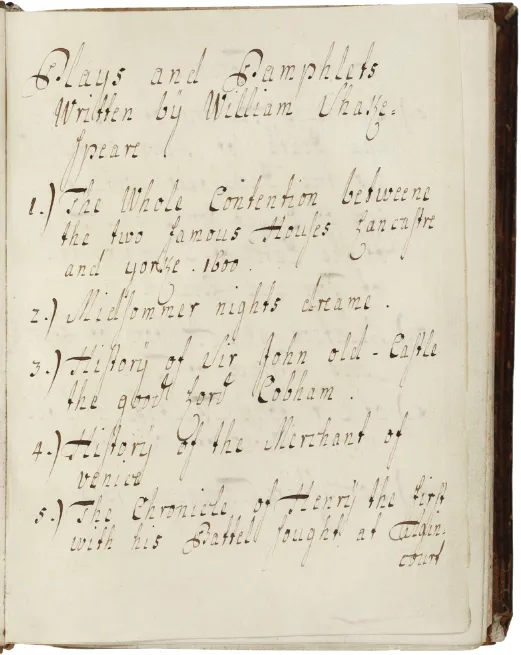
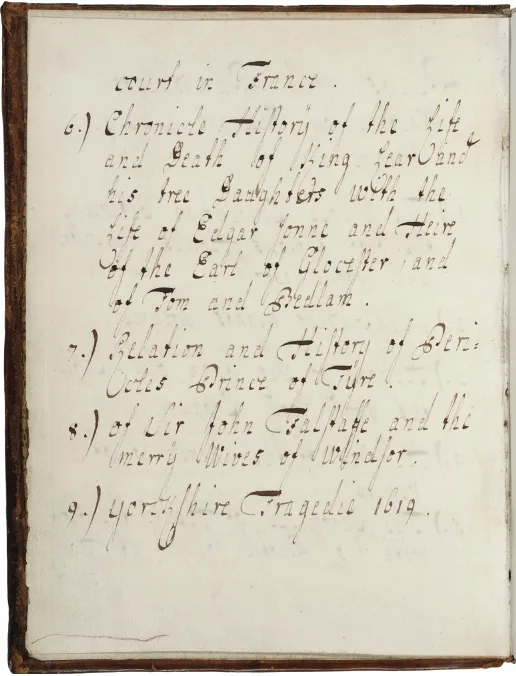
Figure 1.2 Manuscript table of contents in the Edward Gwynn volume. Used by permission of the Folger Shakespeare Library, STC 26101 copy 3.
We can learn more about the misbinding of the Gwynn volume, or rather its binding, from the Pavier Quartos in the Garrick Collection now at the British Library. It is a testament to the power of the New Bibliographic narrative of the Pavier Quartos that this evidence, which is in fact fairly visible, has apparently never been noticed before. As we have seen, Pollard speculated that Garrick’s copies were once bound in a single volume, partly because he was able to pick out “all nine plays from among their fellows simply by their height.”11 Greg noted that the “Garrick copies … are all bound separately, but … their uniform size … points to their having at one time formed parts of a single volume.”12 The Garrick copies are indeed similar in size, although to say they are of “uniform size” is an exaggeration, since by my measurement they range in width from 14.4 cm (King Lear) to 15.0 cm (Dream and Merry Wives); in height, the dimension that Pollard stressed, they are indeed nearly uniform, measuring between 19.1 and 19.3 cm. By itself, however, the nearly uniform size of the quartos cannot tell us as much as Greg and Pollard assumed, because they all were trimmed during multiple rebindings and indeed were almost certainly trimmed by none other than Edward Capell while he was cataloguing the collection for Garrick, precisely in order to give them a “uniform size.”
Capell was a close friend of Garrick’s, and the great actor engaged the Shakespeare editor to put his collection into some order.13 Capell designed an unusual system for doing so. The books were arranged by size and bound into volumes of six to eight plays. Each volume was given a Roman numeral and categorized with other volumes of similar size, within a centimeter or so, under the same letter. Thus Garrick’s Pavier Quartos were all catalogued in the E series, although they were not all in the same volume: Whole Contention and Pericles were consecutive in E.II; Yorkshire Tra...
Table of contents
- Cover
- Title Page
- Copyright
- Dedication
- Contents
- Acknowledgments
- Introduction
- Chapter 1. Ghosts
- Chapter 2. Holes
- Chapter 3. Rips and Scrapes
- Conclusion. Questions
- Appendix A. Census of Known Sets of the 1619 Quartos
- Appendix B. Order of Plays in Known Bindings of the 1619 Quartos
- Appendix C. Copies Consulted
- Notes
- Index
Trusted by 375,005 students
Access to over 1.5 million titles for a fair monthly price.
Study more efficiently using our study tools.
Frequently asked questions
Yes, you can cancel anytime from the Subscription tab in your account settings on the Perlego website. Your subscription will stay active until the end of your current billing period. Learn how to cancel your subscription
No, books cannot be downloaded as external files, such as PDFs, for use outside of Perlego. However, you can download books within the Perlego app for offline reading on mobile or tablet. Learn how to download books offline
Perlego offers two plans: Essential and Complete
- Essential is ideal for learners and professionals who enjoy exploring a wide range of subjects. Access the Essential Library with 800,000+ trusted titles and best-sellers across business, personal growth, and the humanities. Includes unlimited reading time and Standard Read Aloud voice.
- Complete: Perfect for advanced learners and researchers needing full, unrestricted access. Unlock 1.5M+ books across hundreds of subjects, including academic and specialized titles. The Complete Plan also includes advanced features like Premium Read Aloud and Research Assistant.
We are an online textbook subscription service, where you can get access to an entire online library for less than the price of a single book per month. With over 1.5 million books across 990+ topics, we’ve got you covered! Learn about our mission
Look out for the read-aloud symbol on your next book to see if you can listen to it. The read-aloud tool reads text aloud for you, highlighting the text as it is being read. You can pause it, speed it up and slow it down. Learn more about Read Aloud
Yes! You can use the Perlego app on both iOS and Android devices to read anytime, anywhere — even offline. Perfect for commutes or when you’re on the go.
Please note we cannot support devices running on iOS 13 and Android 7 or earlier. Learn more about using the app
Please note we cannot support devices running on iOS 13 and Android 7 or earlier. Learn more about using the app
Yes, you can access Ghosts, Holes, Rips and Scrapes by Zachary Lesser in PDF and/or ePUB format, as well as other popular books in Literatura & Crítica literaria inglesa. We have over 1.5 million books available in our catalogue for you to explore.