Explores the efforts to knot together woods around the Atlantic basin as resources for an English empire
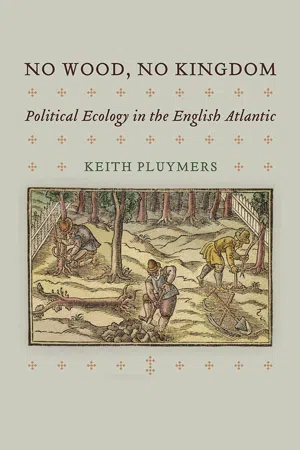
In early modern England, wood scarcity was a widespread concern. Royal officials, artisans, and common people expressed their fears in laws, petitions, and pamphlets, in which they debated the severity of the problem, speculated on its origins, and proposed solutions to it. No Wood, No Kingdom explores these conflicting attempts to understand the problem of scarcity and demonstrates how these ideas shaped land use, forestry, and the economic vision of England's earliest colonies.
Popular accounts have often suggested that deforestation served as a "push" for English colonial expansion. Keith Pluymers shows that wood scarcity in England, rather than a problem of absolute supply and demand, resulted from social conflict over the right to define and regulate resources, difficulties obtaining accurate information, and competing visions for trade, forestry, and the English landscape. Domestic scarcity claims did encourage schemes to develop wood-dependent enterprises in the colonies, but in practice colonies competed with domestic enterprises rather than supplanting them. Moreover, close studies of colonial governments and the actions of individual landholders in Ireland, Virginia, Bermuda, and Barbados demonstrate that colonists experimented with different, often competing approaches to colonial woods and trees, including efforts to manage them as long-term resources, albeit ones that nonetheless brought significant transformations to the land.
No Wood, No Kingdom explores the efforts to knot together woods around the Atlantic basin as resources for an English empire and the deep underlying conflicts and confusion that largely frustrated those plans. It speaks to historians of early modern Europe, early America, and the Atlantic World but also offers key insights on early modern resource politics, forest management, and political ecology of interest to readers in the environmental humanities and social sciences as well as those interested in colonialism or economic history.
- 296 pages
- English
- ePUB (mobile friendly)
- Available on iOS & Android
eBook - ePub
About this book
Information
Publisher
University of Pennsylvania PressYear
2021Print ISBN
9780812253078
9780812253078
eBook ISBN
9780812299557
CHAPTER 1

Scarcity, Conflict, and Regulation in England’s Royal Forests
“Former times,” according to Arthur Standish, had “left a precedent and plenty” of rich woods. In Standish’s narrative, this bounty of natural resources grew from careful and deliberate management. Those past eras knew “how to plant, preserve, and maintain the blessings of God.” Abundant woods were a consequence of sustainable actions and deliberate decisions that considered subsequent generations. In turn, the ailments that faced “this our destroying age” were symptoms of a shift in attitudes and practices that led most English people to pursue the “profit present, but few or none at all [to] regard the posterity or future times.”1
Unlike contemporaries who blamed population increase for pressure on natural resources and myriad other ills, Standish treated deforestation as a problem of policy and practice. Healthy and reliable yields of firewood, acorns and other animal forage, and timber resulted from an expansive sense of both monarchy and commonwealth that explicitly included future generations.2 Although James I offered only a tepid endorsement for Standish’s work, he and his government gave specific directions on managing royal forests, launched commissions to investigate woodlands and prevent their destruction, and endorsed inventions and techniques to save trees that looked toward posterity but also focused on the present.
James’s actions are part of a broader history of royal concern with forestry in the fifteenth through seventeenth centuries. Tudor and early Stuart monarchs’ activities fell into three major categories—describing and surveying woodlands, regulating royal forests and other woods, and supporting projects to reduce deforestation or to restore forests—that were designed, often explicitly, to manage these resources for purportedly common interests and to ensure the welfare of future generations. Nonetheless, each of these activities produced conflicts at numerous levels. Different branches of royal forest bureaucracy fought against each other; members of the nobility protested against the state and plotted against each other. Owners of and workers on manufacturing projects battled forest officials dedicated to hunting, while small tenants and agrarian estate-holders protected embattled common rights. In short, myriad conflicting visions defined English attitudes toward woodlands in the sixteenth and seventeenth centuries.3 At the heart of these struggles lay different political ecologies. Locals dependent on forest commons and ship carpenters seeking timber for the navy might both use the language of commonwealth—the ubiquitous, powerful, and contested conception of political community organized around the common good that defined much early modern English thinking—but they disputed who was included therein and whose interests should come first.4 At the heart of these disputes were different visions for local economies and societies, which had implications for trade and colonization.
Previous accounts that stress the destruction of wooded land miss out on these conflicts and paper over more complex early modern English attitudes toward woodlands. Monarchs like James and Charles I did not simply treat royal forests as a source of extra-Parliamentary revenue, and viewing them in this way ignores the prevalence of early modern conservation rhetoric.5 Surveyors and officials frequently framed policies and actions that facilitated the sale or commercial exploitation of forests as an antidote to wasted woods. Contemporaries on opposite sides of disputes over forest policies and grants invoked posterity and decried spoil. Crown officials were not precocious environmentalists. They adopted these policies to address fears that wood scarcity would deplete royal revenues or harm naval defense. For at least some early modern thinkers, alleviating scarcity and improving Crown finances were complementary.6
Rather than being a battle against exploitative royalty, most disputes over forest management stemmed from changes to how the Crown and members of the nobility managed royal forests and wooded lands on their estates (which were not subject to the same laws as royal forests). Royal forests in England trace their lineage to the aftermath of the Norman Conquest and the policies of mapping and granting lands under William the Conqueror. In popular memory and in many historical narratives, royal forests emerged from efforts to set aside land and protect landscapes for hunting, though recent work has argued that concerns with timber, fuel, and other woodland products emerged much earlier. By the thirteenth century, regulations aimed at preserving trees reinforced forests’ role as sources of timber and fuel. Henry VIII began the shift to a new system of forest management with a series of bureaucratic changes in forest administration, part of a broader program of reform that one historian has described as a “revolution” in government. Beginning in 1511, Tudor monarchs created new positions, which would answer directly to the exchequer, to survey and regulate royal forests. Rather than replacing the preexisting constables, wood wardens, and distinct courts that operated under the medieval Forest Laws, the exchequer officers operated in tandem with them.7 These new officers, alongside independent commissions appointed by the exchequer, periodically surveyed forest lands counting trees, listing access rights and conditions, and chronicling abuses. Parliament also assumed a new role; it passed acts under Henry VIII and Elizabeth I prohibiting tree felling near coastlines or navigable rivers to preserve these sites for naval carpenters, setting out and modifying rules to protect growing trees in coppices, and regulating industrial uses of wood, particularly ironworks.8 James intensified these trends, sending out surveyors and commissioners to evaluate royal forests while simultaneously allowing substantial manufacturing works. These policies culminated in Charles I’s revival, in the 1630s, of the Forest Laws, the largely unenforced code championed by authors like John Manwood, which governed tree felling, resource gathering, land sales, enclosure, and hunting, a policy that produced significant discontent, including uprisings in Dean and other western forests.9
Forests stand at the center of my account because debates in England about scarcity and attempted solutions to it focused on lands potentially or actually under Crown control despite calls from reformers like Standish for a widespread program of replanting, drawing in the gentry and nobility and including hedges as well as woods. As a practical matter, the wood sources Standish mentioned did play an important role as resources, but most of Standish’s contemporaries focused on royal forests to define the problem and explore solutions. The number and geographic extent of these forests in early modern England was a complex question that bedeviled Tudor and Stuart governments (and continues to challenge historians and geographers). Sixteenth- and seventeenth-century governments drew on the work of a new group of professional “improvers” conducting surveys and reexamining local history and geography to reform government and increase revenue. As those governments conducted these assessments, anxieties about scarcity frequently emerged. Royal efforts to combat wood scarcity thus focused on lands over which the Crown had (or might acquire) control and about which it had some information. Similar to other state-sponsored efforts, such as the draining of the English Fens in the 1600s, defining and combating wood scarcity was a state project, albeit one that saw contests over the ideal relationship between royal control and regulated private management.10
This does not mean that there were no problems accessing wood beyond forests. According to one estimate, in 1550 there were approximately 900,000 hectares of woodland in England, which, using a generous estimate for yield, would provide about 2.7 million cubic meters of wood, or about one cubic meter per person per year. Even with the addition of trees standing outside woodlands and hedges, this still left English people with one of the lowest levels of wood- fuel availability in early modern northern Europe, without factoring in competing industrial uses. Those uses could consume significant quantities of fuel. For example, a glazier in London might burn 2,000 wagonloads of wood annually, with brewers burning as much as 20,000 wagonloads. Wood consumption for ironmaking, the most commonly attributed cause in early modern scarcity discourses, is more difficult to estimate, but, according to historian Michael Williams, peak consumption was 8,771 to 7,516 hectares of wood annually—”hardly enough to cause the crisis that was so often said to be imminent.”11
There is an important distinction between the potential material scarcities or lack thereof in historians’ estimates and contemporary understandings of scarcity. In contemporary discourses, the problem of scarcity was most often understood as a threat to the monarchy and the state, particularly after the victory over the Spanish Armada in 1588 saw rumors of foiled plots and future schemes to destroy forests in support of a Spanish invasion.12 The struggles of surveyors, commissions to investigate royal revenue, and other Crown officials defined scarcity; war and political strife in early modern Europe made it a pressing issue. Wood-scarcity fears, although purportedly grounded in material conditions, were always entangled with the ideas, concerns, and ambitions of those articulating them—they were a product of political ecology.
The ambiguous relationship between the conditions of the physical environment and contemporary perceptions of it is essential to understanding efforts to reform forest management and land use in England and to discussions of wood resources abroad. England was not a wholly deforested land, even as pressure in particular areas or between competing user groups might seriously stress supplies, and, as a result, England was more than the material background for an expanding resource frontier. Anxieties about woods ebbed and flowed in response to specific actions—a new survey, trade policy, or plans for naval expansion—even if those anxieties consistently resurfaced. Rather than a permanent push to locate and exploit new resources, scarcity fears provided moments of demand that might quickly disappear. Moreover, reformers promised that new resources might be found at home in old forests as well as across the seas.
* * *
Actions taken under Elizabeth I laid the foundation for early modern English ideas about domestic wood supply, scarcity, and the reforms needed to combat it. Although colonial promoters increasingly pushed the queen to look to Ireland and North America for wood, at the same time Elizabeth’s government took measures to identify and reform domestic wood supplies. Elizabeth reiterated and expanded statutes, previously passed during Henry VIII’s reign, to prevent felling of trees near water and she launched new surveys of royal forests, parks, and chases while also revisiting the sale of lands that had been disafforested (the process of removing land from the specific legal protections of the Forest Laws, enabling it to be sold and converted to agricultural use or pasture) by previous monarchs. This resulted in a mixed policy toward forests. At times, she sold wood rights or disafforested land, but her government also aggressively investigated titles and engaged in lawsuits to bring former forests and leased lands back to the Crown.13 Although contemporaries continued to complain about scarcity, Elizabeth’s government sent out surveyors and passed regulations to more efficiently manage royal forests and preserve trees outside the forests. These actions became the bases for James’s and Charles’s more intensive plans for England’s woods and forests. They also revealed limitations to reform, stemming from surveyors’ difficulties consistently measuring and defining forest resources and the disputes that erupted when untangling conflicting claims of common rights and privileges.
Legislation dealing with English woods and forests was narrow, focusing on particular uses and places, rather than on an effort at widespread reform. In the first year of Elizabeth’s reign, Parliament passed an act prohibiting the conversion of trees into charcoal to fuel ironworks. The act, however, only preserved certain types and species of trees—oak, beech, or ash with trunks measuring one square foot at ground level lying within fourteen miles of the sea or any navigable river.14 These conditions made it clear that the act addressed commercially viable timber—defined by size and proximity to water transportation. Moreover, it provided an exception for ironworks in Sussex, the Weald of Kent, and three parishes of Surrey, areas with abundant ironworks that produced weapons for the state.
Parliamentary attempts to regulate iron production before and during Elizabeth’s reign were often locally specific or were targeted measures to protect London’s fuel supply. In 1552, during Edward VI’s reign, the House of Commons debated two bills, one prohibiting “iron mills” in Horsham, Sussex, and one in the entire county. These bills established a trend that persisted after Elizabeth took the throne. Injunctions against mills brought before the Commons in 1563 targeted specific places. The major focus of the Commons regarding ironworks from 1552 until 1581 was an attempt to prohibit ironworks along the Thames and around London, but in 1581, after nearly three decades of debate, the members still could not agree on whether the ban should extend eight or eighteen miles from the city. A bill eventually passed in 1584-1585 barring new iron mills in Kent, Surrey, and Sussex but exempting existing manufacturers.15 Unlike the 1558 act, these bills sought to preserve stores of firewood for London and its suburbs, part of a broader effort to secure London’s domestic and industrial fuel supply. Ultimately, London would come to depend largely on coal imported from elsewhere in England with dramatic environmental, political, and economic consequences.16 Despite the metropolis’s economic and political centrality, it remains important to distinguish between local issues in London and pervasive conditions throughout the country.
Elizabeth’s government recognized this and began several ambitious projects to survey forests, chases, and parks, as well as woods that had been previously disafforested and placed in private hands. The goal of these surveys was to provide a comprehensive view of wooden resources across all of England. The most notable of these projects were two major surveys by Roger Taverner and his son John. Roger began his service as surveyor for the Court of Augmentations sometime in the 1540s, then became deputy surveyor of the woods south of the Trent under the exchequer, a profession after which his son John followed in 1572.17 Their surveys of woods in England from the 1560s through the 1590s, along with similar works by other contemporary surveyors, offer a glimpse at the Elizabethan state’s view of woods. The Taverners attempted to answer questions of access and use while also providing a record of the physical state of the trees in each area. In doing so, their work, along with other sixteenth-century surveys of woods, provided a vision for English forests, one that blended social, legal, economic, and environmental characteristics together.
The view revealed in sixteenth-century surveys was limited to particular species or types of trees, leaving a blurry image of actual use patterns in royal forests. Surveyors provided numerical counts in either trees or acres for oaks, beeches, or “timber”—a general term used to refer to trees that were of appropriate size, straightness, and maturity to produce boards. They often made notes of coppices—stands of trees, usually oak, ash or beech, that would be felled and allowed to regenerate from the stumps, with enclosures to protect the growing shoots, that were crucial sources of fuel.18 At times, the surveys could offer rich details. Taverner’s “Book of Survey” recorded that the eight acres and two rods of Medman Coppice in Fremantle Park, Southampton contained “about 3 Acres of 7 years growth much bitten with Beasts the residue of 14 years growth.” The description offered a glimpse into management practices—portions of the coppice were felled at different intervals, producing trees at different stages of regrowth—and of their failure to protect tender trees from animals’ teeth.19
The utility of such descriptions becomes difficult to discern when the survey is considered as a whole. To the right of the descriptions for the forests and parks listed throughout the survey, lay numbers of acres and rods. At the bottom or to the right of these numbers lay the total number of acres in the forest or park. In this total, coppices “bitten with Beasts” blended together with notes on underwoods of different ages to the eighty-one acres and two rods present in Fremantle Park. To compute the quantity of underwoods, trees or coppices classified as healthy, ready for harvest, or any value other than total acreage required separate calculations extracted from descriptions of coppices, walks, and other smaller units within forests and parks.
Undertaking such calculations posed its own problems. Smaller units within forests and parks could vary significantly in size, as well as quality. The forest of Eastbeare in Southampton was divided into “The West Walk,” containing 200 acres, and “The East Walk,” containing 36 acres. Within the East Walk, “Foxgrove corner lying in the East part of a ground call’d the Kings Pound” was “sett with Oaks both Timber and firewood of middle growth containing 20 acres.” A...
Table of contents
- Cover
- Title Page
- Copyright
- Contents
- Note on Spelling and Dates
- Introduction. A Wooden World
- Chapter 1. Scarcity, Conflict, and Regulation in England’s Royal Forests
- Chapter 2. Creating Scarcity in Ireland’s Woods
- Chapter 3. The Political Ecology of Woods in Virginia
- Chapter 4. Conservation and Commercialization in Bermuda
- Chapter 5. Deforestation and Preservation in Early Barbados
- Chapter 6. Toward an Atlantic or Imperial Political Ecology?
- Archives Consulted
- Notes
- Index
- Acknowledgments
Trusted by 375,005 students
Access to over 1.5 million titles for a fair monthly price.
Study more efficiently using our study tools.
Frequently asked questions
Yes, you can cancel anytime from the Subscription tab in your account settings on the Perlego website. Your subscription will stay active until the end of your current billing period. Learn how to cancel your subscription
No, books cannot be downloaded as external files, such as PDFs, for use outside of Perlego. However, you can download books within the Perlego app for offline reading on mobile or tablet. Learn how to download books offline
Perlego offers two plans: Essential and Complete
- Essential is ideal for learners and professionals who enjoy exploring a wide range of subjects. Access the Essential Library with 800,000+ trusted titles and best-sellers across business, personal growth, and the humanities. Includes unlimited reading time and Standard Read Aloud voice.
- Complete: Perfect for advanced learners and researchers needing full, unrestricted access. Unlock 1.5M+ books across hundreds of subjects, including academic and specialized titles. The Complete Plan also includes advanced features like Premium Read Aloud and Research Assistant.
We are an online textbook subscription service, where you can get access to an entire online library for less than the price of a single book per month. With over 1.5 million books across 990+ topics, we’ve got you covered! Learn about our mission
Look out for the read-aloud symbol on your next book to see if you can listen to it. The read-aloud tool reads text aloud for you, highlighting the text as it is being read. You can pause it, speed it up and slow it down. Learn more about Read Aloud
Yes! You can use the Perlego app on both iOS and Android devices to read anytime, anywhere — even offline. Perfect for commutes or when you’re on the go.
Please note we cannot support devices running on iOS 13 and Android 7 or earlier. Learn more about using the app
Please note we cannot support devices running on iOS 13 and Android 7 or earlier. Learn more about using the app
Yes, you can access No Wood, No Kingdom by Keith Pluymers in PDF and/or ePUB format, as well as other popular books in History & Economic History. We have over 1.5 million books available in our catalogue for you to explore.