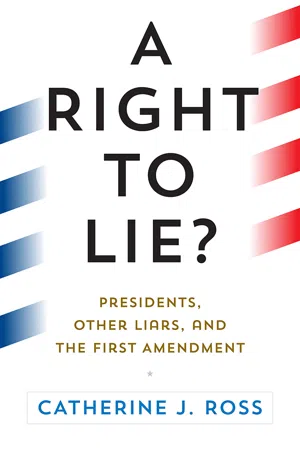
In A Right to Lie?, legal scholar Catherine J. Ross addresses the urgent issue of whether the nation's highest officers, including the president, have a right to lie under the Speech Clause, no matter what damage their falsehoods cause. Does freedom of expression protect even factual falsehoods? If so, are lies by candidates and public officials protected? And is there a constitutional path, without violating the First Amendment, to stop a president whose persistent lies endanger our lives and our democracy?
Perhaps counter-intuitively, the general answer to each question is "yes." Drawing from dramatic court cases about defamers, proponents of birtherism, braggarts, and office holders, Ross reveals the almost insurmountable constitutional and practical obstacles to legal efforts to rein in public deception. She explains the rules that govern the treatment of lies, while also demonstrating the incalculable damage presidential mendacity may lead to, as revealed in President Trump's lies about the COVID-19 pandemic and the legitimacy of the 2020 election.
Falsehoods have been at issue in every presidential impeachment proceeding from Nixon to Trump. But, until now, no one has analyzed why public lies might be impeachable offenses, and whether the First Amendment would provide a defense. Noting that speech by public employees does not receive the same First Amendment protection as the speech of ordinary citizens, Ross proposes the constitutionally viable solution of treating presidents as public employees who work for the people. Charged with oversight of the Executive, Congress may—and should—put future presidents on notice that material lies to the public on substantial matters will be deemed a "high crime and misdemeanor" subject to censure and even impeachment. A Right to Lie? explains how this approach could work if the political will were in place.
- 160 pages
- English
- ePUB (mobile friendly)
- Available on iOS & Android
eBook - ePub
About this book
Information
Publisher
University of Pennsylvania PressYear
2021Print ISBN
9780812253252
9780812253252
eBook ISBN
9780812299731
Subtopic
Governo americanoPART I

Truth Matters
CHAPTER 1
Something Is Rotten
Is there any way to stop a president who lies constantly about matters large and small, who regularly displays his disconnection from facts or verifiable reality, and whose lies endanger the nation and threaten the very foundations of democracy? This book approaches that question and more by examining how the First Amendment treats deception in public life.
President Donald J. Trump’s mendacity during his term in office and its consequences for the nation highlighted the urgent need to grapple with lies by public officials and in public debate.
But this book is not just about Trump, and it is not just about presidents. As I delve into the First Amendment’s treatment of deception I will introduce a range of characters from every walk of public life in situations that implicate factual falsehoods and freedom of expression. They include a minor public official masquerading as a Medal of Honor recipient, purveyors of birtherism, and candidates for office who falsely malign their opponents or even usurp the names of famous people. Their stories, and the outcomes of the resulting court cases, reveal the almost insurmountable constitutional and practical hurdles facing efforts to rein in public deception.
The issues raised by Trump’s falsehoods remain salient even after his term has ended. The approximately 80 million voters who chose Joe Biden may have breathed a sigh of relief as their candidate was sworn in, but nearly 74 million others wanted to give Trump a second term. On the eve of Biden’s inauguration over two-thirds of Republicans still clung to Trump’s biggest lie—that Biden’s victory was not legitimate.1 They either did not perceive that Trump had lied or they did not care.
Social scientists who scrutinized Trump’s “use of fabrications, lies, and bullshit” as a “signature feature of his presidency” underscored that Republican elected officials also appeared not to care. During Trump’s first impeachment trial Republican senators first refused to hear any evidence and then, with one exception, brushed off Congressman Adam Schiff’s solemn plea that “truth matters.”2 But Schiff was right. Truth does matter.
It is one thing to say “truth matters,” and quite another to agree about what is true and what is a lie. To begin with, society would need to define what statements are not true in the sense that they are verifiably false and agree about facts (like who won the 2020 election or whether COVID-19 is a “hoax”), and, finally, choose an arbiter of truth to resolve factual disputes.
The very concept of an arbiter of truth raises the specter of George Orwell’s dystopian 1984, as more than one federal judge has observed. A short distance separates a government empowered to determine what is true and what is false from one that—like Oceania in 1984—limits the very subjects and language of discourse until the populace is stripped of the ability to entertain any unorthodox thought. The freedom of speech guaranteed by the First Amendment expressly aims to protect unorthodox thought—unpopular views and the ideas of dissidents, which majorities are prone to label “false.” A serious tension exists between protecting free speech under the First Amendment and combating the spread of falsehoods that can endanger a free society.
A Sampling of Trump’s Lies
Donald Trump sets the stage for this book. No other fabricator has the potential Trump had as president to mislead masses of people, and no one else’s lies could cause such serious consequences.
Trump is the poster boy for presidential lies. Big, bold, repeated lies, told without blinking, were Trump’s métier. He was not the first president to dissemble or outright lie to the public, and he probably will not be the last. He was, however, the first president whose deluge of deception rendered the old joke applicable: “How do you know he’s lying? He moves his lips.”
This book will not offer a compendium of Trump’s brazen mendacity. Others, such as the Washington Post’s fact-checkers and Daniel Dale at CNN, have counted and catalogued his more than thirty thousand lies during just four years in office.3 My narrative also sets to the side the actions that often accompany false statements. Setting conduct aside clarifies the power of deceptive words and keeps the book’s focus on freedom of expression.
Sages, Jesuits, and Talmudic scholars could spend lifetimes debating which is the most significant among Trump’s big lies to the public. I focus here on his false claims about his very persona and his baseless attacks on the integrity of the 2020 election. I will address a third, his egregious falsehoods about COVID-19, in Chapter 5.
Who Is Trump?
Trump’s 2016 electoral victory built on a foundational lie, the one Trump constructed about his fabricated persona as a brilliant businessman, indeed a billionaire, known to the public as a reality show celebrity who shouted “You’re fired” at would-be employees. But Trump is an imposter. He is a vulgar facsimile of the elegant, well-mannered Mr. Ripley—novelist Patricia Highsmith’s sociopathic impersonator played by Matt Damon in the film The Talented Mr. Ripley.
In the run-up to the 2020 election, the New York Times revealed to the public some of what Trump had been so adamant about hiding that he twice fought release of his tax returns all the way to the Supreme Court. Trump had pressed to the limits of creative accounting (and perhaps beyond), paying no federal income taxes at all for ten of the fifteen years before the 2016 election, and a grand total of $750 (that’s right, no additional zeroes) in 2016 and again in 2017, his first year in office. It turned out, the Times reported, that Trump’s side gig on NBC’s The Apprentice was no hobby; the cash flow it generated apparently saved him from the imminent prospect of seeking a corporate bankruptcy for the fifth or seventh time depending on whether you accept Trump’s own count or that of objective journalists.4
The Times found that Trump, far from being awash in riches, was at least $420 million in debt, loans that he had personally guaranteed and that he would have to pay off in full within a few years. And he was at serious risk of owing the Internal Revenue Service another roughly $100 million pending the outcome of an investigation into whether a refund he had requested and received had been legitimate or would need to be disgorged.
Just weeks later, Forbes declared that the Times had been too cautious in estimating Trump’s debts. Its investigation concluded that Trump was more than $1 billion in debt. Former investment banker William D. Cohan, now a financial writer, asked, “Who knows if he has this kind of money lying around?” Cohan added that his Wall Street contacts “have their serious doubts.”5
The law posits that voters care about who the candidates really are and that they have a right to find out. It may well be that very few people present a fully accurate public portrait of themselves in everyday life; most probably do not share their fears and blemishes. However, candidates for public office open themselves up for close scrutiny. Lying about the essence of the accomplishments presented as qualifications for office constitutes a betrayal of trust and might be thought to be a major offense.
Trump’s posturing was the kind of false presentation that fraudsters engage in to soften up their prey. Sadly, many of Trump’s supporters were so locked into the image they held of him that they did not seem to care that he had been revealed as a charlatan.
No federal law requires candidates to present a truthful image of themselves. And even if a statute outlawed Trump’s fraudulent autobiographical claims, it would likely prove unconstitutional, as you will see.
The Biggest Lie: Electoral Illegitimacy
That brings us to Trump’s most consequential lie: his baseless and unrelenting attacks on the legitimacy of US elections, the fallout from which is still unfolding as this book goes to press. Trump’s unsubstantiated challenge to the legitimacy of US elections began even before he assumed office, continued during his presidency, accelerated as it seemed he was likely to lose his 2020 reelection bid, and reached a crescendo after Biden’s decisive victory.
Trump had attacked the legitimacy of elections even before he ran for office. In 2012, shortly after Barack Obama won the presidency, Trump (then a private citizen) disputed the election results on Twitter: “We should march on Washington and stop this travesty…. This election is a total sham…. We are not a democracy!”6
During the 2016 campaign, when pollsters and pundits widely expected Trump to lose to Hillary Clinton, he demurred when asked if he would accept the results of the election. His signals were so disturbing that the Obama administration secretly made contingency plans in case Trump’s recalcitrance precipitated a constitutional crisis.7 Trump’s surprising Electoral College victory silenced his challenge to the outcome, but he continued to insist that fraud had cost him a victory in the popular vote.
Between 2012 and early 2020, Trump attacked the legitimacy of our electoral system more than seven hundred times, according to election law expert Richard Hasen. By 2020, facing an uphill battle for reelection, President Trump repeatedly and without any factual basis excoriated the system as “rigged.” He increasingly focused his attacks on what he referred to as “mailin” ballots, which use the same process as the widely accepted “absentee ballots” long available in every jurisdiction, and which Trump and his wife themselves used to vote in Florida’s 2020 Republican primary.8
He assailed the integrity of the electoral system ninety more times in the first eight months of 2020. In May, for example, he raged on Twitter, “There is NO WAY (ZERO!) that Mail-In Ballots will be anything less than substantially fraudulent.” On June 22, Trump tweeted, “RIGGED 2020 ELECTION: MILLIONS OF MAIL-IN BALLOTS WILL BE PRINTED BY FOREIGN COUNTRIES, AND OTHERS. IT WILL BE THE SCANDAL OF OUR TIMES!” In July, he tweeted that 2020 will be “the most RIGGED Election” ever.9 And on and on.
Trump suggested that the chaos around voting—that he himself had generated—might prevent us from ever knowing who had won: “The Nov 3rd Election result may NEVER BE ACCURATELY DETERMINED.”10 And he informed Fox News interviewer Maria Bartiromo that a do-over might be needed, oblivious to the distinctions between national elections and golf, where an occasional mulligan is permitted.
Trump’s advance efforts to delegitimize the election prepared his supporters to repudiate his loss. A Yahoo/YouGov poll in mid-September revealed that only 22 percent of registered voters expected the 2020 election would be “free and fair.” Other polls showed that 58 percent to 61 percent of Trump voters anticipated that the only way he was “going to lose in November is if the election is rigged.”11
Trump’s predictions and his insistence after the election that pervasive fraud had occurred flew in the face of studies that showed negligible electoral fraud in the modern United States. Findings by the conservative Heritage Foundation conformed with those of the progressive Brennan Center for Justice and the Washington Post, which calculated the level of electoral fraud in recent years at well under a fraction of 1 percent (the highest estimate was 0.002 percent) of all votes cast. That would not be enough to change the outcome in any contest except perhaps the closest and smallest local election.12
As Election Day 2020 grew nearer, Trump relied on his own lies about election fraud to double down on his refusal to commit to a peaceful transition of power should he lose. Having already declared that any election he lost would have to be “rigged,” Trump insisted that he would have to see if the election was “fair” before conceding.
Trump’s false assertions had an impact. In late November, after he lost, 77 percent of Republican voters told Monmouth University pollsters they believed fraud accounted for Biden’s victory. At about the same time, 67 percent of those who strongly supported Trump reported to another polling group that they did not believe Biden was the rightful winner, while only 9 percent of that group regarded Biden as the “true winner.”13
Trump had further undermined confidence in electoral integrity shortly before the election when he swiftly nominated Amy Coney Barrett to the Supreme Court to replace the recently deceased Justice Ruth Bader Ginsburg, whose funeral had not yet taken place. Trump appeared confident that the conservative justices on the court would have his back in any election dispute. That view may have rested in part on the fact that Barrett as well as Justice Brett Kavanaugh (whom he had appointed) and Chief Justice John Roberts had worked for George W. Bush’s controversial effort to stop the Florida recount in 2000, which succeeded in giving Bush the presidency.
Instead of lying about the reasons for his unseemly rush to appoint Ginsburg’s successor, Trump indulged in one of his periodic bursts of what I call an “explosive truth.” He explained that he needed another justice on the court to avoid a four-to-four tie in case it fell to the court to determine the outcome of a close election.
Trump’s hopes that millions of votes might be thrown out were dashed when the court rebuffed several meritless claims brought on his behalf. The...
Table of contents
- Cover
- Title Page
- Copyright
- Dedication
- Contents
- Part I. Truth Matters
- Part II. No Harm, No Foul
- Part III. Lies Affecting Democracy
- Notes
- Index
- Acknowledgments
Trusted by 375,005 students
Access to over 1.5 million titles for a fair monthly price.
Study more efficiently using our study tools.
Frequently asked questions
Yes, you can cancel anytime from the Subscription tab in your account settings on the Perlego website. Your subscription will stay active until the end of your current billing period. Learn how to cancel your subscription
No, books cannot be downloaded as external files, such as PDFs, for use outside of Perlego. However, you can download books within the Perlego app for offline reading on mobile or tablet. Learn how to download books offline
Perlego offers two plans: Essential and Complete
- Essential is ideal for learners and professionals who enjoy exploring a wide range of subjects. Access the Essential Library with 800,000+ trusted titles and best-sellers across business, personal growth, and the humanities. Includes unlimited reading time and Standard Read Aloud voice.
- Complete: Perfect for advanced learners and researchers needing full, unrestricted access. Unlock 1.5M+ books across hundreds of subjects, including academic and specialized titles. The Complete Plan also includes advanced features like Premium Read Aloud and Research Assistant.
We are an online textbook subscription service, where you can get access to an entire online library for less than the price of a single book per month. With over 1.5 million books across 990+ topics, we’ve got you covered! Learn about our mission
Look out for the read-aloud symbol on your next book to see if you can listen to it. The read-aloud tool reads text aloud for you, highlighting the text as it is being read. You can pause it, speed it up and slow it down. Learn more about Read Aloud
Yes! You can use the Perlego app on both iOS and Android devices to read anytime, anywhere — even offline. Perfect for commutes or when you’re on the go.
Please note we cannot support devices running on iOS 13 and Android 7 or earlier. Learn more about using the app
Please note we cannot support devices running on iOS 13 and Android 7 or earlier. Learn more about using the app
Yes, you can access A Right to Lie? by Catherine J. Ross in PDF and/or ePUB format, as well as other popular books in Politica e relazioni internazionali & Governo americano. We have over 1.5 million books available in our catalogue for you to explore.