The Maternalists is a study of the hitherto unexplored significance of utopian visions of the state as a maternal entity in mid-twentieth century Britain. Demonstrating the affinities between welfarism, maternalism, and psychoanalysis, Shaul Bar-Haim suggests a new reading of the British welfare state as a political project.
After the First World War, British doctors, social thinkers, educators, and policy makers became increasingly interested in the contemporary turn being made in psychoanalytic theory toward the role of motherhood in child development. These public figures used new notions of the "maternal" to criticize modern European culture, and especially its patriarchal domestic structure. This strand of thought was pioneered by figures who were well placed to disseminate their ideas into the higher echelons of British culture, education, and medical care. Figures such as the anthropologists Bronislaw Malinowski and Geza Róheim, and the psychiatrist Ian Suttie—to mention only a few of the "maternalists" discussed in the book—used psychoanalytic vocabulary to promote both imagined perceptions of motherhood and their idea of the "real" essence of the "maternal." In the 1930s, as European fascism took hold, the "maternal" became a cultural discourse of both collective social anxieties and fantasies, as well as a central concept in many strands of radical, and even utopian, political thinking. During the Second World War, and even more so in the postwar era, psychoanalysts such as D. W. Winnicott and Michael Balint responded to the horrors of the war by drawing on interwar maternalistic thought, making a demand to "maternalize" British society, and providing postwar Britain with a new political idiom for defining the welfare state as a project of collective care.
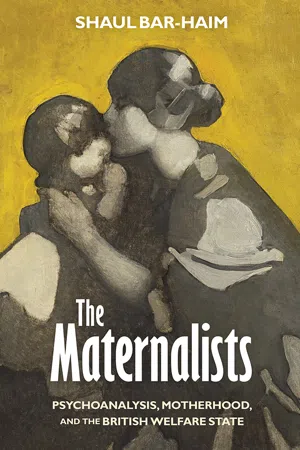
eBook - ePub
The Maternalists
Psychoanalysis, Motherhood, and the British Welfare State
- 352 pages
- English
- ePUB (mobile friendly)
- Available on iOS & Android
eBook - ePub
The Maternalists
Psychoanalysis, Motherhood, and the British Welfare State
About this book
Information
Publisher
University of Pennsylvania PressYear
2021Print ISBN
9781512826050
9780812253153
eBook ISBN
9780812299649
Table of contents
- Cover
- Title Page
- Copyright
- Dedication
- Contents
- Introduction
- Chapter 1. The “Sphincter-Morality” and Beyond: The Concept of Childhood in Interwar Psychoanalysis
- Chapter 2. How Children Think: Susan Isaacs and “Primitive” Thinking
- Chapter 3. Malinowski, Róheim, and the Maternal Shift in British Psychoanalysis and Anthropology
- Chapter 4. Imagining the “Maternal” Past: Ian Suttie and the Critique of Oedipal Culture
- Chapter 5. What About Father? Civic-Republican Maternalism and the Welfare State
- Chapter 6. “The Drug ‘Doctor’”: The Balint Movement and Psychosocial Medicine in Postwar Britain
- Conclusion
- Notes
- Bibliography
- Index
- Acknowledgments
Trusted by 375,005 students
Access to over 1.5 million titles for a fair monthly price.
Study more efficiently using our study tools.
Frequently asked questions
Yes, you can cancel anytime from the Subscription tab in your account settings on the Perlego website. Your subscription will stay active until the end of your current billing period. Learn how to cancel your subscription
No, books cannot be downloaded as external files, such as PDFs, for use outside of Perlego. However, you can download books within the Perlego app for offline reading on mobile or tablet. Learn how to download books offline
Perlego offers two plans: Essential and Complete
- Essential is ideal for learners and professionals who enjoy exploring a wide range of subjects. Access the Essential Library with 800,000+ trusted titles and best-sellers across business, personal growth, and the humanities. Includes unlimited reading time and Standard Read Aloud voice.
- Complete: Perfect for advanced learners and researchers needing full, unrestricted access. Unlock 1.5M+ books across hundreds of subjects, including academic and specialized titles. The Complete Plan also includes advanced features like Premium Read Aloud and Research Assistant.
We are an online textbook subscription service, where you can get access to an entire online library for less than the price of a single book per month. With over 1.5 million books across 990+ topics, we’ve got you covered! Learn about our mission
Look out for the read-aloud symbol on your next book to see if you can listen to it. The read-aloud tool reads text aloud for you, highlighting the text as it is being read. You can pause it, speed it up and slow it down. Learn more about Read Aloud
Yes! You can use the Perlego app on both iOS and Android devices to read anytime, anywhere — even offline. Perfect for commutes or when you’re on the go.
Please note we cannot support devices running on iOS 13 and Android 7 or earlier. Learn more about using the app
Please note we cannot support devices running on iOS 13 and Android 7 or earlier. Learn more about using the app
Yes, you can access The Maternalists by Shaul Bar-Haim,Shaul Bar-Haim in PDF and/or ePUB format, as well as other popular books in History & Modern British History. We have over 1.5 million books available in our catalogue for you to explore.