The Black Death that arrived in the spring of 1348 eventually killed nearly half of England's population. In its long aftermath, wages in London rose in response to labor shortages, many survivors moved into larger quarters in the depopulated city, and people in general spent more money on food, clothing, and household furnishings than they had before. Household Goods and Good Households in Late Medieval London looks at how this increased consumption reconfigured long-held gender roles and changed the domestic lives of London's merchants and artisans for years to come.
Grounding her analysis in both the study of surviving household artifacts and extensive archival research, Katherine L. French examines the accommodations that Londoners made to their bigger houses and the increasing number of possessions these contained. The changes in material circumstance reshaped domestic hierarchies and produced new routines and expectations. Recognizing that the greater number of possessions required a different kind of management and care, French puts housework and gender at the center of her study. Historically, the task of managing bodies and things and the dirt and chaos they create has been unproblematically defined as women's work. Housework, however, is neither timeless nor ahistorical, and French traces a major shift in women's household responsibilities to the arrival and gendering of new possessions and the creation of new household spaces in the decades after the plague.
eBook - ePub
Household Goods and Good Households in Late Medieval London
Consumption and Domesticity After the Plague
- 416 pages
- English
- ePUB (mobile friendly)
- Available on iOS & Android
eBook - ePub
Household Goods and Good Households in Late Medieval London
Consumption and Domesticity After the Plague
About this book
Information
Publisher
University of Pennsylvania PressYear
2021Print ISBN
9780812253054
9780812253054
eBook ISBN
9780812299533
CHAPTER 1

Living in London Before the Plague
A Crowded City
After the first visit of the bubonic plague in 1348/49, London would be both very different and very familiar to survivors. The most striking change would be in the loss of people; London lost between a third and a half of its population in the space of a year.1 It would no longer be overcrowded and densely packed with tenants and landlords jockeying for space. Yet the loss of people did not alter the street plan, dissolve the city’s government or its bureaucracy, or bring down buildings. While neighbors and family members died, their clothing, furnishings, and tools remained. Survivors would repeatedly confront this combination of continuity and change as they picked up the pieces of their lives.
In order to understand what changed and what remained the same, this chapter looks at London’s houses and their furnishings before the plague. While many people would die, things would survive, along with habits and routines for using them. London’s enduring street plan meant that survivors passed the same houses, churches, and company halls when they went to market, the riverfront, or to worship as they had before the plague (Map 1). The enrollments, deeds, wills, and contracts written up before the plague that gave them ownership, tenancy, and legal status still had the force of law afterward. Survivors still wore the same clothing, slept in the same bedding, and ate off the same dishware that they had before the plague.2 Nevertheless, the new economic and demographic context for houses and their furnishings would gradually change how people used these things, change which people would use these things, and change what and how much people bought. Londoners would have more space in which to live, and they would fill that space with more possessions, which they would use in new ways. Before the plague, London was densely populated, but houses were sparsely furnished; afterward, the city had thinned, but the houses would become filled with things that brought color and comfort to their occupants. Even those of modest means would eventually embrace changing consumption and domestic habits.
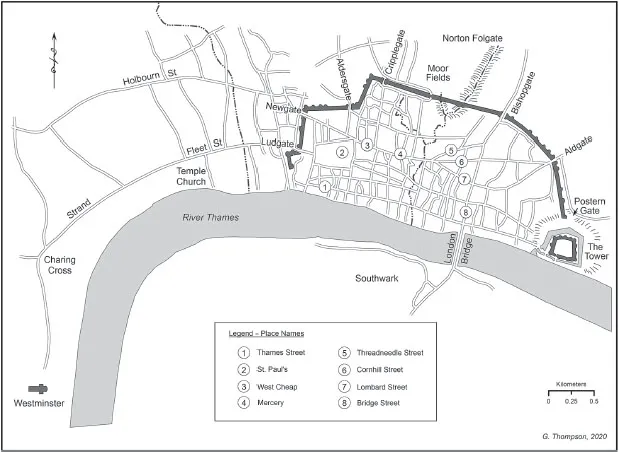
Map 1. Medieval London and environs. Map by Gordon Thompson.
Changes to how London’s merchants and artisans lived in their houses did not happen all at once; they occurred over the course of many decades, as repeated visitations of plague kept the population low and the economic and demographic consequences of a smaller population worked themselves out against the backdrop of royal and civic politics. A smaller population would have a profound impact on everything from staffing government bureaucracies to the purchasing power of the penny. While there were more sawmills, fulling mills, coal mines, and trade via larger and faster ships, which would all technically affect how artisans and merchants made and sourced the products that people put into their houses,3 technology was not the major driver of these changes after the plague; rather, they were driven by demographic and economic changes. For example, milling was an established technology by 1300, but with fewer people to feed, some grain mills were converted to fulling mills, thereby taking advantage of survivors’ disposable income.4 Londoners would make small decisions about how to live in their houses in the post-plague world that would ultimately change how they understood themselves and their relationships to others.
In 1300, London was crowded. Derek Keene cautiously estimates that its population may have been upwards of eighty thousand people.5 Immigrants from across Britain and beyond moved to London searching for a better life. London offered something for nearly everyone: the ambitious servants of the royal court and its aristocratic hangers-on built and furnished lavish stone houses to be near both the center of political power and merchants who dealt in luxury items; gentry families set their younger sons up in trade, because there was no land or title for them to inherit; the sons and daughters of small-town artisans went to serve as apprentices in London shops; the sons and daughters of peasants hoped London wages would improve their marriage prospects back home; and the poor and destitute begged for a living. Merchants, sailors, diplomats, and clergy from the other side of the Channel added to this mix.6 With so many people, the rich and the poor lived next to one another, often even inhabiting the same buildings.
Merchants and artisans were a minority of London’s population, but they were its economic drivers. An even smaller number of those who identified themselves by an occupation were citizens.7 Medieval cities jealously guarded their right to define and bestow citizenship, also known as “freedom of the city.” Those who became citizens or freemen received the right to buy and sell retail, train apprentices, trade in other towns without paying tolls, and hold civic office; these benefits provided economic and political advantages. Citizenship could be purchased, gained by birth, or earned via apprenticeship; given the high mortality rate of medieval cities in general, most citizens came from someplace else.8 Freedom of the city did not, however, grant equal access to political influence or guarantee a materially comfortable life.9
Although central to the economic successes of merchant and artisan households, women were not citizens, but as the wives and daughters of citizens, they could pass this status on to their children.10 Guilds expected their masters to be married, but masters’ wives could not be full members of a guild, in spite of the fact that some were skilled artisans and savvy businesswomen in their own right.11 Lack of a wife hindered a man’s ability to move up in his guild. Citizen households included not only wives and usually their children, but also journeymen, apprentices, and servants. Most of the men and women studied in this book were citizens or members of citizen households. Yet I use the more generic terms “merchant” and “artisan,” because some testators only identified themselves by their occupation and did not state whether or not they had citizenship.12 As London’s citizens were technically not burgesses, I have avoided that term as well.13
Merchants occupied a difficult place in medieval conceptions of social organization. The expansion of commerce and cities in the twelfth and thirteenth centuries profoundly altered the relationship that medieval people had to wealth and property. Cities based their economies and governments on trade and manufacturing, not agricultural production and war. Trade, rooted in movable goods, not land, the basis of medieval political power, required goods to be fungible, that is, their value needed to be abstracted so that dissimilar items could be comparatively valued and traded. Dependent on money and credit, the ultimate forms of abstraction, merchants dealt in separating identity from worth. Artisans, for their part, with their ability to make ordinary materials look like luxury ones, skirted the boundaries of duplicity and fraud, prohibited by guild statute and the law.14 These practices were too easily identified as deceit, greed, and usury, all serious sins.15
The boundaries between rich merchants and their social betters was porous; some landed elites dabbled in trade and some successful merchants married their children into the gentry.16 The difference between rich and poor merchants was often only a shipwreck or an unscrupulous business partner. Poorer merchants and artisans also had a lot in common. While merchant companies ranked higher in city government, a well-to-do artisan could live better than a modest merchant. Both merchants and artisans also depended on elites to buy their wares, and the most successful among them would have been familiar with how the gentry and aristocracy lived. Unsurprisingly, merchants and artisans were frequently accused of social emulation or worse. The idea that merchants and, to a lesser degree, artisans were social climbers has long been a part of historiography. Consumption and social emulation are a historiographical package, but looking at London’s merchants and artisans or any other group only in terms of imitation implies that they lacked a social identity of their own.17 While wealth would remain an important divider of merchants and artisans, their domestic habits, commercial values, and religious ideologies would unite them, creating a common way of inhabiting domestic space and conceptualizations of ideal behavior that their domestic space and furnishings would create and enable.
Pre-Plague Houses
The legal and social meaning of houses changed over the course of the fourteenth century. Some of these changes were driven by demography, some by technology, some by law. The major change was in the value of urban houses relative to the plots of land upon which they sat, with the house becoming the more valuable asset.18 A number of transformations propelled this shift—the rise of corporate landlords, the increased association of urban citizenship with guild membership rather than urban landholding (also known as burgage tenure), the development of written leaseholds, and house building technology. Written leaseholds required tenants to pay an entry fee for the lease, which was often more than the annual rent. Landlords justified large entry fees by improving or repairing the house and establishing rent reductions for tenants, who agreed to maintain their house themselves. These legal and social changes particular to cities, Sarah Rees Jones argues, “accelerated investment in the notion of the house as a ‘home.’”19 Timber framing, a construction technique where an external wooden frame creates, defines, and supports the building, had also grown more sophisticated in London by the end of the twelfth century.20 These improvements allowed carpenters to construct buildings of more than one story, with larger rooms, at less cost than stone ones. Often built over a stone cellar and regulated by building codes aimed at diminishing the threat of fire, timber-framed buildings became long-term investments, offering owners a chance to add a range of additions, adornments, and adaptations as they needed or wanted.21 Buildings added value to a tenement, the plot of land upon which a building stood, and were now durable enough that they could be bequeathed to a succession of heirs. Plague mortality and increasing immigration after the plague combined with these social, legal, and material factors to weaken the ties between individual families and burgage plots and to strengthen the ones between families and houses.
Timber-framed buildings housed the majority of London’s population from the thirteenth century on.22 It was a flexible technology allowing cantilevered, or “jettied,” upper stories to expand living space beyond the building’s footprint, which helped address the pressures of a growing city population.23 The need to house ever more people meant that many owners took advantage of timber framing’s technical possibilities to add on rooms, sometimes ignoring or challenging the limits of property boundaries. Little of medieval London still survives above-ground. Cases from the Assize of Nuisance, a court that enforced building codes, provide some of our best opportunities to peer inside London’s pre-plague houses. For example, in 1314 one Cambin, son of Fulbert, sought to repair a room built over his entrance supported at one end by the party, or shared, wall that separated his property from his neighbor...
Table of contents
- Cover
- Title Page
- Copyright
- Dedication
- Contents
- List of Maps, Figures, and Tables
- Acknowledgments
- Introduction. The Challenges of Increased Consumption
- Chapter 1. Living in London Before the Plague
- Chapter 2. Valuing Household Goods
- Chapter 3. Interior Decorating After the Plague
- Chapter 4. Good Housekeeping in Post-Plague London
- Chapter 5. Some Brought Flesh and Some Brought Fish
- Chapter 6. When a Woman Labors with a Child
- Chapter 7. Praying upon Beads
- Conclusion. What Londoners Learned as They Learned to Live with More
- Appendix
- Notes
- Bibliography
- Index
Trusted by 375,005 students
Access to over 1.5 million titles for a fair monthly price.
Study more efficiently using our study tools.
Frequently asked questions
Yes, you can cancel anytime from the Subscription tab in your account settings on the Perlego website. Your subscription will stay active until the end of your current billing period. Learn how to cancel your subscription
No, books cannot be downloaded as external files, such as PDFs, for use outside of Perlego. However, you can download books within the Perlego app for offline reading on mobile or tablet. Learn how to download books offline
Perlego offers two plans: Essential and Complete
- Essential is ideal for learners and professionals who enjoy exploring a wide range of subjects. Access the Essential Library with 800,000+ trusted titles and best-sellers across business, personal growth, and the humanities. Includes unlimited reading time and Standard Read Aloud voice.
- Complete: Perfect for advanced learners and researchers needing full, unrestricted access. Unlock 1.5M+ books across hundreds of subjects, including academic and specialized titles. The Complete Plan also includes advanced features like Premium Read Aloud and Research Assistant.
We are an online textbook subscription service, where you can get access to an entire online library for less than the price of a single book per month. With over 1.5 million books across 990+ topics, we’ve got you covered! Learn about our mission
Look out for the read-aloud symbol on your next book to see if you can listen to it. The read-aloud tool reads text aloud for you, highlighting the text as it is being read. You can pause it, speed it up and slow it down. Learn more about Read Aloud
Yes! You can use the Perlego app on both iOS and Android devices to read anytime, anywhere — even offline. Perfect for commutes or when you’re on the go.
Please note we cannot support devices running on iOS 13 and Android 7 or earlier. Learn more about using the app
Please note we cannot support devices running on iOS 13 and Android 7 or earlier. Learn more about using the app
Yes, you can access Household Goods and Good Households in Late Medieval London by Katherine L. French in PDF and/or ePUB format, as well as other popular books in History & British History. We have over 1.5 million books available in our catalogue for you to explore.