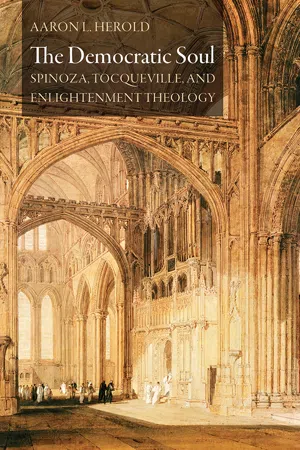
In The Democratic Soul, Aaron L. Herold argues that liberal democracy's current crisis—of extreme polarization, rising populism, and disillusionment with political institutions—must be understood as the culmination of a deeper dissatisfaction with the liberal Enlightenment. Major elements of both the Left and the Right now reject the Enlightenment's emphasis on rights as theoretically unfounded and morally undesirable and have sought to recover a contrasting politics of obligation. But this has re-opened questions about the relationship between politics and religion long thought settled.
To address our situation, Herold examines the political thought of Spinoza and Tocqueville, two authors united in support of liberal democracy but with differing assessments of the Enlightenment. Through an original reading of Spinoza's Theologico-Political Treatise, Herold uncovers the theological foundation of liberal democracy: a comprehensive moral teaching rehabilitating human self-interest, denigrating "devotion" as a relic of "superstition," and cultivating a pride in living, acting, and thinking for oneself. In his political vision, Spinoza articulates our highest hopes for liberalism, for he is confident such an outlook will produce both intellectual flourishing and a paradoxical recovery of community.
But Spinoza's project contains tensions which continue to trouble democracy today. As Herold shows via a new interpretation of Tocqueville's Democracy in America, the dissatisfactions now destabilizing democracy can be traced to the Enlightenment's failure to find a place for religious longings whose existence it largely denied. In particular, Tocqueville described a natural human desire for a kind of happiness found, at least partly, in self-sacrifice. Because modernity weakens religion precisely as it makes democracy stronger than liberalism, it permits this desire to find new and dangerous outlets. Tocqueville thus sought to design a "new political science" which could rectify this problem and which therefore remains indispensable today in recovering the moderation lacking in contemporary politics.
- 288 pages
- English
- ePUB (mobile friendly)
- Available on iOS & Android
eBook - ePub
About this book
Information
Publisher
University of Pennsylvania PressYear
2021Print ISBN
9780812253009
9780812253009
eBook ISBN
9780812299892
Topic
PhilosophySubtopic
Political PhilosophyCHAPTER 1

Spinoza’s Liberal Theology
We turn to Spinoza’s Theologico-Political Treatise to rediscover and reexamine liberal democracy’s theological foundations. That it has such foundations, liberalism’s current claims to neutrality notwithstanding,1 is suggested by the work’s somewhat awkward, hyphenated title, which implies that theology and politics constitute a single inseparable entity: the “theologico-political.”2 We can see this also from the Treatise’s overall structure, which consists of a preface and twenty chapters. Chapter 1 opens by endorsing the veracity of biblical prophecy and the revelation of the Mosaic Law (i.1, 10). Chapter 20, by contrast, begins by asserting Moses’s failure as a statesman, and it argues for a liberal and commercial republic where speech and thought are free, where judgments are made “by reason alone,” and where commerce and credit, rather than religion, cement the social bond (xx.5, 14, 40; Yaffe 1997, 160–62). The Treatise’s structure thus invites the preliminary suggestion that its main task is to move society from revelation and theocracy toward reason and liberal democracy, with its chapters serving as stages in this cultural and political transformation (cf. pref.33).
Spinoza, however, also indicates on his title page that the ultimate goal of his Enlightenment project may be to benefit a certain elite. The Treatise’s subtitle states that the work will show “not only that the Freedom of Philosophizing can be Granted in keeping with Piety and the Peace of the Republic, but that it cannot be Removed unless along with the Peace of the Republic and that very Piety.” In both the Treatise and the Ethics, Spinoza uses the term “freedom of philosophizing” not only to refer to intellectual freedom in the ordinary sense but also to denote the perfection of those rare individuals living a fully self-conscious and rational life (cf., e.g., Spinoza 2004, Annotation 33; 1996, V, preface). If Spinoza’s political project is chiefly an educational project, he hints that it will unfold on two levels: while mass enlightenment produces a more rational politics, it will bring about a fuller and more complete liberation for the most promising.
To appreciate what is most distinctive about Spinoza’s Treatise, it is necessary to consider the importance of this aim.3 Perhaps no other early modern thinker so emphatically stresses this combination of political reform and the philosophic life. If one reads the title page as announcing an enterprise aiming at what Spinoza calls true freedom, then the flourishing of philosophy would be the whole point of his political project. Moreover, as we will see more clearly throughout this chapter and Chapter 2, Spinoza understands philosophy not as the collective enterprise of Baconian natural science—the conquest of nature for the relief of man’s estate—but as a life of independent spiritual liberation characterized by “sound reason” and “doubting” (pref.9).
Spinoza’s Enlightenment seeks to make possible the achievement of a good (philosophy) for the sake of which all other goods, including peace and toleration, exist in turn. But, as he will indicate in his preface, the possibility and choice worthiness of that endeavor and way of life faces a profound theological challenge requiring a biblically based response. Spinoza intimates how he will provide that response by affixing to his title page an epigraph from 1 John (4:13): “Through this, we know that we remain in God and God remains in us: that he has given us of his Spirit.” In the biblical context, John’s words refer to God’s love (agapē) of humankind, which led Him to send into the world and sacrifice His only begotten son, “that we might live through him” (1 John 4:9). On Spinoza’s title page, however, “this” (hoc) most naturally refers to the freedom of philosophizing. The Treatise, Spinoza thus implies from the outset, will make the theological case for a kind of blessedness achievable in this world: Spinoza’s own way of life, which consists of private, solitary thought. As becomes clear from the way Spinoza here effectively revises John’s meaning, that way of life must be understood as opposing and seeking to supplant a rival form of existence that stresses devotional love and, connected to it, the hope for immortality. To make the case for the philosophic life—not just to set forth the political conditions for its flourishing but also to illustrate its very possibility—Spinoza, for reasons that are as yet unclear, will embark on a project of religious reform culminating in a new kind of politics with new corresponding human virtues.4 Hence, Spinoza’s epigraph also provides his earliest hint of the theological outlook he will spread: the pantheism for which he is famous, according to which everything is “in God.”5
In the service of fostering and defending philosophy, Spinoza’s Treatise will cultivate a new kind of citizenry wholeheartedly committed to republican government on the grounds that such government—and only such government—grants the “freedom of philosophizing”—that is, of doubting—“to each” (xx.23). On the basis of this commitment to intellectual independence, Spinoza suggests, that citizenry will endure great sacrifices to ensure the preservation of the republic, which it will view as its “highest good” (summum bonum; xvi.21). The Treatise thus culminates in an argument for a republic in which “each is permitted both to think what he wants and to say what he thinks” (xx, title)—an aim Spinoza lifts from Tacitus’s Histories but that Tacitus, in agreement with a pre-Spinozistic tradition, had considered realizable only in monarchies (Tacitus 1942, 419–20). According to that older tradition, the liberty of republics is made possible and can be prevented from degenerating into license only through the restrictions imposed by a legally established religion (see, e.g., Machiavelli 1996, 35).
Spinoza’s break from that tradition compels us to ask how a commitment to intellectual independence and doubting all authority can create an ethic binding society together and leading citizens to sacrifice for the common good. As we will see, Spinoza’s defense of intellectual liberty is not unqualified. In chapter 14, he articulates a civil theology, and at the end of the Treatise he indicates that even a republic dedicated to liberty of thought and expression must inculcate support for those principles by restricting their exercise. Is it possible, then, that Spinoza, despite his call to make our age happy by freeing it “of all superstition” (xi.24), will be cultivating a popular superstition of his own? But would not such a “liberal” superstition, by cultivating an anti-theocratic and anti-theological kind of pride, contain inherent tensions? To begin addressing these questions, we must now delve into the Treatise, beginning with Spinoza’s preface.
Philosophy, Politics, and the Problem of Superstition (Spinoza’s Preface)
Superstition, Vain Religion, and True Religion
If the Treatise’s twenty chapters outline the steps of a project of theologicopolitical reform, the preface indicates why Spinoza chose to carry out that reform by writing it (cf. pref.13). The work’s first sentence specifies Spinoza’s guiding problem, but it also hints at a solution: “If human beings could regulate all their affairs with certain counsel, or if fortune were always favorable to them, they would not be bound by any superstition” (pref.1). Presenting his work as a Christian apologetic, Spinoza initially suggests that the Treatise is meant to oppose those who are “vulnerable to superstition and adverse to religion” (pref.3). It aims to combat a primitive, heretical, crypto-pagan kind of Christianity that continues to attract adherents even in his own time. Among the most rustic, he suggests, one still encounters the notion that “God” communicates His decrees “not in the mind” but through dreams, entrails, bird omens, the ravings of madmen, and other “childish idiocies” (pref.4). These theological errors, according to Spinoza, arise from the universally recognized tendency of human beings to long for “the uncertain goods of fortune … without measure” (pref.1–2). Our hopes for the goods of this world are rarely restrained by a sense of what is possible, and this is the psychological illness of which superstition is but the most common symptom. The most effective cure would be a stoic acceptance of the role of chance in our affairs, but assuming such an attitude could never become widespread, superstition could be dampened if social arrangements, by helping us rely on more “certain counsel,” could make us more fortunate.
In the present world, however, human beings mostly cannot attain what they long for, and they find themselves alternatively “agitated by hope and dread” (pref.1). At their lowest points, when they are in circumstances so desperate that only a miracle could extricate them, they will look for deliverance anywhere and believe any advice, no matter how absurd (pref.1–2; cf. i.30). Just as gamblers down to their last pennies will entertain illusions that riches could be—indeed, will be—just one bet away, the desperate and the fearful often convince themselves that psychics and astrologers can provide an instant path to happiness. Superstition, in other words, is born of fear, but that fear ignites a hope in people that there is something out there that can help them escape their circumstances, and it may even be that this hope grows stronger the more the odds are stacked against them. But since the sole cause of superstition “is dread” (pref.5), it has no place at the other end of this psychological pendulum. It lasts “only while dread lasts” (pref.6). When humans are more fortunate, they become “overconfident, boastful and proud” (pref.1). Animated by a proud sense of their self-sufficiency, they spurn all counsel and consider offers of it insulting, and they no longer look for supernatural help, because they have no need of it (pref.2).
Spinoza’s initial account of superstition provides an early glimpse of his understanding of human psychology: he locates its origins in the naturally controlling desire all people have to seek their own good. As he later states, utility “is the grit and life of all human actions” (xvii.84), and even if everything we do cannot be traced back to the pursuit of what is truly good for us, it is nonetheless a “universal law” that we will always select our actions with a view to what we think our advantage will be (xvi.15–16). Superstition is ubiquitous because the vast majority of us err in this calculation. Being ignorant of natural causes, we regard unusual events with admiration or “great wonderment” (admiratio), an attitude that inhibits us from seeking instead to understand them (pref.3). Since all men are born not only ignorant and self-interested but also conscious of their appetites, they give their imaginations free rein, imposing onto the universe the view that all natural things are a “means to their own advantage.” We are thus “inclined by nature” to embrace teleology—which, in its anthropocentrism, is superstition par excellence—because our fearful responses to misfortune lead us to imagine “a ruler, or a number of rulers” who designed nature to provide for us (Spinoza 1996, I, Appendix).6
To appease this ruler or rulers, when they “are caught in dangers and are unable to be of help to themselves” (pref.4), human beings who are “vulnerable to superstition and adverse to religion” (pref.3) will carry out “sacrifices and prayers” (pref.3). Spinoza thus strikingly suggests that “religion” involves neither sacrifice nor prayer; instead, it mandates a spirit of practical and intellectual self-reliance. Superstition and religion are equally self-regarding, but religion’s practitioners know that God’s decrees, which can show them the way to their utility, are not revealed supernaturally but inscribed “in the mind” (pref.4). By contrast, the “sacrifices” made by the superstitious would be better described as mercenary transactions that the ignorant seek to make with God or the gods. There is no such thing as a sacrifice strictly speaking, but it may be that, in their admiration and wonderment, human beings delude themselves into thinking such actions will ultimately be rewarded. Indeed, so great is the appeal of this belief that it affects nearly all those who we might think would know better. Thus, Spinoza’s sole example of a superstitious man in the preface is Alexander the Great, who ordered prognosticators to make sacrifices when he was wounded and near defeat (pref.5, quoting Curtius, History of Alexander 7.7.8).
In highlighting Alexander’s example, Spinoza suggests that superstition is hardly a phenomenon limited to “the vulgar.” Or rather, he indicates that in his usage that term includes a great many whom we would ordinarily call elites. The “vulgar” and those “who struggle with the same emotions as the vulgar” (pref.34) include highly educated and influential human beings—even a great statesman tutored by Aristotle!—but who cannot restrain their imaginations and their hopes when facing adversity. Given this, it is no wonder superstition also contains the germ of a more sophisticated outlook that calls “human wisdom vain and reason blind,” since it cannot show the vulgar “the certain way to the vain things they long for” (pref.4). The goods of fortune—such as health, safety, and prosperity (iii.13)—can never be entirely assured, which renders superstition not only a perennial temptation of the human psyche but also a permanent rival of reason and the rational life (which regards such goods as “vain”). Thus, from the rudimentary problem of human misfortune, there arises a robust challenge to rationalism itself in the form of mystical doctrines that “interpret the whole of nature in amazing modes, as if it were going insane with them” (pref.3).7
It is to refute such doctrines, which condemn the natural light “as the source of impiety” (pref.20), that Spinoza claims to have written the Treatise. His main surface claim in the preface is that he will accomplish this through a fresh reading of Scripture, which will show that it actually celebrates reason and shares his own view of “religion” (pref.20–21). But Spinoza also indicates that his moral and psychological account of superstition may be somehow integral to the actual refutation of traditional revealed religion, for he now makes three intriguing claims about the lessons to be learned from people like Alexander: “And in this mode very many examples could be brought up which show … that only while dread lasts do human beings struggle with superstition; that all the things they have ever worshiped by vain religion have been nothing but phantasms and the hallucinations of a sad and fearful psyche; and, finally, that prognosticators have ruled among the plebs to the greatest degree, and have been formidable to their Kings to the greatest degree, in the greatest straits of the imperium” (pref.6; emphasis added). Spinoza’s analysis of superstition—which he now renames “vain religion”—has three components, which are, respectively, psychological, theoretical, and political. He claims his preceding analysis has shown that vain religion always accompanies fear, that its God or gods have been merely imaginary (i.e., false), and that the prevalence of these psychological delusions has engendered a series of political problems that are well known “among everyone” (pref.6).
This striking statement provokes us to question what the connection between these three claims could be. Certainly, if it is true that that belief in providential deities is a psychological response to fear and misfortune, it would follow that these deities are imaginary. But Spinoza has hardly proven this. So far, aside from relating the brief anecdote about Alexander, he has provided no evidence for it at all! Indeed, we may be tempted to ask, what form could such evidence actually take? How could Spinoza adequately respond to a sincere (Greek) believer who pointed out that the connection between Alexander’s fear and his religious belief is only correlational and hence that it does not prove that the divinity Alexander sacrificed to was actually imaginary?
With this question in mind, we must consider the third claim Spinoza makes in the preceding quotation, which underscores the Treatise’s ambitious project to transform society. This claim holds that because superstition is a psychological response to fear and misfortune, it has engendered a particular kind of political dysfunction in which “prognosticators” have effectively “ruled … the plebs” and rendered impotent the authority of kings. Claiming “these things have been spread enough among everyone” (pref.6), Spinoza appeals to an audience well versed in the early Enlightenment criticism of the political dysfunction caused by religion in general and Christianity in particular (cf. Hobbes 1994, xiv.31, xviii.16). According to his hypothesis, then, the theologico-political problems of seventeenth-century Europe can be traced to the same kind of superstition that plagued Alexander and his contemporaries, although adapted to different historical circumstances. And this thought leads to the following tentative but provocative suggestion: if a political science that took Spinoza’s psychological insight as its guiding premise could resolve those political difficulties—if it could launch a political project leading to a drastic weakening of religious conviction—could that prove, as a Machiavellian “effectual truth,” that the objects of Christian worship too “have been nothing but phantasms and the hallucinations of a sad and fearful psyche”? In other words, if political arrangements could be altered to replace Europe’s monarchies with liberal republics that, having improved the fortunes of mankind, were also characterized by a decline in revealed religion, would that demonstrate the truth of Spinoza’s religious psychology and therewith also his theoretical hypothesis (cf. Owen 2015, 107–9; Pangle 2010, 94–129; Strauss 1965, 28–31; 1995, 21–39)?
We must leave these as open questions for now, but Spinoza adds an important element to them when he next contrasts his own view that “human beings are by nature vulnerable to superstition” with that of “others … who deem that it arises in that all mortals have some confused idea of the deity” (pref.7; emphasis added). Spinoza apparently denies that human beings are plagued by a restless concern with their mortality, and this denial is the foundation of both his political project and his theoretical hypothesis. Like Alexander, human beings generally look to superstition to escape death when its prospect is immediately before them, but when fortune is favorable they are so filled with pride and overconfidence they think little of it. This claimed insight is what separates Spinoza’s view of our psychology from that of the Bible, which describes us as unfulfilled in the present life and longing for communion with God, and also—as we will eventually see—from that of T...
Table of contents
- Cover
- Title Page
- Copyright
- Dedication
- Contents
- Acknowledgments
- Introduction
- Chapter 1. Spinoza’s Liberal Theology
- Chapter 2. Spinoza’s Democratic Republicanism
- Chapter 3. Tocqueville on Religion, Democracy, and the Enlightenment Project
- Chapter 4. Tocqueville’s Political Science and the Democratic Soul
- Conclusion
- Notes
- Bibliography
- Index
Trusted by 375,005 students
Access to over 1.5 million titles for a fair monthly price.
Study more efficiently using our study tools.
Frequently asked questions
Yes, you can cancel anytime from the Subscription tab in your account settings on the Perlego website. Your subscription will stay active until the end of your current billing period. Learn how to cancel your subscription
No, books cannot be downloaded as external files, such as PDFs, for use outside of Perlego. However, you can download books within the Perlego app for offline reading on mobile or tablet. Learn how to download books offline
Perlego offers two plans: Essential and Complete
- Essential is ideal for learners and professionals who enjoy exploring a wide range of subjects. Access the Essential Library with 800,000+ trusted titles and best-sellers across business, personal growth, and the humanities. Includes unlimited reading time and Standard Read Aloud voice.
- Complete: Perfect for advanced learners and researchers needing full, unrestricted access. Unlock 1.5M+ books across hundreds of subjects, including academic and specialized titles. The Complete Plan also includes advanced features like Premium Read Aloud and Research Assistant.
We are an online textbook subscription service, where you can get access to an entire online library for less than the price of a single book per month. With over 1.5 million books across 990+ topics, we’ve got you covered! Learn about our mission
Look out for the read-aloud symbol on your next book to see if you can listen to it. The read-aloud tool reads text aloud for you, highlighting the text as it is being read. You can pause it, speed it up and slow it down. Learn more about Read Aloud
Yes! You can use the Perlego app on both iOS and Android devices to read anytime, anywhere — even offline. Perfect for commutes or when you’re on the go.
Please note we cannot support devices running on iOS 13 and Android 7 or earlier. Learn more about using the app
Please note we cannot support devices running on iOS 13 and Android 7 or earlier. Learn more about using the app
Yes, you can access The Democratic Soul by Aaron L. Herold in PDF and/or ePUB format, as well as other popular books in Philosophy & Political Philosophy. We have over 1.5 million books available in our catalogue for you to explore.