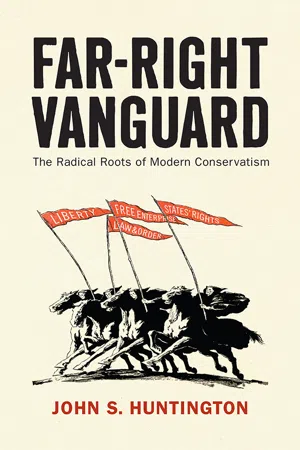
The history of the ultraconservative movement, its national network, and its influence on Republican Party politics Donald Trump shocked the nation in 2016 by winning the presidency through an ultraconservative, anti-immigrant platform, but, despite the electoral surprise, Trump's far-right views were not an aberration, nor even a recent phenomenon. In Far-Right Vanguard, John Huntington shows how, for almost a century, the far right has forced so-called "respectable" conservatives to grapple with their concerns, thereby intensifying right-wing thought and forecasting the trajectory of American politics. Ultraconservatives of the twentieth century were the vanguard of modern conservatism as it exists in the Republican Party of today. Far-Right Vanguard chronicles the history of the ultraconservative movement, its national network, its influence on Republican Party politics, and its centrality to America's rightward turn during the second half of the twentieth century. Often marginalized as outliers, the far right grew out of the same ideological seedbed that nourished mainstream conservatism. Ultraconservatives were true reactionaries, dissenters seeking to peel back the advance of the liberal state, hoping to turn one of the major parties, if not a third party, into a bastion of true conservatism.In the process, ultraconservatives left a deep imprint upon the cultural and philosophical bedrock of American politics. Far-right leaders built their movement through grassroots institutions, like the John Birch Society and Christian Crusade, each one a critical node in the ultraconservative network, a point of convergence for activists, politicians, and businessmen. This vibrant, interconnected web formed the movement's connective tissue and pushed far-right ideas into the political mainstream. Conspiracy theories, nativism, white supremacy, and radical libertarianism permeated far-right organizations, producing an uncompromising mindset and a hyper-partisanship that consumed conservatism and, eventually, the Republican Party.Ultimately, the far right's politics of dissent—against racial progress, federal power, and political moderation—laid the groundwork for the aggrieved, vitriolic conservatism of the twenty-first century.
- 328 pages
- English
- ePUB (mobile friendly)
- Available on iOS & Android
eBook - ePub
About this book
Trusted by 375,005 students
Access to over 1.5 million titles for a fair monthly price.
Study more efficiently using our study tools.
Information
Publisher
University of Pennsylvania PressYear
2021Print ISBN
9780812253474
9780812253474
eBook ISBN
9780812298109
Topic
HistoireSubtopic
Histoire de l'Amérique du NordTable of contents
- Cover
- Title Page
- Copyright
- Dedication
- Contents
- Introduction. The Radical Undercurrent
- Chapter 1. Dissonant Voices
- Chapter 2. Radical Patriots
- Chapter 3. The Cauldron
- Chapter 4. Tightening Networks
- Chapter 5. The Apex
- Chapter 6. The Aftershock
- Epilogue. The Influence of Far-Right Conservatism
- Notes
- Index
- Acknowledgments
Frequently asked questions
Yes, you can cancel anytime from the Subscription tab in your account settings on the Perlego website. Your subscription will stay active until the end of your current billing period. Learn how to cancel your subscription
No, books cannot be downloaded as external files, such as PDFs, for use outside of Perlego. However, you can download books within the Perlego app for offline reading on mobile or tablet. Learn how to download books offline
Perlego offers two plans: Essential and Complete
- Essential is ideal for learners and professionals who enjoy exploring a wide range of subjects. Access the Essential Library with 800,000+ trusted titles and best-sellers across business, personal growth, and the humanities. Includes unlimited reading time and Standard Read Aloud voice.
- Complete: Perfect for advanced learners and researchers needing full, unrestricted access. Unlock 1.5M+ books across hundreds of subjects, including academic and specialized titles. The Complete Plan also includes advanced features like Premium Read Aloud and Research Assistant.
We are an online textbook subscription service, where you can get access to an entire online library for less than the price of a single book per month. With over 1.5 million books across 990+ topics, we’ve got you covered! Learn about our mission
Look out for the read-aloud symbol on your next book to see if you can listen to it. The read-aloud tool reads text aloud for you, highlighting the text as it is being read. You can pause it, speed it up and slow it down. Learn more about Read Aloud
Yes! You can use the Perlego app on both iOS and Android devices to read anytime, anywhere — even offline. Perfect for commutes or when you’re on the go.
Please note we cannot support devices running on iOS 13 and Android 7 or earlier. Learn more about using the app
Please note we cannot support devices running on iOS 13 and Android 7 or earlier. Learn more about using the app
Yes, you can access Far-Right Vanguard by John S. Huntington in PDF and/or ePUB format, as well as other popular books in Histoire & Histoire de l'Amérique du Nord. We have over 1.5 million books available in our catalogue for you to explore.