There is no more contentious and perennial issue in the history of modern Western thought than the vexed relationship between the genesis of an idea and its claim to validity beyond it. Can ideas or values transcend their temporal origins and overcome the sin of their original context, and in so doing earn abiding respect for their intrinsic merit? Or do they inevitably reflect them in ways that undermine their universal aspirations? Are discrete contexts so incommensurable and unique that the smooth passage of ideas from one to the other is impossible? Are we always trapped by the limits of our own cultural standpoints and partial perspectives, or can we somehow escape their constraints and enter into a fruitful dialogue with others?
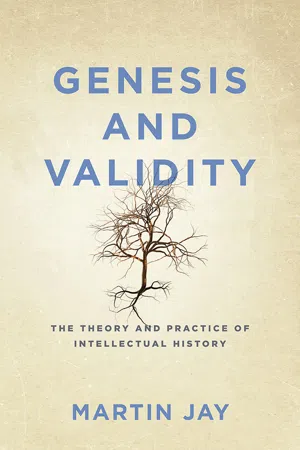
These persistent questions are at the heart of the discipline known as intellectual history, which deals not only with ideas, but also with the men and women who generate, disseminate, and criticize them. The essays in this collection, by one of the most recognized figures in the field, address them through engagement with leading intellectual historians—Hans Blumenberg, Quentin Skinner, Hayden White, Isaiah Berlin, Frank Ankersmit—as well other giants of modern thought—Max Weber, Emile Durkheim, Georg Simmel, Walter Benjamin, Theodor Adorno, and Georg Lukács. They touch on a wide variety of related topics, ranging from the heroism of modern life to the ability of photographs to lie. In addition, they explore the fraught connections between philosophy and theory, the truth of history and the truthfulness of historians, and the weaponization of free speech for other purposes.
- 280 pages
- English
- ePUB (mobile friendly)
- Available on iOS & Android
eBook - ePub
About this book
Information
Topic
PhilosophySubtopic
HistoriographyCHAPTER 1

Impudent Claims and Loathsome Questions: Intellectual History as Judgment of the Past
On November 14, 1956, Theodor W. Adorno addressed a conference in Berlin on the 125th anniversary of Hegel’s death. He began by decrying the genre that has come to be called an “appreciation” (Würdigung) in which the speaker sums up the lasting achievements of the figure celebrated. “It makes the impudent claim,” Adorno charged, “that because one has the dubious good fortune to live later, and because one has a professional interest in the person one is to talk about, one can sovereignly assign the dead person his place, thereby in some sense elevating oneself above him. This arrogance echoes in the loathsome question of what in Kant, and now Hegel as well, has any meaning for the present—and even the so-called Hegel renaissance began half a century ago with a book by Benedetto Croce that undertook to distinguish between what was living and what was dead in Hegel.” Proceeding in this fashion, Adorno went on, prevents us from asking the converse question: “what the present means in the face of Hegel.… All appreciations of Hegel fail from the start to capture the seriousness and cogency of Hegel’s philosophy by practicing on him what he called, with appropriate disdain, a philosophy of perspectives.”1
Whether or not one has to then judge the present specifically from Hegel’s own super-perspective, that of the Absolute Spirit, is an issue I want to leave aside. What I would prefer to address instead is the challenge presented to intellectual history as a whole by Adorno’s critique of the “impudent claim” to superiority by virtue of posterity and the “loathsome question” of the meaning of the past entirely “for us.” Can we, in other words, avoid in this day and age of identity politics and freely acknowledged subject positions the pressure to adopt a historiography of finite, situated perspectives? Can we find a way out of the quicksand of what David Simpson calls “situatedness, or why we keep saying where we’re coming from”?2
Narcissistic presentism is, of course, a perennial problem in all historical analysis, and in one form or another cannot be entirely avoided. That is, the questions we ask and the answers we tend to find persuasive cannot be disentangled from the exigencies of our present condition, assuming of course that there exists a collective “we” whose current state of mind influences these things in a uniform way. This is, needless to say, a very large assumption, but even if we challenge a transcendental notion of the current historical observer and rest content with a multiplicity of different present-day “we’s,” each bringing its own interests, assumptions, and needs to the table, the power of the present is hard to gainsay. The linguistic turn has made us all sensitive to the current tropological emplotments, as Hayden White has called them, that color our narratives of all history, intellectual or otherwise. And commentators like Dominick LaCapra have made us aware as well of the transferential projections that are inevitable impediments to an unmediated relation to the past. These involve, so it would seem, an inevitably moral dimension in our reconstruction of the past.
But are they so overpowering that we are utterly at their mercy in responding to and learning from that past? And are we inevitably forced to impose our standards of what is still relevant and alive in the thought we study, our values about what ideas are “merely historical” and what are of current and perhaps even future viability? Must we write “sovereign appreciations” in which we assign moral grades as well as acknowledgments of the vitality of the work we examine? These questions, which might be asked of all historical inquiry, are especially fraught for intellectual historians. As Peter Gordon has recently argued in his trenchant analysis of the Davos Debate between Ernst Cassirer and Martin Heidegger in 1931, there is a tacit tension between the contextual and transcendental impulses in the intellectual historian’s recovery of past thought.3 That is, we are torn between, on the one hand, understanding it as a symptom of or generated by or indirectly reflecting—the formula is always hard to pin down—something larger or more encompassing that we construe as its historical context and, on the other hand, finding in it perennial lessons, either inspirational or cautionary, as well as still plausible resources for addressing problems in the present. The two are not entirely at odds, but they do not always fit easily together.
Broadly speaking, the contextual impulse is accompanied by a tacit admission of the validity or plausibility or at least comprehensibility of ideas in their original context, which can imply a certain forgiveness if they fail to live up to later standards, either epistemological or normative. That is, contextualization and value relativism are often cozy bedfellows. Explaining and pardoning often, as we know, go together, at least if the explanation depends on a symptomatic reading of a larger context that limits individual responsibility. The historian eschews the role of judge or scold and tries to empathize as best as she might with the figures of a past era, whose horizons were more circumscribed than our own, or at least different from them.
The opposite impulse, valorizing the transcendental implications of ideas, generally betokens a willingness to risk seeing the present as superior to the past in terms of solving problems or learning moral lessons or tolerating differences. It can also be more open to looking for a pattern of ascent in history, reading the story that includes both of our points in time as a meaningful whole, a process of enlightenment or education or the accumulation of experiential wisdom. Sometimes this means a loss of false hopes and the rejection of utopian dreams rather than a faith in their realization, but it still involves privileging the present over the past.
Hegel, to come back to our point of departure, can at times be marshaled on the side of either position. That is, his insistence that the truth manifests itself least in some measure in all previous moments in the grand narrative of history prevents him from judging the past as entirely benighted and morally deficient. The temporalized theodicy in his attitude toward error and partiality means that he shares with contextualists a refusal to judge entirely by current standards, resisting the claim that enlightenment comes only late to those of us lucky enough to live in the present. But conversely, he is also willing to narrate that grand story in ways that infuse it with a transcendental meaning, allowing Minerva’s owl the special wisdom of retrospection, avoiding the relativism that too insistent a contextualizing historicism would abet. Thus if world history can be seen as the world court, in the famous phrase from Schiller he adopted, we are the judge and jury, at least until we are replaced by another generation later on the bench.
Of late, there has been a manifest willingness to adopt that exalted role on the part of certain Anglo-American intellectual historians, who have reacted with scarcely disguised delight at the passing of a moment in cultural cum political fashion that we can roughly call Marxist deconstruction or left post-structuralism. Although loath to adopt anything so grandiose as a Hegelian narrative of rational dialectical development, they nonetheless share an identification with Minerva’s feathered arbiter of the results as they see them. Most prominent among them are Tony Judt, Mark Lilla, and Richard Wolin. Identifying themselves with a version of Enlightenment liberalism that was itself on the defensive during the heyday of that fashion, they have taken their vengeance against a group of thinkers whose political judgments now seem more dubious than they did a generation ago and whose assault on the pieties of liberal bourgeois thought can be blamed for their political mistakes. In works like Past Imperfect, The Reckless Mind, and The Seduction of Unreason, they have charged that these intellectuals were shockingly irresponsible at best and tyrannophile dupes seduced by the lure of power at worst.4 I don’t want now to contest their readings or enter into an extended defense of the figures I have been drawn to most frequently in my own work. Many of the points they make are, in fact, worth taking seriously, at least by those who want to fashion a politics today that learns from past experiments. Rather, what I want to focus on is a larger issue: the assumption that historians are wise to pass such moral judgments on their subjects, allowing themselves to ask the “loathsome questions” and making the “impudent claims” Adorno so disliked in the arrogant “appreciations” of Hegel he tried to resist.
One way to address this question is to probe the status of experience in historical thinking, something I sought to do in my book on Songs of Experience.5 After dealing with Dilthey and Collingwood and their ultimately unsuccessful attempts to conceptualize the primary task of the historian as re-experiencing or re-enacting the Erlebnis of actors in the past, I looked at the more recent debate between Joan Scott and John Toews over the implications of the linguistic turn for the question of experience. I finished with a short discussion of Frank Ankersmit’s defense of what he calls, to cite the title of the book he was about to publish, “sublime historical experience.”6 Arguing against what he sees as the presentist linguistic transcendentalism of Hayden White and Richard Rorty, constructivists who privilege the current cultural context or the tropological imposition of the historian’s own emplotments on a past that lies helpless and passive before his sovereign gaze, Ankersmit also wants to avoid the older and widely discredited objectivism that thinks it can access that past as it actually was. Instead, he seeks to liberate a notion of historical experience that is more akin to aesthetics than anything epistemological, one that inspired the great Dutch historian Johan Huizinga, the author of The Waning of the Middle Ages.
For Huizinga, reconstructive historical imagination in the present is complemented by what he calls an “historical sensation” of the past, which is not akin to the psychological re-experiencing, reliving, or reenacting of someone’s past experience or thoughts. It is rather one of many variants of ecstasies, of an experience of truth that is given to the human being:
the object of this sensation are not individual human beings, nor human lives or human thoughts insofar as these possess discernible contours. It can hardly be called an image what the mind forms here or undergoes. Insofar as it takes on any distinct form at all, this form remains composite and vague.… This contact with the past, which is accompanied by the absolute conviction of complete authenticity and truth, can be provoked by a line from a chronicle, by an engraving, a few sounds from an old song. It is not an element that the author writing in the past deliberately puts down in his work. It is “behind” and not “in” the book that the past has left us.7
For Ankersmit, Huizinga’s somewhat inchoate idea of a sudden illumination of the past precipitated by an unexpected encounter with some trace or residue of radical otherness provides a model for historical experience that is neither dominated by the present nor entirely reducible to the recovery of a past experience that allows itself to be recaptured. It is more akin to that intimation of something there, but impossible to represent that the aesthetics of the sublime tries to capture or at least toward which it gestures. It resists domesticating and mastering the other it cannot fully represent by fully historicizing the residues in a comfortably smooth context that reduces them to exemplars or symptoms or instances of an era whose complexities and contradictions are suppressed. Nor, however, does it judge them by the standards of the present or see them as nothing but projections of current rhetorical or ideological needs. Instead, it pays heed to their mysterious effect on us as objects that produce new experiences rather than merely confirm the ones we already have had.
There is a lot more that can be said about Ankersmit’s attempt to validate sublime historical experience and keep at bay the inevitable epistemological questions that cannot be entirely brushed aside by historians who want to evaluate the accounts we write after Huizinga’s historical sensations have passed and we sit down to convey them to others in meaningful form. What his version of historical experience does allow us to understand, broadly speaking, is that the choice Peter Gordon poses between transcendental presentism and contextualizing historicism has to be supplemented by a third relationship to the past. That is, it alerts us to the possibility that we are located in a triangulated constellation with three poles: (1) the past as an englobing and perhaps coherent context that we can recapture and then employ to situate and make meaningful intellectual production that we may not find plausible by contemporary standards; (2) the present as the place where we are ourselves inevitably located and from which our judgments, implicit or explicit, flow, a present in which paradoxically we cannot avoid holding beliefs as if they were more than just expressions of our own limited horizons; and (3) perhaps most elusively, the experience of a radically incommensurable past that defies both reassuring contextualization in terms of an outdated coherent cultural whole, which we can comfortably reconstruct, and a no less easy dismissal according to current standards of truth or value that can be claimed to be superior to it. That is, it disrupts both the assumption that full narrative contextualization can be made of the past and that the present has the authority to judge the past rather than, as Adorno intimates in the case of Hegel, be judged by it. Such experiences, sublime or otherwise, are reminders that we come to history to be torn out of the complacency of the present, not to confirm our superiority by condescendingly assuming our ability to “appreciate,” that is, judge it from our own perspective. In terms of intellectual history, this means opening ourselves to the possibility that even the most seemingly benighted errors of previous thinkers whose follies we think we have left behind may nonetheless still have something to teach us. Or more precisely, we may learn something from them, only if we learn how to open ourselves to the alterity of a past that resists domestication by either the powers of contextual historicism or transcendental moralizing.
CHAPTER 2
Historical Explanation and the Event: Reflections on the Limits of Contextualization
Intellectuals are people who produce decontextualized ideas.— Randall Collins
For intellectual historians, no more powerful defense of the importance of contextual explanation has been launched than that mounted a generation ago by Quentin Skinner, J. G. A. Pocock, and their colleagues in the so-called Cambridge School of intellectual history.1 Targeting the anachronistic presentism that encouraged historians to designate past thinkers precursors of later movements that were not yet in self-conscious existence, Skinner urged them to situate intellectuals and texts in their immediate contexts of generation and reception. Arguing against the fallacy of attributing a timeless essence to concepts or ideas that emerged only in particular historical circumstances, he warned against isolating even perennial keywords, such as those traced by Raymond Williams, from the changing discursive constellations in which they were situated.2 Scorning the quest for a usable past that would be relevant to current concerns, he urged historians to honor the radical otherness of the past.
It was crucial, Skinner argued, to recover the original matrix of conventions and assumptions out of which a text emerged and into which it was inserted. The intention of the author could not be understood from the words in the text alone, what speech act theorists called their locutionary meaning, but could only be recovered when their illocutionary or performative force was also grasped. That is, texts were meant to do something, to have an effect on the world, not merely to describe it or express the ideas of their authors. They were communicative acts dependent on the conventions and usages of their day in order to be effective. They contained arguments meant to persuade, not merely propositions about the world or expressions of inner states of mind. Whether or not they achieved what they set out to do—their perlocutionary effect—was another question. But unless we appreciated what an author like, say, Hobbes or Locke had intended to accomplish with his intervention in the discourse of his time, we were in danger of missing the true historical meaning of his or her efforts. In other words, every text had to be understood finitely, but holistically, as a response to the unanswered or unsatisfactorily answered questions of the day, not as a contribution to an omnitemporal conversation outside of any historical context.
Although there may well be a surplus of meaning in a text beyond the author’s intention—a point Skinner willingly granted3—the historically productive point of departure had to be the intentionality of the author understood as embedded in a particular force field of discursive relations. Radical contextualism, which has become such a bugaboo for philosophers anxious to avoid relativism and defend transcendental truths, was thus not a problem for historians dedicated to telling particular, contingent stories about the past.4 Following the lead of anthropologists like Clifford Geertz with his celebrated exhortation to interpret the dense webs of relatively coherent meaning that we call culture, historians should set out to make sense of wh...
Table of contents
- Cover
- Title Page
- Copyright
- Dedication
- Contents
- Introduction
- Chapter 1. Impudent Claims and Loathsome Questions: Intellectual History as Judgment of the Past
- Chapter 2. Historical Explanation and the Event: Reflections on the Limits of Contextualization
- Chapter 3. Intention and Irony: The Missed Encounter Between Hayden White and Quentin Skinner
- Chapter 4. Walter Benjamin and Isaiah Berlin: Modes of Jewish Intellectual Life in the Twentieth Century
- Chapter 5. Against Rigor: Hans Blumenberg on Freud and Arendt
- Chapter 6. “Hey! What’s the Big Idea?”: Ruminations on the Question of Scale in Intellectual History
- Chapter 7. Fidelity to the Event? Lukács’s History and Class Consciousness and the Russian Revolution
- Chapter 8. Can Photographs Lie? Reflections on a Perennial Anxiety
- Chapter 9. Sublime Historical Experience, Real Presence, and Photography
- Chapter 10. The Heroism of Modern Life and the Sociology of Modernization: Durkheim, Weber, and Simmel
- Chapter 11. Historical Truth and the Truthfulness of Historians
- Chapter 12. Theory and Philosophy: Antonyms in Our Semantic Field?
- Chapter 13. The Weaponization of Free Speech
- Notes
- Index
- Acknowledgments
Trusted by 375,005 students
Access to over 1.5 million titles for a fair monthly price.
Study more efficiently using our study tools.
Frequently asked questions
Yes, you can cancel anytime from the Subscription tab in your account settings on the Perlego website. Your subscription will stay active until the end of your current billing period. Learn how to cancel your subscription
No, books cannot be downloaded as external files, such as PDFs, for use outside of Perlego. However, you can download books within the Perlego app for offline reading on mobile or tablet. Learn how to download books offline
Perlego offers two plans: Essential and Complete
- Essential is ideal for learners and professionals who enjoy exploring a wide range of subjects. Access the Essential Library with 800,000+ trusted titles and best-sellers across business, personal growth, and the humanities. Includes unlimited reading time and Standard Read Aloud voice.
- Complete: Perfect for advanced learners and researchers needing full, unrestricted access. Unlock 1.5M+ books across hundreds of subjects, including academic and specialized titles. The Complete Plan also includes advanced features like Premium Read Aloud and Research Assistant.
We are an online textbook subscription service, where you can get access to an entire online library for less than the price of a single book per month. With over 1.5 million books across 990+ topics, we’ve got you covered! Learn about our mission
Look out for the read-aloud symbol on your next book to see if you can listen to it. The read-aloud tool reads text aloud for you, highlighting the text as it is being read. You can pause it, speed it up and slow it down. Learn more about Read Aloud
Yes! You can use the Perlego app on both iOS and Android devices to read anytime, anywhere — even offline. Perfect for commutes or when you’re on the go.
Please note we cannot support devices running on iOS 13 and Android 7 or earlier. Learn more about using the app
Please note we cannot support devices running on iOS 13 and Android 7 or earlier. Learn more about using the app
Yes, you can access Genesis and Validity by Martin Jay in PDF and/or ePUB format, as well as other popular books in Philosophy & Historiography. We have over 1.5 million books available in our catalogue for you to explore.