Illusions of Empire adopts a multinational view of North American borderlands, examining the ways in which Mexico's North overlapped with the U.S. Southwest in the context of diplomacy, politics, economics, and military operations during the Civil War era.
William S. Kiser examines a fascinating series of events in which a disparate group of historical actors vied for power and control along the U.S.-Mexico border: from Union and Confederate generals and presidents, to Indigenous groups, diplomatic officials, bandits, and revolutionaries, to a Mexican president, a Mexican monarch, and a French king. Their unconventional approaches to foreign relations demonstrate the complex ways that individuals influence the course of global affairs and reveal that borderlands simultaneously enable and stifle the growth of empires.
This is the first study to treat antebellum U.S. foreign policy, Civil War campaigning, the French Intervention in Mexico, Southwestern Indian Wars, South Texas Bandit Wars, and U.S. Reconstruction in a single volume, balancing U.S. and Mexican source materials to tell an important story of borderlands conflict with ramifications that are still felt in the region today.
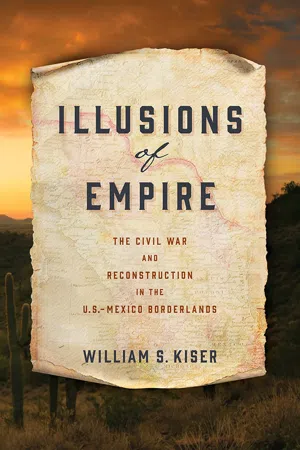
eBook - ePub
Illusions of Empire
The Civil War and Reconstruction in the U.S.-Mexico Borderlands
- 304 pages
- English
- ePUB (mobile friendly)
- Available on iOS & Android
eBook - ePub
About this book
Information
Publisher
University of Pennsylvania PressYear
2021Print ISBN
9780812253511
9780812253511
eBook ISBN
9780812298147
CHAPTER 1

The Origins of Irregular Diplomacy in U.S.-Mexico Relations
Texas turned out to be a headache for the leaders of independent Mexico. In 1828, the central government selected General Manuel Mier y Terán as a boundary commissioner and sent him to determine the international border between the Mexican northeast and the American Southwest. The Adams-Onís Treaty between the United States and Spain, finalized almost a decade earlier, laid out the basic parameters for the boundary line, but that line had yet to be definitively surveyed. Because Texas posed several urgent challenges to the fledgling Mexican republic—most notably Indian raiding and American colonizing—Mier y Terán also had instructions to observe the influence that foreign empresarios were asserting over the Tejano population. When the general submitted his final report, it must have startled Mexican leaders. His prescient observations suggested that Texas was already slipping from Mexico’s grasp, and he predicted that serious diplomatic and political difficulties lay in the immediate future.1
Mier y Terán visited dozens of Texas towns and plantations and met with Tejano and Anglo inhabitants, giving him an understanding of rapidly evolving events on Mexico’s northeastern frontier. “The department of Texas is contiguous to the most avid nation in the world,” he cautioned in reference to the United States. With a hint of trepidation, he pointed out that Americans, in the five decades since their independence, “have conquered whatever territory adjoins them” and in so doing “become masters of extensive colonies which formerly belonged to Spain and France, and of even more spacious territories from which have disappeared the former owners, the Indian tribes.” The most extraordinary aspect of American expansion, however, was not the rapidity with which it kept happening. Far more concerning, he believed, were the sneaky methods that migrating Americans and their political leaders used to conquer and absorb new territory. His explanation was both a paean to the determination and efficiency of the foreign interlopers as well as a stark warning to Mexico’s government officials. “There is no power like that to the north, which by silent means has made conquests of momentous importance,” he warned after viewing the methods at work in Texas. “Such dexterity, such constancy in their designs, such uniformity of means of execution which always are completely successful, arouses admiration.” Traditionally, expanding empires employed much more overt and violent tactics in their conquests, but the American empresarios that he met in Texas seemed to have perfected a safer and equally effective technique for asserting control over land and people. “Instead of armies, battles, or invasions—which make a great noise and for the most part are unsuccessful—these men lay hand on means that, if considered one by one, would be rejected as slow, ineffective, and at times palpably absurd,” the officer added.2
Mier y Terán was not the only one sounding alarms about American encroachment. The French botanist Jean Louis Berlandier, who accompanied the 1828 expedition, noted that Anglo Americans seemed to be establishing “a monopoly” over Texas agriculture, and he came to the conclusion that native Tejanos “cannot vie in any respect with those industrious colonists.”3 That same year, an artillery lieutenant named José María Sánchez noticed that “North Americans have taken possession of almost all of the eastern part of Texas, in most cases without the knowledge of the authorities, since they emigrate incessantly without anyone to hinder them, taking possession of whatever place suits them, without asking.” By that time, he claimed, only San Antonio de Béxar and Nacogdoches retained Tejano-majority populations.4 In a speech to Mexican legislators two years later, the statesman Lucas Alamán cited these reports when referring to American settlement in Texas as “the progress of … evil.”5 It was apparent to firsthand witnesses that these newcomers had begun circumventing open diplomacy using a process of gradual conquest by settlement, taking advantage of the porous borderlands to expand American empire. All the migrants needed was an excuse for settling on foreign land—however extralegal or fanciful it might be—and once they gained that crucial foothold, the process of Americanization would be set in motion. When the aforementioned officers compiled their reports, empresarios and their colonial followers had been living west of the Sabine River for just five years, but already the U.S. government was working assiduously to purchase Texas and arrange for its annexation as a slaveholding state. The accounts of Mier y Terán, Berlandier, and Sánchez provide glimpses into one of the most well-known causes of diplomatic controversy between the United States and Mexico—the colonization of Texas—but the methods of settlement and political incorporation that the three men described would be repeated again and again over the next four decades. The United States and Mexico developed an increasingly fraught relationship, resulting in unconventional diplomatic techniques that finally reached their apex during the chaotic 1860s.
Mexico gained its independence in 1821, and less than a year later, President James Monroe publicly recommended diplomatic recognition, making the United States one of the first nations to acknowledge Mexican sovereignty.6 As a testament to the power and influence of Indians on the country’s northern frontier, the new government also negotiated treaties with Comanches and Lipan Apaches within months of breaking from Spain. No sooner had Mexico become independent than a team of diplomats propositioned chiefs Barbaquista, Pisinampe, and Quenoc for peace. At a camp of five thousand Coman-ches, these tribal leaders convened a council that debated for three days before agreeing to sign a treaty at San Antonio in the summer of 1822. Several months later, another indigenous delegation under Chief Guonique rode to Mexico City, where they finalized a pact in which tribal diplomats acknowledged Mexican sovereignty in exchange for a reciprocal recognition of the “Comanche Nation.” Mexico also agreed to generous terms for trade, allowed the tribe to keep captives, and assigned a permanent diplomat to serve Comanche interests in much the same way that a minister plenipotentiary would do in a foreign embassy.7 That same year, Lipan chiefs Cuelga de Castro, El Cojo, and Poca Ropa also traveled to Mexico City for a peace agreement. They stayed at the capital for several months, lodging in the Colegio Apostólico de San Fernando, and in September finally made their marks upon a treaty that granted land for farming and pasturage, allowed tribe members to claim unbranded livestock, and promised government protection from enemies in exchange for the forgiveness of past wrongs and formal recognition of the Mexican government.8
Although Mexico initially came under the rule of Emperor Agustín de Iturbide—the three Lipan Apache chiefs and the Comanche leader Guonique all witnessed his coronation ceremony—the country managed to enact a democratic constitution in 1824 that, among other things, granted territorial status to New Mexico and statehood to the northern provinces of Tamaulipas, Nuevo León, Chihuahua, Durango, and Occidente (later split into Sinaloa and Sonora).9 In 1825, Joel Poinsett was dispatched as the first American minister to serve in Mexico City, and the following year, commerce between the two countries exceeded $10 million in imports and exports.10 To the casual observer, these auspicious beginnings gave the impression that Mexico was headed for political stability and economic prosperity, but in truth, the country’s relationship with other nations, including independent Indians in Texas and New Mexico, had already begun to deteriorate, as even the most basic diplomatic interchanges tended to elicit stark disparities over foreign policy.
The seeds of discord between Mexico and Europe were sown with remarkable rapidity. Within a decade of achieving nationhood, leaders in Mexico City had already saddled themselves with enormous debts to English and French benefactors.11 In 1824–1825, British companies loaned £6.4 million to Mexico at interest rates ranging from 5 to 6 percent. Beginning in 1826, Mexico added an average of $7.2 million to its national deficit each year, so that by 1844 the treasury found itself nearly $115 million (roughly $6 billion in 2020 dollars) in arrears.12 During its first three decades of independence, Mexico sustained massive shortfalls because its tax revenues never came close to equaling federal expenditures, even though, according to one eyewitness, the government had undertaken “the experiment of how much taxation the people can bear.”13 Each year, monetary shortages necessitated additional foreign loans to keep the nation afloat. Recalling the riches in silver and gold that Mexico produced during its colonial era, European firms sensed a lucrative investment opportunity and were eager at first to lend money. Acting on hindsight, financiers drastically underestimated Mexico’s fiscal straits and failed to anticipate the country’s inability to repay what it owed.14 “They borrow money, and lavish it as if it formed part of their annual income,” Poinsett wrote after his tenure as foreign minister ended. He added, “They anticipate their revenue at a ruinous sacrifice, and make no permanent provision for repaying their debt.”15 By 1838, in what came to be known as the Pastry War, France was sending battleships to blockade the Mexican coast at Tampico and Vera Cruz in an attempt to coerce amortization of mounting financial obligations.16 Economic uncertainty and foreign debts beleaguered Mexico’s early republic and led to the chronic political instability that plagued the country for many years. Nationhood had set off a self-defeating cycle for independent Mexico: inadequate tax revenue necessitated foreign loans, which prompted economic dependency on outside sources, and that in turn fostered political weakness that re-created the need for more loans, leading to diplomatic crises as Europe held Mexico accountable for its debts.17
While difficulties between Mexico and Europe began in the 1820s, the roots of troubled diplomacy with nomadic Indians on the northern frontier stretched back to the Spanish colonial era, and those conflicts would be exacerbated following independence. Comanches and Lipan Apaches in Texas posed the most serious threat to Mexican interests, although Chiricahua and Mescalero Apaches in New Mexico also raided and waged war with devastating effect.18 Initial tribal recognitions of Mexican sovereignty in 1822 proved unsustainable, largely because the country was unable to fulfill its treaty obligations. Within two years, the governor of Coahuila y Tejas predicted that the peace agreements would fail, as Comanches and Lipans raided frontier settlements with increasing intensity. National and local representatives negotiated new pacts with these powerful indigenous groups, one example being a treaty that the Comanche diplomatist Paruakevitsi approved at San Antonio in 1827. But four years later, when Tejanos commanded by Captain Manuel Lafuente killed Paruakevitsi during a haphazard attack on his camp, relations devolved once more into violence, and the contract became meaningless.19
Similar episodes of treachery occurred with shocking regularity throughout Mexico’s far north, where diplomatic resolutions proved difficult to attain. Chihuahua and Sonora sustained tentative conditions of peace with some subgroups of Chiricahua and Mescalero Apaches throughout the 1820s, issuing rations and supplies at establecimientos de paz (peace establishments) near towns like Janos and San Elizario. As Mexico’s fiscal straits deepened, funding for these subsistence programs dried up, and a smallpox epidemic compounded the stress. Under the leadership of Chiricahua chief Juan José Compá, some of the last remaining Apaches de paz deserted the establecimientos in the fall of 1831 and took to the warpath. In the first fifteen years of Mexican independence, Indians killed some five thousand fronterizos, and Mexicans reciprocated at every opportunity.20 One of the most renowned Apache diplomats of his time, Compá himself perished in 1837 when Sonora’s first experiment with bounty systems motivated a team of scalp hunters to blast twenty Indians with a hidden cannon during a trade fair. In the 1840s, state governments in Sonora, Chihuahua, and Durango settled on paid scalping and mercenary warfare as their preferred methods for dealing with Apaches, Comanches, Kiowas, Seris, and Yaquis, the result being a series of genocidal massacres that claimed the lives of hundreds of Indians and saw many more sold into slavery.21
When Indians did negotiate treaties, their Mexican counterparts usually acted at the state rather than national level, meaning that at any given time Chihuahua could be at peace with the same Apaches that Sonora was fighting or New Mexico might be in friendship with the same Comanches that Texas waged war upon. State leaders often encouraged different tribes to attack one another, and scalp-hunting gangs included Delaware and Shawnee operatives, further confounding diplomacy and creating a confusing atmosphere of borderlands violence that militated against any long-lasting or all-encompassing peace pacts.22 Donaciano Vigil, a legislator in New Mexico, expressed the frustration that many Hispanos felt over this issue, criticizing the central government for neglecting the safety of its frontier inhabitants. “The peculiar location of our country, surrounded on all sides by heathen Indians who harass us most of the time … reduces New Mexico to a state of anxiety and distress,” he inveighed, pointing out that no other state or province was so egregiously ignored by the nation’s leaders.23 These dilemmas arose in part because of the pervasive spirit of federalism on the northern frontier, where state governments were unable or unwilling to act cohesively as a national unit and instead pursued their own courses with Indian tribes. Antonio López de Santa Anna criticized the Mexican north for this, saying that the lack of military cooperation in that region had “placed the peaceful inhabitants at the mercy of the aggressors.”24 Policies for preventing Indian raids became an important political issue across northern Mexico, and a convoluted borderlands environment emerged wherein Apaches of the Chiricahua, Lipan, Mescalero, and Western groups, Comanches from the Hois, Kotsoteka, Tenewa, and Yamparika divisions, as well as Indians from the Kiowa, Seri, Tarahumara, and Yaqui tribes found themselves interacting separately with Texas, New Mexico, Sonora, Chihuahua, Durango, Coahuila, Nuevo León, Tamaulipas, and even the United States in a maelstrom of diplomac...
Table of contents
- Cover
- Title Page
- Copyright
- Dedication
- Contents
- Introduction
- Chapter 1. The Origins of Irregular Diplomacy in U.S.-Mexico Relations
- Chapter 2. The Contest for Chihuahua and Sonora
- Chapter 3. Confederate Lifelines in Northeast Mexico
- Chapter 4. Chaos and Imperialism in Northwest Mexico
- Chapter 5. The Shifting Tides of War and Diplomacy in Northeast Mexico
- Conclusion
- Notes
- Bibliography
- Index
- Acknowledgments
Trusted by 375,005 students
Access to over 1.5 million titles for a fair monthly price.
Study more efficiently using our study tools.
Frequently asked questions
Yes, you can cancel anytime from the Subscription tab in your account settings on the Perlego website. Your subscription will stay active until the end of your current billing period. Learn how to cancel your subscription
No, books cannot be downloaded as external files, such as PDFs, for use outside of Perlego. However, you can download books within the Perlego app for offline reading on mobile or tablet. Learn how to download books offline
Perlego offers two plans: Essential and Complete
- Essential is ideal for learners and professionals who enjoy exploring a wide range of subjects. Access the Essential Library with 800,000+ trusted titles and best-sellers across business, personal growth, and the humanities. Includes unlimited reading time and Standard Read Aloud voice.
- Complete: Perfect for advanced learners and researchers needing full, unrestricted access. Unlock 1.5M+ books across hundreds of subjects, including academic and specialized titles. The Complete Plan also includes advanced features like Premium Read Aloud and Research Assistant.
We are an online textbook subscription service, where you can get access to an entire online library for less than the price of a single book per month. With over 1.5 million books across 990+ topics, we’ve got you covered! Learn about our mission
Look out for the read-aloud symbol on your next book to see if you can listen to it. The read-aloud tool reads text aloud for you, highlighting the text as it is being read. You can pause it, speed it up and slow it down. Learn more about Read Aloud
Yes! You can use the Perlego app on both iOS and Android devices to read anytime, anywhere — even offline. Perfect for commutes or when you’re on the go.
Please note we cannot support devices running on iOS 13 and Android 7 or earlier. Learn more about using the app
Please note we cannot support devices running on iOS 13 and Android 7 or earlier. Learn more about using the app
Yes, you can access Illusions of Empire by William S. Kiser in PDF and/or ePUB format, as well as other popular books in History & American Civil War History. We have over 1.5 million books available in our catalogue for you to explore.