We do not have many definitions of Christianity from late antiquity, but among the few extant is the brief statement of Gregory of Nyssa (335-395 CE) that it is "mimesis of the divine nature." The sentence is both a historical gem and theologically puzzling. Gregory was the first Christian to make the infinity of God central to his theological program, but how could he intend for humans to imitate the infinite? If the aim of the Christian life is "never to stop growing towards what is better and never to place any limit on perfection," how could mimesis function within this endless pursuit?
In Imitations of Infinity, Michael A. Motia situates Gregory among Platonist philosophers, rhetorical teachers, and early Christian leaders to demonstrate how much of late ancient life was governed by notions of imitation. Questions both intimate and immense, of education, childcare, or cosmology, all found form in a relationship of archetype and image. It is no wonder that these debates demanded the attention of people at every level of the Roman Empire, including the Christians looking to form new social habits and norms. Whatever else the late ancient transformation of the empire affected, it changed the names, spaces, and characters that filled the imagination and common sense of its citizens, and it changed how they thought of their imitations.
Like religion, imitation was a way to organize the world and a way to reach toward new possibilities, Motia argues, and two earlier conceptions of mimesis—one centering on ontological participation, the other on aesthetic representation—merged in late antiquity. As philosophers and religious leaders pondered how linking oneself to reality depended on practices of representation, their theoretical debates accompanied practical concerns about what kinds of objects would best guide practitioners toward the divine. Motia places Gregory within a broader landscape of figures who retheorized the role of mimesis in search of perfection. No longer was imitation a marker of inauthenticity or immaturity. Mimesis became a way of life.
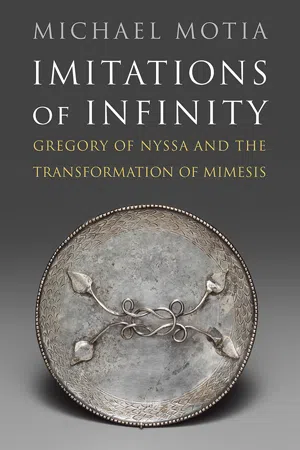
eBook - ePub
Imitations of Infinity
Gregory of Nyssa and the Transformation of Mimesis
- 312 pages
- English
- ePUB (mobile friendly)
- Available on iOS & Android
eBook - ePub
Imitations of Infinity
Gregory of Nyssa and the Transformation of Mimesis
About this book
Information
Publisher
University of Pennsylvania PressYear
2021Print ISBN
9780812253139
9780812253139
eBook ISBN
9780812299618
Topic
Theology & ReligionSubtopic
Christian TheologyTable of contents
- Cover Page
- Title Page
- Copyright Page
- Dedication Page
- Contents
- Introduction. The Mimetic Life
- Chapter 1. Two Tracks of Mimesis
- Chapter 2. Crossing Tracks: Mimesis in Neoplatonism
- Chapter 3. Early Christian Mimesis
- Chapter 4. Mimetic Names
- Chapter 5. Mimetic Spaces
- Chapter 6. Mimetic Characters
- Conclusion. Mimesis and Mystery
- List of Abbreviations
- Notes
- Bibliography
- Index
- Acknowledgments
Trusted by 375,005 students
Access to over 1.5 million titles for a fair monthly price.
Study more efficiently using our study tools.
Frequently asked questions
Yes, you can cancel anytime from the Subscription tab in your account settings on the Perlego website. Your subscription will stay active until the end of your current billing period. Learn how to cancel your subscription
No, books cannot be downloaded as external files, such as PDFs, for use outside of Perlego. However, you can download books within the Perlego app for offline reading on mobile or tablet. Learn how to download books offline
Perlego offers two plans: Essential and Complete
- Essential is ideal for learners and professionals who enjoy exploring a wide range of subjects. Access the Essential Library with 800,000+ trusted titles and best-sellers across business, personal growth, and the humanities. Includes unlimited reading time and Standard Read Aloud voice.
- Complete: Perfect for advanced learners and researchers needing full, unrestricted access. Unlock 1.5M+ books across hundreds of subjects, including academic and specialized titles. The Complete Plan also includes advanced features like Premium Read Aloud and Research Assistant.
We are an online textbook subscription service, where you can get access to an entire online library for less than the price of a single book per month. With over 1.5 million books across 990+ topics, we’ve got you covered! Learn about our mission
Look out for the read-aloud symbol on your next book to see if you can listen to it. The read-aloud tool reads text aloud for you, highlighting the text as it is being read. You can pause it, speed it up and slow it down. Learn more about Read Aloud
Yes! You can use the Perlego app on both iOS and Android devices to read anytime, anywhere — even offline. Perfect for commutes or when you’re on the go.
Please note we cannot support devices running on iOS 13 and Android 7 or earlier. Learn more about using the app
Please note we cannot support devices running on iOS 13 and Android 7 or earlier. Learn more about using the app
Yes, you can access Imitations of Infinity by Michael Motia,Michael A. Motia in PDF and/or ePUB format, as well as other popular books in Theology & Religion & Christian Theology. We have over 1.5 million books available in our catalogue for you to explore.