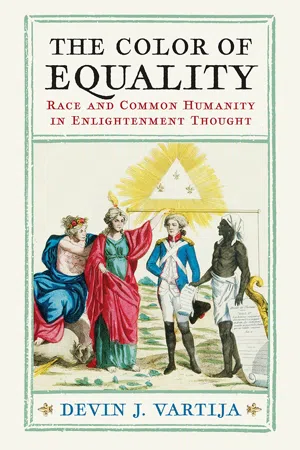
The Enlightenment is often either praised as the wellspring of modern egalitarianism or condemned as the cradle of scientific racism. How should we make sense of this paradox? The Color of Equality is the first book to investigate both the inclusive language of common humanity and the hierarchical language of race in Enlightenment thought, seeking to understand how eighteenth-century thinkers themselves made sense of these tensions. Using three major Enlightenment encyclopedias from England, France, and Switzerland, the book provides a rich contextualization of the conflicting ideas of equality and race in eighteenth-century thought.
Enlightenment thinkers used physical features to categorize humanity into novel "racial" groups in a discourse that was imbued with Eurocentric aesthetic and moral judgments. Simultaneously, however, these very same thinkers politicized equality by putting it to new uses, such as a vitriolic denunciation of slavery and inhumane treatment that was grounded in the nascent philosophy of human rights. Vartija contends that the tension between Enlightenment ideas of race and equality can best be explained by these thinkers' attempt to provide a naturalistic account of humanity, including both our physical and moral attributes. Enlightenment racial classification fits into the novel inclusion of humanity in histories of nature, while the search for the origins of morality in social experience alone lent equality a normative authority it had not previously possessed.
Eschewing straightforward approbation or blame of the Enlightenment, The Color of Equality demonstrates that our present-day thinking about human physical and cultural diversity continues to be deeply informed by an eighteenth-century European intellectual revolution with global ramifications.
- 312 pages
- English
- ePUB (mobile friendly)
- Available on iOS & Android
eBook - ePub
About this book
Information
Publisher
University of Pennsylvania PressYear
2021Print ISBN
9780812253191
9780812253191
eBook ISBN
9780812299670
CHAPTER 1

Early Modern Debates on Human Sameness and Difference
No two human beings are exactly alike and thus they are unequal in a very basic sense. Looking at the empirical world, a positivist would conclude that inequality is palpable, natural, and perhaps inevitable, and this is what makes equality so significant, because it must be invented and imagined.1 An in-group notion of equality as fairness has arguably always been a part of human communities, but so too has some measure of hierarchy, not to mention hostility toward foreigners.2 With the first Western theorizations of equality, in the context of the Greek polis, Aristotle’s reflections stand out for their enduring impact. He famously asserted that justice is a “kind of equality,” yet in his Politics, he also posited the existence of natural slaves.3 This potentially contradictory position is circumvented because justice means treating like alike, and, because nature has created an inferior class of human beings, one need not, in fact must not (according to Aristotle’s argument), treat natural slaves as the equals of free citizens.4 While nearly all of the major early modern philosophers rejected Aristotle’s idea of natural slavery, they seem to have performed a similar argumentative maneuver in restricting the applicability of such universalist statements as “all men are created equal.” Although assertions of the natural equality of human beings were a common feature of early Greek and Roman philosophy and Christian theology which endured through the medieval period, prominent thinkers seem not to have been troubled in defending strict social hierarchies or even slavery, often justifying such inequalities as a consequence of humankind’s fallen state.5
These past “shortcomings” in egalitarian thinking are sketched not to praise present-day moral and ethical consistency or achievement, but rather to demonstrate that professing human equality as a fact or ideal is not sufficient for its thoroughgoing defense in a given political or social system. We have to place reflections on equality and inequality—the interplay between reflections on what we share and what sets us apart and why they matter—in a specific context in order to understand what a given thinker was trying to achieve in writing about natural equality or inequality. This chapter lays out the early modern context of European debates concerning human origins and history, physical diversity, and equality in order to better understand the significance of the Enlightenment encyclopedists’ interventions. Because the modern racial classificatory system developed within the discipline of natural history, I pay particular attention to this field of inquiry. With regard to equality, natural law and arguments for women’s equality were particularly important in the evolution of Enlightenment thinking on the subject, and so I concentrate on these genres and perspectives to illuminate how eighteenth-century thinkers transformed egalitarian thought. I conclude with remarks on how these ideas overlapped and what the present research contributes to the existing historiography.
All but a handful of early modern European theories of human diversity took for granted the monogenetic creation story of Genesis and the descent of humankind from Noah’s three sons following the biblical flood.6 The traditional Christian account held that Europeans could trace their origins to Japhet; Africans, to the cursed Ham; and Semites, to Shem. Disdain for non-Christians and dark pigmentation is evident in this myth, because blackness was considered a curse.7 More generally, blackness was often associated with sin, evil, and heresy in Christian mythology, though not uniformly given the use of black clothing by some Christian religious orders.8 Skin color and other physical features, while remarked upon by early modern travelers, were not used as the basis of a classificatory system until the late seventeenth century. In her classic study of sixteenth- and seventeenth-century anthropological and ethnological thought, Margaret Hodgen remarks that while skin color may have been a divisive factor in cultural interactions, it would be anachronistic to speak of race in the modern sense for this period.9 Instead, Europeans tended to classify peoples based on shared language and religion. Christianity played an important role here, bequeathing to early modern Europeans a powerful monogenetic legacy and an emphasis on humanity’s linguistic and religious diversity, as opposed to physical diversity. However, scholars have also noted that this did not prevent deeply racialist interpretations of Scripture throughout the centuries of European expansion.10
The Expansion of Natural History and the Transformations of a Racial Worldview
As Michel de Montaigne wrote, “Human eyes cannot perceive things but in the shape they know them by.”11 We can apply this general insight to make sense of the ways in which early modern Europeans incorporated Native Americans into their worldviews, underpinned as they were by a canon of texts from a circumscribed number of classical and Christian thinkers, in addition to the Bible.12 Following the incorporation of Aristotelian anthropological categories into Christian thought by Albertus Magnus and Thomas Aquinas in the thirteenth century, “barbarian” referred to both non-Christians and to peoples who behaved in “uncivil” ways.13 Throughout the sixteenth century, Europeans made one-to-one comparisons of New World peoples with Ethiopians and with Aristotle’s favorite barbarians, the Thracians. In the initial debates concerning the status and nature of Native Americans among theologians of the Castilian crown in the late fifteenth and early sixteenth century, Aristotle’s argument for the existence of natural slavery was used to justify the enslavement of the Antillean population, which was “uncivilized” in the rudimentary sense that they did not live in cities.
The debate changed, however, upon the discovery of the Aztec and Incan Empires in the early sixteenth century. Francisco de Vitoria, one of the most influential theologians in the so-called School of Salamanca, rejected that the New World peoples were Aristotelian natural slaves, since they fulfilled the basic requirements of “civil life.” Nonetheless, the European colonists maintained that New World peoples were cannibals and that some performed human sacrifice, characteristics that denigrated the status of Native Americans. Sixteenth-century Europeans thought that cannibalism went against the law of nature (ius naturale), and Vitoria argued that the Native Americans had thus failed to interpret the natural world correctly but, as civil beings, they possessed reason in potentia.14 In this way, Anthony Pagden argues that Vitoria brought Native Americans “into” the European worldview at the lowest possible social and human levels.15 Even when Vitoria and some of his contemporaries criticized the cruelty of Spanish colonialism, they still argued that Native Americans had to be converted to Christianity, revealing what Siep Stuurman has called the “limits of Christian equality.”16
Other important sixteenth-century Spanish theorists who would have an enduring impact on early modern ethnology were Bartolomé de Las Casas and José de Acosta. In his Apologética historia summaria de las gentes destas Indias (Apologetic History of the Indies, 1536), Las Casas aimed to show that precontact Native American societies were civil in an Aristotelian sense and that their “barbarism” was not primary and absolute but relative. To explain why their societies were so radically and shockingly different from European society, Las Casas drew on Hippocratic climatic theory and Aquinas’s idea of adherence to perverse customs.17 He argued that the difference of Native American society was not one of kind but of degree, as all peoples had performed human sacrifice in the distant past and that these peoples were simply at an earlier stage of a developmental process.18 José de Acosta, a Jesuit missionary who lived in South America for seventeen years, would elaborate on this developmental view of history in his Historia natural y moral de las Indias (Natural and Moral History of the Indies, 1590), which was quickly translated into every major European language. It was a remarkable work for the time, as a “moral history,” or a history of customs, was highly unusual, and it would remain the most popular work on Spanish America throughout Europe until the publication of William Robertson’s History of America, in 1777, and Francisco Javier Clavijero’s Historia Antigua de Mexico, in 1781. Acosta’s masterpiece can be read in two keys—religious and secular. On the one hand, he interprets the religious practices of Native Americans as the work of the devil, rejects Copernican heliocentrism, and attempts to reconcile all of the empirical observations of the New World with Christian and classical scholarship. On the other hand, significant parts of his work can be read as a more secular ethnographic study: he postulates that the Americas were populated by an as-yet undiscovered land bridge between the Eurasian continent and the Americas, and he draws constant comparisons between the Native Americans’ customs and religion and those of the Ancient Egyptians, Greeks, and Romans.
The two registers of the work are demonstrated by Acosta’s assessment: “First, although the darknesse of infidelitie holdeth these nations in blindnesse, yet in many things the light of truth and reason works somewhat in them.”19 In numerous passages, he even calls European prejudice against Native Americans into question, as when he states that his aim is “to confute that false opinion many doe commonly holde of them [Native Americans], that they are a grose and brutish people, or that they have so little understanding.”20 He reprimands his fellow Spaniards who burned an Aztec book of natural history because it was thought to be superstitious, writing of these Spaniards’ “foolish and ignorant zeal.”21 Acosta clearly believes that the Native Americans possess reason and are capable of being taught to live virtuous Christian lives. In the more secular mode of analysis, he posits that the first inhabitants of America were nomadic hunters, peoples who had degenerated to the point where they were “without King, Law, God, or Reason,” a state in which, he says, one could still find various Native American populations.22 That view fits with the wider perception among late medieval and Renaissance thinkers that the lateral transmission of culture was associated with corruption and degeneration, because it was linked to the rupture of the original monolithic Edenic culture.23
Acosta argues that American societies developed beyond this initial degenerated state in varying degrees across the continent, such that upon European contact one could find three stages of development. There were those who still lived in the utterly “degenerated” nomadic state, those who established some kind of “barbarous” political order, and those who had established great empires. Other sixteenth-century European authors also argued that Native Americans lived like all peoples had once lived at an early stage in historical development, as Louis Le Roy wrote in his De la vicissitude ou variété des choses en l’univers (Of the Interchangeable Course, or Variety of Things in the Whole World, 1575): “They which have navigated thither, have found many people living yet as the first men, without letters, without Lawes, without Kings, etc.”24 In this secular key, Le Roy and Acosta perceived the historical evolution of human societies, a theme that would be taken up and further developed by numerous seventeenth- and eighteenth-century thinkers. Thus, as Anthony Pagden points out, Vitoria, Las Casas, and Acosta all buried “the first crude image of the American Indian as an unreasoning creature of passion, non-cultural ‘natural man,’ and thus made some kind of comparative ethnology, and ultimately some measure of historical relativism, inescapable.”25
With the global expansion of the sixteenth and seventeenth centuries, Europeans were confronted with a veritable explosion in newly discovered plants, animals, and peoples. The sharp increase in the amount of travel literature available to European readers in the early modern period illustrates this. In the case of France, 805 books on the geography of extra-European lands were published in the seventeenth century, as opposed to 263 in the sixteenth century.26 One of the overriding intellectual concerns from the beginnings of early modern European expansion was to integrate the newly discovered peoples, plants, and animals into a classical and Christian worldview, an increasingly difficult task by the seventeenth century. By way of example, when the botanical garden of Leiden University first opened in 1594, it contained 1,060 plants, whereas just 600 plants were known from ancient sources.27 Unsurprisingly, classification became a central concern for many thinkers during the Scientific Revolution.28 This preoccupation would have ramifications for how Europeans viewed the human species, as exemplified in Francis Bacon’s Novum Organum (1620).29 Bacon calls on the learned men of his day to undertake the observational study of nature, including human beings, writing that one must investigate the “History of Man,” including the “History of the Figure and external Members of ...
Table of contents
- Cover
- Title Page
- Copyright
- Dedication
- Contents
- Introduction
- Chapter 1. Early Modern Debates on Human Sameness and Difference
- Chapter 2. Chambers’s Cyclopaedia and Supplement: The Growth of the Natural History of Humanity
- Chapter 3. Diderot and d’Alembert’s Encyclopédie: A New Human Science
- Chapter 4. De Felice’s Encyclopédie d’Yverdon: Expanding and Contesting Human Science
- Conclusion
- Notes
- Index
- Acknowledgments
Trusted by 375,005 students
Access to over 1.5 million titles for a fair monthly price.
Study more efficiently using our study tools.
Frequently asked questions
Yes, you can cancel anytime from the Subscription tab in your account settings on the Perlego website. Your subscription will stay active until the end of your current billing period. Learn how to cancel your subscription
No, books cannot be downloaded as external files, such as PDFs, for use outside of Perlego. However, you can download books within the Perlego app for offline reading on mobile or tablet. Learn how to download books offline
Perlego offers two plans: Essential and Complete
- Essential is ideal for learners and professionals who enjoy exploring a wide range of subjects. Access the Essential Library with 800,000+ trusted titles and best-sellers across business, personal growth, and the humanities. Includes unlimited reading time and Standard Read Aloud voice.
- Complete: Perfect for advanced learners and researchers needing full, unrestricted access. Unlock 1.5M+ books across hundreds of subjects, including academic and specialized titles. The Complete Plan also includes advanced features like Premium Read Aloud and Research Assistant.
We are an online textbook subscription service, where you can get access to an entire online library for less than the price of a single book per month. With over 1.5 million books across 990+ topics, we’ve got you covered! Learn about our mission
Look out for the read-aloud symbol on your next book to see if you can listen to it. The read-aloud tool reads text aloud for you, highlighting the text as it is being read. You can pause it, speed it up and slow it down. Learn more about Read Aloud
Yes! You can use the Perlego app on both iOS and Android devices to read anytime, anywhere — even offline. Perfect for commutes or when you’re on the go.
Please note we cannot support devices running on iOS 13 and Android 7 or earlier. Learn more about using the app
Please note we cannot support devices running on iOS 13 and Android 7 or earlier. Learn more about using the app
Yes, you can access The Color of Equality by Devin J. Vartija in PDF and/or ePUB format, as well as other popular books in History & Early Modern History. We have over 1.5 million books available in our catalogue for you to explore.