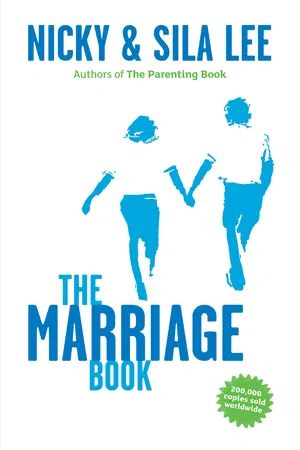
How can we be happily married to one person for the whole of our lives? How do we resolve conflict? How can we discover and rediscover sexual intimacy?Nicky and Sila Lee have been married for over 40 years, and this book distils all the wisdom and advice they have gleaned from their own experience, and the experience of others they have counselled. Based on the solid foundations of the Christian faith, Nicky and Sila demonstrate the value, importance and potential of any marriage. They suggest how we can not only stay married, but also make the most of our married lives together, covering topics such as: - Effective communication
- Parents and in-laws
- Conflict and forgiveness
- Sex and expressions of love The Marriage Book provides practical advice for any married or engaged couple who want to build a strong and lasting marriage, while also offering insights for single people who are interested in getting married in the future.
- 400 pages
- English
- ePUB (mobile friendly)
- Available on iOS & Android
eBook - ePub
About this book
Information
Topic
Theologie & ReligionSubtopic
ChristentumSection 1
Building strong foundations
Chapter 1
Taking a long view
There is a woman in bed beside me. Right this moment I could reach out my hand and touch her, as easily as I touch myself, and as I think about this, it is more staggering than any mountain or moon. It is even more staggering, I think, than if this woman happened instead to be an angel (which, come to think of it, she might well be). There are only two factors which prevent this situation from being so overpoweringly awesome that my heart would explode just trying to take it in: one is that I have woken up just like this, with this same woman beside me, hundreds of times before; and the other is that millions of other men and women are waking up beside each other, just like this, each and every day all around the world, and have been for thousands of years.1
Mike Mason
Marriage is a unique opportunity. We have the chance to share every aspect of our life with another human being. We have promised to stick together through the highs and lows, and out of the security of our mutual promise, we dare to reveal everything about ourselves.
We relate to each other in our common humanity, feeling each other’s pain and covering each other’s weaknesses. We rejoice in each other’s strengths and delight in each other’s successes. We are given a counsellor, a companion, a best friend – in short, a partner through life. And if we are patient enough, kind enough and unselfish enough, we shall discover that each of us is inexhaustibly rich.
Marriage has brought untold joy to millions and throughout history has been celebrated around the world in ceremony, poetry, prose and song.
What is marriage?
For this reason a man will leave his father and mother and be united to his wife and the two will become one flesh.
Genesis 2:24
Marriage is about two people being joined together to become one, and is therefore the closest, most intimate relationship of which human beings are capable. Some might object that the parent-child relationship is closest, given that the child’s life begins within the mother. However, a healthy parent-child relationship is to be one of increasing separation and growing independence with each child leaving the parental nest to make a home of their own. The marriage relationship is altogether the other way round. Two people, at one time strangers to each other, meet and subsequently get married. They enter into a relationship marked, at its best, by an increasing interdependence.
John Bayley writes about his fifty years of marriage to his late wife in A Memoir of Iris Murdoch. Towards the end she suffered from Alzheimer’s disease, through which he nursed her himself:
Looking back, I separate us with difficulty. We seem always to have been together … But where Iris is concerned my own memory, like a snug-fitting garment, seems to have zipped itself up to the present second. As I work in bed early in the morning, typing on my old portable with Iris quietly asleep beside me, her presence as she now is seems as it always was, and as it always should be. I know she must once have been different, but I have no true memory of a different person.2
This process of growing together is not automatic. Most couples come into marriage with big expectations. As they leave their wedding through a shower of confetti and meander off into the sunset, they cannot imagine ever not wanting to be together. The long-term reality is different and, potentially, far better.
Both husband and wife must be ready to build their marriage. Each stage of the process brings its own challenges and opportunities. In the early days we may be shocked by the things that we discover about each other that had not been apparent during the heady days of courtship and engagement.
For ourselves, even though we had known each other for four years prior to getting married, we both had to make adjustments in the light of what married life revealed: irritating habits, unexpected behaviours, values which differed from our own.
The first lesson of marriage is to accept our husband or wife as they are, rather than trying to make them into the person we had hoped they would be. This mutual acceptance must continue as the passing years will inevitably bring change. As Shakespeare mused:
… Love is not love
Which alters when it alteration finds,
Or bends with the remover to remove.
… Love’s not time’s fool, though rosy lips and cheeks
Within his bending sickle’s compass come;
Love alters not with his brief hours and weeks …3
Despite our best efforts, we cannot stay the same. Not only will our appearance change, but our thinking will mature, our character will develop and our circumstances will alter. Perhaps the greatest change comes with the arrival of children, although equally challenging is the distressing and traumatic circumstances of infertility. Difficulties in conceiving can put great stress on a marriage and will call for much patience, loving support and a refusal to blame.
The birth of a baby brings supreme joy but is often accompanied by physical exhaustion. Later on the teenage years can be immense fun and can provide opportunities for growing friendship with our children, but are usually an emotionally exhausting roller-coaster ride. When eventually they move out, we may find ourselves grieving their absence, the expression used by one mother whose children were gradually leaving home in their early twenties.
Through these years of bringing up children, when there is so much to think about at home and at work, it is all too easy to neglect our marriage. Undoubtedly children need to be nurtured, but so too do marriages. When a couple have continued to invest in their relationship and have supported each other through the varying pressures of family life, the final twenty-five years can be the most rewarding.
A friend of ours was questioning her parents recently about their marriage. Her father turned to her mother and said, ‘I think we’ve had a great marriage, but there have been difficult bits and wonderful bits.’ Both agreed that the hardest phase was in their thirties when they had young children, not much money and tough demands at work. But as the children became increasingly independent (although still very much part of their lives), the pressures eased and they had the time and opportunity to rediscover each other in new ways.
Frank Muir described in his autobiography what this later stage of his long marriage to Polly meant to him:
When brother Chas and I were teenagers our granny decided to give us signet rings. I hated the idea of wearing jewellery and so she gave me something else.
It was coming up to our forty-seventh wedding anniversary and Polly asked me if there was something I would like to have as a keepsake, and suddenly I knew exactly what I wanted. I said, ‘Please may I have a wedding ring?’
Polly was very surprised. She said, ‘Tell me why you suddenly want a wedding ring after all these years and you shall have one.’
‘Well, I wanted to be sure first,’ I said, the sort of slick half-joke inappropriate for a rather emotional moment, but it gave me time to think …
I find it quite impossible to visualise what life without Polly would have been like. Finding Polly was like a fifth rib replacement, or ‘the other half’ we search for to make us complete in the process which Plato called ‘the desire and pursuit of the whole’. It was a wonderfully successful process in my case.
I asked for a wedding ring so that I could wear it as a symbol of the happiness my marriage to Pol has brought. Now that I work at home it is so good just to know that Pol is somewhere around, even though invisible, perhaps bending down picking white currants in the fruit cage and swearing gently, or upstairs shortening a skirt for a granddaughter.
The happy thing is to know that Pol is near.4
Why do some marriages stop working?
Tragically we hear of many marriages today that fail to experience this type of togetherness. For some, after the initial few years, a creeping separation causes them to become disconnected. This may happen when children are young and exhausting or when they leave home. In the latter case a couple may discover that they have nothing to say to each other and they divorce, assuming that they should never have got married in the first place.
We grow up believing in a romantic myth: if Cinderella happens to meet her Prince Charming, they will live happily ever after. Should friction arise and we fall out of love, then, the myth states, we have married the wrong person and we are destined to live unhappily ever after or get divorced. This message is reinforced for adults through love songs, books and films. Underlying this pervasive and dangerous myth is the belief that real love is something that happens to us, over which we have little or no control.
This view is sometimes reported in the press as though it is beyond dispute. A recent article in The Guardian stated that some ‘lucky souls’ keep an intimate marriage relationship going for twenty years or more, but the natural time limit is closer to four years. Once you’ve lost it, ‘nothing on earth will bring back that magic spark … You either feel it or you don’t, and that’s the end of the matter.’ In apparent consolation the article ended, ‘It can always be re-kindled for somebody new.’5
But anyone who has been in a stable marriage for more than a few years will say that a relationship has to be worked at. It has taken more than romantic feelings to keep them together. It has taken a daily choice, on some occasions having to talk through sensitive issues, on others having to control an attraction to another man or woman, and, if the romantic feelings left for a while, in time they returned at a deeper and richer level. Couples who get married thinking that the line in their vows, ‘for better or for worse’, will not really apply to them are in for a shock or a failed marriage.
Marriages that break down are usually the result of a process of growing apart over many years, as this anonymous poem entitled The Wall describes:
Their wedding picture mocked them from the table
These two whose lives no longer touched each other.
They loved with such a heavy barricade between them
That neither battering ram of words
Nor artilleries of touch could break it down.
Somewhere between the oldest child’s first tooth
And youngest daughter’s graduation
They lost each other.
Throughout the years each slowly unravelled
That tangled ball of string called self
And as they tugged at stubborn knots
Each hid their searching from the other.
Sometimes she cried at night and begged
The whispering darkness to tell her who she was
While he lay beside her snoring like a
Hibernating bear unaware of her winter.
Once after they had made love he wanted to tell her
How afraid he was of dying
But fearing to show his naked soul he spoke instead
About the beauty of her breasts.
She took a course in modern art trying to find herself
In colours splashed upon a canvas
And complaining to other women about men
Who were insensitive.
He climbed into a tomb called the office
Wrapped his mind in a shroud of paper figures
And buried himself in customers.
Slowly the wall between them rose cemented
By the mortar of indifference.
One day reaching out to touch each other
They found a barrier they could not penetrate
And recoiling from the coldness of the stone
Each retreated from the stranger on the other side.
For when love dies it is not in a moment of angry battle
Nor when fiery bodies lose their heat.
It lies panting exhausted expi...
Table of contents
- Cover
- Title Page
- Copyright
- Contents
- Foreword
- Acknowledgments
- Epigraph
- Introduction
- Section 1: Building strong foundations
- Section 2: The art of communication
- Section 3: Love in action
- Section 4: Resolving conflict
- Section 5: The power of forgiveness
- Section 6: Parents and in-laws
- Section 7: Good sex
- Section 8: Epilogue
- Appendix 1: Ready for marriage?
- Appendix 2: Engagement, sex and the honeymoon
- Appendix 3: Working out a budget
- Appendix 4: Praying together
- Endnotes
- Bibliography
- Other relationship resources available from Alpha International
- Also by Nicky and Sila Lee
Trusted by 375,005 students
Access to over 1.5 million titles for a fair monthly price.
Study more efficiently using our study tools.
Frequently asked questions
Yes, you can cancel anytime from the Subscription tab in your account settings on the Perlego website. Your subscription will stay active until the end of your current billing period. Learn how to cancel your subscription
No, books cannot be downloaded as external files, such as PDFs, for use outside of Perlego. However, you can download books within the Perlego app for offline reading on mobile or tablet. Learn how to download books offline
Perlego offers two plans: Essential and Complete
- Essential is ideal for learners and professionals who enjoy exploring a wide range of subjects. Access the Essential Library with 800,000+ trusted titles and best-sellers across business, personal growth, and the humanities. Includes unlimited reading time and Standard Read Aloud voice.
- Complete: Perfect for advanced learners and researchers needing full, unrestricted access. Unlock 1.5M+ books across hundreds of subjects, including academic and specialized titles. The Complete Plan also includes advanced features like Premium Read Aloud and Research Assistant.
We are an online textbook subscription service, where you can get access to an entire online library for less than the price of a single book per month. With over 1.5 million books across 990+ topics, we’ve got you covered! Learn about our mission
Look out for the read-aloud symbol on your next book to see if you can listen to it. The read-aloud tool reads text aloud for you, highlighting the text as it is being read. You can pause it, speed it up and slow it down. Learn more about Read Aloud
Yes! You can use the Perlego app on both iOS and Android devices to read anytime, anywhere — even offline. Perfect for commutes or when you’re on the go.
Please note we cannot support devices running on iOS 13 and Android 7 or earlier. Learn more about using the app
Please note we cannot support devices running on iOS 13 and Android 7 or earlier. Learn more about using the app
Yes, you can access The Marriage Book by Nicky Lee,Sila Lee in PDF and/or ePUB format, as well as other popular books in Theologie & Religion & Christentum. We have over 1.5 million books available in our catalogue for you to explore.