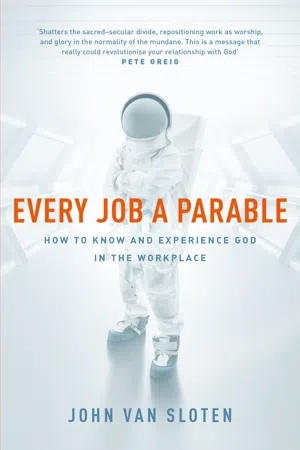
A farmer, a nurse and an astronaut walk into a church...They each bring with them their own exhaustions and exasperations, their own uncertainty about whether and how their work matters to God. Good news: all work matters to God, because all work reflects some aspect of the character of God. God created the world so that it runs best when it mirrors him, and we ourselves find the most fulfilment when we recognize God behind our labour.John Van Sloten offers a fascinating and innovative reflection on vocation: our work is a parable of God; as we work, we are icons of grace.
eBook - ePub
Every Job a Parable
What Farmers, Nurses and Astronauts Tell Us about God
- 240 pages
- English
- ePUB (mobile friendly)
- Available on iOS & Android
eBook - ePub
About this book
Information
Topic
Theology & ReligionSubtopic
Christian Theology
1
ALL WORK MATTERS
WHAT A FLYER DELIVERY PERSON, A WALMART GREETER, A FORENSIC PSYCHOLOGIST, AND A RESIDENTIAL LANDLORD TEACH US ABOUT THE VALUE OF ALL WORK
Surely the LORD is in this place, and I was not aware of it.
JACOB, IN GENESIS 28:16
FEATURED IN THIS CHAPTER:
• Flyer delivery person
• Walmart greeter
• Forensic psychologist
• Residential landlord
In the book of Genesis, there is a story about the Old Testament patriarch Jacob, who, while on a journey, stopped in a seemingly ordinary, middle-of-nowhere place to rest for the night. He slept on the ground, using a rock as a pillow. And there he had a dream in which he met God
In that dream, God made hope-filled promises to Jacob: that he would be Jacob’s God, give him a place to make a life, and bless him in such a way that everyone around him would be blessed through his presence. When Jacob awoke from his sleep, he thought, “Surely the LORD is in this place, and I was not aware of it. … How awesome is this place! This is none other than the house of God; this is the gate of heaven” (Genesis 28:16-17).
Far too often people journey through their vocational lives with no expectation of ever meeting God there. For one reason or another, they have lost sight of God’s everywhere presence. Some think their jobs are too insignificant, ordinary, and middle-of-nowhere. Others think that what they do couldn’t possibly connect to the ways of God and that there is nothing of God’s goodness in their jobs. Some have never even considered or imagined connecting with God at work. Work is work; God is at church.
A few years ago, I had a conversation with a woman who delivered flyers in our neighborhood. She was no more than five feet tall and in her seventies. Two or three times a week, she would pull a heavy, homemade wooden wagon filled with flyers through our streets—up and down the many hills; over curbs; through rain, snow, and heat. Every time I saw her working, I was amazed and also a bit saddened by how difficult that kind of job must have been for an older woman. Often I would say hi and talk to her as we passed on the street. One day I decided to stop and have a real conversation.
We talked about her work. She told me that she had been delivering flyers in my neighborhood for over twenty years; this was her last day on the job. Twenty years! Wow!
I told her that I had been watching her do her work since I had moved into the area. “I can’t believe you have been strong enough to pull this heavy thing.” I grabbed the handle of her wagon and pulled it a few inches; it must have weighed fifty pounds! She said that it wasn’t so bad, once you got used to it.
I asked her why she had decided to stop work now. She said that over the past year, she had come to realize that she just couldn’t do the job anymore—“You just know these things.” She was thinking of working at Walmart instead. “At least I’ll be warm in the winter.”
This was the day of her retirement. Was anyone going to throw a party? Present her with a gold watch? Say a few kind words? I knew I had to say something and recognize her for what she had given. Someone had to thank her.
So I thanked her. “You know, you must have helped thousands of people in this community save money over the years with all those coupons and sales flyers. Thank you for that!”
She paused, took it in for a second, and then said, “Yeah, I guess so.” Then she smiled. I asked her name; she told me it was Colleen. I introduced myself, shook her hand, and wished her all the best in her retirement.
I continued on my walk, and she picked up her wagon handle, looked over her address list one more time, and pulled her stack of flyers to the next house.
Too many times over the years, I have pulled a thick wad of advertisements out of my mailbox and felt a bit of frustration with the flyer industry. All that wasted paper and recycling hassle—all that consumer pressure. But for Colleen, this was her job—her life, in some large part. After our “retirement conversation,” I hoped I could engage my job with as much dignity, perseverance, and strength.
I have to admit, I was kind of surprised that I was able and willing to articulate some of God’s goodness to Colleen in relation to her work. As I look back, it had a lot to do with what I was feeling in that moment: a deep compassion, bordering on love, for her as a human being. As I looked at her from that perspective, I was able to see value in who she was and what she did. I was able to see where God was working through her.
Surely God was already in that place, and I was unaware of it.
Surely God feels a love that brings dignity to every human being doing every kind of job, no matter how big or small.
There is a Latin phrase used by the ancient mystics: ubi amor, ibi oculus—“Where there is love, there is seeing.”1 God is love, so he must see everything. As maker and keeper of all people and things, God knows the real value, the eternal significance, of even the most seemingly insignificant work. “With God nothing is empty of meaning,” wrote the early church father Irenaeus.2 As people of faith, we worship “a creator who loves us enough to seek us in the most mundane circumstances of our lives.”3 There is no job so boring that it would disinterest God, because there is no person whom God does not love and see.
God is whispering truth and meaning in the most ordinary and small places. In fact, those are often the places where God especially shows up. Given what the Bible reveals about how he came to us as a baby and was born into very humble circumstances, it seems clear that God often chooses to show up in middle-of-nowhere places. Remember the times where Jesus reached out to and included the last and least? He chose untrained fishermen to be his disciples—ordinary laborers to deliver the world’s greatest message.
So if you work at a seemingly ordinary job, don’t let that lead you to believe that it is ordinary to God. God is at work and can be known anywhere.
We humans have created a kind of vocational hierarchy: White-collar is better than blue-collar; leading others trumps following them; high salaries outshine low salaries; managing beats out serving; highly educated is superior to less educated; high-profile is better than behind-the-scenes. While there is nothing wrong with high-level leadership, business success, or making a good salary (Jacob, for example, was materially blessed), these false assumptions undermine the vocational experience of many workers, lowering their job satisfaction and leaving them with little or no expectation of experiencing God at work. If you can’t love an ordinary job, how can you ever find God there?
The first time I met Shirley, she was greeting at our neighborhood Walmart. When I asked her whether she would be willing to do a video interview for a sermon I was preaching, she initially didn’t want to draw any attention to herself. For Shirley, greeting was all about others. “I like people,” she said. “I want to help them find the department they are looking for, have a better day … by smiling or just saying hello … [or] by getting them a shopping cart.” She loved her job, and she loved serving. Shirley did for others what she would want them to do for her. Many of the customers who walked by that morning knew her name.
Once she realized I was serious about wanting to understand more about her work, she consented to an interview. Following the interview, with the camera off, we had a more personal conversation. I discovered her deeper side. She had been through a lot, yet she seemed so content and at peace. She knew herself!
Driving home I thought, What a wonderful human being!
And then I felt ashamed.
The day before the interview, I had come up with the idea of asking the Walmart manager if I could be a greeter for a morning. What better way to understand the job? I quickly nixed the idea because I worried that someone I knew might see me there. Yet here was Shirley—a seventy-seven-year-old woman who didn’t go to church but still believed in God—imaging Christ in a way that I couldn’t.
At one point in the Gospels, Jesus washed his disciples’ feet (John 13:1-17). Shirley does the same every time she humbly puts a Walmart customer before herself.
According to the Bible, God is a God who serves. Selflessness in the smallest things is indicative of his nature. So whenever anybody humbly serves another in a selfless way at their job or anywhere else, they are, in a very real sense, imitating Christ. I believe that the Holy Spirit is moving through them, giving them the humility to kneel and to look up to others. And through that humble act, they become more human. This must be why Shirley knew herself so well; God’s humility was moving through her.
Theologian Cornelius Plantinga wrote,
According to God’s intelligence, the way to thrive is to help others to thrive; the way to flourish is to cause others to flourish; the way to fulfill yourself is to spend yourself. Jesus himself tried to get this lesson across to his disciples by washing their feet, hoping to ignite a little of the trinitarian life in them. The idea is that if—in a band of disciples, in a family, in a college—people encourage each other, pour out interest and goodwill upon each other, favor each other with blessings customized to fit the other person’s need, what transpires is a lovely burst of shalom.4
For weeks after that Walmart interview, I kept seeing an image of Shirley’s aged hands pushing those shopping carts—a great-grandmother doing all that physical work for other able-bodied people, standing all day, greeting customers where they were, selflessly incarnating the hospitable heart of God. She didn’t judge those who walked through the door. And it made a difference.
Now, when I reconnect with Shirley at Walmart, I tell her about how her story continues to be told via online sermon video downloads, and she glows. My prayer is that through the attention I have shown her, she will catch a glimpse of a God who sees her as well. Perhaps she will even experience his smiling presence every time she smiles at another and a foretaste of his goodness in the goodness she already feels in greeting others.
There is no job too small for God’s presence. But for some workers, it is not the size of their job that is the problem; it is the nature, scope, and content. What they do seems very far removed from what God would do. Aren’t there just some jobs where God’s goodness is unlikely to be found?
FORENSIC PSYCHOLOGY
A while ago, a forensic psychologist told me that while there are many jobs where God’s truth and goodness are clearly evident, in work like his—diagnosing and then bearing bad news about what is often irreparable impairment—God’s presence is a lot harder to find. How could this kind of vocation ever image God?
Later he sent me an e-mail further detailing the nature of his work: “My job essentially consists of identifying neurocognitive impairment (i.e., impaired concentration, memory, speech/language, decision-making) associated with brain pathology (disease or injury) and predictive of disability.” In other words, 99 percent of the time, he’s giving people bad news: “The only good news would be if an individual is less impaired than he/she thought.”
As I considered his e-mail, the words of God through the prophet Jeremiah came to mind:
This is what the LORD says:
“Your wound is incurable,
your injury beyond healing.
There is no one to plead your cause,
no remedy for your sore,
no healing for you.”
JEREMIAH 30:12-13
We live in a sin-corrupted and broken world. People’s bodies and minds and families and communities are not what they are supposed to be, not what God intended when he first made them. Life falls short—all of it, including our work.
But this psychologist’s work was not devoid of the presence of God. Nothing can be completely so. While his particular profession may deal with more brokenness than most, God is still very much at work there.
A forensic psychologist is made in the image of a God who sometimes brings terrible news: “Your wound is incurable, your injury beyond healing. This won’t ever go away or get better.” Sometimes the truth is difficult to hear. Nobody wants to be the bearer of bad news. And yet, there is still something very right—something Godlike!—about the act of naming fallen reality for what it is.
The forensic psychologist started to do the math himself. “Does a person whose job it is to search for pathology work in a role similar to the Holy Spirit, who convicts of brokenness, sin, and impurity?” he wrote me. “In turn, the pathologist is in...
Table of contents
- Cover
- Praise
- About the Author
- Title Page
- Copyright
- Dedication
- Contents
- Introduction: Finding God at Work
- Part One: What Does it Mean to Image God?
- Part Two: What is a Parable, and How is Work a Parable?
- Part Three: What Does God Reveal to Us About Himself Through Our Work?
- Part Four: How Can We More Effectively and Consistently Image God Through Our Work?
- Epilogue: The Parable of a Pastor: Honoring God as We Honor the Work of Others
- Index of Vocations
- Acknowledgments
- Notes
Trusted by 375,005 students
Access to over 1.5 million titles for a fair monthly price.
Study more efficiently using our study tools.
Frequently asked questions
Yes, you can cancel anytime from the Subscription tab in your account settings on the Perlego website. Your subscription will stay active until the end of your current billing period. Learn how to cancel your subscription
No, books cannot be downloaded as external files, such as PDFs, for use outside of Perlego. However, you can download books within the Perlego app for offline reading on mobile or tablet. Learn how to download books offline
Perlego offers two plans: Essential and Complete
- Essential is ideal for learners and professionals who enjoy exploring a wide range of subjects. Access the Essential Library with 800,000+ trusted titles and best-sellers across business, personal growth, and the humanities. Includes unlimited reading time and Standard Read Aloud voice.
- Complete: Perfect for advanced learners and researchers needing full, unrestricted access. Unlock 1.5M+ books across hundreds of subjects, including academic and specialized titles. The Complete Plan also includes advanced features like Premium Read Aloud and Research Assistant.
We are an online textbook subscription service, where you can get access to an entire online library for less than the price of a single book per month. With over 1.5 million books across 990+ topics, we’ve got you covered! Learn about our mission
Look out for the read-aloud symbol on your next book to see if you can listen to it. The read-aloud tool reads text aloud for you, highlighting the text as it is being read. You can pause it, speed it up and slow it down. Learn more about Read Aloud
Yes! You can use the Perlego app on both iOS and Android devices to read anytime, anywhere — even offline. Perfect for commutes or when you’re on the go.
Please note we cannot support devices running on iOS 13 and Android 7 or earlier. Learn more about using the app
Please note we cannot support devices running on iOS 13 and Android 7 or earlier. Learn more about using the app
Yes, you can access Every Job a Parable by John Van Sloten in PDF and/or ePUB format, as well as other popular books in Theology & Religion & Christian Theology. We have over 1.5 million books available in our catalogue for you to explore.