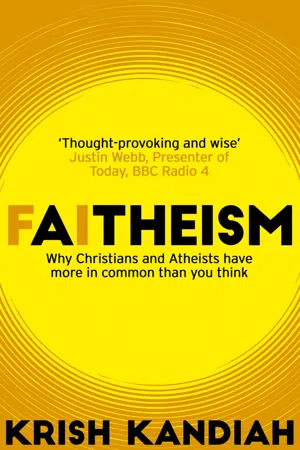
Over the past decade the Religion vs. Atheism debate has generated a lot more heat than light. With passionate advocates on both sides, it is possible we have lost sight of the real people and problems behind the controversies and conflicts.Where does the truth lie?In Faitheism Krish Kandiah asks us to take a long hard look at ourselves - and a more understanding look at each other. Written for both committed Christians and committed Atheists and everyone in between, this accessible and practical book can help all of us find a way to talk about the things that really matter to us in ways that encourage empathy, mutual understanding and respect and yet that don't shy away from tackling the hard topics. The ideas in this book can transform our relationships, our workplaces and our nation as it lays down a path for a genuinely more inclusive, hospitable and understanding society. Krish contends that whether you are a Christian, an Atheist or somewhere in between, we can all grow in our own beliefs and understand each other better.In this challenging exploration of the myths about Christianity and Atheism, time and again we will find the evidence shows that the truth on the ground is not what one might expect - and the potential for genuine understanding is far greater than the antagonists on either side would have you believe.
- 272 pages
- English
- ePUB (mobile friendly)
- Available on iOS & Android
eBook - ePub
About this book
Information
Topic
Teologia e religioneSubtopic
CristianesimoChapter 1
Christians are weird / Atheists are normal
Collision
The homeless man shuffled back a few centimetres into the shop doorway as it began to rain, but he was soon disturbed by a passer-by who asked if he could point him in the direction of Burger King. The passer-by had just come out of a long business meeting, and was taken a little by surprise when the homeless guy left all his worldly possessions right there and accompanied him to the eatery in question. The two men chatted as they walked, and when they arrived at Burger King, the businessman bought dinner for both of them. They were there for about an hour, talking and waiting for the rain to stop. During conversation, the businessman happened to mention that he didn’t believe in God. The homeless man’s response took him by surprise: ‘You are much too nice to be an Atheist.’
A public servant explained to me that they had a problem with recruitment. The issue was that there were a lot of Christians who showed an interest in joining the caring professions, but not so many Atheists. ‘It’s a shame,’ she explained, ‘because we don’t have a problem with Atheists. Christians, however, are socially deviant and so we “red flag” them in the review process.’ Just a week earlier I had been at a Westminster event where a similar sentiment was expressed. A professional psychologist commented that if a patient mentioned God during a counselling session, this could very well result in a referral for psychiatric assessment. My Chemistry professor had warned me about this twenty years before. He believed that faith and science could not mix, and so when he overheard me talking about church in a long laboratory session, he turned to me and said: ‘You are much too smart to be a Christian.’
There was a time, not so long ago, when it was socially deviant to be an Atheist, and socially acceptable to be a Christian. There was a time when Christians were deemed to be the smart ones, and Atheists were considered to be in need of a head examination. But there has been a switch, just in the past couple of decades. There is now a new normal and a new weird.
This switch has happened before. There have been huge shifts in public opinion towards and against Christianity and Atheism over the centuries. Strangely enough, the first Christians were described as Atheists. That was the label given to them because they rejected the traditional gods of the time. They didn’t have any physical images of God, and they didn’t have any temples. This led the Christian thinker Justin Martyr to write in the early second century:
We admit that in respect of such supposed gods as those (i.e. the gods of ancient Greece and Rome) we are atheists: but not in regard to the most true God, the Father of righteousness and moderation and the other virtues, the God who is without a trace of evil. Him we worship and adore, and his Son, who came from him and taught us of these things … These we worship with reason and truth.1
Christianity started as a minority faith, whose claims that Jesus was the long-awaited Messiah that Judaism predicted, were not only rejected by the Jewish authorities, but were also anathema to the Roman ruling power that had invaded Israel at the time.
Christians gained a public reputation for vice and immorality. They were accused of cannibalism because they had been overheard talking about ‘eating the body of Christ’ when they took part in Holy Communion, when bread is eaten to represent and celebrate God’s love shown in allowing Jesus to die for the sins of the world. Christians were also accused of sexual deviancy because they referred to other members of the Church as ‘brothers and sisters’, and husbands and wives were misunderstood to be incestuously related.
Christianity was also seen as politically seditious, as it was believed to challenge the rule of the Roman Empire, and it upset the influence of the Jewish ruling elites. That was why Christians were beheaded, crucified, and savaged by wild beasts as entertainment at the Colosseum. Famously, the Emperor Nero blamed Christians for a fire in Rome in AD 64, and if this was when a new phase of persecution started, it only ended with the passing of the Edict of Milan in AD 313, which allowed for the toleration of Christianity. About a hundred years after that edict, under the reign of Emperor Theodosius I, Christianity became the official religion of the Roman Empire, and other religions and pagan practices were suppressed. It seems that what had been a persecuted minority then became complicit in a new persecution, paving the way for Christianity to remain the dominant religion in the Western world for over one a half thousand years.
Atheism, too, has a mixed history. During ancient times philosophers such as Plato argued that Atheism was inherently dangerous, because it undermined the God-ordained rule of the monarch.2 Plato, in his writing on law, was very vocal in his opposition to Atheism, believing it was a cause of vice and immorality.3 Much later, in the thirteenth century, Thomas Aquinas argued for the inherent immorality of Atheists because they were seen to have no moral framework, and therefore, he said, were dangerous to society as a result.4 Then, in the eighteenth century, the philosopher Thomas More described a utopia in which religious tolerance would extend to all residents except those who ‘did not believe in God or the immortality of the soul’.5
One of the most infamous instances of legal discrimination against an Atheist in the UK was in the nineteenth century when Charles Bradlaugh, one of the founders of the National Secular Society, was excluded from the British Parliament for refusing to swear allegiance on the Bible. He was forcibly expelled from the House numerous times, fined for voting illegally, and once even imprisoned in the Tower of London. Eventually, after he was re-elected for the fourth time, the Speaker of the House agreed to offer him his right to affirm, rather than swear allegiance on the Bible.
Up until recently, it has been far easier in terms of social acceptability to call oneself a Christian than an Atheist. The legal system, the educational system, the political system, the social holidays and community or parish life all catered predominantly for those who went to church on Sundays and conformed to religiously derived social norms.
But times are changing, and it is far more acceptable now to be an Atheist than perhaps ever before. It would certainly – and rightly – create a constitutional crisis if someone were to be expelled from Parliament for being an Atheist today. Yet, recently, a Christian Member of Parliament famously felt discriminated against because of his faith. Liberal Democrat leader Tim Farron expressed in his resignation speech his experience as a practising Christian in public life:
The consequences of the focus on my faith is that I have found myself torn between living as a faithful Christian and serving as a political leader … To be a political leader – especially of a progressive, liberal party in 2017 – and to live as a committed Christian, to hold faithfully to the Bible’s teaching, has felt impossible for me.6
Farron here reacted – in pretty polite terms – to social pressure against his beliefs that would have been unheard of a generation or two ago. Although there remains a large degree of Christian privilege in the West, due to the religious freedoms built into the law in Western democracies, and although we know very little of persecution compared to the abuses that are taking place under military dictatorships and other unjust regimes elsewhere in the world, there is nevertheless a developing undercurrent of suspicion, even antagonism, towards Christians. In politics, media and our social system, there appears to be what we might call ‘unconscious’ or ‘implicit’ bias when it comes to relating with faith groups in general, and Christians in particular.
Most people recognise the existence of bias in their lives. For example, socially we tend to find it easier to associate with people who are similar to us in age, interests, culture and background. We have come to expect a degree of bias in our news sources, as media outlets often betray their political allegiances in their reporting. We have always had bias in our political system, where an unusually high percentage of our political class have been educated in exclusive schools and at elite universities. Sadly, we must recognise that elitism, racism, sexism, favouritism – and the spin that goes with them – are still a part of our society.
Over recent years, though, there has been a growing awareness that not all of our biases are explicit or conscious. Unconscious bias describes the negative associations we hold, which, even though they are outside of our awareness, have a significant influence on our outlook and actions. Some argue that unconscious bias is far more prevalent than conscious prejudice, and, strangely, it can often be the opposite of our conscious values. In other words, people who consider themselves fair, equitable and kind may nevertheless respond in a negative way at a gut level to other people because of differences in ethnicity, sexuality, gender or ability. Indeed, according to the wide body of literature in this area we can sometimes show bias even to groups that we identify ourselves with. It has been noted, for example, that highly regarded female academics may discriminate against their female colleagues. This could come out in a lack of public acknowledgement for their work, or more subtly, in whether or not they recommend them for awards or promotions.7
The implicit associations we have can be very difficult to override, even when we come to recognise them to be wrong, as they are so deeply woven into our psyche.8 Christians are beginning to recognise both conscious and unconscious bias against them, but it was not that long ago that the shoe was on the other foot. Atheists have long been seen as socially deviant, and in some contexts this is still the case. For example, it is illegal to be an Atheist in some Islamic countries, and even in Western cultures, Atheists argue they can still feel marginalised and excluded. There remain seven states in America whose constitutions include a religious test, which would, in theory, prohibit Atheists from taking public office.
Despite our so-called progressive and tolerant society, sadly there are still many areas of public life where there is an implicit bias against all sorts of people, including those from ethnic minorities, women, couples who don’t have children, people from working-class backgrounds, people with disabilities, those from the LGBT community, as well as those who call themselves Christians, Atheists, secularists, humanists or agnostics.
At school I was called sambo, nig nog, Paki and wog. I knew I had a lot of nationalities covered in my ethnic make-up, but never once did anyone manage to correctly identify my Malaysian-Indian-Sri Lankan-Irish ancestry. I was also, even as a child, mildly aware of the difference between conscious bias and unconscious bias. While other kids’ parents were kind to me in the playground, they stopped short of inviting me to their children’s parties. I often wondered if my dad was laid off work because of his skin colour or if my mum was given the most demeaning tasks to perform at work because of her ethnicity. Although my neighbours freely accepted us, enjoyed our hospitality, and reciprocated generously, nonetheless I sometimes overheard anti-immigrant rhetoric. If they realised, they may have said something like ‘Present company excluded’, or ‘But you’re different – we know you.’ What sounded like – and was meant as – a compliment, still grated against me, even from a young age, because of an irreconcilable sense of the hypocrisy shown.
On one occasion a friend’s dad took me to London to a computer fair. It was a much-appreciated gesture for a computer-mad twelve-year-old, and I had a fantastic day with his son, discovering all the latest gadgetry. But at the end of the day I got too close to a car speeding through the car park, and my bag full of freebies brushed the car’s door. The driver slammed on his brakes, got out of his car and began shouting racist abuse at me. As I looked to my friend’s father to rescue me from this mad-eyed stranger, he walked away, saying he didn’t know me. He would have claimed not to be racist, there was plenty of evidence (not least my being there that day) to show that he wasn’t racist, and yet his decision not to stand up for me betrayed an underlying collusion with racist attitudes that perhaps he was unaware of himself. It was a long and silent journey home.
I am personally grateful for the huge steps forward Western societies have made to recognise xenophobic and racist language and attitudes, although there is still a long way to go in tackling bias and prejudice in all its forms. In recent years most business and public sector environments have invested in specific training to help challenge both conscious and unconscious bias in the areas of race, gender and sexuality. But implicit bias due to someone’s faith background has not been widely studied or challenged. It would seem to be the next logical extension of the quest for equality, especially as faith is already in theory a protected category according to the Equalities Act. Public services and authorities are legally required to ‘eliminate discrimination, harassment, victimisation’. They are also supposed to ‘advance equality of opportunity between persons who share a relevant protected characteristic’ and to ‘foster good relations between persons who share a relevant protected characteristic and persons who do not share it’.9
In other words, neither Christians nor Atheists are supposed to be discriminated against. And yet, both groups can put a case forward for feeling marginalised – and often they point the finger at one another.
On the training days I run for public servants I ask delegates what they associate with three different groups of people. The first is ‘Christian’, the second ‘Muslim’ and the third ‘Atheist’. Everyone in the room is university educated. Everyone has been through a rigorous selection process, and they have all received extensive training on inclusion and diversity. Nevertheless, group feedback shows that the overwhelming majority of the words associated with Christians are negative: ‘Bible-basher’, ‘intolerant’, ‘bigot’, ‘homophobic’ are just a few. Sadly, the words associated with Muslims are worse: ‘jihadi’, ‘terrorist’, ‘suicide bomber’. The words associated with Atheists as a group were far more positive: ‘discerning’, ‘thoughtful’ and ‘rational’. This is by no means a scientific study at this stage, just the fruit of a substantial number of workshops. But from these in-practice experiences and from anecdotal evidence, the prevailing climate has changed. Atheism is becoming more socially acceptable, respectable and even aspirational. Christianity, on the other hand, is increasingly understood to be socially deviant and suspect. There has been a switch. Christians are the new weird. Atheists are the new normal.
Collusion
Despite the implicit bias that many Atheists have towards Christians and Christians have towards Atheists, there is more collusion going on when it comes to Christianity and Atheism than you might think. Let me put it provocatively:
Many Atheists live like Christians, yet they claim not to believe in God.
Many Christians live like Atheists, yet they claim to believe in God.10
There is often a disconnect between confession and behaviour, from both sides of the fence, that may well have something to do with unconscious bias, association and social acceptance.
Perhaps you have seen the political surveys that come up on social media platforms, where you are led through a number of questions exploring your views on particular policies and then told which party you have most affinity with. Despite their upbringing and heritage and even personal identification with a particular party, many people’s views end up being closer in practice to a party that they would never have considered voting for. It can be similar for our ideological views. Whatever we may call ourselves, whatever we may say we believe or don’t believe, a broader or deeper survey of our life values may throw up some interesting conclusions. Some Atheists live lives that are more consistent with the moral and ideological framework provided by the Christian faith than with their own atheistic assumptions. Some people who call themselves Christians will actually have more in common with Atheists than they may like to think, and may live more consistently with Atheist convictions than with Christian beliefs. We shall see this illustrated on several occasions during the course of this book.
At one level this crossover is understandable. If you grew up in London and then moved to Lagos as a teenager, you might still speak with an English accent, even in your forties. Similarly, there is no doubt that Western civilisations have been shaped and formed significantly by the Christian faith. Theo Hobson argues that many of the most treasured aspects of secular humanism owe their origins to the impact of Christianity on the moral imagination of the West.11 So, as Western cultures transition from a majority Christian population to one where confessing Christians are in a minority, it is not surprising that there is a time lag in the transition from one moral framework to another. This would account for some Atheists having subconsciously adopted a Christian-based moral outlook. Equally, because the cultural artefacts that are being generated by contemporary Western media, such as movies, popular music, news reports and advertisements, have a predominantly secular humanist outlook, it is not surprising that Christians who are immersed in this culture may subconsciously adhere to an atheistic mindset.
This mingling of mindsets can ...
Table of contents
- Cover
- Praise
- About the Author
- Title Page
- Copyright
- Contents
- Introduction
- 1: Christians are weird / Atheists are normal
- 2: Christians are born / Atheists are made
- 3: Christians are judgemental / Atheists are tolerant
- 4: Christians are do-gooders / Atheists are good-for-nothings
- 5: Christians are boring / Atheists are fun
- 6: Christians are Bible-bashers / Atheists are bus-bashers
- 7: The Bible is inspired / The Bible has expired
- 8: Christians are warmongers / Atheists are peacemakers
- 9: Christians are immortal / Atheists are mortal
- 10: Suffering necessitates God / Suffering negates God
- Conclusion
- Acknowledgements
- Notes
- Endorsements
Trusted by 375,005 students
Access to over 1.5 million titles for a fair monthly price.
Study more efficiently using our study tools.
Frequently asked questions
Yes, you can cancel anytime from the Subscription tab in your account settings on the Perlego website. Your subscription will stay active until the end of your current billing period. Learn how to cancel your subscription
No, books cannot be downloaded as external files, such as PDFs, for use outside of Perlego. However, you can download books within the Perlego app for offline reading on mobile or tablet. Learn how to download books offline
Perlego offers two plans: Essential and Complete
- Essential is ideal for learners and professionals who enjoy exploring a wide range of subjects. Access the Essential Library with 800,000+ trusted titles and best-sellers across business, personal growth, and the humanities. Includes unlimited reading time and Standard Read Aloud voice.
- Complete: Perfect for advanced learners and researchers needing full, unrestricted access. Unlock 1.5M+ books across hundreds of subjects, including academic and specialized titles. The Complete Plan also includes advanced features like Premium Read Aloud and Research Assistant.
We are an online textbook subscription service, where you can get access to an entire online library for less than the price of a single book per month. With over 1.5 million books across 990+ topics, we’ve got you covered! Learn about our mission
Look out for the read-aloud symbol on your next book to see if you can listen to it. The read-aloud tool reads text aloud for you, highlighting the text as it is being read. You can pause it, speed it up and slow it down. Learn more about Read Aloud
Yes! You can use the Perlego app on both iOS and Android devices to read anytime, anywhere — even offline. Perfect for commutes or when you’re on the go.
Please note we cannot support devices running on iOS 13 and Android 7 or earlier. Learn more about using the app
Please note we cannot support devices running on iOS 13 and Android 7 or earlier. Learn more about using the app
Yes, you can access Faitheism by Krish Kandiah in PDF and/or ePUB format, as well as other popular books in Teologia e religione & Cristianesimo. We have over 1.5 million books available in our catalogue for you to explore.