'A heavenly book, elegant and thoughtful. Get one for yourself and one for the church-crawler in your life!' Lucy Worsley Christianity has been central to the lives of the people of Britain and Ireland for almost 2, 000 years. It has given us laws, customs, traditions and our national character. From a persecuted minority in Roman Britannia through the 'golden age' of Anglo-Saxon monasticism, the devastating impact of the Vikings, the alliance of church and state after the Norman Conquest to the turmoil of the Reformation that saw the English monarch replace the Pope and the Puritan Commonwealth that replaced the king, it is a tangled, tumultuous story of faith and achievement, division and bloodshed.In If These Stones Could Talk Peter Stanford journeys through England, Scotland, Wales and Ireland to churches, abbeys, chapels and cathedrals, grand and humble, ruined and thriving, ancient and modern, to chronicle how a religion that began in the Middle East came to define our past and shape our present. In exploring the stories of these buildings that are still so much a part of the landscape, the details of their design, the treasured objects that are housed within them, the people who once stood in their pulpits and those who sat in their pews, he builds century by century the narrative of what Christianity has meant to the nations of the British Isles, how it is reflected in the relationship between rulers and ruled, and the sense it gives about who we are and how we live with each other. 'There is no better navigator through the space in which art, culture and spirituality meet than Peter Stanford' Cole Moreton, Independent on Sunday
eBook - ePub
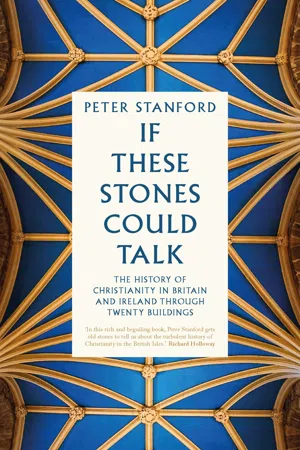
If These Stones Could Talk
The History of Christianity in Britain and Ireland through Twenty Buildings
- 352 pages
- English
- ePUB (mobile friendly)
- Available on iOS & Android
eBook - ePub
If These Stones Could Talk
The History of Christianity in Britain and Ireland through Twenty Buildings
About this book
Information
Topic
Theologie & ReligionSubtopic
ArchitekturgeschichteChapter 1
The First Century
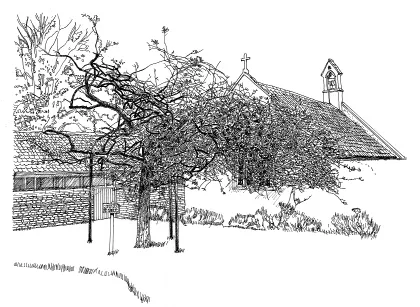
Glastonbury Abbey: And Did Those Feet in Ancient Times?
The rapidity with which the faith spread through the Roman Empire astounded the Christians themselves.
Professor Henry Chadwick1
There were almost certainly Christians in the British Isles in the first century. The Church established by the followers of Jesus of Nazareth in the middle decades of the century, following his death and based on the conviction that he had risen from his tomb, expanded rapidly out of Palestine. It spread around the Middle East, into the imperial capital of Rome, and then onwards to all points of the far-flung Roman Empire, which, from ad 43, included the conquered province of Britannia. Yet, while it is possible to identify how the new religion would have reached these islands, exactly when it did and who embraced it still remain just out of reach, and therefore largely the stuff of legend.
One location in particular – Glastonbury in Somerset – boasts of being ‘the cradle of Christianity in England’. The description appears on the information boards that greet today’s visitors to its ruined Abbey, a much later creation, once one of the grandest and richest in the country but destroyed in 1539 as part of the Dissolution of the Monasteries during the English Reformation. Such an eye-catching assertion, however, rests precariously on medieval claims widely dismissed by scholars that Joseph of Arimathea, the disciple who, according to the Gospels, provided a tomb where Jesus’ corpse could be laid after his crucifixion,2 came to Glastonbury as part of the first-century missionary push. He is said to have established there, on the site subsequently occupied from the early 700s by the first of three abbey buildings, a simple Christian church that was the first of its kind in the land.
The strongest evidence to back up this story comes from 1130, when William of Malmesbury, sometimes referred to as second only to the Venerable Bede as a reliable source on early Christianity in Britain, wrote in his description of Glastonbury that it contained an ‘ancient’ church that was ‘the oldest of all those that I know of in England’.3 He makes no reference to Joseph of Arimathea. That only came as an addition to his writings, inserted by others in later editions that appeared after his death.
William’s picture of this church, though, is a beguiling one for those searching for evidence of early Christianity in the British Isles:
In it are preserved the bodily remains of many saints, and there is no part of the church that is without the ashes of the blessed. The stone-paved floor, the sides of the altar, the very altar itself, above and within, are filled with relics close-packed. Deservedly indeed is the repository of so many saints said to be a heavenly shrine on earth.4
This earliest of Christian churches, made, William suggested, of ‘brushwood’, was destroyed in 1184, when fire consumed the whole abbey complex. In the rebuilding that followed, it was reborn, at the request of the monastic authorities, as a chapel dedicated to the Virgin Mary, whose cult grew popular in medieval Christianity (compared to in its early centuries). Money was required to fund the construction, and it seems likely that the wily monks took liberties with a hazy Joseph of Arimathea legend that had become attached to the ‘ancient’ chapel. They rightly saw its potency in attracting pilgrims who would be inspired to dig ever deeper into their ‘scrips’, or wallets, by the suggestion that they were standing on the very spot where someone who knew Jesus had once walked.5
They were being misled. A 2018 archaeological study by academics from Reading University concluded that, while there were traces of a fifth-century structure buried underneath and around what are now the ruins of the twelfth-century Lady Chapel, there was no evidence of anything dating back to the first century.6
Christianity’s arrival on British shores has, then, left no structure that, however distantly and indirectly, connects visitors with those early decades. It is a conclusion that fits with what we know of the circumstances of first-century Britannia. The new Jesus sect had been spreading rapidly. The Welsh monk and chronicler, Gildas, writing in the 540s in De Excidio et Conquestu Britanniae (On the Ruin and Conquest of Britain), claimed that Christianity had been established in the British Isles before the death of Emperor Tiberius in 37,7 but most discount any suggestion that it predated the Roman conquest in 43. It is unlikely, though, to have been imported by the elite of colonial administrators, military and civil, who arrived after that date. They were the people who would have had to approve, or at least turn a blind eye to, the building of any Christian church, and the Roman Empire, while generally tolerant of local religious sects and cults within its borders, also insisted on formal adherence by all to its state pantheon of gods – Jupiter, Juno, Minerva, Mars and others – to whom was ascribed imperial success and prosperity. This top-down demand that all go through the motions as regards the official religion weighed most heavily on senior officials and their families. They were expected to set an example, leaving them little room to indulge their own private religious convictions.
For those lower down in the colonial ranks, including in the entourage of these high-ranking figures, there may have been a little more freedom to reject the official polytheism of the Roman state – but only as long as they, too, were seen in public to offer symbolic sacrifice, when required, to the gods. Such acts were akin to an oath of allegiance to the Empire.
However, before embarking for this Roman outpost, some among their number may have had some contact or connection with what we know from Saint Paul’s letters was a growing, if still small, community of Christians in the imperial capital in the first century. In his epistle to the Romans, dating from the mid 50s, he greets Prisca and Aquila as ‘fellow workers’ and refers to ‘the church at their house’.8 In such settings, the talk was not of the vast official pantheon of gods, but of the one God who sent his Son, Jesus, to preach a radical, bottom-up message of reform to the world.
There may even have been some who were touched by the fledgling Christian communities that were springing up elsewhere in the Empire among the legions of soldiers who played their part in bringing and keeping most of Britannia under the rule of Emperor Claudius (41–54) (though Scotland remained free, and parts of the north and Wales were just too far from the centre of Roman power in southern England to see for many years any sustained efforts at effective imperial control). Many of those who made up the occupying force under Aulus Plautius had come from Roman-controlled Gaul (France), where Christianity is said to have spread especially quickly up from the Mediterranean coast and into the Rhône valley, making Avignon, Lyon and Marseille significant centres of Christianity in these early centuries. It grew so rapidly in numbers that its followers faced a major persecution by the authorities in Lyon by 177.
To mark the addition of Britannia to his empire, Claudius – nephew of and successor to the infamously louche Caligula (37–41) – paid a sixteen-day celebratory visit. He was accompanied, according to reports, by elephants when he arrived in triumph in the newly established Roman capital at Camulodunum (Colchester). In his retinue, as well as the generals and administrators (and those who answered to them) required to keep down the unruly locals in the patchwork of kingdoms and tribes now under his authority, was the first influx of traders. The Empire was not just about territorial power but also about economics, and Britannia’s mineral reserves in particular had made it very attractive to the Romans. There were profits to be made, and so in the string of fortified towns, linked by the well-made, straight roads that are Rome’s lasting mark on the countryside, merchants and dealers would gather. Again, among the less-regimented ranks of this commercial fraternity there may well have been some who had already encountered and carried with them the Christian faith.
A lot is written of the Roman persecution of Christians. Generations of schoolchildren have grown up on tales of those who refused to deny Jesus Christ being thrown to the lions in vast Roman arenas in front of baying crowds. Much of that brutal oppression came later, growing over the centuries as numbers of Christians and their network of churches and bishops expanded, causing official alarm that this new sect of believers posed an existential threat to the cohesion of the Empire itself. By contrast, in the first century only two flashpoints of anti-Christian violence stand out. Emperor Nero (54–68) blamed and punished Christians for the Great Fire of Rome in 64, during which, legend has it, he did nothing but play his fiddle as the flames took hold. The ensuing persecution may even have claimed the lives of both Saint Paul, the missionary par excellence who, more than any other figure, defined the Christian canon, and of Saint Peter, Jesus’ chosen leader for his new Church.9 Subsequent Christian accounts of their deaths in Rome sometime between 64 and 67 have, though, been widely challenged. Peter may never have been to the imperial capital at all. And the whole story of Nero’s targeting of Christians rests on a single contemporary reference by the Roman historian Tacitus who, in his Annals, writes of the emperor inflicting ‘the most exquisite torture’ on adherents of a ‘most mischievous superstition’ called ‘Chrestian’.10
The second outbreak of violence in the first century came with the persecution of Christians at the end of Domitian’s reign (89–96). It provided the backdrop and inspiration for the apocalyptic scenes that dominate Revelation, the final book of the Bible, written at this time. Yet such purges were often confined to specific places and regions. While Domitian’s imperial decrees and edicts would have applied equally to Britannia, prosecution relating to them was much less fierce in this new colony than elsewhere.
This may have been because there were just too few Christians around to pose a real threat, especially when compared to the much more pressing uprising against Roman rule in Britannia led by Boudica, queen of the Celtic Iceni tribe. Her forces destroyed Camulodunum, Londinium (London) and Verulamium (St Albans), leaving an estimated 60,000 dead, before being defeated in 60 or 61. Next to this, the private activities of a scattering of first-century Christians would scarcely have set alarm bells ringing, especially if they kept their beliefs to themselves and others of like mind, while all the time paying lip service to the official gods.
Christianity is, of course, an evangelistic faith, with Jesus urging his followers to go out and spread his message.11 For those first British Christians, what might have proved just as inhibiting as fear of persecution may well have been the (baseless) reputation this new sect enjoyed in Roman society. ‘Popular fear of this strange new group,’ writes American historian Paula Fredriksen, ‘fed also on rumour, which attributed terrible anti-social crimes to Christians – infanticide, cannibalism, incest.’12
As a consequence, the earliest manifestations of Christianity in Britannia would have been in the privacy of a family’s home, and later other believers would be invited into what became a house church. These were not, then, the brushwood, rock, wooden, stone and bricks-and-mortar structures that tell so much of the subsequent story of Christianity in Britain and Ireland. ‘Church’ for these early Christians – taking their cue from the Greek noun ἐκκλησία (ekklesía), meaning assembly or cong...
Table of contents
- Cover
- Also by Peter Stanford
- Title Page
- How to Use this eBook
- Dedication
- Contents
- Timeline
- Map
- Prologue
- 1 The First Century
- 2 The Second Century
- 3 The Third Century
- 4 The Fourth Century
- 5 The Fifth Century
- 6 The Sixth Century
- 7 The Seventh Century
- 8 The Eighth Century
- 9 The Ninth Century
- 10 The Tenth Century
- 11 The Eleventh Century
- 12 The Twelfth Century
- 13 The Thirteenth Century
- 14 The Fourteenth Century
- 15 The Fifteenth Century
- 16 The Sixteenth Century
- 17 The Seventeenth Century
- 18 The Eighteenth Century
- 19 The Nineteenth Century
- 20 The Twentieth Century
- Epilogue: A Twenty-First Century Church?
- Acknowledgements
- Notes
- Endmatter page 1
- Imprint Page
Trusted by 375,005 students
Access to over 1.5 million titles for a fair monthly price.
Study more efficiently using our study tools.
Frequently asked questions
Yes, you can cancel anytime from the Subscription tab in your account settings on the Perlego website. Your subscription will stay active until the end of your current billing period. Learn how to cancel your subscription
No, books cannot be downloaded as external files, such as PDFs, for use outside of Perlego. However, you can download books within the Perlego app for offline reading on mobile or tablet. Learn how to download books offline
Perlego offers two plans: Essential and Complete
- Essential is ideal for learners and professionals who enjoy exploring a wide range of subjects. Access the Essential Library with 800,000+ trusted titles and best-sellers across business, personal growth, and the humanities. Includes unlimited reading time and Standard Read Aloud voice.
- Complete: Perfect for advanced learners and researchers needing full, unrestricted access. Unlock 1.5M+ books across hundreds of subjects, including academic and specialized titles. The Complete Plan also includes advanced features like Premium Read Aloud and Research Assistant.
We are an online textbook subscription service, where you can get access to an entire online library for less than the price of a single book per month. With over 1.5 million books across 990+ topics, we’ve got you covered! Learn about our mission
Look out for the read-aloud symbol on your next book to see if you can listen to it. The read-aloud tool reads text aloud for you, highlighting the text as it is being read. You can pause it, speed it up and slow it down. Learn more about Read Aloud
Yes! You can use the Perlego app on both iOS and Android devices to read anytime, anywhere — even offline. Perfect for commutes or when you’re on the go.
Please note we cannot support devices running on iOS 13 and Android 7 or earlier. Learn more about using the app
Please note we cannot support devices running on iOS 13 and Android 7 or earlier. Learn more about using the app
Yes, you can access If These Stones Could Talk by Peter Stanford in PDF and/or ePUB format, as well as other popular books in Theologie & Religion & Architekturgeschichte. We have over 1.5 million books available in our catalogue for you to explore.