'Sixty years ago I found myself distracted.' So begins the introduction to As Kingfishers Catch Fire. What follows is the record of the collaboration of pastor and congregation in acts of worship and a life together. What Eugene Peterson, for thirty years pastor of a Maryland church, discovered is that the pastor's life is much more than just the preaching. It is also made up of attending to the details in all the circumstances and relationships specific to a people and a place - prayers at a hospital bed, conversations with the elderly, small talk on a street corner. This collection of spiritual writings presents Peterson's distinctive approach designed to communicate to his congregation, and the reader, 'the full counsel of God.' Seven sections containing seven teachings, each expertly crafted to stir the biblical imagination. In these teachings, Peterson walks the reader through Scripture to bring fresh insight to familiar names such as Moses, David, Isaiah, Solomon, Peter, Paul, and John of Patmos.
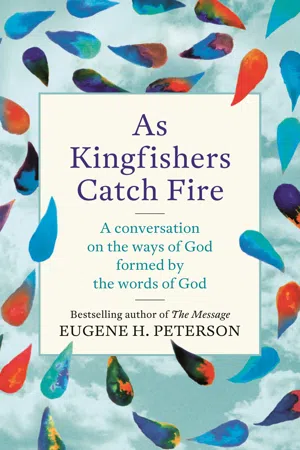
eBook - ePub
As Kingfishers Catch Fire
A Conversation on the Ways of God Formed by the Words of God
- 368 pages
- English
- ePUB (mobile friendly)
- Available on iOS & Android
eBook - ePub
As Kingfishers Catch Fire
A Conversation on the Ways of God Formed by the Words of God
About this book
Information
Topic
Theology & ReligionSubtopic
Christian DenominationsPart 1

“HE SPOKE AND IT CAME TO BE”
PREACHING IN THE COMPANY OF MOSES
Introduction
An enormous authority and dignity have, through the centuries, developed around the first five books of the Bible, traditionally designated the Books of Moses. Over the course of many centuries, they account for a truly astonishing amount of reading and writing, study and prayer, teaching and preaching.
God is the primary concern of these books. That accounts for the authority and the dignity. But it is not only God; we get included. That accounts for the widespread and intense human interest. We want to know what’s going on. We want to know how we fit into things. We don’t want to miss out.
The Books of Moses are made up mostly of stories and signposts. The stories show us God working with and speaking to men and women in a rich variety of circumstances. God is presented to us not in ideas and arguments but in events and actions that involve each of us personally. The signposts provide immediate and practical directions to guide us into behavior that is appropriate to our humanity in the particular place and time in which we live, and that is honoring to God.
The artless simplicity of the storytelling and signposting in these books makes what is written here as accessible to children as to adults, but the simplicity (as in so many simple things) is also profound, inviting us into a lifetime of growing participation in God’s saving ways with us.
Preaching requires that we develop a Moses imagination, with stories and signposts. Using the name of Moses to identify these books does not mean he wrote them, for many unnamed Hebrew prophetic minds told and wrote what was eventually gathered and copied here. Moses, rather, represents the way of life and the way of using language that sets the tone for everything else that makes up Holy Scripture. The five books are foundational for the subsequent sixty-one. Preaching in the company of Moses keeps proclamation personal and local while at the same time breathing the clean air of creation (what God does) and the air of covenant (how God brings us into participation).
Moses is mentioned in the New Testament more frequently than any other Old Testament person—seventy-eight times. His influence is everywhere. It is impossible to exaggerate his importance. A giant in the land. The first Christians (and preachers!), living by faith in Jesus Christ and teaching others to do the same, had Moses constantly on their tongues and his example always in their vision.
Elie Wiesel, retelling the Moses story with a blend of biblical and Talmudic materials, wrote, “Moses [was] the most solitary and most powerful hero in Biblical history. The immensity of his task and the scope of his experience command our admiration, our reverence, our awe. Moses, the man who changed the course of history … his emergence became the decisive turning point. After him, nothing was the same again.”1
The way of language in which Moses is our first teacher is most accurately described, I think, as a storytelling language, a language textured by the give-and-take of a life under the formative influence of God’s Word, language that develops in a worshiping congregation, language that invokes God and then listens and prays. It is the language of a mixed company of struggling sinners and faltering saints, preachers and teachers, homemakers and business people—people on pilgrimage, telling their family stories, passing on the counsels and promises of God. Preaching in the company of Moses develops precisely this storytelling imagination that keeps our sermons grounded in the everyday realities of the people to whom we are preaching.

But during the last three hundred years, the name of Moses, so long identified with the Five Books, the Torah, has for many been gradually effaced from the spine of his books, much as names disappear from centuries-old, weather-scoured cemetery markers. In this case the weather did not consist of wind and rain, snow and sleet, but of historical criticism, a new way of reading the Bible.
So for many of our pastor colleagues, the long practice of reading the Bible as a book of faith has played second fiddle to reading it strictly as history. The story—the narrative of a lived faith in God—has been obscured if not lost altogether. Those who read the Bible this way (but not all) ignore the literary context of the Bible and take it apart, looking for development and historical change. They challenge the historicity of foundational events and traditional ideas of authorship and then reconstruct the history, but they leave the Bible itself as a pile of disjointed fragments from various times and places. They have no interest in the literary and theological coherence of the text. These critics suppose that by digging underneath the Moses books they can serve us a better or truer truth. But most writers are highly offended when people get more interested in the contents of their wastebaskets and filing cabinets than the books they write. “Read the book!” The meaning is in the book, not in the information about the book.
When I was twelve years old, in the year 1944, my father bought a disreputable ’36 Plymouth, drove it home, and parked it in the alley behind our house. There it died. It never ran again. I don’t think my father ever went out back and looked at it again. But I put it to good use. I was a couple of years away from getting my driver’s license, and I sat in that old wreck most days for an hour after school and practiced using the gear shift, shifting from first to second to third and back down again, using the brake and clutch pedals, positioning my hands on the steering wheel, imagining myself in the act of driving over mountain roads and through blizzards.
After a few months I had mastered the moves. But having used up my imagination in driving the inert machine, I thought I might as well try to find out what made it tick when it did tick. I think I had a vague idea that maybe I could make it run again. I took it apart, piece by piece, educating myself in the ways of carburetors, cooling systems, transmissions, and brake drums. After a few months I was familiar with most of the parts now laid out on the grass, but I never did figure out what made it run. And of course by the time I had completed my investigative work, there was no chance of it ever running again.
Is it possible to appreciate the work of the historical critics that in large part (not completely) removes Moses as the author of the Five Books and yet at the same time affirms the traditional Mosaic presence that has provided a cohesive and personal authorial voice, the story line that has kept all the parts together for both Jews and Christians for so long? Is it possible to take the Torah apart historically and then put it back together again as a book of faith with theological and literary integrity? I think it is. It is not only possible but worth any effort it might take. And pastors occupy an influential place in the Christian church from which to do it.
The world that we read of in our Bibles was essentially an oral world, although there is plenty of evidence that much of the speaking also got written. Language in itself, in its origins and in most of its practice, is oral. We speak words long before we write and read them. The world we live in today continues to be primarily oral. Orality does not mean primitive. Words spoken are both previous to and inherently superior to words written, even in the most literate of cultures.
Among our Hebrew ancestors, generations of orally transmitted traditions developed and seasoned their unique people-of-God memory. Here and there, now and then, the words were written down and preserved, copied and collected, honored and read. Moses is remembered as one who wrote down the words (Exodus 24:4; 34:27–28; Deuteronomy 31:9, 24). The words became books. In all that was said or sung or written, the memory and words of Moses provided the story line that kept it all together. Over time, the telling and the writing became the Five Books of Moses.
Moses’s presence was profound: his leadership, his integrity, his ordained authority as the leader of the people of God out of the slavery of Egyptian bondage into the service of God, his Sinai transmission of God’s revelation, his provision and instruction for recentering the life of the people in worship. His pastoral care of his flock during all those years in the wilderness shaped all the seemingly disparate stories, instructions, and directions into a coherent whole. Moses looms still as the architect of the huge, sprawling house of language that is the Torah, the Five Books, the founding document for the faith of Israel and the Christian gospel. Torah: the revelation of God written for the people of God, Jew and Christian alike. Not just author in a strictly literal sense, but authority in an encompassing literary and Spirit-inspired sense.
Jesus, who confined his language to the spoken word, and those who wrote his story for us commonly referred to the Torah (“the Law”) simply as “Moses.” In the early church Moses was the most prominent ancestral name, whether as leader of the people of God or as the one giving voice to the revelation of God in the Torah. Torah and Moses were virtual synonyms in both Judaism and the church.
As we preach in the company of Moses, we will nourish this storytelling imagination.
1
“In the Beginning God Created”
GENESIS 1:1–2:4
JOHN 1:1–3
A little more than a year ago, three men were orbiting the moon in a space capsule. It was Christmas Eve, and they took turns reading Genesis 1, the opening chapter of the Bible: “In the beginning God created the heavens and the earth,” a most magnificent choice of texts for Christmas Eve.
The Apollo 8 spacecraft was transformed momentarily into a Jewish/Christian pulpit. Man’s most impressive technological achievement to date was absorbed in the declaration of God’s creative act. Apollo, the most dashing of the pagan Greek gods, bowed down in worship to “God, the Father Almighty, maker of heaven and earth.”1 The astronauts did what a lot of people spontaneously do when they integrate an alert mind with a reverent heart—they worshiped.
One person objected stridently. The self-proclaimed atheist Madalyn Murray O’Hair noisily complained that the nation’s space program had been hijacked to advance a minority religion. She said that the tax money of millions had been used to propagate the Christian faith of a few, violating the rights of the atheists. The wealth of a nation had been put in the service of a Christian witness. The conscience of the atheist was offended.2
She was, of course, right. It was unfair. You might even say it was shocking. We have gotten used to listening in on the conversations between Mission Control in Houston and astronauts orbiting the earth and moon. It is a highly technical conversation using an unambiguous mathematical-scientific vocabulary. We have learned to admire the cool, unflappable consistency of the men who sit at the controls of the complex, intricate mechanisms of space travel. We are occasionally reminded that they are human by a boyish burst of enthusiasm over the view of Earth wrapped in beauty. We are even reminded once in a while that they are sinners as tempers flare or profanity slips out. We reassure ourselves, by reading interviews with their spouses and looking at pictures of their homes, that they are really humans much like we are. But that is only the diverting, anecdotal background to the big picture. The astronauts represent modern man at his scientific apogee, superbly in control, precisely trained, dominating the world with power and skill.
When these men without warning recite an ancient confession of faith, when these men openly admit they are not just the conquerors of space but at the same time worshipers of God, well, it is unusual. Mrs. O’Hair did well to be angry.
The fact is that the space capsule is an educational center. Millions of persons were watching images of it on TV and listening to radio transmissions of the conversations. What the astronauts said had enormous coverage and intense impact. It was one of the educational highlights in human history. The world became a classroom. An appropriate passage from Heisenberg or Einstein would be heard and repeated all over the world and through repetition would be indelibly impressed on the minds of millions.
But this text was from millennially old Genesis. Would there be laments over the wasted educational opportunity for science? Would anyone feel that this was a painful opening of old wounds? For a long period of time there had been bitter controversy between Genesis and geology, Eden and evolution. Battle lines had formed. The defenders of God used their Bibles instead of bullets. The defenders of Darwin stockpiled weapons in the form of fragments of jawbones and stratified rocks. One group looked to the Garden of Eden for the beginnings of creation; the other group was convinced you could learn...
Table of contents
- Cover
- About the Author
- Title Page
- Copyright
- Praise
- Dedication
- Contents
- Letter to the Reader
- Preface
- Part 1: “He Spoke and it Came to Be”: Preaching in the Company of Moses
- Part 2: “All My Springs Are in You”: Preaching in the Company of David
- Part 3: “Prepare the Way of the Lord”: Preaching in the Company of Isaiah
- Part 4: “On Earth as it is in Heaven”: Preaching in the Company of Solomon
- Part 5: “Yes and Amen and Jesus”: Preaching in the Company of Peter
- Part 6: “Christ in You the Hope of Glory”: Preaching in the Company of Paul
- Part 7: “In the Beginning Was the Word”: Preaching in the Company of John of Patmos
- Acknowledgments
- Footnotes
Trusted by 375,005 students
Access to over 1.5 million titles for a fair monthly price.
Study more efficiently using our study tools.
Frequently asked questions
Yes, you can cancel anytime from the Subscription tab in your account settings on the Perlego website. Your subscription will stay active until the end of your current billing period. Learn how to cancel your subscription
No, books cannot be downloaded as external files, such as PDFs, for use outside of Perlego. However, you can download books within the Perlego app for offline reading on mobile or tablet. Learn how to download books offline
Perlego offers two plans: Essential and Complete
- Essential is ideal for learners and professionals who enjoy exploring a wide range of subjects. Access the Essential Library with 800,000+ trusted titles and best-sellers across business, personal growth, and the humanities. Includes unlimited reading time and Standard Read Aloud voice.
- Complete: Perfect for advanced learners and researchers needing full, unrestricted access. Unlock 1.5M+ books across hundreds of subjects, including academic and specialized titles. The Complete Plan also includes advanced features like Premium Read Aloud and Research Assistant.
We are an online textbook subscription service, where you can get access to an entire online library for less than the price of a single book per month. With over 1.5 million books across 990+ topics, we’ve got you covered! Learn about our mission
Look out for the read-aloud symbol on your next book to see if you can listen to it. The read-aloud tool reads text aloud for you, highlighting the text as it is being read. You can pause it, speed it up and slow it down. Learn more about Read Aloud
Yes! You can use the Perlego app on both iOS and Android devices to read anytime, anywhere — even offline. Perfect for commutes or when you’re on the go.
Please note we cannot support devices running on iOS 13 and Android 7 or earlier. Learn more about using the app
Please note we cannot support devices running on iOS 13 and Android 7 or earlier. Learn more about using the app
Yes, you can access As Kingfishers Catch Fire by Eugene Peterson in PDF and/or ePUB format, as well as other popular books in Theology & Religion & Christian Denominations. We have over 1.5 million books available in our catalogue for you to explore.