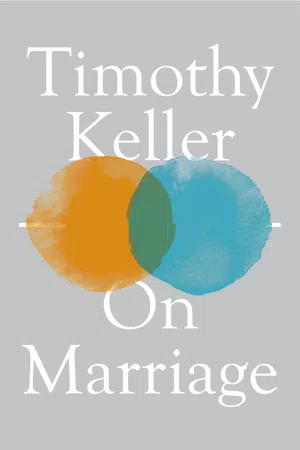
There are few events as significant and life-altering as birth, marriage, and death. These are the moments in which we experience our greatest happiness and our deepest grief. And so it is profoundly important to understand these events and their religious and spiritual significance in the course of our lives. In On Marriage, Timothy Keller and his wife, Kathy, take us on a journey into the Christian meaning of marriage. With wisdom, joy and compassion, the Kellers teach us to understand marriage through the lessons embedded within the Bible. The perfect gift for anyone thinking about marriage, On Marriage is a short, powerful book that gives us the tools to understand its meaning within God's vision of life.'A Christian intellectual who takes on the likes of Nietzsche, Marx, and Freud.' The Wall Street Journal
- 128 pages
- English
- ePUB (mobile friendly)
- Available on iOS & Android
eBook - ePub
On Marriage
About this book
Information
Topic
Theology & ReligionSubtopic
ChristianityBeginning a Marriage
Why bother to get married at all?
In the words of the traditional Christian wedding service, “God has established and sanctified marriage for the welfare and happiness of humankind.”1 While true, that cannot be the end of the discussion for modern people.
This is a more pressing question now than it has ever been in previous times. In the past it was a given that to become an adult member of society you married and had children, and the vast majority of people did so. But younger adults in Western countries today postpone marriage at unprecedented rates. Nearly a third of all millennials in the United States may stay unmarried through age forty, and 25 percent may not marry at all, the highest proportion of any generation in modern history.2 Why? There are two reasons that so many marriages never begin: economic stress and the rise of individualism in culture.
Fears About Marriage
The economic factor is seen in the widespread belief of single adults that they must be financially secure in a good career before they marry and that, of course, their prospective mate should be as well. The background assumption is that married life is a drain on resources, especially with the arrival of children. Before marrying, it is therefore believed, you should have a guaranteed income stream, adequate savings, and perhaps even an investment portfolio.
However, this view flies in the face of both statistics and tradition. Traditionally, you got married not because you were economically secure and stable, but in order to become so. Marriage brings with it unique economic benefits. Studies show that married couples save significantly more than singles. Spouses can encourage one another to greater levels of self-discipline than can friends. Spouses also provide each other with more support through the trials of life, so that they experience greater physical and mental health than singles.
The other factor in the decline of marriage to which experts point is “expressive individualism.”3 This is a term popularized by sociologists to describe a growing cultural trend. In traditional cultures our personal identity was worked out in our relationships. “Who I am” was defined by my place in a family and community, and perhaps by my place in the universe with God. I became a person of worth as I fulfilled my responsibilities in these relationships. In modern times, however, we have turned inward. “Who I am” must not be determined by what anyone else says or thinks about me. I become a person of worth as I discover my own deepest desires and feelings and express them. Once I determine who I am, then I can enter into relationships, but only with those who accept me on my own terms.
This modern approach to identity is instilled in us by our culture in countless ways. In the 2016 film Moana, the crown princess of a Polynesian island has been told by her father that she is the island’s future leader and will have to submit to many traditional responsibilities. But instead, Moana has a desire to set out to sea to find adventure. Her grandmother sings her a song that tells her that her “true self” resides not in her duties and social responsibilities, but in the expression of her inmost desires. She tells Moana that if a “voice inside” her heart tells her to follow her desires, “that voice inside is who you are.”4
We are assailed by this message at every turn—in television, movies, advertising, classrooms, books, social media, and casual conversation—until it is an unquestioned, virtually invisible assumption about how we become authentic persons.
The effect of this modern self on marriage has been considerable. It means that we do not want to even consider marriage if we have not established our own unique identity. We don’t want anyone else to have any say in who we are until we have fully decided it for ourselves. Further, today we expect and even demand that all relationships be transactional, provisional as long as profitable, and never binding and permanent. If impermanence is the standard, then marriage and particularly parenting are deeply problematic since leaving a marriage is difficult and leaving a parenting relationship is essentially impossible. What if a relationship with a spouse or a child gets in the way of your expressing your “true self”?
Many modern people only marry if they believe they have found a spouse who won’t try to change them and who will provide emotional and financial resources to help them toward their personal goals.
But it is an illusion to think that we find ourselves only by looking inside, rather than in relationships with those outside of us. In every heart there are deep, multiple, contradictory desires. Fear and anger exist alongside hope and aspiration. We try to sort these contradictory desires, determining which ones are “not really me.” But what if they are all a part of me? How do we make decisions about which are “us” and which are not?
The answer is that we come to admire and respect some individuals or groups whose views we then deploy to sift and assess the impulses of our hearts. In other words, contrary to what we are told, we do develop an identity not merely by looking inside but through important relationships and narratives that profoundly shape how we see ourselves. We do not merely look within.
The traditional approach to marriage was wise, in that people knew intuitively that it would profoundly shape and reshape our identity. And that’s good—because identity is always worked out in negotiation with significant others in your life. As psychologist Jennifer B. Rhodes put it, “In previous generations people were more willing to make that decision [to marry] and [then] figure it out.”5 What better way to discover who you are than to marry someone you love and respect, and then figure it out together?
So the contemporary decline in marriage is based on two mistaken beliefs about it, namely, that it is a drain economically and it is an impediment to the full realization of our freedom and identity.
Marriage Was Made for Us
Social scientists have marshaled evidence against these two mistaken views, showing how significantly marriage benefits us both economically and psychologically. In addition, they have demonstrated how crucial the traditional family is to the welfare of the young, that children do much better if raised in families of two married parents. But Christians should not be at all surprised by these findings.6 The book of Genesis tells us that God established marriage even as he created the human race. This should not be understood to teach that every individual adult must be married. Jesus himself was single, and since he stands as the great exemplar of what a human being should be, we cannot insist—as some cultures have—that you must be married to be a fully realized person. But neither can we see marriage, as our own culture does, as merely a development to guard property rights during the Neolithic Age that today can be altered or discarded as we please.
Wendell Berry famously addressed the modern idea that whether we have sex inside marriage or outside is “a completely private decision.” He disagreed, saying, “Sex is not and cannot be any individual’s ‘own business,’ nor is it merely the private concern of any couple. Sex, like any other necessary, precious, and volatile power that is commonly held, is everybody’s business.”7 Sex outside of marriage creates babies outside of marriages, it often spreads disease, and it habituates us to treat others as pleasure objects rather than persons. All of these have a major impact on social conditions, conditions that affect everyone.
We know this line of thinking is deeply counterintuitive to modern people in the West, but it has been quite natural to most human beings in most places and times. Your choice regarding marriage is not ultimately a private decision. It affects everyone around you.
Marriage was made for us, and the human race was made for marriage.
Fear of Failure
There is another reason many people give to explain the modern reticence to marry. “I saw how difficult my own parents’ marriage was, and I don’t want that for myself.” A fear of strife and marital failure keeps many people from seeking a spouse or, at least, makes them l...
Table of contents
- Cover
- About the Authors
- Also by The Authors
- Title Page
- Dedication
- Contents
- Introduction to the How to Find God Series
- Beginning a Marriage
- Sustaining a Marriage
- The Destiny of Marriage
- Acknowledgments
- Notes
- Copyright
Trusted by 375,005 students
Access to over 1.5 million titles for a fair monthly price.
Study more efficiently using our study tools.
Frequently asked questions
Yes, you can cancel anytime from the Subscription tab in your account settings on the Perlego website. Your subscription will stay active until the end of your current billing period. Learn how to cancel your subscription
No, books cannot be downloaded as external files, such as PDFs, for use outside of Perlego. However, you can download books within the Perlego app for offline reading on mobile or tablet. Learn how to download books offline
Perlego offers two plans: Essential and Complete
- Essential is ideal for learners and professionals who enjoy exploring a wide range of subjects. Access the Essential Library with 800,000+ trusted titles and best-sellers across business, personal growth, and the humanities. Includes unlimited reading time and Standard Read Aloud voice.
- Complete: Perfect for advanced learners and researchers needing full, unrestricted access. Unlock 1.5M+ books across hundreds of subjects, including academic and specialized titles. The Complete Plan also includes advanced features like Premium Read Aloud and Research Assistant.
We are an online textbook subscription service, where you can get access to an entire online library for less than the price of a single book per month. With over 1.5 million books across 990+ topics, we’ve got you covered! Learn about our mission
Look out for the read-aloud symbol on your next book to see if you can listen to it. The read-aloud tool reads text aloud for you, highlighting the text as it is being read. You can pause it, speed it up and slow it down. Learn more about Read Aloud
Yes! You can use the Perlego app on both iOS and Android devices to read anytime, anywhere — even offline. Perfect for commutes or when you’re on the go.
Please note we cannot support devices running on iOS 13 and Android 7 or earlier. Learn more about using the app
Please note we cannot support devices running on iOS 13 and Android 7 or earlier. Learn more about using the app
Yes, you can access On Marriage by Timothy Keller in PDF and/or ePUB format, as well as other popular books in Theology & Religion & Christianity. We have over 1.5 million books available in our catalogue for you to explore.