It is in the shelter of each other that the people live. Drawing on this Irish saying, poet, storyteller and theologian Pádraig Ó Tuama relates ideas of shelter and welcome to journeys of life, using poetry, story, biblical refelction and prose to open up gentle ways of living well in a troubled world. The fourth gospel tells of Jesus arriving in the room where the disciples are gathered, full of fear, on Easter Sunday. He does not chide or admonish; instead he says 'Peace be with you', which, in the Aramaic of his day, was simply a greeting. To people locked in a room of fear he said 'Hello, ' welcoming them to a place of deep encounter: encounter with themselves, with their fear, with each other and with the incarnate one in their midst.Interweaving everyday stories with narrative theology, gospel reflections with mindfulness and Celtic spirituality with poetry, In the Shelter reveals the transformational power of welcome.
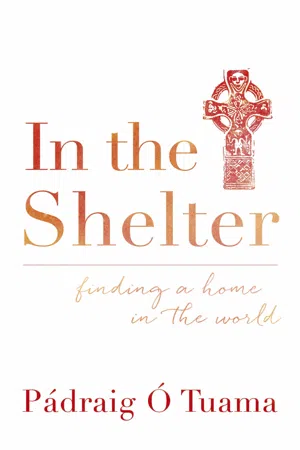
- 272 pages
- English
- ePUB (mobile friendly)
- Available on iOS & Android
eBook - ePub
About this book
Information
Topic
Theology & ReligionSubtopic
ReligionNarrative theology # 1
And I said to him:
Are there answers to all of this?
And he said:
The answer is in a story
and the story is being told.
And I said:
But there is so much pain
And she answered, plainly:
Pain will happen.
Then I said:
Will I ever find meaning?
And they said:
You will find meaning
where you give meaning.
The answer is in a story
and the story isn’t finished.
1
Hello to here
When travelling, I carry three books, one each of poetry, fiction and religion. I also bring a diary. In 1998, everything fell apart. At that stage, I had been ill for a year – dizziness, aching, exhaustion, insomnia, nausea – and I was finding it impossible to hold it together. I didn’t know what to do. My friend Wendy said, ‘I’m driving to France, do you want to come?’ I’d had to leave my job because I was too ill, and now, while I didn’t have much money, I had enough for a few months. So, for no reason other than it was the first idea in a year that had felt good, I went. I went with some clothes, a book of poetry, a book of religion and a book of fiction and I ended up in Taizé, that little monastery in eastern France known for generosity and light.
It was Easter, and I stayed in the house of silence at Taizé. I was there with twenty other men. It was a sunny Lent. I enjoyed bites of chocolate in small buns of bread for breakfast and I showed up for prayer and reflection. ‘During your weeks in silence here, don’t spend too much of your time reading,’ one of the Taizé brothers said, ‘make sure you spend time in silence and stillness.’
I read The Lord of the Rings in a week.
It wasn’t my first time reading it. You could call it rhythm or habit, but I’ve always re-read books, sometimes re-beginning the first page once the last page has ended. For years, I accompanied exam time with readings from Middle Earth, because the anxiety of exams was calmed by the richness of Sam’s courage. So, in France, it was no surprise that I had put Tolkien in the bag I’d packed. I was standing in what felt like the ruin of myself and I had brought a fiction to hold me together. It was a good fiction, and it worked. It held me together.
I had a copy of the Bible too, but I was doubting my decision to bring it. I didn’t feel like I could read it – I felt that I could read it if I were someone else, someone more holy, healthy and heterosexual. I felt caged in by my readings of the Bible, so it lay in the bag with the woollen jumpers, underwear and guilt I’d packed.
Tolkien wrote:
I have claimed that Escape is one of the main functions of fairy-stories, and since I do not disapprove of them, it is plain that I do not accept the tone of scorn or pity with which ‘Escape’ is now so often used. Why should a man be scorned if, finding himself in prison, he tries to get out and go home? Or if he cannot do so, he thinks and talks about other topics than jailers and prison-walls?
I was, in a sense, wanting to escape a religious belief that said I shouldn’t be ill, I couldn’t be gay and I couldn’t go on. And so, in a monastery, surrounded by rules, silence and four-part harmonies, I was finding myself in some kind of prison. I did what made most sense at the time: I turned to myth. Myth is, after all, what is more than true.

My favourite poem from David Wagoner is ‘Lost’:
Stand still. The trees ahead and bushes beside you
Are not lost. Wherever you are is called Here
And you must treat it as a powerful stranger.
The truth of this poem is an old truth. There are the places you wish to go, there are the places you desperately wish you never left, there are the places you imagine you should be, and there is the place called here. In the world of Wagoner’s poem, it is the rooted things – trees and bushes – that tell the truth to the person who is lost, the person with legs and fear who wishes to be elsewhere. The person must stand still, feel their body still on the ground where they are, in order to learn the wisdom. This is not easy wisdom, it is frightening wisdom. In Irish, there is a phrase ar eagla na heagla that translates as ‘for fear of fear’. It is true that there are some things that we fear, but that there is, even deeper, a fear of fear. So we are prevented from being here not only by being frightened of certain places, but by the fear of being frightened of certain places. So, ‘Stand still’ the poet advises. Learn from the things that are already in the place where you wish you were not.
Hello to the fear of fear.
Hello to here.
Anyway, it was Easter week. In Taizé we had morning reflections, of about ten minutes each, every morning. We had a monk there who could deliver his short talks in English, French, German or Spanish. He would ask, moving casually from language to language, which tongues he should use in order to be understood by everyone. He translated himself with ease, and his English was as rich in poetry as his French. On Holy Thursday – the day that we should have been reading about the last supper – he instead turned to a reading for Easter Sunday. He turned to the Gospel of John, particularly reading the text where Jesus arrives in the upper room wherein the disciples had locked themselves for fear. The Taizé monk read the text, asked someone else to read it in Dutch, someone else in Norwegian, and then he noted that when Jesus arrived in that room of fear he greeted his disciples by saying ‘Peace be with you’.
Part of the concern in re-reading a text often is that in so doing you read less and recognise more. You glide over familiar words. Or, to be more particular, you glide over familiar presumptions, and so, with time, you aren’t reading what’s there, you’re reading what you think is there.
The Taizé brother suggested that we pause for a moment and consider the words ‘Peace Be With You’ that the resurrected Jesus says to his locked-in followers. The Taizé brother said that, in a real sense, we can read that as ‘Hello’. After all, it’s the standard greeting in Hebrew, Arabic and Aramaic. He smiled and asked us all to say hello in our own language. There were many languages in the room. Then we approached the text again.
The disciples were there, in fear, in an upper room, locked away, and suddenly the one they had abandoned and perhaps the one they most feared to be with them was with them, and he said hello.
Hello to you in this locked room.
In many circles of faith or spirituality, there is generous time given to the testimony – the telling of the story of conversion, or re-conversion, of enlightenment or change. It is a moving thing, to listen to the testimony. But testimony, if told or heard unwisely, can be a colonisation of a single experience into a universal requirement. Jesus fed me when I was hungry, we hear, and those who are hungry feel bereft. Jesus healed me when I was sick, say the healthy, and the burdened feel more burdened. Meditation cured me of depression, say some, and others make plans to hide the Prozac. Upon whom is the burden of words? I don’t know. I don’t think there is an answer. I cannot dampen gladness because it will burden the unglad. But I cannot proclaim gladness as a promise that will only shackle the already bound. Faith shelters some, and it shadows others. It loosens some, and it binds others. Is this a judgment of the message or the messenger, the one praying or the prayer prayed? I don’t know.
Hello to what we do not know.
What I do know is that it can help to find the words to tell the truth of where you are now. If you can find the courage to name ‘here’ – especially in the place where you do not wish to be – it can help you be there. Instead of resenting another’s words of gladness or pain, it may be possible to hear it as simply another location. They are there and I am here. At another point, we will be in different locations, and everybody will pass by many locations in their life. The pain is only deepened when the location is resented or, even worse, unnamed.
Hello to here.
By the time I arrived with my bag and my books at Taizé, my relationship with religion had worsened my sense of my self. At that point, my relationships with others were guided by what I now recognise as desperation. ‘Could you like me?’ I asked over and over and over. I asked it of friends, I asked it of colleagues, I was desperate to ask it of authority, and to beg for acceptance from the God that I was trying to love.
Somehow, in the simplicity of that moment in a monastery in France, something became clear. I might be locked in somewhere, I might be looking to Middle Earth to save me, but I could do somethi...
Table of contents
- Cover
- Praise
- Title Page
- Copyright
- Contents
- Dedication
- Hello to the world
- Narrative theology # 1
- 1. Hello to here
- Staring match
- 2. Hello to the beginning
- Day of the dead
- 3. Hello to the imagination
- Is it working?
- 4. Hello to trouble
- In the name
- 5. Hello to what we cannot know
- Narrative Theology # 2
- 6. Hello to the body
- Yearn
- 7. Hello to the shadow
- Collect
- 8. Hello to change
- After the confession
- 9. Hello to power
- Returnings
- 10. Hello to story
- De noche
- Notes
- Acknowledgements
Trusted by 375,005 students
Access to over 1.5 million titles for a fair monthly price.
Study more efficiently using our study tools.
Frequently asked questions
Yes, you can cancel anytime from the Subscription tab in your account settings on the Perlego website. Your subscription will stay active until the end of your current billing period. Learn how to cancel your subscription
No, books cannot be downloaded as external files, such as PDFs, for use outside of Perlego. However, you can download books within the Perlego app for offline reading on mobile or tablet. Learn how to download books offline
Perlego offers two plans: Essential and Complete
- Essential is ideal for learners and professionals who enjoy exploring a wide range of subjects. Access the Essential Library with 800,000+ trusted titles and best-sellers across business, personal growth, and the humanities. Includes unlimited reading time and Standard Read Aloud voice.
- Complete: Perfect for advanced learners and researchers needing full, unrestricted access. Unlock 1.5M+ books across hundreds of subjects, including academic and specialized titles. The Complete Plan also includes advanced features like Premium Read Aloud and Research Assistant.
We are an online textbook subscription service, where you can get access to an entire online library for less than the price of a single book per month. With over 1.5 million books across 990+ topics, we’ve got you covered! Learn about our mission
Look out for the read-aloud symbol on your next book to see if you can listen to it. The read-aloud tool reads text aloud for you, highlighting the text as it is being read. You can pause it, speed it up and slow it down. Learn more about Read Aloud
Yes! You can use the Perlego app on both iOS and Android devices to read anytime, anywhere — even offline. Perfect for commutes or when you’re on the go.
Please note we cannot support devices running on iOS 13 and Android 7 or earlier. Learn more about using the app
Please note we cannot support devices running on iOS 13 and Android 7 or earlier. Learn more about using the app
Yes, you can access In the Shelter by Padraig O Tuama in PDF and/or ePUB format, as well as other popular books in Theology & Religion & Religion. We have over 1.5 million books available in our catalogue for you to explore.