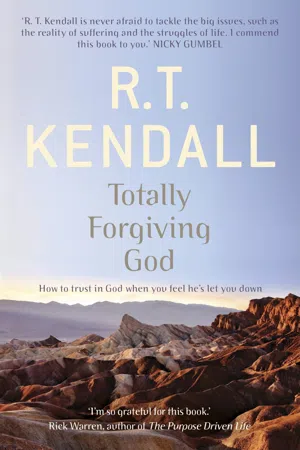
It's one of the most difficult questions that Christians face, and a problem that keeps many away from faith: why does a good God allow bad things to happen? And how do we keep on trusting him when they do? Having written bestselling books on how to forgive both others and ourselves, much-loved author R. T. Kendall now tackles our need to forgive God for all the times we feel he's let us down. Written with courage, humour and above all kindness, this book is an encouragement to all who've grappled with life's deepest mysteries.
- 240 pages
- English
- ePUB (mobile friendly)
- Available on iOS & Android
eBook - ePub
Totally Forgiving God
About this book
Information
Topic
Theology & ReligionSubtopic
ChristianityPART ONE
Our Perspective
O Lord . . . you have put me in the lowest pit, in the darkest depths . . . the darkness is my closest friend. (Ps. 88:1, 6, 18)
All looks yellow to the jaundiced eye. (Alexander Pope)
1
The Dilemma
Judge nothing before the appointed time; wait until the Lord comes. He will bring to light what is hidden in darkness and will expose the motives of the heart. At that time each will receive their praise from God. (1 Cor. 4:5)
I do not know how the great loving Father will bring out light at last, but he knows, and he will do it. (David Livingstone)
After fifty-seven years of Christian ministry I have observed and experienced countless enigmas; I have more questions I want to see answered in heaven than you could imagine. For example, I will never forget preaching the funeral sermon of a gifted child who had such a brilliant future, and shortly after that watching old people who didn’t know their own names live on and on. I have often prayed with the most beautiful and worthy people who remain unmarried (against their wish), and have seen countless others marry (and wish they hadn’t). I have known people in the ministry whom I felt should be under the just judgment of God but who flourished instead, and those who were faithful and godly who have never been very successful.
I have been continually surprised to see how many apparently dysfunctional parents have produced the most productive, amazing, godly children. On the other hand I have watched those parents who seemed to me to be the nearest to perfection one could imagine, and yet, to their dismay, watched their children grow up to reject the faith, marry the most unsuitable mates and end tragically. I recall one godly layman who prayed daily for years and years that neither of his two children would fall in love with the wrong person. In one case his prayer was clearly answered; one child seemed to be extremely blessed and enjoyed a long, fruitful marriage. But the other child went through two divorces and has known anything but marital bliss.
How could these things be? Why does God let people with Alzheimer’s or dementia exist, when they cannot possibly live productive lives? Why does God appear to bless certain flamboyant ministries who uphold questionable teaching, but seem not to bless others who have sought to be sound, self-effacing and honest? Why would God answer the prayers of a godly layman for one of his children and not the other? These are questions I expect to have answered in heaven.
Some of the words of Solomon seem ironic – if not cynical. But if one lives long enough one will eventually have to agree with this observation: ‘the righteous who get what the wicked deserve, and the wicked who get what the righteous deserve’ (Eccles. 8:14). So after all is said and done, we must all do our best and trust the mercy of God – and be thankful when that mercy is manifest in our lives and in our children. If any of us enjoy any accomplishments they will have come by the sheer grace of God.
My aim in writing this book
I write this book as a follower of Jesus Christ rather than as a theologian, pastor or evangelist. My aim in writing this book is to uphold the God of the Bible as faithfully as I can while also sharing with you as honestly as I can some of the things I have learned and observed. I am sure you have found out that life is not all black or white; you may even have personal stories which, if I knew them, would make better illustrations than I have here. Perhaps you too have lived through disappointment, disillusionment, rejection and betrayal. I am not writing a book that gives you a rosy picture of the Christian life, of Christians, the Church or of high-profile leaders whom God has used. The best of human beings are human beings at best.
For some reason I have always had a tendency to be a hero-worshipper. From the age of ten I began to admire Joe DiMaggio, the baseball player of the New York Yankees. I even combed my hair like he did, tried to smile like he did. I read the sports page every morning with anxiety to see if he had hit a home run the day before. If his batting average was up, so was my spirit. He could do no wrong in my eyes. Twenty years later I had the chance to meet him. After I shook his hand I was as excited as if I were a ten-year-old child. I still love reading anything I can about him.
Unfortunately I carried this tendency into my life in the Church. Even those I learned to love and admire let me down. From an early age I was introduced to famous preachers by my dad, and I began to look up to them. I hero-worshipped many preachers. But little by little I began to get a different picture of some of them. I began to hear stories of inconsistent living: their upholding high standards for their followers, but living quite differently in secret. Some of these people became friends, some very close friends. I learned a long time ago – years before we came to England – that every person I began to admire a little bit too much sooner or later disappointed me.
It is sad when young people who are preparing for ministry in the Church become completely disillusioned when they see older Christians who disappoint them, especially their mentors. I know of those who gave up the idea of ministry entirely, in some cases even abandoning the faith. I have often thought that young Samuel was broken into ministry in an extraordinary manner; he saw his mentor Eli’s imperfections after God had become so real to him. That perhaps is what saved him.
A close relationship with God
Looking back on my life, an intimate friendship with God is almost certainly what saved me from giving up. When I was in my first pastorate in Palmer, Tennessee, when I was nineteen, God graciously revealed himself to me in unusual power – showing me how real Jesus is, how true the Bible is. I am humbled that God would deal with me in that manner. It set me up for things coming down the road that almost certainly would have destroyed me, including not only seeing hypocrisy in leadership but having to face liberal teaching (which denied the infallibility of Scripture) years later. I was even given visions (which I had never had before) that warned me of certain leaders I had hero-worshipped.
God spoke directly to Samuel so powerfully that the young man could never doubt God’s existence and sovereignty. Samuel, thinking he had heard Eli speak, dutifully ran to him to see what he wanted (1 Sam. 3:4). Eli knew nothing and told Samuel to go back to bed. After the third occasion Eli realised something unusual was happening and told Samuel to reply to God, ‘Speak, for your servant is listening’; and the next day Eli forced young Samuel to reveal what was going on: ‘May God deal with you, be it ever so severely, if you hide from me anything he told you.’ Samuel then had to tell Eli that God was going to judge Eli himself, along with his family – a scary word for anybody to have to relate, not to mention one so young. But to Eli’s credit he replied, ‘He is the Lord; let him do what is good in his eyes’ (1 Sam. 3:18). Samuel therefore grew up under Eli’s supervision with no illusion about his mentor. It was, however, a great mercy that Samuel discovered for himself how real God was; otherwise the whole situation – with the wickedness that Eli was overlooking – could have destroyed him.
It is very, very important that a person going into Christian ministry, first, has a solid relationship with God, and also, second, a sound doctrine of sin and knowledge of the human heart. ‘The heart is deceitful above all things’, said Jeremiah; ‘Who can understand it?’ (Jer. 17:9). If we have a naive view of people we are an easy target for the devil to bring down. It is said of Jesus: ‘He did not need any testimony about mankind, for he knew what was in each person’ (John 2:25). The subsequent failures of Judas Iscariot and Simon Peter therefore did not take Jesus by surprise.
We are all called into ministry
This caution applies to any reader of this book. You may not be called into what we call ‘full-time’ Christian ministry, but you are absolutely called to develop a solid relationship with God. It is not only to those in ‘public’ ministry that God reveals himself; he does this with all those who want a close relationship with him. Also, you are called to ministry. Your calling to be a nurse, secretary, doctor, salesperson, accountant, housewife, lawyer or lorry driver is just as important as being the next Billy Graham. The question is, do you want a close relationship with God? I hope you do. James said, ‘Come near to God and he will come near to you’ (James 4:8). God loves to surprise the person who feels the most unworthy, the most insignificant and the most unlikely – if they desire to know God intimately. If you have such a desire, congratulations! That desire was put there by God. He would not give you that desire if he did not have further plans for you.
James said, ‘Not many of you should become teachers, my fellow believers, because you know that we who teach will be judged more strictly’ (James.3:1). Soon after starting out in my ministry I began to realise that people set me apart and looked up to me. I never – ever – felt worthy of this. I know too much about myself to take their adulation seriously.
And so too in writing this book. I do not want to mislead you or promise you more than can be delivered. Neither do I want to send you on a guilt trip because you cannot totally forgive God for the things he has allowed in your life. We are all what we are by the grace of God, and can only do what we are called to do by the same grace of God. As St Augustine (354–430) put it, ‘Give what Thou commandest and command what Thou wilt.’ Or as Charles Wesley (1707–88) put it in one of his hymns, ‘All my help from Thee I bring.’ If we are able to come through with what God asks of us, it will be by his help alone. I come to you with a sincere conviction that I am supposed to write this book, even with a title that could at first be misunderstood.
God cares how you feel. Your feelings matter to him very much indeed. Jesus has never forgotten what it was like when he was on this earth, being tempted at all points as we are, but without sin. For this reason he is to this very day ‘touched with the feeling’ of our weaknesses (Heb. 4:15, KJV). He doesn’t moralise us, scold us or make us feel sub-standard because we have a particular weakness. If you have been disillusioned that the Creator God – with whom the buck stops, and who controls all events – allowed you to suffer as you have, I want to say right now that I don’t blame you. God could have stopped what happened but didn’t. You are therefore very, very hurt and possibly very, very angry.
Three reasons why you should totally forgive God
At the same time I shall be bold and let you know up front that I hope to lead you gently but definitely to the place where you will eventually let God totally off the hook for allowing what he did.
Why? First, because of what it will do for you. I can safely promise you an inner freedom and release you never dreamed possible. We must forgive those on the earth who have hurt us, and we must forgive God in heaven who let things happen that hurt us. In much the same way as we experience peace when we totally forgive those who have hurt us, so too when we come to the place where we totally forgive God. An extraordinary joy will be yours. As I say in my book Total Forgiveness, this is what happens when you let others off the hook – regardless of how evil they were, or how hurt you continue to be. Don’t wait for them to apologise; chances are they never will. Chances are too that they don’t even think they have done anything wrong! Like it or not, most people we have to forgive honestly do not feel they have done the slightest thing wrong, and if you wait for them to repent you could go to your grave in bitterness.
Moreover, don’t go to them and tell them how hurt you are. This forgiveness should happen in your heart. I myself have had to forgive a lot of people over the years. Never once have I said a word to them (unles...
Table of contents
- Cover
- Title Page
- Imprint Page
- Dedication
- Contents
- Foreword by Rob Parsons
- Foreword by Dr Ed Stetzer
- Preface
- Introduction
- PART ONE
- 1 The Dilemma
- 2 Habakkuk’s Complaint
- 3 Let Down
- PART TWO
- 4 Why Faith?
- 5 The Way He Is
- 6 God’s Reply to Habakkuk
- PART THREE
- 7 The Accuser
- 8 Deceitful Hearts
- PART FOUR
- 9 Why Forgive God?
- 10 How to Forgive God – Totally
- 11 Not Guilty!
- 12 A Dream Deferred
- Also by R. T. Kendall
Trusted by 375,005 students
Access to over 1.5 million titles for a fair monthly price.
Study more efficiently using our study tools.
Frequently asked questions
Yes, you can cancel anytime from the Subscription tab in your account settings on the Perlego website. Your subscription will stay active until the end of your current billing period. Learn how to cancel your subscription
No, books cannot be downloaded as external files, such as PDFs, for use outside of Perlego. However, you can download books within the Perlego app for offline reading on mobile or tablet. Learn how to download books offline
Perlego offers two plans: Essential and Complete
- Essential is ideal for learners and professionals who enjoy exploring a wide range of subjects. Access the Essential Library with 800,000+ trusted titles and best-sellers across business, personal growth, and the humanities. Includes unlimited reading time and Standard Read Aloud voice.
- Complete: Perfect for advanced learners and researchers needing full, unrestricted access. Unlock 1.5M+ books across hundreds of subjects, including academic and specialized titles. The Complete Plan also includes advanced features like Premium Read Aloud and Research Assistant.
We are an online textbook subscription service, where you can get access to an entire online library for less than the price of a single book per month. With over 1.5 million books across 990+ topics, we’ve got you covered! Learn about our mission
Look out for the read-aloud symbol on your next book to see if you can listen to it. The read-aloud tool reads text aloud for you, highlighting the text as it is being read. You can pause it, speed it up and slow it down. Learn more about Read Aloud
Yes! You can use the Perlego app on both iOS and Android devices to read anytime, anywhere — even offline. Perfect for commutes or when you’re on the go.
Please note we cannot support devices running on iOS 13 and Android 7 or earlier. Learn more about using the app
Please note we cannot support devices running on iOS 13 and Android 7 or earlier. Learn more about using the app
Yes, you can access Totally Forgiving God by R T Kendall Ministries Inc.,R.T. Kendall in PDF and/or ePUB format, as well as other popular books in Theology & Religion & Christianity. We have over 1.5 million books available in our catalogue for you to explore.