Something in us is waiting - for what, we don't know. Something different? Something better?For Christians, perhaps the deepest expression of what we're waiting for is found in the phrase 'eternal life'. But what is eternal life? Why do we want it? And how do we know if we have it?In Eternity Is Now in Session, bestselling author John Ortberg dispels the myth that eternal life is something way out in outer space that we can only hope to experience after we die - and that being saved is merely about meeting the minimal entrance requirements for getting into heaven. Instead, John unpacks the reality that the moment we trust Christ, we are initiated into 'eternal living' with God as a here and now reality, one that will continue beyond our life on this earth.Jesus defined eternal life just once, in John 17: 3: "... that they may know you, the only true God, and Jesus Christ whom you have sent." The kind of 'knowing God' that is eternal life is an interactive relationship, not just an affirmation of certain facts about God. Once we begin the transformative journey of truly knowing God, we can start to experience his presence, favour, and resurrection power right here on this earth - in the details, tasks, and challenges of daily, ordinary life.And as we begin to know God this way, we'll realise each moment of our lives is a vehicle to the eternity we've been longing for all along.
eBook - ePub
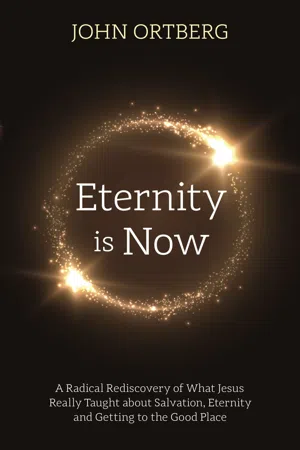
Eternity is Now
A Radical Rediscovery of What Jesus Really Taught about Salvation, Eternity and Getting to the Good Place
- 208 pages
- English
- ePUB (mobile friendly)
- Available on iOS & Android
eBook - ePub
Eternity is Now
A Radical Rediscovery of What Jesus Really Taught about Salvation, Eternity and Getting to the Good Place
About this book
Information
Topic
Theology & ReligionSubtopic
ChristianityPART 1RETHINKING SALVATION
1BREAKING NEWS
[The Widow Douglas] told me all about the bad place, and I said I wished I was there. . . . She said it was wicked to say what I said . . . she was going to live so as to go to the good place. . . . She said all a body would have to do there was to go around all day long with a harp and sing, forever and ever. . . . Well, I couldn’t see no advantage in going where she was going, so I made up my mind I wouldn’t try for it.
Most human beings believe in an afterlife. And in most cases, this belief involves a good place and a bad place.
If you’re a good person, and you embrace the right beliefs, you go to the good place. If you’re not, and you don’t, you go to the bad place. Seems simple enough.
If you were to ask people what they believe heaven will be like, some would halfheartedly describe it like the Widow Douglas’s harp community. Others think of it as an eternal pleasure factory, where you are always happy, you have amazing superpowers, and you can do whatever you want. In the movie Defending Your Life, heaven is depicted as a place where you can eat all the carbs and fat you want because they have no calories. The TV series The Good Place features a utopian afterlife where angel Ted Danson allows only “good people.” In the initial plot twist, the central character is allowed in by accident and has to fake being good. In the season’s final plot twist, it turns out that Ted Danson is not an angel (should have seen that one coming) and the Good Place is actually the Bad Place.
Most people think heaven is a place where anybody would love to spend eternity as long as they’re allowed in. This view of heaven leads people to wonder, Why doesn’t God let more people in?
The problem with these views of heaven is that they’re not true. People are taking their picture of heaven from movies rather than thoughtful, sober, grown-up reflection on what Jesus said. “Movie heaven” is pretty much a pleasure factory that anybody would enjoy as long as they were allowed in.
But the life after death that Jesus describes is very different from “movie heaven.” Here’s the main truth to know about heaven: heaven will be life with God.
In fact, in heaven, it will be impossible to avoid God.
It’s not like heaven is an immense place and you have to track God down somewhere, like finding the Wizard of Oz. Heaven does not contain God; God contains heaven. So becoming the kind of person who wants heaven—uninterrupted life with God—is a problem because I often want freedom to do things I don’t want God to see. Real heaven means life where my every thought, deed, and word lie ceaselessly open to God. For eternity.
Have you ever committed a sexual sin? I’ll bet you didn’t do it while your mother was watching you. That would have taken all the fun out of it. In order to commit sin and enjoy it, you have to be someplace your mother isn’t. In heaven, there is no place where God is not. Once you’re in heaven, there is nowhere to run to for a quick sin. If you want to gossip, hoard, judge, self-promote, overindulge, or be cynical, where will you go?
Dallas Willard writes of a time his two-and-a-half-year-old granddaughter wanted to play in the forbidden mud, so she kept saying to her grandmother, “Don’t look at me, Nana.” Thus “the tender soul of a little child shows us how necessary it is to us that we be unobserved in our wrong.”[1] That’s why the promise of hiddenness sells. “What happens in Vegas stays in Vegas.” This is perhaps the real sinner’s prayer, offered before every forbidden act, word, and thought: “Don’t look at me, God.” In heaven that prayer can be neither offered nor answered.
In other words, heaven is the kind of place where people who want to sin would be miserable. A nonsmoking restaurant is great if you’re a nonsmoker but miserable to a nicotine addict. What brings joy to one creature may torture another. C. S. Lewis once wrote that “a heaven for mosquitoes and a hell for men could very conveniently be combined.”[2]
Heaven is a certain kind of community where humility and honesty and servanthood and generosity of spirit are as predictable as gravity is here. As John Henry Newman wrote, “Heaven is not for everyone: it is an acquired taste.”[3]
People often criticize Christianity because they think it envisions heaven as an exclusive club that everyone desperately wants to get into and that God is trying to keep people out of. The reality that Jesus taught, however, is that no one really wants heaven.
The hymn “Rock of Ages” has a telling line:
Be of sin the double cure;Save from wrath and make me pure.
It’s not hard to want the “save from wrath” part of the cure. God was so willing to save us from wrath that he sent Jesus to the cross so that he could experience ultimate spiritual death in our place. Anyone would want to be saved from wrath. We’re often a little more ambivalent about “make me pure.”[4]
Our issue with heaven is not so much about getting in; it’s about becoming the kind of person for whom heaven would be an appropriate and welcome setting. If I don’t want the unceasing presence of God in my life now, how could I truly want an eternity in the ceaseless presence of God, where the possibility of any sinful action or thought—no matter how desirable—is forever cut off?
If that’s the case, who will get in?
If you ever find yourself anxious about “getting in,” the best thought I know is not about what arrangement can take away your anxiety but about God. And the thought is this: God will do the absolute best he can by every human being for all eternity. Including you. In light of his Father’s goodness, Jesus advised, “Do not worry about tomorrow” (Matthew 6:34). And if God can take care of one tomorrow, he can take care of an eternity of them.
Surely the message that God gave his Son to die on a cross for our sins is the ultimate statement of his limitless desire to forgive and restore human beings. Dallas Willard put it like this: “I am thoroughly convinced that God will let everyone into heaven who, in his considered opinion, can stand it.”[5]
That statement often provokes surprise or a chuckle. But if you stop to think about it, it must be true. Why else would God send his Son to die on our behalf?
The problem is that “standing it” may be more difficult than we imagine—especially for those of us hoping for the eternal pleasure factory. That is why, in The Problem of Pain, C. S. Lewis writes that “the doors of hell are locked on the inside.”[6] Hell is the absence of God, and more people want that than you think. I suspect that’s why we sometimes speak of only a stairway to heaven but a highway to hell.
There is some good news, though. Eternal life is far more than getting into heaven. Remember, eternal life is qualitative—it makes a difference in the kind of life we live—more than it is quantitative. And Jesus taught about that life. More than getting us into heaven, he taught how to get heaven into us.
THE GOOD NEWS
You can tell a lot about people by where they get their news. If people are on one side of the political spectrum, they might get their news from one source; if they’re on the other side, they might get it from another source.
Where do you get your news?
Jesus was, among other things, in the news-announcing business. That may sound odd; we often think of news as a modern invention. Yet we read that “Jesus went throughout Galilee, teaching in their synagogues, preaching the good news of the kingdom, and healing every disease and sickness among the people. News about him spread all over Syria” (Matthew 4:23-24, emphasis added).
There’s a key distinction here that we can miss. Jesus teaches—he gives instruction or advice on how to live. But he also preaches, or proclaims. Today we associate preaching with churches and telling people what to do. But preaching wasn’t used that way in Jesus’ time. It wasn’t even a religious word. It was a “news” word.
Jesus went around announcing that something had happened. And it wasn’t just news; it was good news. That’s what the word gospel means.
Most people have heard of the word gospel. But most people—even most church people—do not know the gospel that Jesus himself announced.
So what is the Good News that Jesus himself proclaimed?
When that question was first posed to me, I had been a pastor for many years. I had been through seminary and then some. I was a “licensed minister of the gospel,” and if you are licensed in something, you should understand it. Yet I had never thought about Jesus preaching a gospel. I had thought of the gospel as something that got invented after he died.
But Jesus did have a gospel. The New Testament writers are very clear about it. And if Jesus thought something was the biggest news in history, it is unthinkable that people who follow him don’t know it.
Mark summarizes Jesus’ gospel carefully at the beginning of Jesus’ ministry: “After John was put in prison, Jesus went into Galilee, proclaiming the good news [gospel] of God. ‘The time has come,’ he said. ‘The kingdom of God has come near. Repent and believe the good news!’” (Mark 1:14-15).
After choosing his disciples, Jesus “called the Twelve together, he gave them power and authority to drive out all demons and to cure diseases, and he sent them out to preach the kingdom of God” (Luke 9:1-2).
After Jesus rose from the dead, “he appeared to them over a period of forty days and spoke about the kingdom of God” (Acts 1:3).
And in the last glimpse we have of the early church in the book of Acts, Paul “boldly and without hindrance . . . preached the kingdom of God” (Acts 28:31).
Jesus’ good news—his gospel—is simply this: the Kingdom of God has now, through Jesus, become available for ordinary human beings to live in.
It’s here. Now. You can live in it if you want to.
This good news was ultimately vindicated by his death and resurrection and has since gone viral, but it is still Jesus’ gospel.
New Testament scholar Matthew Bates notes that from the earliest days of the church, the accounts of Jesus’ life were not titled “The Gospel of Mark,” “The Gospel of Matthew,” and so on. Instead they were titled “The gospel according to Mark” and “The gospel according to Matthew.”[7] The idea here is that there is only one gospel, and it belongs to Jesus. It was first expressed by him. It is the gospel of Jesus. Matthew, Mark, Luke, and John (and Peter and Paul, too, for that matter) were simply writing about the gospel that Jesus articulated and made possible.
Which raises a question: What is the gospel according to you? We all—religious or not—build our lives on some gospel...
Table of contents
- Cover
- About the Author
- Title Page
- Copyright
- Dedication
- Contents
- Introduction: Are We There Yet?
- Part 1: Rethinking Salvation
- Part 2: Walking with Jesus
- Acknowledgments
Trusted by 375,005 students
Access to over 1.5 million titles for a fair monthly price.
Study more efficiently using our study tools.
Frequently asked questions
Yes, you can cancel anytime from the Subscription tab in your account settings on the Perlego website. Your subscription will stay active until the end of your current billing period. Learn how to cancel your subscription
No, books cannot be downloaded as external files, such as PDFs, for use outside of Perlego. However, you can download books within the Perlego app for offline reading on mobile or tablet. Learn how to download books offline
Perlego offers two plans: Essential and Complete
- Essential is ideal for learners and professionals who enjoy exploring a wide range of subjects. Access the Essential Library with 800,000+ trusted titles and best-sellers across business, personal growth, and the humanities. Includes unlimited reading time and Standard Read Aloud voice.
- Complete: Perfect for advanced learners and researchers needing full, unrestricted access. Unlock 1.5M+ books across hundreds of subjects, including academic and specialized titles. The Complete Plan also includes advanced features like Premium Read Aloud and Research Assistant.
We are an online textbook subscription service, where you can get access to an entire online library for less than the price of a single book per month. With over 1.5 million books across 990+ topics, we’ve got you covered! Learn about our mission
Look out for the read-aloud symbol on your next book to see if you can listen to it. The read-aloud tool reads text aloud for you, highlighting the text as it is being read. You can pause it, speed it up and slow it down. Learn more about Read Aloud
Yes! You can use the Perlego app on both iOS and Android devices to read anytime, anywhere — even offline. Perfect for commutes or when you’re on the go.
Please note we cannot support devices running on iOS 13 and Android 7 or earlier. Learn more about using the app
Please note we cannot support devices running on iOS 13 and Android 7 or earlier. Learn more about using the app
Yes, you can access Eternity is Now by John Ortberg in PDF and/or ePUB format, as well as other popular books in Theology & Religion & Christianity. We have over 1.5 million books available in our catalogue for you to explore.