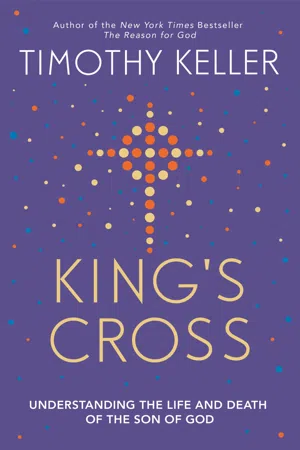
Unpredictable yet reliable, gentle yet powerful, authoritative yet humble, human yet divine.' At a time when interest in Jesus has never been higher, respected pastor and bestselling author Tim Keller takes a deep and thought-provoking look at the life of Christ. Drawing from Mark's gospel, he explains how Jesus' identity as king and his purpose in dying on the cross have meaning and significance on a cosmic scale as well as for the individual. THE REASON FOR GOD gave a passionate and intellectually compelling case for God, while THE PRODIGAL GOD explored the gospel's central message of grace. Now KING'S CROSS gives a captivating account of the person at the heart of it all: Jesus. Written in Keller's trademark authoritative yet inviting style, this book will unlock new insights for believers and unbelievers alike.
- 300 pages
- English
- ePUB (mobile friendly)
- Available on iOS & Android
eBook - ePub
About this book
Information
Topic
Theologie & ReligionSubtopic
Biblische StudienPART ONE

THE KING
The Identity of Jesus
ONE
THE DANCE
The beginning of the gospel about Jesus Christ, the Son of God.
It is written in Isaiah the prophet:
“I will send my messenger ahead of you, who will prepare your way”—“a voice of one calling in the desert, ‘Prepare the way for the Lord, make straight paths for him.’”
And so John came, baptizing in the desert region and preaching.
(Mark 1:1–4)
Mark wastes no time in establishing the identity of his subject. He abruptly and bluntly asserts that Jesus is the “Christ” and the “Son of God.” Christos was a Greek word meaning “an anointed royal figure.” It was another way of referring to the “Messiah,” the one who would come and administer God’s rule on earth, and rescue Israel from all its oppressors and troubles. Not just a king, but The King.
But Mark does not just call Jesus the “Christ”; he goes further. “Son of God” is an astonishingly bold term that goes beyond the popular understanding of the Messiah at the time. It is a claim of outright divinity. Mark then raises the stakes all the way and makes the ultimate claim. By quoting Isaiah’s prophetic passage, Mark asserts that John the Baptist is the fulfillment of the “voice” calling out in the desert. Since Mark equates John with the one who would “prepare the way for the Lord,” by clear inference it means he is equating Jesus with the Lord himself, with God Almighty. The Lord God; the long-awaited divine King who would rescue his people; and Jesus—they are somehow one and the same person.
In making this audacious claim, Mark roots Jesus as deeply as possible in the historic, ancient religion of Israel. Christianity, he implies, is not a completely new thing. Jesus is the fulfillment of all the biblical prophets’ longings and visions, and he is the one who will come to rule and renew the entire universe.
The Dance of Reality
Having announced him in this way, Mark introduces Jesus in a striking scene that tells us more about his identity:
Jesus came from Nazareth in Galilee and was baptized by John in the Jordan. As Jesus was coming up out of the water, he saw heaven being torn open and the Spirit descending on him like a dove. And a voice came from heaven: “You are my Son, whom I love; with you I am well pleased.”
(Mark 1:9–11)
For the Spirit of God to be pictured as a dove is not particularly striking to us, but when Mark was writing, it was very rare. In the sacred writings of Judaism there is only one place where the Spirit of God is likened to a dove, and that is in the Targums, the Aramaic translation of the Hebrew Scriptures that the Jews of Mark’s time read. In the creation account, the book of Genesis 1:2 says that the Spirit hovered over the face of the waters. The Hebrew verb here means “flutter”: the Spirit fluttered over the face of the waters. To capture this vivid image, the rabbis translated the passage for the Targums like this: “And the earth was without form and empty, and darkness was on the face of the deep, and the Spirit of God fluttered above the face of the waters like a dove, and God spoke: ‘Let there be light.’” There are three parties active in the creation of the world: God, God’s Spirit, and God’s Word, through which he creates. The same three parties are present at Jesus’s baptism: the Father, who is the voice; the Son, who is the Word; and the Spirit fluttering like a dove. Mark is deliberately pointing us back to the creation, to the very beginning of history. Just as the original creation of the world was a project of the triune God, Mark says, so the redemption of the world, the rescue and renewal of all things that is beginning now with the arrival of the King, is also a project of the triune God.
That’s what Mark is doing with his picture of Jesus’s baptism. But why is it important that creation and redemption are both products of a Trinity, one God in three persons?
The Christian teaching of the Trinity is mysterious and cognitively challenging. The doctrine of the Trinity is that God is one God, eternally existent in three persons. That’s not tritheism, with three gods who work in harmony; neither is it unipersonalism, the notion that sometimes God takes one form and sometimes he takes another, but that these are simply different manifestations of one God. Instead, trinitarianism holds that there is one God in three persons who know and love one another. God is not more fundamentally one than he is three, and he is not more fundamentally three than he is one.
When Jesus comes out of the water, the Father envelops him and covers him with words of love: “You are my Son, whom I love; with you I am well pleased.” Meanwhile the Spirit covers him with power. This is what has been happening in the interior life of the Trinity from all eternity. Mark is giving us a glimpse into the very heart of reality, the meaning of life, the essence of the universe. According to the Bible, the Father, the Son, and the Spirit glorify one another. Jesus says in his prayer recorded in John’s Gospel: “I have brought you glory on earth by completing the work you gave me to do. And now, Father, glorify me in your presence with the glory that I had with you before the world began” (John 17:4–5). Each person of the Trinity glorifies the other. It’s a dance.
In the words of my favorite author, C. S. Lewis, “In Christianity God is not a static thing … but a dynamic, pulsating activity, a life, almost a kind of drama. Almost, if you will not think me irreverent, a kind of dance.”11 Theologian Cornelius Plantinga develops this further, noting that the Bible says the Father, the Son, and the Spirit glorify one another: “the persons within God exalt each other, commune with each other, and defer to one another…. Each divine person harbors the others at the center of his being. In constant movement of overture and acceptance, each person envelops and encircles the others…. God’s interior life [therefore] overflows with regard for others.”12
You’re glorifying something when you find it beautiful for what it is in itself. Its beauty compels you to adore it, to have your imagination captured by it. This happened to me with Mozart. I listened to Mozart to get an A in music appreciation in college. I had to get good grades to get a good job, so in other words, I listened to Mozart to make money. But today I am quite willing to spend money just to listen to Mozart, not because it’s useful to me anymore but because it’s beautiful in itself. It’s no longer a means to an end.
And when it’s a person you find beautiful in that way, you want to serve them unconditionally. When you say, “I’ll serve, as long as I’m getting benefits from it,” that’s not actually serving people; it’s serving yourself through them. That’s not circling them, orbiting around them; it’s using them, getting them to orbit around you.
Of course there are many of us who look unselfish and dutiful, simply because we can’t say no: We say yes to everything, and people are always using us. Everybody says, “Oh, you’re so selfless, so giving of yourself; you need to think more about taking care of yourself.” But think about those of us who don’t have boundaries and who let people walk all over us and use us and can’t say no—do you think we’re doing that out of love for other people? Of course not, we’re doing it out of need—we say yes to everything out of fear and cowardice. That’s far from glorifying others. To glorify others means to unconditionally serve them, not because we’re getting anything out of it, just because of our love and appreciation for who they truly are.
The Father, the Son, and the Spirit are each centering on the others, adoring and serving them. And because the Father, Son, and Spirit are giving glorifying love to one another, God is infinitely, profoundly happy. Think about this: If you find somebody you adore, someone for whom you would do anything, and you discover that this person feels the same way about you, does that feel good? It’s sublime! That’s what God has been enjoying for all eternity. The Father, the Son, and the Spirit are pouring love and joy and adoration into the other, each one serving the other. They are infinitely seeking one another’s glory, and so God is infinitely happy. And if it’s true that this world has been created by this triune God, then ultimate reality is a dance.
“What does it all matter?” Lewis writes. “It matters more than anything else in the world. The whole dance, or drama, or pattern of this three-Personal life is to be played out in each one of us…. [Joy, power, peace, eternal life] are a great fountain of energy and beauty spurting up at the very centre of reality.”13 Why does Lewis choose to dwell on the image of the dance? A self-centered life is a stationary life; it’s static, not dynamic. A self-centered person wants to be the center around which everything else orbits. I might help people; I might have friends; I might fall in love as long as there’s no compromise of my individual interests or whatever meets my needs. I might even give to the poor—as long as it makes me feel good about myself and doesn’t hinder my lifestyle too much. Self-centeredness makes everything else a means to an end. And that end, that nonnegotiable, is whatever I want and whatever I like, my interests over theirs. I’ll have fun with people, I’ll talk with people, but in the end everything orbits around me.
If everyone is saying, “No, you orbit around me!” what happens? Picture five people, ten people, a hundred people on a stage together, and every one of them wants to be the center. They all just stand there and say to the others, “You move around me.” And nobody gets anywhere; the dance becomes hazardous, if not impossible.
The Trinity is utterly different. Instead of self-centeredness, the Father, the Son, and the Spirit are characterized in their very essence by mutually self-giving love. No person in the Trinity insists that the others revolve around him; rather each of them voluntarily circles and orbits around the others.
Entering the Dance
If this is ultimate reality, if this is what the God who made the universe is like, then this truth bristles and explodes with life-shaping, glorious implications for us. If this world was made by a triune God, relationships of love are what life is really all about.
You see, different views of God have different implications. If there’s no God—if we are here by blind chance, strictly as a result of natural selection—then what you and I call love is just a chemical condition of the brain. Evolutionary biologists say there’s nothing in us that isn’t there because it helped our ancestors pass on the genetic code more successfully. If you feel love, it’s only because that combination of chemicals enables you to survive and gets your body parts in the places they need to be in order to pass on the genetic code. That’s all love is—chemistry. On the other hand, if God exists but is unipersonal, there was a time when God was not love. Before God created the world, when there was only one divine person, because love can exist only in a relationship. If a unipersonal God had created the world and its inhabitants, such a God would not in his essence be love. Power and greatness possibly, but not love. But if from all eternity, without end and without beginning, ultimate reality is a community of persons knowing and loving one another, then ultimate reality is about love relationships.
Why would a triune God create a world? If he were a unipersonal God, you might say, “Well, he created the world so he can have beings who give him worshipful love, and that would give him joy.” But the triune God already had that—and he received love within himself in a far purer, more powerful form than we human beings can ever give him. So why would he create us? There’s only one answer. He must have created us not to get joy but to give it. He must have created us to invite us into the dance, to say: If you glorify me, if you center your entire life on me, if you find me beautiful for who I am in myself, then you will step into the dance, which is what you are made for. You are made not just to believe in me or to be spiritual in some general way, not just to pray and get a bit of inspiration when things are tough. You are made to center everything in your life on me, to think of everything in terms of your relationship to me. To serve me unconditionally. That’s where you’ll find your joy. That’s what the dance is about.
Are you in the dance or do you just believe God is out there somewhere? Are you in the dance or do you just pray to God every so often when you’re in trouble? Are you in the dance or are you looking around for someone to orbit around you? If life is a divine dance, then you need more than anything else to be in it. That’s what you’re built for. You are made to enter into a divine dance with the Trinity.
Dancing into Battle
Immediately after Jesus’s baptism, he finds himself in the wilderness. Mark writes:
At once the Spirit sent him out into the desert, and he was in the desert forty days, being tempted by Satan. He was with the wild animals….
(Mark 1:12–13)
Mark is showing us in these two lines that even though ultimate reality is a dance, we’re going to experience reality as a battle.
Mark weaves his account into the shared history of his readers by drawing parallels between the Hebrew Scriptures and the life of Jesus. In Genesis: The Spirit moves over the face of the waters, God speaks the world into being, humanity is created, and history is launched. What’s the very next thing that happens? Satan tempts the first human beings, Adam and Eve, in the Garden of Eden.
Now here in Mark: The Spirit, the water, God speaks, a new humanity, history is altered, and immediately the pattern continues with Satan tempting Jesus in the wilderness. Mark’s choice of words is pointed; he says that Jesus was “with the wild animals.” At the time Mark was writing his Gospel, Christians were being thrown to wild animals. Not surprisingly, many surviving Christians were tempted to doubt their beliefs, tempted to hedge their commitment to God. But here they see Jesus, like Adam, experiencing a spectacular relationship with God and then having to contend with a threat of his own.
You see, the wilderness isn’t just a random detour into trouble—it’s a battleground. Temptation isn’t impersonal—there is an actual enemy doing the tempting. Mark treats Satan as a reality, not a myth. This is certainly jarring in contemporary cultures that are skeptical of the existence of the supernatural, let alone the demonic. To us, Satan is a personification of evil left over from a pre-scientific, superstitious society. He’s just a symbol now, an ironic way to deflect personal responsibility for evil. But if you believe in God, in a good personal supernatural being, it is perfectly reasonable to believe that there are evil personal supernatural beings. The Bible says that in the world, there are very real forces of evil, and these forces are tremendously complex and intelligent. Satan, the chief of these forces, is tempting us away from the dance. That’s what we see with Adam in the Garden of Eden, and again with Jesus in the wilderness.
In the Garden, Adam was told, “Obey me about the tree...
Table of contents
- Cover
- Title
- Copyright
- Contents
- Dedication
- Also by Timothy Keller
- Before
- Part One: The King
- Part Two: The Cross
- After
- Notes
- Acknowledgments
- About the Author
Trusted by 375,005 students
Access to over 1.5 million titles for a fair monthly price.
Study more efficiently using our study tools.
Frequently asked questions
Yes, you can cancel anytime from the Subscription tab in your account settings on the Perlego website. Your subscription will stay active until the end of your current billing period. Learn how to cancel your subscription
No, books cannot be downloaded as external files, such as PDFs, for use outside of Perlego. However, you can download books within the Perlego app for offline reading on mobile or tablet. Learn how to download books offline
Perlego offers two plans: Essential and Complete
- Essential is ideal for learners and professionals who enjoy exploring a wide range of subjects. Access the Essential Library with 800,000+ trusted titles and best-sellers across business, personal growth, and the humanities. Includes unlimited reading time and Standard Read Aloud voice.
- Complete: Perfect for advanced learners and researchers needing full, unrestricted access. Unlock 1.5M+ books across hundreds of subjects, including academic and specialized titles. The Complete Plan also includes advanced features like Premium Read Aloud and Research Assistant.
We are an online textbook subscription service, where you can get access to an entire online library for less than the price of a single book per month. With over 1.5 million books across 990+ topics, we’ve got you covered! Learn about our mission
Look out for the read-aloud symbol on your next book to see if you can listen to it. The read-aloud tool reads text aloud for you, highlighting the text as it is being read. You can pause it, speed it up and slow it down. Learn more about Read Aloud
Yes! You can use the Perlego app on both iOS and Android devices to read anytime, anywhere — even offline. Perfect for commutes or when you’re on the go.
Please note we cannot support devices running on iOS 13 and Android 7 or earlier. Learn more about using the app
Please note we cannot support devices running on iOS 13 and Android 7 or earlier. Learn more about using the app
Yes, you can access King's Cross by Timothy Keller in PDF and/or ePUB format, as well as other popular books in Theologie & Religion & Biblische Studien. We have over 1.5 million books available in our catalogue for you to explore.