This book is a comprehensive, profound and immediately accessible book which opens the way for all to increase their understanding and develop their practice of prayer. Richard Foster explores the riches of the historical classics of prayer as well as his own personal experience. No one who reads Prayer will remain unmoved; all will find encouragement within its pages.
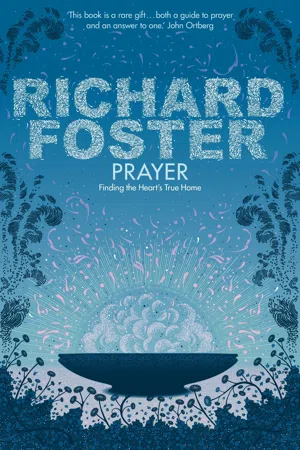
- 320 pages
- English
- ePUB (mobile friendly)
- Available on iOS & Android
eBook - ePub
About this book
Information
Topic
Theology & ReligionSubtopic
ReligionPART I
Moving Inward: Seeking the
Transformation We Need
Transformation We Need
To pray is to change. This is a great grace. How good of God to provide a path whereby our lives can be taken over by love and joy and peace and patience and kindness and goodness and faithfulness and gentleness and self-control.
The movement inward comes first because without interior transformation the movement up into God’s glory would overwhelm us and the movement out into ministry would destroy us.
A disciple once came to Abba Joseph saying, ‘Father, according as I am able, I keep my little rule, my little fast, and my little prayer. And according as I am able I strive to cleanse my mind of all evil thoughts and my heart of all evil intents. Now, what more should I do?’ Abba Joseph rose up and stretched out his hands to heaven, and his fingers became like ten lamps of fire. He answered, ‘Why not be totally changed into fire?’
1
Simple Prayer
Pray as you can, not as you can’t.
– Dom Chapman
We today yearn for prayer and hide from prayer. We are attracted to it and repelled by it. We believe prayer is something we should do, even something we want to do; but it seems as if a chasm stands between us and actually praying. We experience the agony of prayerlessness.
We are not quite sure what holds us back. Of course we are busy with work and family obligations, but that is only a smoke screen. Our busyness seldom keeps us from eating or sleeping or making love. No, there is something deeper, more profound keeping us in check. In reality, there are any number of ‘somethings’ preventing us, all of which we will explore in due time. But for now there is one ‘something’ that needs immediate attention. It is the notion – almost universal among us modern high achievers – that we have to have everything ‘just right’ in order to pray. That is, before we can really pray, our lives need some fine tuning, or we need to know more about how to pray, or we need to study the philosophical questions surrounding prayer, or we need to have a better grasp of the great traditions of prayer. And on it goes.
It isn’t that these are wrong concerns or that there is never a time to deal with them. But we are starting from the wrong end of things – putting the cart before the horse. Our problem is that we assume prayer is something to master the way we master algebra or motor mechanics. That puts us in the ‘on top’ position, where we are competent and in control. But when praying we come ‘underneath’, where we calmly and deliberately surrender control and become incompetent. ‘To pray,’ writes Emilie Griffin, ‘means to be willing to be naïve.’1
I used to think that I needed to get all my motives straightened out before I could pray, really pray. I would be in some prayer group, for example, and I would examine what I had just prayed and think to myself, ‘How utterly foolish and self-centred; I can’t pray this way!’ And so I would determine never to pray again until my motives were pure. You understand, I did not want to be a hypocrite. I knew that God is holy and righteous. I knew that prayer is no magic incantation. I knew that I must not use God for my own ends. But the practical effect of all this internal soul-searching was to completely paralyse my ability to pray.
The truth of the matter is, we all come to prayer with a tangled mass of motives – altruistic and selfish, merciful and hateful, loving and bitter. Frankly, this side of eternity we will never unravel the good from the bad, the pure from the impure. But what I have come to see is that God is big enough to receive us with all our mixture. We do not have to be bright, or pure, or filled with faith, or anything. That is what grace means, and not only are we saved by grace, we live by it as well. And we pray by it.
Jesus reminds us that prayer is a little like children coming to their parents. Our children come to us with the craziest requests at times. Often we are grieved by the meanness and selfishness of their requests, but we would be all the more grieved if they never came to us even with their meanness and selfishness. We are simply glad that they do come – mixed motives and all.
This is precisely how it is with prayer. We will never have pure enough motives, or be good enough, or know enough in order to pray rightly. We simply must set all these things aside and begin praying. In fact, it is in the very act of prayer itself – the intimate, ongoing interaction with God – that these matters are cared for in due time.
JUST AS WE ARE
What I am trying to say is that God receives us just as we are and accepts our prayers just as they are. In the same way that a small child cannot draw a bad picture so a child of God cannot offer a bad prayer. So we are brought to the most basic, the most primary form of prayer: Simple Prayer. Let me describe it for you. In Simple Prayer we bring ourselves before God just as we are, warts and all. Like children before a loving father, we open our hearts and make our requests. We do not try to sort things out, the good from the bad. We simply and unpretentiously share our concerns and make our petitions. We tell God, for example, how frustrated we are with the co-worker at the office or the neighbour down the road. We ask for food, favourable weather, and good health.
In a very real sense we are the focus of Simple Prayer. Our needs, our wants, our concerns dominate our prayer experience. Our prayers are shot through with plenty of pride, conceit, vanity, pretentiousness, haughtiness and general all-around egocentricity. No doubt there are also magnanimity, generosity, unselfishness and universal goodwill.
We make mistakes – lots of them; we sin; we fall down, often, but each time we get up and begin again. We pray again. We seek to follow God again. And again our insolence and self-indulgence defeat us. Never mind. We confess and begin again . . . and again . . . and again. In fact, sometimes Simple Prayer is called the ‘Prayer of Beginning Again’.
Simple Prayer is the most common form of prayer in the Bible. There is little that is lofty or magnanimous about the faith heroes who journey across the pages of Scripture. Think of Moses complaining to God about his stiff-necked and erstwhile followers: ‘Why have I not found favour in your sight, that you lay the burden of all this people on me? Did I conceive all this people? Did I give birth to them, that you should say to me, “Carry them in your bosom, as a nurse carries a sucking child,” to the land that you promised on oath to their ancestors?’ (Num. 11:11b–12). Or consider Elisha retaliating against the children who had jeered at him, calling him a ‘baldhead’: ‘He cursed them in the name of the Lord. Then two she-bears came out of the woods and mauled forty-two of the boys’ (2 Kings 2:24). And then there is the Psalmist delighting in the violent death of the babies of his enemies: ‘Happy shall they be who take your little ones and dash them against the rock!’ (Ps. 137:9).
Yet right in the midst of all this self-serving prayer are some of the most noble and sublime utterances of the human spirit. Think of Moses interceding before God on behalf of a stubborn and disobedient Israel: ‘But now, if you will only forgive their sin – but if not, blot me out of the book that you have written’ (Exod. 32:32). Or consider this same Elisha who had cursed the children, on another day showing mercy to a barren woman of Shunem and prophesying over her: ‘At this season, in due time, you shall embrace a son’ (2 Kings 4:16). Or look into the heart of the Psalmist crying out to Yahweh, ‘Oh, how I love your law! It is my meditation all day long’ (Ps. 119:97). In Simple Prayer the good, the bad, and the ugly are all mixed together.
Simple Prayer is found throughout Scripture. Abraham prayed this way, as did Joseph, Joshua, Hannah, David, Gideon, Ruth, Peter, James, John, and a host of other biblical luminaries.
Simple Prayer involves ordinary people bringing ordinary concerns to a loving and compassionate Father. There is no pretence in Simple Prayer. We do not pretend to be more holy, more pure, or more saintly than we actually are. We do not try to conceal our conflicting and contradictory motives from God – or ourselves. And in this posture we pour out our heart to the God who is greater than our heart and who knows all things (1 John 3:20).
Simple Prayer is beginning prayer. It is the prayer of children and yet we will return to it again and again. St Teresa of Avila notes, ‘There is no stage of prayer so sublime that it isn’t necessary to return often to the beginning.’2 Jesus, for example, calls us to Simple Prayer when he urges us to ask for daily bread. As John Dalrymple rightly observes, ‘We never outgrow this kind of prayer, because we never outgrow the needs which give rise to it.’3
There is a temptation, especially by the ‘sophisticated’, to despise this most elementary way of praying. They seek to skip over Simple Prayer in the hopes of advancing to more ‘mature’ expressions of prayer. They smile at the egotistical asking, asking, asking of so many. Grandly they speak of avoiding ‘self-centred prayer’ in favour of ‘other-centred prayer’. What these people fail to see, however, is that Simple Prayer is necessary, even essential, to the spiritual life. The only way we move beyond ‘self-centred prayer’ (if indeed we do) is by going through it, not by making a detour round it.
Those who think they can leap over Simple Prayer deceive themselves. Most likely they themselves have not prayed. They may have discussed prayer, analysed prayer, even written books about prayer, but it is highly unlikely that they have actually prayed. But when we pray, genuinely pray, the real condition of our heart is revealed. This is as it should be. This is when God truly begins to work with us. The adventure is just beginning.
BEGINNING WHERE WE ARE
Up to this point we have been describing Simple Prayer. That is theory. But we must move beyond theory to ask the question for which all that has gone before is a prelude. How do we practise Simple Prayer? What do we do? Where do we begin?
Very simply, we begin right where we are: in our families, at our jobs, with our neighbours and friends. Now, I wish this did not sound so trivial because on the practical level of knowing God it is the most profound truth we will ever hear. To believe that God can reach us and bless us in the ordinary junctures of daily life is the stuff of prayer. But we want to throw this away, so hard is it for us to believe that God would enter our space. ‘God can’t bless me here,’ we moan. ‘When I graduate . . .’ ‘When I’m the chairman of the board . . .’ ‘When I’m the president of the company . . .’ ‘When I’m the senior pastor . . . then God can bless me.’ But you see, the only place God can bless us is where we are, because that is the only place we are!
Do you remember Moses at the burning bush? God had to tell him to take off his shoes – he did not know he was on holy ground. And if we can just come to see that where we are is holy ground – in our jobs and homes, with our co-workers and friends and families – this is where we learn to pray.
In the most natural and simple way possible we learn to pray our experiences by taking up the ordinary events of everyday life and giving them to God. Perhaps we have a crushing failure that gives us more than one sleepless night. Well, we pace the floor with God, telling him of our hurt and our pain and our disappointment. ‘Why me?’ we cry out, ‘why me?’ for frustration and tears and anger are also the language of Simple Prayer. We invite God to walk with us as we grieve the loss of our dream. Maybe the offhand remark of a neighbour triggers a whole explosion of emotions within us: anger, jealousy, fear. Very well, we speak frankly and honestly with God about what is happening and ask him to help us see the hurt behind the emotion.
We should feel perfectly free to complain to God, or argue with God, or yell at God. The prophet Jeremiah once shouted out, ‘You have seduced me, Yahweh, and I have let myself be seduced; you have overpowered me: you were the stronger. I am a daily laughing-stock, everybody’s butt’ (Jer. 20:7, JB). And I can well imagine that Jeremiah shook his fist to heaven as he spoke! God is perfectly capable of handling our anger and frustration and disappointment. C. S. Lewis counsels us to ‘lay before him what is in us, not what ought to be in us’.4
We must never believe the lie which says that the details of our lives are not the proper content of prayer. For example, we may have been taught that prayer is a sublime and otherworldly activity; that in prayer we are to talk to God about God. As a result we are inclined to view our experiences as distractions and intrusions into proper prayer. This is an ethereal, decarnate spirituality. We, on the other hand, worship a God who was born in a smelly stable, who walked this earth in blood, sweat, and tears, but who nevertheless lived in perpetual responsiveness to the heavenly Monitor.
And so I urge you: carry on an ongoing conversation with God about the daily stuff of life, a little like Tevye in Fiddler on the Roof.* For now, do not worry about ‘proper’ praying, just talk to God. Share your hurts; share your sorrows; share your joys – freely and open...
Table of contents
- Cover
- Title
- Copyright
- Contents
- Dedication
- Also by Richard Foster
- Acknowledgments
- Preface
- Coming Home: An Invitation to Prayer
- PART I: Moving Inward: Seeking the Transformation We Need
- PART II: Moving Upward: Seeking the Intimacy We Need
- PART III: Moving Outward: Seeking the Ministry We Need
- Notes
- Afterword by James Catford
Trusted by 375,005 students
Access to over 1.5 million titles for a fair monthly price.
Study more efficiently using our study tools.
Frequently asked questions
Yes, you can cancel anytime from the Subscription tab in your account settings on the Perlego website. Your subscription will stay active until the end of your current billing period. Learn how to cancel your subscription
No, books cannot be downloaded as external files, such as PDFs, for use outside of Perlego. However, you can download books within the Perlego app for offline reading on mobile or tablet. Learn how to download books offline
Perlego offers two plans: Essential and Complete
- Essential is ideal for learners and professionals who enjoy exploring a wide range of subjects. Access the Essential Library with 800,000+ trusted titles and best-sellers across business, personal growth, and the humanities. Includes unlimited reading time and Standard Read Aloud voice.
- Complete: Perfect for advanced learners and researchers needing full, unrestricted access. Unlock 1.5M+ books across hundreds of subjects, including academic and specialized titles. The Complete Plan also includes advanced features like Premium Read Aloud and Research Assistant.
We are an online textbook subscription service, where you can get access to an entire online library for less than the price of a single book per month. With over 1.5 million books across 990+ topics, we’ve got you covered! Learn about our mission
Look out for the read-aloud symbol on your next book to see if you can listen to it. The read-aloud tool reads text aloud for you, highlighting the text as it is being read. You can pause it, speed it up and slow it down. Learn more about Read Aloud
Yes! You can use the Perlego app on both iOS and Android devices to read anytime, anywhere — even offline. Perfect for commutes or when you’re on the go.
Please note we cannot support devices running on iOS 13 and Android 7 or earlier. Learn more about using the app
Please note we cannot support devices running on iOS 13 and Android 7 or earlier. Learn more about using the app
Yes, you can access Prayer by Richard Foster in PDF and/or ePUB format, as well as other popular books in Theology & Religion & Religion. We have over 1.5 million books available in our catalogue for you to explore.