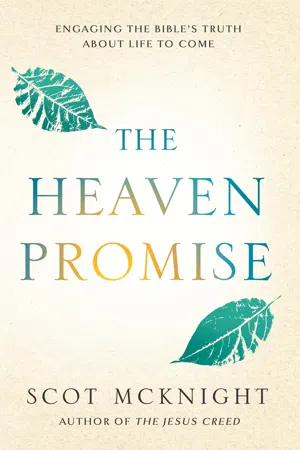
Heaven. Eternity. The Afterlife. Mention any of these concepts, and people of all ages and from all walks of life are certain to have opinions. Maybe that's why there are so many books and movies that feature heaven-and-back experiences. But how can we know if those accounts are accurate? How can we know for sure what heaven will be like? According to New Testament scholar and author Scot McKnight, all we need to do is to turn to the Bible to answer our questions. Separating fact from fiction, McKnight helps the reader examine the over-arching story of scripture in order to discover what awaits us. Heaven isn't the construction of a fairytale or some mythical narrative. It's very real; it's very good; and it's very much the fulfillment of God's promise to us.
- 224 pages
- English
- ePUB (mobile friendly)
- Available on iOS & Android
eBook - ePub
About this book
Information
Topic
Teologia e religioneSubtopic
Cristianesimo
Visit a local bookshop or Google “heaven,” and you will quickly discover that heaven is an intense human-interest story. In fact, a shelf or two of books about heaven are published each year. Add to these the stories of near-death experiences, and we have the makings of Hollywood movies about heaven.
Many are asking what I call The Heaven Question: Is there a heaven after we die or not? That question, of course, leads to others, such as: Who will be there? Will I be there? What will heaven be like?
But others are asking an entirely different question: Shouldn’t we be focusing on life now and living for the kingdom now and making the kingdom more of a reality now?
That question must be answered with a firm yes, but before we move on, we have to get a stronger grip on what the Bible means by the word heaven. Once we do, not only can we be firm in our yes, but we can also learn how Heaven people ought to live today.
Talk about heaven excites the imagination of many people, some of whom just might surprise you.

Surprising Places
Some Children, an Atheist, Authors, a Movie Star, and Questions
Guesses, of course, only guesses. If they are not true, something better will be.
—C. S. Lewis
Even in a world where religious faith is in decline, when someone asks, “Is there a heaven?” most people have an answer or at least a guess. Some are astonishingly bold about what they think heaven will be like and who will be there. We often hear responses that surprise us. Children, for instance, often think about heaven.
When I was a child, I asked my mother if something I liked at that time would be in heaven. Her response was simple and memorable: “If it will make you happy, it will be in heaven.” Little did I know she had something up her sleeve with the word “happy.”
One Sunday, sitting in the front row at church (and for some reason my mother was next to me and not in the choir loft), the pastor, who had taken up golf, said, “I have learned to enjoy golf, but I wonder if there will be room in heaven for golf.” Afterward I said to Mother, “I know there will be golf in heaven.” She asked, “How do you know that?” I responded, “Because it will make me happy.”
She gave me the kind of look that indicated that the pastor was probably right and that I should retool my sense of what I needed to make me happy.
When that great theologian and Christian martyr Dietrich Bonhoeffer and his twin sister Sabine were children, they nightly put themselves to sleep pondering the word eternity. World War I was in motion; Bonhoeffer’s oldest brother, Walter, died in that war; and his mother was staggered by Walter’s death. Death filled their not particularly religious home. Bonhoeffer later admitted that he could be obsessed with dying a good death. To cope with his fears—and amid the phosphorescent crosses that gleamed in their room—the twins would utter aloud “eternity” to make it their only thought. When Dietrich got his own room at age twelve, lying in his bed he would tap on the wall that separated the twins and the tap meant “think of God.”1
AN ATHEIST
Not all who talk about heaven are as serious as the young Bonhoeffer twins. When an atheist takes on heaven we might do well to listen. Julian Barnes, in his book A History of the World in 10 1/2 Chapters, lampoons those who think they know about heaven.2 Barnes imagines his own kind of heaven. In this imagined place, he gets to have multiple breakfasts in bed and long, long baths. He does everything on his bucket list: cruises, exploring a jungle, some painting. He falls in love a number of times with many different women, and he meets every important footballer. But in his guesses, Barnes has noted, after a time there is a strange absence: there is no God in heaven.
So Barnes has a conversation with Margaret, his imagined guide.
“I don’t want to sound ungrateful,” I said cautiously, “but where’s God?”
“God. Do you want God? Is that what you want?”. …
“I didn’t think it depended on me in any way.”
“Of course it does.”
Then Barnes provides an alarming, but brutally honest, description of so much speculation about heaven these days.
“Heaven is democratic these days,” she said. Then added, “Or at least, it is if you want it to be.”
“What do you mean, democratic?”
“We don’t impose Heaven on people anymore,” she said. “We listen to their needs. If they want it, they can have it; if not, not. And then of course they get the sort of Heaven they want.”
“And what sort do they want on the whole?”
“Well, they want a continuation of life, that’s what we find. But … better. …”
“Sex, golf, shopping, dinner, meeting famous people and not feeling bad?” I asked a bit defensively.3
We need this Mark Twain–like lampooning of what we would like heaven to be because it forces us to take a deeper look at what we believe. Is heaven nothing but projections of what we enjoy here and now? The British philosopher, David Hume, once told James Boswell that “he did not wish to be immortal.” Surprised, Boswell pushed for more. Why would he not want immortality? Hume said it was because “he was very well in this state of being, and that the chances were very much against his being so well in another state.”4
I suspect more people are like Barnes than Hume. People dream of heaven being the fulfillment of our longings and wishes, the healing of our hurts, and the answer to all our questions. We think of heaven as far more than delicious food and outstanding sex, more possessions, reunions with friends and family, more money and pleasure, and more glory.
AUTHORS
My friend and author Karen Spears Zacharias has a view of heaven too, and it’s close to mine. So, of course, I think (and hope) she’s right:
It’s hard to visualize Heaven. To be honest, streets of gold and gated communities don’t interest me much. And I only want a mansion if there is a staff like on Downton Abbey to take care of it.
My idea of heaven would be a home at the end of a dirt road on Mobile Bay. A place surrounded by white roses, a porch for pondering, and birds—redbirds, bluebirds, mockingbirds, and even a visit from [her own] Mama bird, every now and then.5
Lots of people think of heaven as a church service, or at least as Eternal Sundays. My wife, Kris, is an introvert. By Sunday at about noon she has had enough and needs a rest from all those people talking and singing and hugging and asking questions and telling stories and sometimes standing a bit too close. So Karen’s heaven is Kris’s kind of heaven too, though both would gladly toss in some kids and grand-kids. Bring on the children and grandchildren, but at the end of a long road, quiet and peaceful. That’s heavenly.
Here’s how Ernest Hemingway described his idea of heaven in a 1925 letter to F. Scott Fitzgerald:
To me heaven would be a big bull ring with me holding two barrera seats and a trout stream outside that no one else was allowed to fish in and two lovely houses in the town; one where I would have my wife and children and be monogamous and love them truly and well and the other where I would have my nine beautiful mistresses on 9 different floors. … Then there would be a fine church like in Pamplona where I could go and be confessed on the way from one house to the other and I would get on my horse and ride out with my son to my bull ranch … and toss coins to all my illegitimate children that lived [along] the road.6
At least he’s colorful in his ribald manliness and imagination.
A MOVIE STAR
Not only do we all have theories about what heaven is like, we are not afraid to announce who will be there and who won’t be let in. Most vote against Hitler, and all but the grumps vote in Mother Teresa. The movie star Jane Fonda, who has never hesitated to share her opinions publically, announced her decision on the eternal fate of her ex-husband, mega-millionaire Ted Turner. From CNN:
Fonda said she believes Turner’s childhood traumas left him so protective of himself that he had trouble opening up emotionally. But, she said, he does want to get into heaven. And, she said, he’s a shoo-in.
Finally, with our 23 minutes with Turner ticking down, we’ve gotten his full attention. We let [Ted] in on what Fonda has told CNN about his heavenly prospects:
“Given his childhood,” Fonda said, “he should’ve become a dictator. He should’ve become a not nice person. The miracle is that he became what he is. A man who will go to heaven, and there’ll be a lot of animals up there welcoming him, animals that have been brought back from the edge of extinction because of Ted. He’s turned out to be a good guy. And he says he’s not religious. But he, the whole time I was with him, every speech—and he likes to give speeches—he always ends his speech with ‘God bless.’ And he’ll get into heaven. He’s a miracle.”
Turner listened intently. There was a long pause. Was he tearing up?
Finally, he spoke. “She said that?”
Another long pause. “Well, I sure don’t want to go to hell.” …
[Ted] has said he “can’t see myself sitting on a cloud and playing the harp day in and day out.” So what is Ted Turner’s notion of heaven?
“Montana in the summer.”7
Everyone seems to have a vivid imagination when it comes to heaven.
QUESTIONS ABOUT THE HEAVEN QUESTION
We ask in this surprising welter of guesses and opinions and hopes: How can we know what heaven will be like? (Read on.) Is heaven an illusion? (No, but sometimes it is.) Is it merely in our brains? (Sometimes.) Is it a grand projection of what we most want for our world? (For some, it is.) Is it a spiritual realm unlike what we experience on earth? (In part.) Can we know who goes there (or who doesn’t)? (Yes.) Is there a way to know about heaven in more detail? (Read on.)8 What about all the near-death experiences people are writing about and some are tempted to fabricate? (Keep reading.)
In what follows I want to sketch the most important ideas about heaven that come from the Bible. Then in the last section we will turn to the top ten questions about heaven. We can’t answer most of the questions until we first get a solid grip on the big ideas about heaven. It is to those ideas that we now turn.

Imaginations of the Imaginative
The Bib...
Table of contents
- Cover
- Books by Scot Mcknight
- Title Page
- Copyright
- Dedication
- Epigraph
- Contents
- Part 1: The Heaven Question
- Part 2: The Heaven Promise
- Part 3: God’s six Promises about Heaven
- Part 4: Ten Questions about Heaven
- After Words
- Notes
- Footnotes
- Praise for The Heaven Promise
Trusted by 375,005 students
Access to over 1.5 million titles for a fair monthly price.
Study more efficiently using our study tools.
Frequently asked questions
Yes, you can cancel anytime from the Subscription tab in your account settings on the Perlego website. Your subscription will stay active until the end of your current billing period. Learn how to cancel your subscription
No, books cannot be downloaded as external files, such as PDFs, for use outside of Perlego. However, you can download books within the Perlego app for offline reading on mobile or tablet. Learn how to download books offline
Perlego offers two plans: Essential and Complete
- Essential is ideal for learners and professionals who enjoy exploring a wide range of subjects. Access the Essential Library with 800,000+ trusted titles and best-sellers across business, personal growth, and the humanities. Includes unlimited reading time and Standard Read Aloud voice.
- Complete: Perfect for advanced learners and researchers needing full, unrestricted access. Unlock 1.5M+ books across hundreds of subjects, including academic and specialized titles. The Complete Plan also includes advanced features like Premium Read Aloud and Research Assistant.
We are an online textbook subscription service, where you can get access to an entire online library for less than the price of a single book per month. With over 1.5 million books across 990+ topics, we’ve got you covered! Learn about our mission
Look out for the read-aloud symbol on your next book to see if you can listen to it. The read-aloud tool reads text aloud for you, highlighting the text as it is being read. You can pause it, speed it up and slow it down. Learn more about Read Aloud
Yes! You can use the Perlego app on both iOS and Android devices to read anytime, anywhere — even offline. Perfect for commutes or when you’re on the go.
Please note we cannot support devices running on iOS 13 and Android 7 or earlier. Learn more about using the app
Please note we cannot support devices running on iOS 13 and Android 7 or earlier. Learn more about using the app
Yes, you can access The Heaven Promise by Scot McKnight in PDF and/or ePUB format, as well as other popular books in Teologia e religione & Cristianesimo. We have over 1.5 million books available in our catalogue for you to explore.