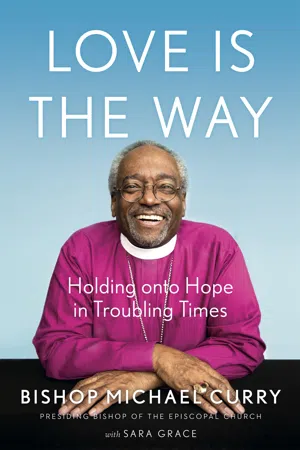
We were created by love, for love, to love and to be loved. And we are at our best when we live in God's love. And I believe deep down, it's what we all want. We don't want hatred. We don't want the abyss. We want Beloved Community. The way of love is how to live it. When Prince Harry married Meghan Markle in 2018, two billion people watched around the world. For one brief moment, love recreated the cosmos, the world came together. And the Bishop Michael Curry preached his revolutionary sermon on the power of love. In this book, Bishop Curry shares his deep faith that characterised that cultural moment: the way of love. It is the underappreciated, all-but-forgotten understanding of agape, the love that uplifts, liberates and changes the world. Though some might believe the world has to be the same, this way has the power to change things for the better.In his warm and accessible style Bishop Curry holds out the hope of love in troubling times.
- 272 pages
- English
- ePUB (mobile friendly)
- Available on iOS & Android
eBook - ePub
About this book
Information
Topic
Teología y religiónSubtopic
CristianismoChapter 1
What Is This Thing Called Love?
Question: What is love?
In my own life, love has had so many, many faces, but among the boldest is the face of Josie Robbins. Josie, who’s eighty-five years old as I write this and still in my life, was one of the people who took care of me and my sister when my mother passed away after a long illness. When my father first asked her to help take care of us during Mommy’s illness and after, she wasn’t a longtime family friend. She was just a lady who stopped by his church some Sundays to drop off her neighbor’s child before going to her own Baptist church. But she heard about our family’s situation and asked, “How can I help?” Soon thereafter my father nervously welcomed her into our house and led her to the spare bedroom, where both twin beds were covered with clothes that my father had managed to wash but not iron. Josie had never been in our house, hadn’t met the children who wore most of those clothes, but she ironed every single garment with love. A little later my father called: He was running late, could she give his kids lunch? We, who had been instructed to play upstairs and not bother Ms. Robbins, came running down to meet the woman who would eventually be a surrogate mother to us. I can’t remember the day, but she says that after lunch, I pulled up a chair next to her ironing board and didn’t stop talking until the moment she finished and left.
Moved by love, Josie jumped in with both arms and never let go. She would take me and my sister on the bus to the W. T. Grant store in downtown Buffalo so that we could head straight for the parakeets and hamsters, like we had done with Mommy. She made the hurt go away. She was the only person my tender-headed sister ever let wash and braid her hair, because no one else in this world was so patient and careful not to pull. She had dinner with us so many nights, and over the years was present at all our family events and big days—from my high school, college, and seminary graduations, to weddings, ordinations, births and baptisms, and on and on and on.
Josie Robbins is what love looks like. It’s important that we define the word love here with clarity, because these days we use the word to mean so many things. We might use it to talk about how we feel about our spouse or significant other, or about our children . . . or about our new sofa. The love I’m talking about isn’t love on a Valentine’s Day card. Those are nice, but they’re not what I have in mind when I say that love is the only thing that can save the planet.
Many languages have several words for love, to encompass all the different kinds and dimensions. The three most frequently used in Koine Greek, the language of the New Testament, are eros, philia, and agape. Eros is romantic or sexual love. Our English word erotic comes from that. Eros is what Valentine’s Day is about. Philia is fraternal or brotherly love, which is why the city of Philadelphia is called the City of Brotherly Love. And finally, there is agape, which is love for the other—sacrificial love that seeks the good and well-being of others, of society, of the world.
Unfortunately in English we have only the one word, love, for everything from telenovelas to Mother Teresa. And so the different dimensions and nuances have all been muddled together, which has obscured love’s true power to instigate a better world. Agape, love that looks outward, is the love that I’m most interested in.
You may not have heard the Greek word before, but you’ve experienced agape. Think about someone who impacted your life for the good. Someone who stood by you, pushed you, believed in you, maybe even sacrificed for you. Odds are they weren’t doing it because it served them. They were doing it because they cared about you. Because they wanted life’s sweetness to open wide to you.
Love is a firm commitment to act for the well-being of someone other than yourself. It can be personal or political, individual or communal, intimate or public. Love will not be segregated to the private, personal precincts of life. Love, as I read it in the Bible, is ubiquitous. It affects all aspects of life.
What I didn’t know as a kid was that Josie Robbins’s love, shared so generously with my family, had changed many other lives as well. Josie was a principal at St. Augustine’s School, a high school for pregnant and parenting teens. She had walked in thinking that it was a summer position—and never left. In the 1960s, when girls got pregnant in Buffalo, like most other places, they weren’t allowed to stay in school. But Josie and St. Augustine’s, which became Fulton Academic Complex with the support of the public school system, picked them back up. They gave them the chance at a better future for themselves and their children. Because of Josie, thousands of girls got their diplomas and the pride of walking the stage to graduate with their class. The school is now closed—partly because Josie retired, but also because Josie and others advocated until the day the public schools stopped punishing those mothers who were still children themselves, so they could get their education and keep their dignity.
An oft-quoted passage in the New Testament says, “God so loved the world that he gave his only son.” The Greek word used by the New Testament writer for the word love is agape. And the Greek word used for world is kosmos, but what it really means is “everything”—“everything that is.” Kosmos is what the spiritual is talking about when it says of God, “He’s got the whole world in his hands.”
God so loved the world that he “gave.” God gave. God did not take. God gave. That’s agape. That’s love. And love such as that is the way to the heart of God, the heart of each other. It is the way to a new world that looks something more like God’s dream for us and all creation, what Dante spoke of as “the love that moves the sun and stars.”
Love Is Rules for Living
I’ve officiated more than a few weddings in forty years as a preacher. In the course of preparing couples for marriage and for the actual wedding, I ask them to select a passage of scripture to be read in the service. Nine times out of ten they choose 1 Corinthians 13, St. Paul’s great guidelines for love. I’ve almost gotten them memorized by now. They’re famous enough that you might have, too. The passage begins with these words:
If I speak in the tongues of men and of angels, but have not love, I am a noisy gong or a clanging cymbal. And if I have prophetic powers, and understand all mysteries and all knowledge, and if I have all faith, so as to remove mountains, but have not love, I am nothing. If I give away all I have, and if I deliver my body to be burned, but have not love, I gain nothing.
Love is patient; love is kind;
love is not envious or boastful or arrogant or rude.
It does not insist on its own way; it is not irritable or resentful;
it does not rejoice in wrongdoing, but rejoices in the truth.
It bears all things, believes all things, hopes all things, endures all things.
Love never ends.
Paul gets it. But it’s easy for us today to miss it, having limited the use of love as we have to weddings and babies. Because here’s the catch. When Paul said those beautiful words about love, he wasn’t at a wedding. He wasn’t giving advice to a couple of young lovers about how to make a marriage work, though his advice is great for that, too. Paul broke love down so eloquently because he was really upset. He put those words in a letter to some folk in a little Greek seaport in the middle of the first century AD. He had founded the community there around the teachings of Jesus of Nazareth, and now he had heard some bad news out of Corinth. Its members had forgotten all those values that had brought them together and were ripping each other apart. They had lost the love, you could say.
These Corinthians, Paul tells us, are fighting in the pews at church. They are splitting into factions according to who baptized them. People are suing each other. Sleeping with each other’s spouses. The rich and high-status folk are demanding they get Communion first. Other people are getting drunk at Communion! This was some serious dysfunction. Amid all this, everybody’s arguing about who is the better Christian, who is going to heaven and who is not.
This behavior sounds a little bit familiar. Tilt your head at it, and it sounds like a lot of us today on social media. Arrogant, rude, insisting on our own way, irritable, resentful, rejoicing in wrongdoing? Paul’s got it, all right! It also sounds like some of our leaders in Washington, D.C. It sounds like some of our business leaders. It sounds like some of us in religious communities. It might even sound like heated conversations around the dinner table at Thanksgiving. The situation that occasioned the ancient epistle sounds remarkably contemporary.
Because we forgot: Love your neighbors! In our modern world, we lost this sense of love for our fellow humans. But for Paul and the disciples, love was something different. Love, to these Greeks, was a gift of the self to others. Love was rules for living.
Back in AD 50, Paul was furious. “Man,” he says, basically, “I’m sure glad I didn’t baptize any of you, because you make me sick.” But he comes to them with an answer, offering the only corrective he sees for the mess they’ve gotten themselves into. The answer is love. Love isn’t a sentiment—it’s the only thing left to save a community divided.
You might think the opposite of love is hate. Watch out—you’re falling into the trap of vague sentiment again. If love looks outward, to the good of the other, then its opposite isn’t hate. Its opposite is selfishness! It’s a life completely centered on the self. Dr. King referred to this as the “reverse Copernican revolution.”1 To be selfish is to put yourself in the place of the sun, the whole universe revolving around you. Forget morality—at that point you’ve left reason behind. Life becomes a living lie. Because no amount of smarts, money, or accomplishments puts any one human at the center of existence.
Intuitively, we all understand that nothing good ever comes out of selfishness and greed. Selfishness is the most destructive force in all the cosmos, and hate is only its symptom. Selfishness destroys families. Selfishness destroys communities. Selfishness has destroyed societies, nations, and global communities, and it will destroy the human race by laying waste to our planet. If we let it.
Love Turns the World Upside Down
There’s another problem when love becomes a mere sentiment. Love the sentiment—a nice feeling that rises up inside us—becomes love the sedative. It’s a sweet thing that leaves us complacent and sleepy. No, the love I’m asking you to discover inside yourself, or reconnect to, is something fierce. This love is a verb: It’s an action, with force and follow-through. When we pull love out of the abstract, really put it to work, it starts to reveal its extraordinary power.
Love as an action is the only thing that has ever changed the world for the better. Love is Martin Luther King, Mahatma Gandhi, and Josie Robbins. Love is a little girl in Pakistan named Malala Yousafzai standing up to armed men who said that girls shouldn’t be educated. She was rescued and taken to England, where she could have retreated to a quiet life but instead made a commitment to spend her life working to improve other women’s lives.
Love is Fannie Lou Hamer, whose contribution to the civil rights movement was honored on the floor of the U.S. House of Representatives in 2017, on the one hundredth anniversary of her birth. Fannie was one of twenty children. Her parents were two sharecroppers, de facto slaves. They were desperately poor. She had polio, but walking with a limp didn’t stop her from picking cotton, so much cotton, in her teens. She dropped out of schoo...
Table of contents
- Cover
- About the Author
- Title Page
- Imprint Page
- Dedication
- Contents
- Introduction
- 1 What Is This Thing Called Love?
- 2 Looking for God
- 3 Making Do and Making New
- 4 What Desmond Tutu and Dolly Parton Have in Common
- 5 Love’s Call—and Love’s Calling
- 6 It’s Not Easy
- 7 Leave No One Behind
- 8 When the Spirit Reworks You
- 9 The Real E Pluribus Unum
- 10 The Great Relationship Revival
- 11 The Still More Excellent Way
- 12 Hope, Help, and Healing
- Appendix
- Acknowledgments
- Notes
- Endmatter page 1
Trusted by 375,005 students
Access to over 1.5 million titles for a fair monthly price.
Study more efficiently using our study tools.
Frequently asked questions
Yes, you can cancel anytime from the Subscription tab in your account settings on the Perlego website. Your subscription will stay active until the end of your current billing period. Learn how to cancel your subscription
No, books cannot be downloaded as external files, such as PDFs, for use outside of Perlego. However, you can download books within the Perlego app for offline reading on mobile or tablet. Learn how to download books offline
Perlego offers two plans: Essential and Complete
- Essential is ideal for learners and professionals who enjoy exploring a wide range of subjects. Access the Essential Library with 800,000+ trusted titles and best-sellers across business, personal growth, and the humanities. Includes unlimited reading time and Standard Read Aloud voice.
- Complete: Perfect for advanced learners and researchers needing full, unrestricted access. Unlock 1.5M+ books across hundreds of subjects, including academic and specialized titles. The Complete Plan also includes advanced features like Premium Read Aloud and Research Assistant.
We are an online textbook subscription service, where you can get access to an entire online library for less than the price of a single book per month. With over 1.5 million books across 990+ topics, we’ve got you covered! Learn about our mission
Look out for the read-aloud symbol on your next book to see if you can listen to it. The read-aloud tool reads text aloud for you, highlighting the text as it is being read. You can pause it, speed it up and slow it down. Learn more about Read Aloud
Yes! You can use the Perlego app on both iOS and Android devices to read anytime, anywhere — even offline. Perfect for commutes or when you’re on the go.
Please note we cannot support devices running on iOS 13 and Android 7 or earlier. Learn more about using the app
Please note we cannot support devices running on iOS 13 and Android 7 or earlier. Learn more about using the app
Yes, you can access Love is the Way by Bishop Michael B. Curry in PDF and/or ePUB format, as well as other popular books in Teología y religión & Cristianismo. We have over 1.5 million books available in our catalogue for you to explore.