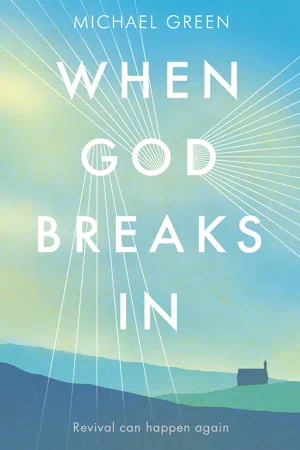
Despite the growth of religion in general and Christianity in particular around the world, Western Europe and the UK remain overwhelmingly secular, with the church increasingly seen as backwards and irrelevant. In this provocative book well-known speaker and author Michael Green gives a snapshot of various different revivals from the UK's history, as well as describing how the early church started and focusing on various revivals around the world. Be bold, writes Michael - revival can happen again!
- 208 pages
- English
- ePUB (mobile friendly)
- Available on iOS & Android
eBook - ePub
About this book
Information
1
Give me the springs!
Thirst for God
God is Back is the title of the book on my desk. This is not, as you might imagine, the hopeful cry of some religious enthusiast, but a substantial and carefully researched book by two writers who I think would call themselves atheists, John Micklethwait and Adrian Wooldridge. Next to it lies The Desecularisation of the World edited by perhaps the most distinguished sociologist alive today, Peter Berger.
What on earth is happening?
The resurgence of religion
The answer is that the most assured assumption of sociology has been shown to be completely wrong! Egg is on many a social scientist’s face! Ever since the French Revolution it has been assumed that the advance of modernisation would inevitably mean the decline of religion. Sixty years ago it was an article of faith among sociologists that religion would fade away by about the year 2000. Peter Berger himself was pre-eminent among them in predicting the demise of religion, and now he cheerfully eats his words and admits he had got it completely wrong. ‘The assumption that we live in a secularised world is false. The world today . . . is as furiously religious as it ever was, and in some places more so than ever.’ He charmingly continues: ‘As I like to tell my students, one advantage of being a social scientist . . . is that you can have as much fun when your theories are falsified as when they are verified.’
The truth of the matter is that belief in God is not only proving impossible to eradicate: worldwide, it is growing apace. Pentecostalism, for instance, emerged only a century or so ago, but already has over 500 million adherents worldwide. Africa is another example of massive Christian growth. At the start of the twentieth century there were fewer than ten million Christians in the whole of Africa. Now there are some 450 million! There are about two billion Christians in the world, increasing at a rapid pace, matched by the advance in numbers and confidence by some 800 million Muslims. The Jews are holding firm, and there is significant growth in Buddhism and Hinduism as well. It is estimated that the four biggest religions of the world, Christianity, Islam, Hinduism and Buddhism, accounted for 67 per cent of the world’s population in 1900 and a hundred years later had grown to 73 per cent, and rising.
This may be part of the reason for the increasing stridency of the new atheists in the West, men like Sam Harris, Richard Dawkins and the late Christopher Hitchens. Could it be that they suspect that their basic assumption may be false, so they shout louder? Religion shows no sign whatever of dying in a world of advancing sophistication. For all the self-confidence you can detect in their writings, and their scorn of believers, the fact remains that they are in a tiny minority. Atheists constitute a microscopic proportion of the world’s population.
Indeed, Dawkins, who boasts of being the most famous atheist alive, gets mentioned only twice in one of the books I mentioned above and not at all in the other. Both books are fascinated by the continual growth and dynamism of religion, particularly fundamentalist Islam and evangelical Christianity. Berger playfully alludes to the millions of dollars spent by the MacArthur Foundation on research into fundamentalism, as though passionate religious faith was hard to understand. He suggests that the money would have been better spent researching into why the subculture of academics, media moguls and politicians find religious conviction so hard to understand!
As you look round the religious map of the world it is not only the numbers that are arresting, but the willingness of adherents to stand firm for their beliefs in the face of opposition and persecution. And although this growth is a populist movement, particularly among poor people in Africa and Latin America, there is today a vigorous intellectual resurgence in defence of faith, among both evangelical Christians and Muslims, while politically the influence of religion is everywhere to be seen. There would have been no war in Iraq or Afghanistan had not nineteen Muslims killed themselves for their faith in attacking the Twin Towers in 2001. The same is true of almost all the trouble spots in the world – Israel, Pakistan, Nigeria, Indonesia. Sometimes, of course, religion forges peace, as it has between Christians and Muslims in Tanzania. But on any showing, religion is a massive factor to be reckoned with in human affairs.
Everywhere except Western Europe
There is one exception to the growing influence of religion – Western Europe. This was the birthplace of the eighteenth-century Enlightenment with its twin beliefs in human reason and human goodness. Here alone the old theory that modernisation leads to the death of religion seems to hold, though why the developed countries of Europe should be so godless whereas the even more developed country of the United States should be so god-fearing is problematic. But the fact remains: Europe in general and Britain in particular seem to have outgrown their Christian heritage.
The Christian faith used to be the dominant worldview in Europe, although of course a good deal of that will have been nominal. At all events, the majority of the population went to church. Christian ethics was the norm, whether you were a Christian or not. Christian education was taught in the schools. Many homes would have family prayers. The laws were framed on broadly Christian standards. The majority of people would have called themselves Christians, whether or not it meant much to them.
What a transformation today! Within two or three generations, and at an accelerating pace, it is all change. Church attendance in Britain is down to some 5 per cent, and despite the historic bedrock of Christianity underpinning so many of our institutions, Christianity has become a minority faith in the country. Many clergy have never seen anybody, let alone any adult, convert to the Christian faith. A great many churches are virtually deserted. Most have no youth work at all, and countless youngsters have never entered a church building. Little is taught about Christianity in the schools, for they are committed to a multi-faith approach. A meagre smattering of information about some of the main religions is given, often taught by staff who do not believe any of them.
Few young families and fewer working men attend worship: church is seen to be the preserve of middle-class people over seventy. Great swathes of the country have no knowledge of even the basics of Christianity. Christmas is seen as a spending spree, involving excessive consumption, and Easter means chocolate rabbits. Their origin in the coming, the dying and the rising of the man who split history in two is forgotten.
Within the Church the decline is no less apparent. Even among regular churchgoers belief in the historic facts of Christianity is sketchy, and for many, family prayers and Bible reading have disappeared. Church members have no enthusiasm for spreading the faith, owing to the prevalent rejection of religion in society. The money given to support overseas missionary work is microscopic, though church people do join fully with people of other faiths and none in humanitarian action in the face of natural disasters, seeking to rectify homelessness, and running food banks. But when you look for deep habits of prayer, clear understanding of the faith, passion for evangelism and firm ethical standards – qualities which have been associated with lively Christianity down the centuries – they are often hard to find in today’s Church.
Society at large is no longer influenced by Christian belief and standards of behaviour. The norms of our legal system are no longer determined by the Bible but by the human rights legislation administered by Brussels, which came in after the Second World War in an effort to prevent any repetition of Nazi atrocities. Abortion on demand has become a major industry – 200,000 a year in the UK alone. Homosexual activity, although clearly forbidden in the Bible, is increasingly accepted as normal, despite the massive health risks involved, and as I write there is worldwide vilification of Russia, which does not allow homosexual practice to be taught to minors. The very nature of marriage, universally recognised in the world as being between a man and a woman, has been re-invented to enable two men or two women to marry – and the age of consent has been reduced to sixteen. Divorce and fornication have long since been normalised, and I have heard on the BBC the next step in sexual permissiveness being touted – polygamy and polyandry.
Not to put too fine a point on it, Christianity is in low water. God is left entirely out of account by most Europeans, and laughed out of court by many. Atheism is more fashionable than at any time in our history. The very concept of right and wrong has largely disappeared. In our postmodern society the best we can do is to say, ‘It seems right to me but of course it may seem very different to you.’ There are no objective standards. Truth itself has run into the sands of subjectivism and relativism. Truth claims are seen as power games. It is time for the Church to wake up.
Sleeper, awake!
In ancient Ephesus you would have heard some of the slaves singing it; you would have noticed some of the errand boys whistling it. ‘Wake up, sleeper, rise from the dead, and Christ will shine on you.’ This was one of the early Christian songs, and the apostle Paul alludes to it in his letter to the church at Ephesus (5:14). If ever the cry of ‘Wake up, sleeper!’ was needed, it is imperative today if the Church and Christian civilisation are to survive.
Do not imagine that I am pessimistic about the future of Christianity. Nothing could be further from my mind. Did not Jesus predict that the gates of hell would not be able to prevail against the advance of the kingdom? Nor have they! Time and again down the past two thousand years Christians have been persecuted, tortured and slaughtered. Their holy book has been consigned to the flames. They have been forbidden to allow the name of Jesus to pass their lips. Society has ostracised them, written them off, laughed at them and killed them. But the gospel continues to grow, particularly in countries where it has never been strong before. A graphic modern example is China, as we shall see in a later chapter. When the missionaries were kicked out in 1952 there were perhaps five million Christians in that great land. Now the estimate is that there are probably in the region of a hundred million, and they appear to be growing at a rate of some twenty thousand a day. No, the gospel will not die, but national churches and denominations may. So it is always important for Christians to heed the call to wake up, and remember that the Church is always only one generation away from extinction.
It is helpful to look back at times in the past when the spiritual outlook seemed bleak, but then God broke through in a remarkable way and transformed the situation. I propose to look at a number of such occasions in this book. The Old Testament book of Judges is a useful pointer. It shows how the people of Israel were so often lawless and apostate, but in generation after generation, when all seemed lost, they turned back to God and cried to him for deliverance. And each time he raised up a ‘saviour’ for them – men like Gideon or Samson – who became God’s agent in restoration. The patience and humility of God is breathtaking. People can spit in his eye, swear he does not exist and yet, when they reach the end of their tether and reluctantly turn to him as the last forlorn hope, he breaks in and comes triumphantly to their aid.
It has been like that with the history of Christianity in Britain and beyond. In the pages that follow I want to trace some of those divine renewals, majoring on Britain, because they will bring encouragement that God can do it again. They will also give us some examples of the human conditions that appear to be needed before we can expect God to act. These may enable us to ‘wake up, and rise from the dead’, and in his mercy ‘Christ will shine on us’.
It is at first sight strange that this early Christian song should call on us first to wake up and then to rise from the dead. But surely there are two categories in mind here, the sleeping and the dead. And those two categories exist in many of our churches! There is a massive amount of ability, skill and dynamism in the pews, but it is largely somnolent. It has not been mobilised. It needs to wake up to the social and political mire by which we are engulfed as a result of our spiritual apostasy. The Church is dominated by its ministers to far too great an extent. Laypeople are often not encouraged to take initiative. Instead they are corralled into being mini-clergy, taking the collection, being sidespeople, running children’s meetings and perhaps preaching occasionally in church. It is not often that you see a coordinated plan to mobilise the congregation as a whole to serve the local community in whatever way is appropriate. We need to wake up! Christians need to get involved and to speak up in sport, politics, social concerns, the media, academia – the places where decisions are made and policy formulated.
But there are others in our churches who are not just asleep but spiritually dead. I recall a distinguished Roman Catholic, Cardinal Suenens, leading a mission in Oxford University some years ago, and referring to the many thousands of ‘baptised pagans’ in Europe. Some of the college chaplains walked out in high dudgeon, but he was perfectly right. Baptism is the mark of the new birth but it cannot confer it. Only God can do that. Just as we need to experience natural birth if we are to be humans at all, so we need to experience spiritual birth if we are to be Christians at all. It is indispensable. Yet in many churches you hear nothing of the need for a radical new beginning, a new birth, as the New Testament calls it. It is assumed that if you have been baptised and if you come to church from time to time you must be a Christian, whether you believe the Christian faith or not. But that is crazy, and the apostles will have none of it. ’You were dead in your transgressions and sins,’ writes Paul to these same Ephesians to whom he included this little chorus: ‘Wake up, sleeper, rise from the dead.’
You were dead in your transgressions and sins, in which you used to live . . . All of us also lived among them at one time, gratifying the cravings of our flesh and following its desires and thoughts. Like the rest, we were by nature deserving of wrath. But because of his great love for us, God, who is rich in mercy, made us alive with Christ even when we were dead in transgressions – it is by grace you have been saved.
(Ephesians 2:1:5)
From spiritual death to spiritual life – that is the essential and astonishing transformation which describes every true Christian. So the ‘dead’ need to come to the Lord for new life, in our day as in the first century. And the ‘sleepers’ need the wake-up call which will jolt them into action. ‘Wake up, sleeper, rise from the dead, and Christ will shine on you.’
Give me the springs!
A South African cardiologist and Christian leader, Dr Khalid Leon, has drawn my attention to a couple of remarkable but usually unnoticed passages in the Old Testament about water. Water is of priceless value in a hot country where much of the land is desert, and accordingly water figures largely in both the Old Testament and the New. It is a symbol of spiritual life. When Isaiah paints the picture of what return from exile could mean for the Jews, he hears God saying
The poor and needy search for water, but there is none; their tongues are parched with thirst. But I the Lord will answer them; I, the God of Israel, will not forsake them. I will make rivers flow on barren heights, and s...
Table of contents
- Cover
- Title Page
- Imprint Page
- Contents
- Foreword
- 1 Give me the springs!
- 2 A spring in the desert
- 3 River of new life
- 4 The springs erupt
- 5 The healing streams
- 6 Floods in the valleys
- 7 Overflowing the banks
- 8 Rivers in the east
- 9 Floodtide
- 10 Fresh springs
- End Notes
- Hodder Faith
Trusted by 375,005 students
Access to over 1.5 million titles for a fair monthly price.
Study more efficiently using our study tools.
Frequently asked questions
Yes, you can cancel anytime from the Subscription tab in your account settings on the Perlego website. Your subscription will stay active until the end of your current billing period. Learn how to cancel your subscription
No, books cannot be downloaded as external files, such as PDFs, for use outside of Perlego. However, you can download books within the Perlego app for offline reading on mobile or tablet. Learn how to download books offline
Perlego offers two plans: Essential and Complete
- Essential is ideal for learners and professionals who enjoy exploring a wide range of subjects. Access the Essential Library with 800,000+ trusted titles and best-sellers across business, personal growth, and the humanities. Includes unlimited reading time and Standard Read Aloud voice.
- Complete: Perfect for advanced learners and researchers needing full, unrestricted access. Unlock 1.5M+ books across hundreds of subjects, including academic and specialized titles. The Complete Plan also includes advanced features like Premium Read Aloud and Research Assistant.
We are an online textbook subscription service, where you can get access to an entire online library for less than the price of a single book per month. With over 1.5 million books across 990+ topics, we’ve got you covered! Learn about our mission
Look out for the read-aloud symbol on your next book to see if you can listen to it. The read-aloud tool reads text aloud for you, highlighting the text as it is being read. You can pause it, speed it up and slow it down. Learn more about Read Aloud
Yes! You can use the Perlego app on both iOS and Android devices to read anytime, anywhere — even offline. Perfect for commutes or when you’re on the go.
Please note we cannot support devices running on iOS 13 and Android 7 or earlier. Learn more about using the app
Please note we cannot support devices running on iOS 13 and Android 7 or earlier. Learn more about using the app
Yes, you can access When God Breaks In by Michael Green in PDF and/or ePUB format, as well as other popular books in Teologia e religione & Critica e interpretazione biblica. We have over 1.5 million books available in our catalogue for you to explore.