The issue of idolatry has been with the human race for thousands of years; the subtle temptation is always to take what is good and turn it into the ultimate good, elevating it above all other things in the search for security and meaning. In this timely and challenging book, New York pastor Timothy Keller looks at the issue of idolatry throughout the Bible -- from the worship of actual idols in the Old Testament, to the idolatry of money by the rich young ruler when he was challenged by Jesus to give up all his wealth. Using classic stories from the Bible Keller cuts through our dependence on the glittering false idols of money, sex and power to uncover the path towards trust in the real ultimate -- God. Today's idols may look different from those of the Old Testament, but Keller argues that they are no less damaging. Culturally transforming as well as biblically based, COUNTERFEIT GODS is a powerful look at the temptation to worship what can only disappoint, and is a vital message in today's current climate of financial and social difficulty.
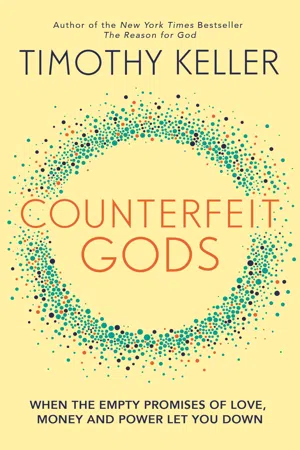
eBook - ePub
Counterfeit Gods
When the Empty Promises of Love, Money and Power Let You Down
- 240 pages
- English
- ePUB (mobile friendly)
- Available on iOS & Android
eBook - ePub
About this book
Information
Topic
Theology & ReligionSubtopic
ChristianityNOTES
INTRODUCTION—The Idol Factory
1. All of these suicides occurred between May 2008 and April 2009. They were compiled on a blog post at http://copycateffect.blogspot.com/2009/04/recess-x.html
2. Alexis de Tocqueville, Democracy in America, trans. George Lawrence (New York, Harper, 1988), p. 296, quoted in Andrew Delbanco, The Real American Dream: A Meditation on Hope (Cambridge, Mass.: Harvard University Press, 1999), p. 3.
3. Ibid.
4. David Brooks, “The Rank-Link Imbalance,” New York Times, March 14, 2008.
5. The use of idolatry as a major category for psychological and sociocultural analysis has been gaining steam again in the last fifteen years in the academic world. First there was the heyday of Feuerbach, Marx, and Nietzsche, who used the vocabulary of “idolatry” to critique religion and Christianity itself, saying the church had created God in its own image, to further its own interests. See Merold Westphal, Suspicion and Faith: The Religious Uses of Modern Atheism (The Bronx: Fordham, 1999). After neglect, the concept has been given groundbreaking, serious academic treatment by two prominent Jewish philosophers, Moshe Halbertal and Avishai Margalit, in Idolatry (Cambridge, Mass.: Harvard University Press, 1992). Building on this work, there has been a recent wave of serious scholarship on the subject. For example, see Stephen C. Barton, ed., Idolatry: False Worship in the Bible, Early Judaism, and Christianity (London and New York: T and T Clark, 2007), G. K. Beale, We Become What We Worship: A Biblical Theology of Idolatry (Downers Grove, Ill.: InterVarsity Press, 2008), Edward P. Meadors, Idolatry and the Hardening of the Heart: A Study in Biblical Theology (London and New York: T and T Clark, 2006), Brian S. Rosner, Greed as Idolatry: The Origin and Meaning of a Pauline Metaphor (Grand Rapids, Mich.: Eerdmans, 2007).
6. In the Bible, idolatry includes, of course, the ritual worship of gods other than the true God of Israel. It means to bow down or to “kiss the hand” or make sacrifices to the gods of other religions and nations (Exodus 20:3; 23:13; Job 31:26–28; Psalms 44:20–21). Anyone who does so forfeits God’s salvation (Jonah 2:8). But the Bible makes it clear that we cannot confine idolatry to literal bowing down before the images of false gods. It can be done internally in the soul and heart without being done externally and literally (Ezekiel 14:3ff). It is substituting some created thing for God in the heart, in the center of the life. For example, the prophet Habakkuk speaks of the Babylonians, “whose own strength is their god” (Habakkuk 1:11) and of their military power, to which they “sacrifice . . . and burn incense” (Habakkuk 1:16). In Ezekiel 16 and Jeremiah 2–3, the prophets charge Israel with idolatry because they entered into protective treaties with Egypt and Assyria. These treaties offered the payment of high taxes and political subjugation in exchange for military protection. The prophets considered this idolatry because Israel was relying on Egypt and Assyria to give them the security that only God could give them (Halbertal and Margalit, Idolatry. pp. 5–6). When King Saul disobeyed the word of the Lord from Samuel and began to conduct business and foreign policy in a way typical of imperialistic powers, the prophet Samuel told him that arrogant disobedience to the Lord was idolatry (I Sam 15:23). In the Bible, then, idolatry is looking to your own wisdom and competence, or to some other created thing, to provide the power, approval, comfort, and security that only God can provide. One of the classic Protestant expositions of idolatry is found in the Puritan David Clarkson’s sermon “Soul Idolatry Excludes Men Out of Heaven” (The Works of David Clarkson [Edinburgh: James Nichols, 1864], vol. 2). Clarkson distinguishes between “External” idolatry, which consists in literal bowing down to a physical image, and “Internal” idolatry, which consists of an act of the soul. “When the mind is most taken up with an object and the heart and affections most set upon it, this is soul worship; and this is . . . the honor due only to the Lord, to have the first, the highest place, both in our minds and hearts and endeavors” (p. 300).
7. Tom Shippey, J. R. R. Tolkien: Author of the Century (New York: Houghton Mifflin, 2000), p. 36.
8. Near the end of the magisterial book Idolatry by Moshe Halbertal and Avishai Margalit, they summarize the nature of idolatry this way. “Granting something ultimate value does not necessarily mean attributing a set of metaphysical divine attributes; the act of granting ultimate value involves a life of full devotion and ultimate commitment to something or someone. Absolute value can be conferred upon many things. . . . In this extension of worship, religious attitude is perceived not as part of metaphysics or as an expression of customary rituals, but as a form of absolute devotion, an attitude that makes something into a godlike being. What makes something into an absolute is that it is both overriding and demanding. It claims to stand superior to any competing claim. . . . Any nonabsolute value that is made absolute and demands to be the center of dedicated life is idolatry.” From Idolatry (Cambridge, Mass.: Harvard University Press, 1992), pp. 245–246.
9. “When a finite value . . . [becomes] a center of value by which other values are judged . . . [and] has been elevated to centrality and imagined as a final source of meaning, then one has chosen what Jews and Christians call a god. . . . To be worshipped as a god, something must be sufficiently good to be plausibly regarded as the rightful center of one’s valuing. . . . One has a god when a finite value is worshipped and adored and viewed as that without which one cannot receive life joyfully.” Thomas C. Oden, Two Worlds: Notes on the Death of Modernity in America and Russia (Downers Grove, Ill: InterVarsity Press, 1992), p. 95.
10. Margaret I. Cole, ed. Beatrice Webb’s Diaries, 1924–1932 (London: Longmans, Green, and Co., 1956), p. 65.
11. Brian Rosner does the best job of showing the basis for each of these three models in Biblical exegesis and the history of interpretation. See especially pp. 43–46 and Chapter 10 in Brian S. Rosner, Greed as Idolatry: The Origin and Meaning of a Pauline Metaphor (Grand Rapids, Mich.: Eerdmans, 2007). He bases much of his analysis on the work of Moshe Halbertal and Avishai Margalit, Idolatry (Cambridge, Mass.: Harvard University Press, 1992). Most books on idolatry tend to stress only one of the three models.
12. Biblical texts that spell out idolatry as adultery toward God as our true Spouse: Jeremiah 2:1–4:4; Ezekiel 16:1–63; Hosea 1–4; Isaiah 54:5–8; 62:5. See also Chapter 1, “Idolatry and Betrayal,” in Halbertal and Margalit, Idolatry.
13. Biblical texts that spell out idolatry as self-salvation, rejecting God as our true Savior, include those in which God asks his people: “Where are the gods you have made for yourselves? Let them come and save you when you are in trouble” (Jeremiah 2:28). Cf. also Judges 10:13–14, Isaiah 45:20, Deuteronomy 32:37–38. Also see 1 Samuel 15:23, where arrogant self-sufficiency is considered idolatry.
14. Biblical texts that spell out idolatry as spiritual treason, betraying our true King: 1 Samuel 8:6–8, 12:12; Judges 8:23. Romans 1:25–26 teaches that whatever we worship and center our lives on we must “serve” and obey (Verse 25). Verse 26 goes on to say this means that the heart falls into the grip of overwhelming, inordinate drives and desires. In the rest of the New Testament, these idolatrous, enslaving desires (Greek epithumia) are mentioned whenever the need for personal change is addressed. See Galatians 5:16ff; Ephesians 2:3, 4:22; 1 Peter 2:11, 4:2; 1 John 2:16; James 1:14ff. See also Chapter 8, “Idolatry and Political Authority,” in Halbertal and Margalit, Idolatry.
15. Rebecca Pippert, Out of the Saltshaker (Downers Grove, Ill.: InterVarsity Press, 1979), p. 53.
16. The suicide was described in the blog post cited earlier at http://copycateffect.blogspot.com/2009/04/recess-x.html.
17. I have changed his name and the names of others throughout the book whose lives I use as examples of the principles we are treating.
ONE—All You’ve Ever Wanted
18. Cynthia Heimel, If You Can’t Live Without Me, Why Aren’t You Dead Yet? (New York: Grove Press, 2002), p. 13. This quote originally appeared in The Village Voice.
19. Halbertal and Margalit, Idolatry, p. 10.
20. Ishmael, though older, was born not of Abraham’s wife, but of his wife’s servant woman. Had Isaac not been born to Sarah, Ishmael would have been Abraham’s heir.
21. Jon Levenson, The Death and Resurrection of the Beloved Son: The Transformation of Child Sacrifice in Judaism and Christianity (New Haven: Yale University Press, 1995).
22. For this rendering of Job 23:10, see Francis I. Anderson, Job: An Introduction and Commentary (Downers Grove, Ill.: InterVarsity Press, 1976), p. 230.
23. See 2 Chronicles 3:15. “Moriah” is a name given to the mountains and hills surrounding Jerusalem. On one of these hills, Jesus Christ was put to death.
24. Romans 3:26.
TWO—Love Is Not All You Need
25. Robert Alter, Genesis: Translation and Commentary (New York: W. W. Norton, 1996), pp. 151–157.
26. Ernest Becker, The Denial of Death (New York: Free Press, 1973), p. 160.
27. Ernest Becker, The Denial of Death, p. 167.
28. There has been a wave of articles and books on this minor cultural shift. See the article by Barbara F. Meltz, “Hooking Up Is the Rage, but Is It Healthy?” in The Boston Globe, February 13, 2007. Also see Laura Sessions Stepp, Unhooked: How Young Women Pursue Sex, Delay Love, and Lose at Both (New York: Riverhead, 2007).
29. Mere Christianity, Book II, Chapter 5, “Sexual Morality.”
30. Why didn’t Jacob simply refuse to go along with this bold, obvious swindle? Again, Robert Alter’s insights are invaluable. When Jacob asks, “Why have you deceived me?” the Hebrew word is the same one used in chapter 27 to describe what Jacob did to Isaac. Alter...
Table of contents
- Cover Page
- Title Page
- Copyright Page
- Dedicaton
- Contents
- Introduction: The Idol Factory
- One All You've Ever Wanted
- Two Love is Not All You Need
- Three Money Changes Everything
- Four The Seduction of Success
- Five The Power and The Glory
- Six The Hidden Idols in Our Lives
- Seven The End of Counterfeit Gods
- Epilogue: Finding and Replacing Your Idols
- Notes
- Bibliography
- Acknowledgements
- About the Author
Trusted by 375,005 students
Access to over 1.5 million titles for a fair monthly price.
Study more efficiently using our study tools.
Frequently asked questions
Yes, you can cancel anytime from the Subscription tab in your account settings on the Perlego website. Your subscription will stay active until the end of your current billing period. Learn how to cancel your subscription
No, books cannot be downloaded as external files, such as PDFs, for use outside of Perlego. However, you can download books within the Perlego app for offline reading on mobile or tablet. Learn how to download books offline
Perlego offers two plans: Essential and Complete
- Essential is ideal for learners and professionals who enjoy exploring a wide range of subjects. Access the Essential Library with 800,000+ trusted titles and best-sellers across business, personal growth, and the humanities. Includes unlimited reading time and Standard Read Aloud voice.
- Complete: Perfect for advanced learners and researchers needing full, unrestricted access. Unlock 1.5M+ books across hundreds of subjects, including academic and specialized titles. The Complete Plan also includes advanced features like Premium Read Aloud and Research Assistant.
We are an online textbook subscription service, where you can get access to an entire online library for less than the price of a single book per month. With over 1.5 million books across 990+ topics, we’ve got you covered! Learn about our mission
Look out for the read-aloud symbol on your next book to see if you can listen to it. The read-aloud tool reads text aloud for you, highlighting the text as it is being read. You can pause it, speed it up and slow it down. Learn more about Read Aloud
Yes! You can use the Perlego app on both iOS and Android devices to read anytime, anywhere — even offline. Perfect for commutes or when you’re on the go.
Please note we cannot support devices running on iOS 13 and Android 7 or earlier. Learn more about using the app
Please note we cannot support devices running on iOS 13 and Android 7 or earlier. Learn more about using the app
Yes, you can access Counterfeit Gods by Timothy Keller in PDF and/or ePUB format, as well as other popular books in Theology & Religion & Christianity. We have over 1.5 million books available in our catalogue for you to explore.