Overscheduled.
Exhausted.
Overwhelmed.
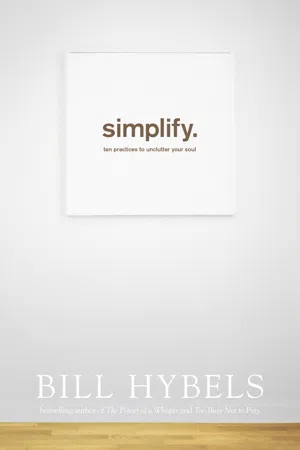
Sound familiar? Too familiar? You are living at a velocity you know deep down is unsustainable. Your life is off course - too crammed with busyness, too out of focus. You keep waiting for things to get better, but they never do. In Simplify, bestselling author Bill Hybels identifies core issues that drive this kind of living and offers action steps to help you live a better way. By eradicating clutter from your inner world, you can experience immediate rewards: greater energy, clearer purpose, richer relationships and more.Your life won't simplify itself. You must act. Isn't it time?
- 320 pages
- English
- ePUB (mobile friendly)
- Available on iOS & Android
eBook - ePub
About this book
Information
Topic
Teología y religiónSubtopic
Cristianismochapter one
from exhausted to energized
Replenishing Your Energy Reserves
A GOOD PORTION of my work these days involves coaching and mentoring leaders, both here in the United States and around the world. Increasingly, whether I’m speaking with leaders at home or abroad, at Willow Creek or in other circles of my life, I hear the same words repeated over and over: exhausted, overwhelmed, overscheduled, anxious, isolated, dissatisfied. It’s a bipartisan issue—young and old, rich and poor, professionals and parents, women and men, Republicans and Democrats. And it’s a global issue—I’ve heard these words in English and in countless foreign languages.
It was startling to hear these words so often. I began to realize that, as leaders and Christ followers, we needed to address this situation. So whenever I had a chance, I began openly discussing burnout, stress, and dissatisfaction. My gut told me the topics might strike a chord with people, because they certainly struck a chord with me.
I grossly underestimated the impact.
As I explored the concerns that leave people feeling isolated, overwhelmed, and exhausted, and as I sought to formulate a framework for how to tackle the diverse complexities of these issues, I began using the term simplify. How do we simplify our lives? The term stuck. The very word seemed to energize people.
Perhaps they hoped I would unveil a closely held secret, a key to the universe that would help them uncomplicate their frazzled lives. Perhaps they assumed I was well beyond these issues in my own experience and hoped I might whisk some crumbs of wisdom off the mahogany table of my life into their waiting and eagerly cupped hands.
Not so! Those who know me well can tell you I’ve spent the majority of my adult life wrestling with the same dark swarm of words I’ve lately been hearing from leaders across the globe. I am nowhere near immune. I know far too much about being overwhelmed and overscheduled and exhausted. I know all too well what it feels like to be anxious, dissatisfied, wounded, and spent. As I’ve talked about these issues, I have been both a student and a teacher, to be sure. You’ll see in the pages you’re about to read that I’m a serious fellow learner on the topic of simplifying our lives.
I am not naturally inclined to lead a simple life. I feel a strong sense of responsibility to the calling God has entrusted to me—not just at work, but also with my family, the relationships I invest in, the recreation I need for my mental health, and the travel my work requires. I don’t foresee my life slowing to a lounge-by-the-pool pace anytime soon, if ever. Can you relate?
Simplified living is about more than doing less. It’s being who God called us to be.
Simplified living is about more than doing less. It’s being who God called us to be, with a wholehearted, single-minded focus. It’s walking away from innumerable lesser opportunities in favor of the few to which we’ve been called and for which we’ve been created. It’s a lifestyle that allows us, when our heads hit the pillow at night, to reflect with gratitude that our day was well invested and the varied responsibilities of our lives are in order.
If we don’t change how we live, our overcomplicated world will begin to feel frighteningly normal. We will become accustomed to life at a frantic pace, no longer able to discriminate between the important and the unessential. And that’s the danger: When we fritter away our one and only life doing things that don’t really matter, we sacrifice the things that do matter. Through more misses than hits, I have experienced the high cost of allowing my life to get out of control. My desire is to spare you some of the pain of learning these lessons as I did—the hard way.
What if your life could be different? What if you could be certain you were living the life God called you to live and building a legacy for those you love? If you crave a simpler life anchored by the priorities that matter most, roll up your sleeves: Simplified living requires more than just organizing your closets or cleaning out your desk drawer. It requires uncluttering your soul. By examining core issues that lure you into frenetic living, and by eradicating the barriers that leave you exhausted and overwhelmed, you can stop doing the stuff that doesn’t matter and build your life on the stuff that does.
Simplified living requires more than just organizing your closets or cleaning out your desk drawer. It requires uncluttering your soul.
In my experience, a handful of key practices are vital to keeping my soul clutter-free. These practices help me overcome the barriers that keep me from living the life “to the full” that Jesus promises in John 10:10. In each chapter of this book, I invite you to examine one of these practices, assess what Scripture has to say about it, hold up a mirror to your own life, and then take action.
There are no shortcuts to simplified living. Untangling yourself from the overscheduled, overwhelming web of your current life is not for the faint of heart. It’s honest, rigorous work. As I tell leaders whenever I speak on the subject, action is required. That’s why each chapter of this book concludes with Action Steps—questions about what keeps you in bondage to such frenetic, cluttered patterns, as well as hands-on practices for eradicating clutter from your soul and moving toward a simplified life. I challenge you to go beyond reading each chapter merely for theory. Don’t let an intellectual nod to the concept of simplified living inoculate you against making actual changes in your actual life. Rather, apply what you read with courage and grit.
I can tell you from my own experience that simplifying your life will produce immediate rewards. Each day will have a clear purpose, and each relationship will receive the investment it’s due. And without the needless clutter clanging around in your soul, you’ll be able to hear—and respond to—each whisper from God.
This is what I know: Change is possible. Whether you’re teetering on the edge of a cluttered collapse or you’re just starting to realize that some minor life adjustments are in order, you can simplify. You may well have to simplify to live the life God is inviting you to live. As you begin to implement these key practices, they will become habits that create simplified days, then months, then years, and eventually a lifetime that brings satisfaction and fulfillment. Making these course corrections will produce a life you’ll be glad to have lived when you look in the rearview mirror.
You’ve been warned: This process is not for the faint of heart. Action on your part is required. Still game? Let’s dive in.
“TELL HER TO HELP ME!”
Of all the people Jesus interacted with during His three-year teaching ministry, Scripture records only one person whom He redirected in the area of simplicity: a good friend of His, a woman named Martha.
Jesus had hundreds of followers during His ministry—not just the twelve disciples—but He chose only a handful to be in His inner friendship circle. Three were His disciples: Peter, James, and John. And there were three others: Mary, Martha, and Lazarus, siblings who were faithful supporters of His ministry. They lived in a little suburb of Jerusalem called Bethany, which still exists today. Jesus stayed with them from time to time and deeply valued their hospitality.
The incident I’m about to describe took place as the demands on Jesus were growing. The more He taught, the more people wanted from Him—more healings, more miracles, more of everything He could offer. His days were increasingly packed. So occasionally, Jesus called a time-out and retreated to the serenity of the guest quarters in Bethany, where He could wind down for a day or two and refuel in the company of His closest friends. Here’s how Luke describes one such visit:
As Jesus and his disciples were on their way, he came to a village where a woman named Martha opened her home to him. She had a sister called Mary, who sat at the Lord’s feet listening to what he said. But Martha was distracted by all the preparations that had to be made. She came to him and asked, “Lord, don’t you care that my sister has left me to do the work by myself? Tell her to help me!”
“Martha, Martha,” the Lord answered, “you are worried and upset about many things, but few things are needed—or indeed only one. Mary has chosen what is better, and it will not be taken away from her.”1
You can see the dynamics of this situation shaping up from a mile away. Mary and Martha have had no time to prepare for this drop-in visit by Jesus and twelve dusty disciples. But Jesus feels comfortable enough in His friendship with them that He stops by for some replenishing time.
Mary decides to go with the flow and pulls up a chair. Perhaps she says something to Jesus like, “I’m so glad You stopped by. How’s it been going on the road? How big a pain have the Pharisees been lately? You can tell us; we’re friends. What You share in Bethany stays in Bethany.”
Meanwhile, Martha has busied herself in the kitchen getting a meal going. She is frantically trying to play the role of accommodating hostess, tending to the physical needs of Jesus and His disciples—appetizers, entrées, and drinks. It begins to grate on her that Mary is simply lounging in the other room with Jesus, catching up on the latest events.
After a while, Martha snaps. She loses it. She’s clearly ticked. Perhaps she had already attempted some subtle cues to get her sister to give her a hand with the food. First she may have peeked around the corner and given Mary the stink-eye—the look that says, Get in here and help me! Then maybe she started dropping pans to get Mary’s attention. My wife, Lynne, used to do that with me. When she thought I wasn’t helping enough, she’d “accidentally” let a few pans crash to the kitchen floor. After about the fifth pan—I was a little slow on the draw—I would catch a clue: “That’s the signal!” And I’d head for the kitchen to pitch in.
We don’t know whether Mary has missed, or has chosen to ignore, her sister’s hints that she needs help, but at a certain point, Martha bursts into the room and interrupts the conversation Mary is having with Jesus. She doesn’t address Mary; she addresses Jesus directly with an opening salvo: “Lord, don’t You care?”
The irony here is thick. “Don’t You care?” she asks the Lord of the universe, the one who left heaven’s splendor to put on human flesh and descend into first-century Palestine; who has been out on the road, teaching and healing and serving others until He’s absolutely exhausted; and who will soon bleed and die for the redemption of everyone in the world, including Martha.
“Don’t You care?”
I picture Martha in this scene with a wooden spoon in her hand. She gets right up in Jesus’ face: “You tell her to help me! Order that lazy sister of mine into the kitchen before I do something with this spoon!”
If I were Jesus, I would have had several ideas running through my mind about what Martha could do with that spoon. But Jesus doesn’t escalate the conflict. He doesn’t power up on Martha. He doesn’t say, “How dare you speak to the Son of God this way …” According to the text, He simply says her name twice: “Martha, Martha.” In other words, “Easy does it, Martha. Take a chill pill.”
Jesus doesn’t escalate the conflict. He doesn’t say, “How dare you speak to the Son of God this way …”
Then, with genuine kindness, He makes an observation: “You are worried and upset about many things.”
He can tell she’s overwhelmed, overscheduled, and exhausted—the very words that define our culture. And He invites her to put down her spoon and take a couple of deep breaths.
“So many things are occupying your mind right now,” He says. “They’re churning you up inside. You’re making My visit much more complicated than I want it to be.”
I picture Jesus clarifying the lines, taking advantage of a teachable moment for everyone in the room: “Martha, can I simplify something for you? Whenever I stop by, it’s not for the food. If I wanted a five-star dinner, I could arrange for one—I just fed five thousand people a couple of weeks ago, you know. And I made some awesome chardonnay at a wedding reception once. I can arrange for food and drink anywhere, anytime. When I stop by to visit, it’s for friendship, for connection, to be with you. I come here for the life-giving, life-exchanging engagement, for fellowship. That’s all, really.”
In Luke’s text, Jesus tells Martha something that I, too, often need to be reminded of: “Few things are needed—indeed only one.”
Martha was missing what mattered most; but not Mary. She got it.
“Mary has chosen the good part,” Jesus says, “and I’m not going to take it away from her. I will not send her into the kitchen to do a dozen things that don’t really matter in the big picture.”
By affirming Mary’s choice, Jesus invites Martha to set down her spoon and follow her sister’s example.
Your heart and mine yearn for an antidote to all the drivenness and busyness in our lives. The antidote isn’t getting it all done in the kitchen—or the office, or the mall. The antidote is leaving that stuff—sometimes undone—to sit down for an unrushed conversation with Jesus.
Your heart and mine yearn for an antidote to all the drivenness and busyness in our lives.
What a terrific story. In a few short words, Jesus teaches us about His values and priorities.
I also find it fascinating that the Gospel of Luke juxtaposes the Mary and Martha story with the parable of the Good Samaritan.2 On the heels of teach...
Table of contents
- Cover
- Title Page
- Copyright
- Dedication
- Contents
- Chapter One: From Exhausted to Energized
- Chapter Two: From Overscheduled to Organized
- Chapter Three: From Overwhelmed to In Control
- Chapter Four: From Restless to Fulfilled
- Chapter Five: From Wounded to Whole
- Chapter Six: From Anxious to Peaceful
- Chapter Seven: From Isolated to Connected
- Chapter Eight: From Drifting to Focused
- Chapter Nine: From Stuck to Moving On
- Chapter Ten: From Meaningless to Satisfied
- Appendix A: How to Choose Your Life Verse
- Appendix B: Life Verse Catalog
- Notes
- Acknowledgments
- About the Author
Trusted by 375,005 students
Access to over 1.5 million titles for a fair monthly price.
Study more efficiently using our study tools.
Frequently asked questions
Yes, you can cancel anytime from the Subscription tab in your account settings on the Perlego website. Your subscription will stay active until the end of your current billing period. Learn how to cancel your subscription
No, books cannot be downloaded as external files, such as PDFs, for use outside of Perlego. However, you can download books within the Perlego app for offline reading on mobile or tablet. Learn how to download books offline
We are an online textbook subscription service, where you can get access to an entire online library for less than the price of a single book per month. With over 1.5 million books across 990+ topics, we’ve got you covered! Learn about our mission
Look out for the read-aloud symbol on your next book to see if you can listen to it. The read-aloud tool reads text aloud for you, highlighting the text as it is being read. You can pause it, speed it up and slow it down. Learn more about Read Aloud
Yes! You can use the Perlego app on both iOS and Android devices to read anytime, anywhere — even offline. Perfect for commutes or when you’re on the go.
Please note we cannot support devices running on iOS 13 and Android 7 or earlier. Learn more about using the app
Please note we cannot support devices running on iOS 13 and Android 7 or earlier. Learn more about using the app
Yes, you can access Simplify by Bill Hybels in PDF and/or ePUB format, as well as other popular books in Teología y religión & Cristianismo. We have over 1.5 million books available in our catalogue for you to explore.