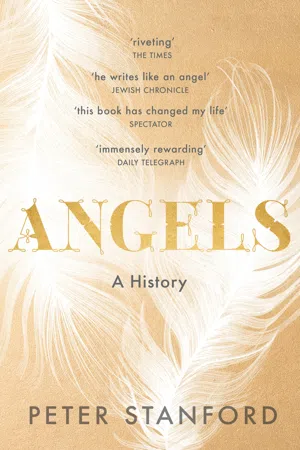
'An intriguing exploration of the many roles that angels have played in spiritual life.' - The Sunday Times: Nick Rennison 'In a 2016 poll, one in 10 Britons claimed to have experienced the presence of an angel, while one in three remain convinced that they have a guardian angel. These are huge numbers and mean that, on some counts, angels are doing better than God.' In the secular, sceptical, post-Christian world of the West, continuing faith in angels is both anomaly and comfort. But what exactly are angels, and why have so many in different times and contexts around the globe believed in them? What is their history and role in the great faiths and beyond their walls? Are angels something real, a manifestation of divine concern? Or part of the poetry of religion? And can they continue to illuminate a deeper truth about human existence and the cosmos? These are not new questions. They have been asked over millennia, right up to the present day, as writer, journalist and broadcaster Peter Stanford explores in Angels, his latest investigation into the history, theology and cultural significance of religious ideas. 'There is no better navigator through the space in which art, culture and spirituality meet than Peter Stanford' Cole Moreton, Independent on Sunday
- 352 pages
- English
- ePUB (mobile friendly)
- Available on iOS & Android
eBook - ePub
About this book
Information
Topic
Theology & ReligionSubtopic
European Medieval HistoryPart One
The Authorised Version of Angels
‘And as imagination bodies forth
The form of things unknown, the poet’s pen
Turns them to shapes, and gives to airy nothing
A local habitation and a name.’
Duke Theseus, in A Midsummer Night’s Dream, by William Shakespeare (V.i.8–23)
A
A is for Asa Vahista, one of the six Amesha Spenta (or ‘Beneficent Immortals’) of Zoroastrianism, the predominant religion of Persia from 1500 bce until it was displaced by Islam in the seventh century ce. Each of the six were ‘divine sparks’ created by the good god, Ahura Mazda, to watch over his people, and protect them from the bad god, Angra Mainyu. They were a type of guardian angel, with the elevated status of archangels. Though technically all are gender neutral, Asa is usually regarded as masculine. To his name is added Vahista – a word used of him in the sacred Zoroastrian text the Gathas by the prophet Zoroaster himself and meaning simply ‘the best’. Asa represents truth, justice and righteousness, the combination of which embodies what it is to be a good Zoroastrian. Each Amesha Spenta is also allocated a specific domain. In the case of Asa, it is fire – still an integral and distinctive part of Zoroastrian rituals.
B
B is for the Bulgarian angels, who local legend has it inhabit the Devil’s Throat Gorge in the Rhodope Mountains in the south-eastern European country. Amid marble cliffs is a deep cave through which an underground waterfall plunges deafeningly over forty metres. It was here that, Christian legend has it, based on a passage in the Book of Genesis, the fallen angels retreated once they had come down to earth and impregnated the daughters of men. It was as good as a prison, not least because of the constant thundering sound of the waterfall inside the cave, caused by their tears of regret. An alternative, possibly earlier, legend has it that this was the spot where the Greek god Orpheus came to enter the underworld and find Eurydice.
1
Holy Books – the First Angels
‘And yet, as angels in some brighter dreams
Call to the soul when man doth sleep,
So some strange thoughts transcend our wonted themes,
And into glory peep.’
Henry Vaughan, ‘They Are All Gone Into the World of Light’ (1655)1
For almost three thousand years, the words ‘Holy, Holy, Holy, Lord God of Hosts / Heaven and Earth are full of your glory / Hosanna in the highest’ have been set to music by believers as part of their liturgies and rituals in synagogues and churches. The origins of what is called ‘The Song of the Angels’ rest in the Jewish tradition, an approximation of it having first been recorded in the Hebrew Scriptures in the Book of Isaiah, one of a series of prophets sent by God to the Jewish people in their hour of need.2
The early sections of the book date back to the eighth century bce, and it is here that the ‘Holy, Holy, Holy’ rings out to herald Isaiah’s extraordinary vision of the Almighty seated on a throne in the Temple in Jerusalem. Accompanying him is an honour guard of mighty angels known as seraphim, ‘each one with six wings: two to cover its face, two to cover its feet, and two for flying’.3
As these seraphim sing their hymn of praise, the very foundations of the Temple – the holiest of holies in Judaism – shake and it fills with smoke. Then, with great ceremony, one of their number takes a red hot lump of coal from the altar and touches Isaiah’s lips with it, burning away his sins and anointing him as God’s messenger.4
Many of the details given in Isaiah – including the words of ‘The Song of the Angels’ – are repeated in chapter four of the Book of Revelation, the final, apocalyptic instalment of the Christian New Testament, written towards the end of the first century ce.5 Now, though, there are four creatures, still with six wings, not angels but three animals – a lion, a bull and a flying eagle – and a fourth with a human face. All of them have ‘eyes all the way round as well as inside; and day and night they never stopped singing: “Holy, Holy, Holy is the Lord God Almighty; he was, he is and he is to come.” ’6
In Jewish ritual today the words of ‘The Song of the Angels’ continue to be heard in the Kedushah (or sanctification), part of the daily prayer service. Traditionally those reciting them rise onto their toes with every ‘kadosh’ or ‘holy’, a little higher each time, as if straining to reach up towards the angels above.
Among the early Christians, too, the Book of Isaiah was regarded with a special reverence because of the prophet’s promise that God would come among his people. Christians took this as an early promise of Jesus. So much so that Isaiah is still sometimes referred to as the ‘fifth gospel’.7 ‘The Song of the Angels’ was incorporated by the Western Church in the fifth century ce into the officially approved text of the mass, with the ‘Holy, Holy, Holy’ repeated in the Sanctus (the Latin for ‘Holy’). Meanwhile, in the East, Orthodox Christians continue to recite the angels’ words, as part of their liturgy, in the Trisagion (or ‘Thrice Holy’). In all these traditions, which together cover over 1.5 billion of the world’s population, it is understood that human voices join in song with those of angels in a single choir that transcends the boundaries of heaven and earth.8
Of all the words included in ‘The Song of the Angels’, it is arguably their collective ‘Hosanna’ – in Hebrew yasha na, or ‘O, Save!’ – that has been most often placed on the lips of angels, or hung around their person. It is there, for instance, in the popular early sixteenth-century Christmas carol, ‘Ding Dong Merrily On High’, where ‘the sky / is riv’n with angels singing: / Gloria, Hosanna in excelsis!’ And ‘Hosanna’ is spelt out, too, on the banners that the angels unfurl from their trumpets on Christmas cards (though any sense of it being a plea to be saved is lost). Meanwhile, in Dante’s Paradiso, the final leg of the poet’s journey through the next world that makes up his three-part Divine Comedy, the narrator only manages to work out that the millions of ‘scintillating sparks’ that encircle him in the upper realms of heaven are in fact angels when he hears the sound of their hosannas.
I heard them sing hosanna choir by choir
To the fixed point which holds them at the ‘Ubi’,
And ever will, where they have ever been.9
The Song even gives us the word ‘host’ – our collective noun for angels. The origins of host predate even Isaiah and belong to the period around the eleventh century bce when the Jewish king, Saul, established a united kingdom of Israel, with his successor David making its capital at Jerusalem. In the Hebrew Scriptures concerned with that time (for example, at the very start of the First Book of Samuel), Yahweh is credited with playing an active part in these victories, and is regularly referred to as ‘Lord of Hosts’.10 The Hebrew word sabaoth, translated as ‘hosts’, also means armies, and carries with it therefore the sense of massed ranks of supporters. In earthly terms, that becomes the Yahweh-inspired troops who brought Saul and his successors victories on the battlefield against their opponents, the Philistines. Mixed in with them, it was believed, were angels, sent from heaven to assist.
Beyond music, liturgy and scripture, the lines of ‘The Song of the Angels’ open out to reveal how entwined the history of angels is with the Israelites’ relationship with their God. Indeed, the story goes back to the very beginning, and the creation story of the Garden of Eden. When God expels Adam and Eve from paradise for eating the apple from the tree against his instructions, ‘He posted the cherubs, and the flame of a flashing sword, to guard the way to the tree of life.’11 And later in the same Book of Genesis – the first text in both the Pentateuch, taken by Jews as the work of Moses and containing the Jewish law, and of the Christian Bible – three angels appear at Mamre to Abraham,12 regarded as a founding father by Judaism, Christianity and Islam alike.
In understanding the origins of humankind’s enduring relationship with angels, the overlapping holy books of Judaism, Christianity and Islam are one obvious starting point. Yet, though they present themselves – or are often presented by religious literalists – as the start of everything that ever was, these are neither the first holy texts, nor the first ones to feature angel-like creatures.
Those six-winged seraphim that Isaiah described so memorably in the eighth century bce in his vision of Yahweh entering Jerusalem have no obvious forerunners in earlier sections of the Hebrew Scriptures. Only much later in Revelation do they appear again in the Christian Bible. And yet the seraphim have gone on to figure large in theological debates about angels and their hierarchies, as well as in art and in literature. In Paradise Lost, Milton even gives his seraphim individual personalities, with Abdiel – a name he borrowed from a minor, Old Testament character13 – described as the seraph ‘than ...
Table of contents
- Cover
- About the Author
- Also by Peter Stanford
- Title Page
- Imprint Page
- Dedication
- Contents
- Prelude: Loving Angels Instead
- Part One: The Authorised Version of Angels
- 1 Holy Books – the First Angels
- 2 Wrestling with Angels – Genesis and the Hebrew Scriptures
- 3 Call Us by Our Names – Michael, Gabriel and Raphael
- 4 Enoch and the ‘Watchers’ of Heaven
- 5 Putting Angels in Their Place – the New Testament
- 6 The Recording Angels of Islam
- Part Two: The Enduring Influence of Angels
- 7 How Angels Helped the Early Church to Grow
- 8 Francis, Avicenna and Aquinas – When and Why Angelology Was Taken Seriously
- 9 From Invisible to Visible – Bringing Angels to Life
- 10 The Renaissance Angels
- 11 The Enlightenment – Moving to the Margins
- 12 Angels on the Modern Shelf
- Epilogue: Dwellers All in Time and Space
- Acknowledgements
- Notes
- Illustration Credits
- Endmatter page 1
Trusted by 375,005 students
Access to over 1.5 million titles for a fair monthly price.
Study more efficiently using our study tools.
Frequently asked questions
Yes, you can cancel anytime from the Subscription tab in your account settings on the Perlego website. Your subscription will stay active until the end of your current billing period. Learn how to cancel your subscription
No, books cannot be downloaded as external files, such as PDFs, for use outside of Perlego. However, you can download books within the Perlego app for offline reading on mobile or tablet. Learn how to download books offline
Perlego offers two plans: Essential and Complete
- Essential is ideal for learners and professionals who enjoy exploring a wide range of subjects. Access the Essential Library with 800,000+ trusted titles and best-sellers across business, personal growth, and the humanities. Includes unlimited reading time and Standard Read Aloud voice.
- Complete: Perfect for advanced learners and researchers needing full, unrestricted access. Unlock 1.5M+ books across hundreds of subjects, including academic and specialized titles. The Complete Plan also includes advanced features like Premium Read Aloud and Research Assistant.
We are an online textbook subscription service, where you can get access to an entire online library for less than the price of a single book per month. With over 1.5 million books across 990+ topics, we’ve got you covered! Learn about our mission
Look out for the read-aloud symbol on your next book to see if you can listen to it. The read-aloud tool reads text aloud for you, highlighting the text as it is being read. You can pause it, speed it up and slow it down. Learn more about Read Aloud
Yes! You can use the Perlego app on both iOS and Android devices to read anytime, anywhere — even offline. Perfect for commutes or when you’re on the go.
Please note we cannot support devices running on iOS 13 and Android 7 or earlier. Learn more about using the app
Please note we cannot support devices running on iOS 13 and Android 7 or earlier. Learn more about using the app
Yes, you can access Angels by Peter Stanford in PDF and/or ePUB format, as well as other popular books in Theology & Religion & European Medieval History. We have over 1.5 million books available in our catalogue for you to explore.