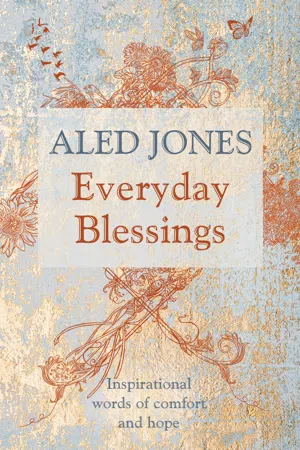
Daily life is so busy that it's hard to see the wood for the trees. Take a few minutes each day to ponder a nugget of wisdom chosen especially for you by singer and presenter Aled Jones.Aled's faith in God has sustained him all his life -- it is a God that speaks and exists through all things, times and places. Drawing on spritual wisdom across the ages, from ancient times to the modern day, as well as across diverse cultures, Aled has compiled a daily reader that will help ground and inspire you each day of the year. The year is divided up into monthly themes, ranging from New Beginnings, to treasuring the little things in life and the power of a smile. Charming line drawing illustrations decorate the page and journalling space allows the reader to respond to what they are reading by either making notes or with a drawing of their own.A book that's perfect as a gift for mum or dad, it is perfect to dip in and out of during the year and will be a favourite treasure trove of wisdom for all who love watching Aled on BBC TV or listen to his inspiring show on Classic FM. Complied by the singer Aled Jones, this book is a compilation of blessings to read throughout the year. Each page is illustrated with a quote to bring you joy and peace everyday.
- 384 pages
- English
- ePUB (mobile friendly)
- Available on iOS & Android
eBook - ePub
About this book
Information
Topic
Theology & ReligionSubtopic
Christianity
During the month of April, all the main faiths celebrate important ‘feast’ days. Let me take us through some of the main ones happening this month.
For Christians, Easter is our most joyous and important festival, commemorating the resurrection of Jesus Christ. However, the most solemn time of the Christian year is Holy Week, the week leading up to Easter, during which Christians remember the last days of Jesus’ life. Holy Week begins on Palm Sunday which re-enacts Christ’s triumphant arrival in Jerusalem to the cheers of the crowd. Later in the week many of the people in that cheering crowd would be among those shouting for Jesus to be executed. Christian leaders will often use the Palm Sunday story to help people think about the strength of their own commitment to their faith.
Maundy Thursday is the Thursday of Holy Week, just before Easter, remembered as the day of the Last Supper, when Jesus washed the feet of his disciples and established the ceremony known as the Eucharist (a Christian sacrament in which bread and wine are consecrated and consumed in memory of Jesus’ death; the bread and wine symbolise his body and blood). The night of Maundy Thursday is when Judas betrayed Jesus in the Garden of Gethsemane, then, on Good Friday, Jesus was executed by crucifixion. His body was taken down from the cross and buried in a guarded tomb. An enormous stone was put over the entrance, so that no one could steal the body. But after three days, two women disciples of Jesus visited the grave only to find that the stone had been moved and the tomb was empty! Jesus himself was seen that same day, and for days afterwards by many people. His followers realised that God had raised Jesus from the dead.
Now, whether you’re a Christian believer or not, you have to admit it’s a great story that really does have it all: love, betrayal, hatred, death and resurrection! The magical story and all the ceremony that goes with it is what I loved as a young chorister at Bangor Cathedral. Some of the most uplifting music ever written is performed at Easter and as choristers we really felt we were part of something much bigger than ourselves. We felt an indescribable energy for the whole week. Every service was vital and needed total focus and commitment. Holy Week left you exhausted vocally yet emotionally exhilarated.
A sensation of joy and happiness spreads among Muslims when the month of April or Sha’ban arrives. Sha’ban signals the coming of Ramadan, the best and most blessed month in Islam. Lailat ul Bara’h (Night of Forgiveness) is the fifteenth night of Sha’ban and takes place two weeks before Ramadan. Muslims seek forgiveness for their sins and believe that, on this night, one’s destiny is fixed for the year ahead. It is believed that to stand in prayer on this one night is better than a thousand months of worship. Muslims pray and ask God for forgiveness either at the mosque or at home; they may visit the graves of relatives and give to charity. Although not a religious requirement, in some parts of the world there are firework displays that mark this occasion. Muslims believe that their good actions bring a greater reward during Sha’ban than at any other time of year, because it has been blessed by Allah. They also believe that it is easier to do good in this month because the devils have been chained in hell, and the gates of heaven are open. What an amazing vision!
Another term associated with the events and activities of days of sacred significance is ‘holy day’, from which is derived the word ‘holiday’. And on the day of the first full moon in April, one of the three main branches of Buddhism, Theravada (the other two are Mahayana and Vajrayana) celebrates a New Year, with holidays lasting up to a week. April is also the end of the dry season for many South East Asian countries so, perhaps not surprisingly, water features prominently in welcoming in both the New Year as well as the rainy season. Water in Buddhism represents purity and it is used symbolically to ‘wash away’ one’s sins, as well as cleaning homes, statues and temples to welcome in the New Year afresh. You can expect some serious water ‘fights’ in some countries too!
And there isn’t anything quite like a Hindu festival. Larger than life, they tend to seriously catch the eye: bright colours, lavish meals, chanting and even throwing colour sprays at anyone passing have captured the fascination of the world. None more so than at Navratri (literally meaning ‘nine nights’), one of the most widely celebrated Hindu festivals. It is celebrated to honour Goddess Durga, who symbolises power and purity. Then there is Rama Navami, the day in April marking the birth of Lord Rama. He is the protagonist of the Ramayana, an epic poem that has vast religious significance in Hinduism. Lord Rama, with his divine prowess and benevolence, slays immoral beings, conquers the realm and establishes order. Hindus observe the festival by giving to charity, holding recitals and attending devotional worship. Many of the faithful also fast for nine days in order to cleanse their bodies.
Spiritual disciplines also play a huge part in the Jewish holiday called ...
Table of contents
- Cover
- About the Author
- Title Page
- Dedication
- Contents
- Introduction
- JANUARY: New Beginnings
- FEBRUARY: Love Never Fails
- MARCH: Do the Little Things
- APRIL: High Days and Holidays
- MAY: Be Kind
- JUNE: Summer Sunshine
- JULY: Childhood Memories
- AUGUST: The Arts
- SEPTEMBER: Back to School
- OCTOBER: Conkers!
- NOVEMBER: Remembrance
- DECEMBER: The Most Wonderful Time of the Year
- Copyright
Trusted by 375,005 students
Access to over 1.5 million titles for a fair monthly price.
Study more efficiently using our study tools.
Frequently asked questions
Yes, you can cancel anytime from the Subscription tab in your account settings on the Perlego website. Your subscription will stay active until the end of your current billing period. Learn how to cancel your subscription
No, books cannot be downloaded as external files, such as PDFs, for use outside of Perlego. However, you can download books within the Perlego app for offline reading on mobile or tablet. Learn how to download books offline
Perlego offers two plans: Essential and Complete
- Essential is ideal for learners and professionals who enjoy exploring a wide range of subjects. Access the Essential Library with 800,000+ trusted titles and best-sellers across business, personal growth, and the humanities. Includes unlimited reading time and Standard Read Aloud voice.
- Complete: Perfect for advanced learners and researchers needing full, unrestricted access. Unlock 1.5M+ books across hundreds of subjects, including academic and specialized titles. The Complete Plan also includes advanced features like Premium Read Aloud and Research Assistant.
We are an online textbook subscription service, where you can get access to an entire online library for less than the price of a single book per month. With over 1.5 million books across 990+ topics, we’ve got you covered! Learn about our mission
Look out for the read-aloud symbol on your next book to see if you can listen to it. The read-aloud tool reads text aloud for you, highlighting the text as it is being read. You can pause it, speed it up and slow it down. Learn more about Read Aloud
Yes! You can use the Perlego app on both iOS and Android devices to read anytime, anywhere — even offline. Perfect for commutes or when you’re on the go.
Please note we cannot support devices running on iOS 13 and Android 7 or earlier. Learn more about using the app
Please note we cannot support devices running on iOS 13 and Android 7 or earlier. Learn more about using the app
Yes, you can access Everyday Blessings by Aled Jones in PDF and/or ePUB format, as well as other popular books in Theology & Religion & Christianity. We have over 1.5 million books available in our catalogue for you to explore.