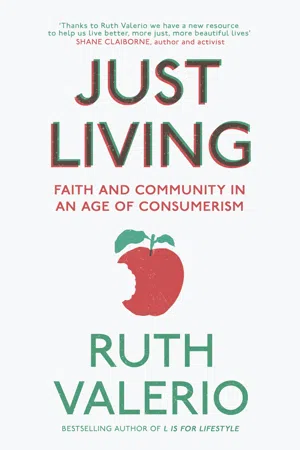
Globalisation and consumerism affect every area of our lives. But it's not just about shopping; these powerful forces shape our personal lives, how we relate to one another, how we view the world - and they are having a seriously detrimental impact both on the lives of the global poor, and on the health of the planet itself.Every Christian in every generation down through the history of the church has had to work out what it means to be a follower of Jesus in their particular culture; for us in the twenty-first century, we must think about discipleship in a globalised, consumerist context. Environmentalist and theologian Ruth Valerio examines these issues in a book that is intellectually rigorous yet practical, and as inspiring as it is challenging.
- 336 pages
- English
- ePUB (mobile friendly)
- Available on iOS & Android
eBook - ePub
About this book
Information
Topic
Theology & ReligionSubtopic
EcologyPART ONE
The Air We Breathe – the Context
Chapter 1
The Elephant and the Blind Men
Just what is globalisation?
Just what is globalisation?
Take a few moments before reading any further to think about what countries you have been in contact with so far today. Have a look at the labels on your clothes: where are they from? Maybe you are wearing jeans from Morocco, or a top from Pakistan. How about the food you have eaten so far today? Maybe you have had some coffee from Nicaragua or tea from India, cornflakes from US corn, tomatoes from Spain, potatoes from Egypt and beans from Kenya (although possibly not all in the same dish). Take a look around you: your carpet might be from Australia and your furniture from Scandinavia. And then what have you (hopefully) washed yourself with? Your soap might come from Germany, your facial cleanser from France and your deodorant from Ireland.
Now think about actual people with whom you have had contact. If you have been on social media today, then chances are you have seen posts or tweets from people all over the world. Greg sometimes has days when he feels like he has spent the whole day in his office, following the sun on Skype, talking with different people around the world as it becomes their daytime.
Once you begin to think like this, you realise that in the course of a day we might each have had some sort of a connection with ten . . . twenty . . . thirty countries. Of course, trade between countries has always taken place, but the speed at which this now happens and the sheer number of countries with which we all have connections every day is unprecedented and in stark contrast to life in the sixteenth and seventeenth centuries, when many people rarely travelled more than twenty miles away from their homes.1
It feels like our world is getting smaller. When the Jesuit missionaries of the sixteenth and seventeenth centuries set off from southern Europe, they knew it would take them two years before they reached Goa in India. For those who were headed for China, it would take them another year from there, or possibly two if the winds were not in their favour, thus making a possible journey time of four years from Italy and Spain to China (it is also sobering to think that around half of all passengers on such journeys died en route). By the time my great-great-grandfather went to India to be a missionary in 1846, his sailing boat could get him there in four months: what a revolution in speed! When my parents went to Singapore in the 1960s and my grandfather (who himself had been a missionary in China) heard that they could travel there by boat in three weeks, he exclaimed, ‘How amazing to get there so quickly!’ Now, of course, we can fly out there in around fourteen hours.
What we are talking about here is globalisation, a word that ‘encapsulates our latest contemporary story’.2 Globalisation might sound like a big word that has little to do with the life we are living, but actually it is the framework within which we are each living out our lives, and it is of particular relevance for those of us who want to think through how we serve Jesus well in a world of inequality and environmental suffering.
Globalisation is a much debated term, but at its simplest it describes – as illustrated above – the way our world is increasingly interconnected. It is a process that has been accelerating since the onset of the Industrial Revolution in the mid-1700s and it has moved us from a world that is exclusively national and transnational, in which the primary world actors are those that exist within national boundaries (i.e. national governments), to one that is global, in which nation-bound actors jostle on the stage alongside those that operate across – and whose concerns are not restricted by – national boundaries, such as business corporations, global NGOs (non-governmental organisations) and institutions like the IMF (International Monetary Fund) and World Bank.
It needs to be recognised that there is constant debate over globalisation. For some (what we could call the hyper-globalisers), the whole world is being globalised and homogenised, with the national completely superseded by the global, and economies coming together into a global system. Others question whether it really exists and point to the increasing rise of fundamentalism and a concern for national identities. The Slow Food movement, for example, was a classic backlash against what was seen as the ‘McDonaldisation’ of food around the world, with a desire to reaffirm the importance of local, regional food. People wondered whether the events of the 9/11 terrorist attacks and the 2008 banking crisis and recession would bring globalisation to an end. While the terrorist attacks highlighted the lack of homogeneity in the world and the clash of cultures that existed, the banking crisis revealed the vulnerability of a globalised economic system and potentially encouraged nations to withdraw and turn in on themselves. Even the former head of the IMF, Dominique Strauss-Kahn, acknowledged this possibility and said that the events since 2008 have ‘devastated the intellectual foundations of the global economic order of the last twenty-five years’.3
However, when we count up the countries we touch in just one day (or even just one meal), it seems that, although events such as 9/11 and the recession brought in new dynamics, globalisation is alive and well, albeit undeniably fluid and shifting.
David Held and Anthony McGrew are two leading commentators on globalisation and they identify three particular reasons why globalisation has continued apace, despite the potential of international crises to derail it. First, it is socially embedded. Globalisation is now so much a part of both our social narrative and our experience that it is hard to conceive of going ‘back’ to anything else. Second, it is institutionally entrenched. In other words, the global institutions of our day are ideologically embedded to the economic philosophy of free trade that underpins globalisation and they show no signs of moving away from that (we will explore this a bit more shortly). Third, crucially, there is currently no politically mainstream alternative to the open world economy of globalisation.4
In its current form, globalisation is a phenomenon that has a whole range of different approaches to it and is understood in a number of different ways, reflecting many different networks of relationships. It is evolving constantly and is very complex to define.
A well-known Indian story tells the tale of six blind men trying to describe an elephant. One man touches the leg and describes the elephant as being like a pillar; one touches the tail and says it is like a rope. Another man touches the trunk and says it is like the thick trunk of a tree, while another touches the tummy and says the elephant is like a huge wall. The fifth man touches the ear and believes the elephant to be like a big hand-held fan, and the final man touches the tusk and describes the elephant as being like a solid pipe. They all begin to argue, each one convinced that they are right. After all, they know what they have felt! And it takes a wise man to come to their rescue and explain to them that each one is right because they are describing the part of the elephant that they have experienced, but that each one is also wrong because none of them have experienced the elephant in full.
This is a helpful way of understanding why there are so many different opinions on what globalisation is and why it is so hard to define: each commentator’s definition comes from their own experience of globalisation, which varies depending on their geographical and social location. Like in the story above, no one person has overall sight. Indeed, one could go further and suggest that there is actually no one elephant called ‘globalisation’: what it is differs according to which part of our global scene we are looking at.
Despite all these many debates around globalisation, however, there is a general level of agreement that globalisation has four main aspects to it – what I call the four faces of globalisation – and I want to look at these (the economic, political, technological and cultural5) and consider what relevance they have to the overall subject matter of this book.
Economic globalisation
When the 9/11 terrorist attacks focused on the twin towers of the World Trade Center, they were going right to the heart of the dominant economic system of the world. Trade is what our world is built on, but not just any form of trade: a very specific form of trade called ‘free trade’.
Free trade is all about removing the barriers to trading between countries that nations can impose. These barriers are often in the form of tariffs, where a government places a tax on a product that is being exported out of the country. On the one hand, such a tariff can help provide revenue for that country, but it can also have the effect of discouraging others from wanting to buy from them, hence creating a barrier to trade. Because of this, supporters of free trade generally want to limit the degree to which states can intervene in the trading processes (this is called deregulation) and allow market forces to find their own equilibrium.
When Bill Clinton, as President of the United States, said, ‘The United States has 4.5 per cent of the world’s population but 22 per cent of its income. We cannot sustain our standard of living unless we sell some things to other people’, what he was pushing for was an American economy that did not close in on itself protectively but opened up its borders and traded more openly with other countries.6
This way of running the economy – both nationally and therefore globally – is based on what is called the Washington Consensus. This was a set of ten principles, laid down in 1989 by economist John Williamson and agreed by the American financial institutions, that brought together the main tenets of free market economics and acted as a guide for economic growth. While thinking has developed and we are now into the ‘Post-Washington Consensus’, these initial principles together formed a distinct ideology on which economic globalisation has been built – an ideology labelled ‘neo-liberalism’.
Underpinning these principles was – and is – the belief that the economy must grow continually. It may not be quite true that in the aftermath of 9/11 President Bush urged Americans to ‘go shopping’, but it is easy to see how that urban myth arose when, in his address to the nation on 20 September of that year (at which he announced his ‘war on terror’), he stated that it was imperative for them to continue their ‘participation and confidence in the American economy’.7 Participation in the American economy (i.e. shopping) has to continue because, without it, the American economy would not keep growing, which would bring collapse and disaster.
Economic globalisation in the form of free market economics is highly contested and it attracts intense criticism from those who are concerned about the numbers of people still living in poverty.8 The criticism comes from different voices, speaking from diverse perspectives. Some speak from a position of power and essentially agree that free trade is the way to bring people and countries out of poverty. However, they also acknowledge that the so-called ‘invisible hand’ of the market has not done the job it was expected to do: it has not brought a natural state of balance between supply and demand to the global economy, and it has not led to all societies being better off, and so it cannot be left entirely to its own devices. Therefore, some measure of state control is needed to encourage the market forward but without its negative side effects.9 Others fundamentally reject globalisation as little more than a selfish ideology advanced by rich elites.10
In between these two ends is a variety of views. One of the most interesting global developments from this perspective in recent years has been the rise of the anti-globalisation movement (possibly better named ‘alter-globalisation’ by Geoffrey Pleyers11). This has been made visible at large-scale gatherings such as the protests at the Genoa Group of Eight meeting at Genoa in 2001 and at the WTO (World Trade Organisation) meeting in Seattle in 1999, the regular World Social Forums and the Occupy Wall Street/London movements. These gatherings attract a mass of different groups and individuals, representing a wide range of views, but all agreeing that globalisation as it currently exists is intensely problematic.
Many of these groups are large but often generally invisible because they represent the powerless: groups such as Via Campesina and the Landless Workers Movement in Brazil. Of increasing importance, additionally, are the internet-based pressure groups that are able to mobilise sometimes hundreds of thousands of citizens around the world within hours.12
What makes the debates around globalisation confusing is that, for many, there is no doubt that it has brought enormous benefits. One of the amazing success stories of recent years has been the fall in poverty rates in Asia. In East Asia, the proportion of people living in poverty fell...
Table of contents
- Cover
- Endorsements
- Title Page
- Imprint Page
- Contents
- Introduction
- PART ONE
- 1 The Elephant and the Blind Men
- 2 Skinny Jeans and a Broken Nose
- 3 Of Monks and Men
- PART TWO
- Introduction
- 4 Get Thee to a Nunnery?
- 5 In Plenty or in Want
- 6 Temperance, Justice and Human Flourishing
- PART THREE
- Introduction
- A Global Social Concern
- An Ecological Concern
- A Christian Approach to Money and Material Goods
- Ethical Consumerism
- Local Community
- Activism
- Time
- Final Words
- Acknowledgements
- Notes
- Bibliography
Trusted by 375,005 students
Access to over 1.5 million titles for a fair monthly price.
Study more efficiently using our study tools.
Frequently asked questions
Yes, you can cancel anytime from the Subscription tab in your account settings on the Perlego website. Your subscription will stay active until the end of your current billing period. Learn how to cancel your subscription
No, books cannot be downloaded as external files, such as PDFs, for use outside of Perlego. However, you can download books within the Perlego app for offline reading on mobile or tablet. Learn how to download books offline
Perlego offers two plans: Essential and Complete
- Essential is ideal for learners and professionals who enjoy exploring a wide range of subjects. Access the Essential Library with 800,000+ trusted titles and best-sellers across business, personal growth, and the humanities. Includes unlimited reading time and Standard Read Aloud voice.
- Complete: Perfect for advanced learners and researchers needing full, unrestricted access. Unlock 1.5M+ books across hundreds of subjects, including academic and specialized titles. The Complete Plan also includes advanced features like Premium Read Aloud and Research Assistant.
We are an online textbook subscription service, where you can get access to an entire online library for less than the price of a single book per month. With over 1.5 million books across 990+ topics, we’ve got you covered! Learn about our mission
Look out for the read-aloud symbol on your next book to see if you can listen to it. The read-aloud tool reads text aloud for you, highlighting the text as it is being read. You can pause it, speed it up and slow it down. Learn more about Read Aloud
Yes! You can use the Perlego app on both iOS and Android devices to read anytime, anywhere — even offline. Perfect for commutes or when you’re on the go.
Please note we cannot support devices running on iOS 13 and Android 7 or earlier. Learn more about using the app
Please note we cannot support devices running on iOS 13 and Android 7 or earlier. Learn more about using the app
Yes, you can access Just Living by Ruth Valerio in PDF and/or ePUB format, as well as other popular books in Theology & Religion & Ecology. We have over 1.5 million books available in our catalogue for you to explore.