'For all those who have understood that doubt and free thinking are failings of your faith, Brian's book will help you live fuller and breathe easier.' Glennon Doyle Sixty-five million adults in the US have dropped out of active church attendance and about 2.7 million more are leaving every year. In the UK, surveys indicate that religious belief is also declining - and yet a surprising number of people still pray. Faith After Doubt is for all those who feel that their faith is falling apart.Using his own story and the stories of a diverse group of struggling believers, Brian D. McLaren, a former pastor and now an author, speaker, and activist shows how old assumptions are being challenged in nearly every area of human life, not just theology and spirituality. He proposes a four-stage model of faith development in which questions and doubt are not the enemy of faith, but rather a portal to a more mature and fruitful kind of faith. The four stages - simplicity, complexity, perplexity and harmony - offer a path forward that can help sincere and thoughtful people leave behind unnecessary baggage and increase their commitment to what matters most. 'In this important book, my friend and colleague Brian McLaren helps you find a deeper and wiser faith that is enriched by doubt instead of threatened by it.' Fr Richard Rohr
eBook - ePub
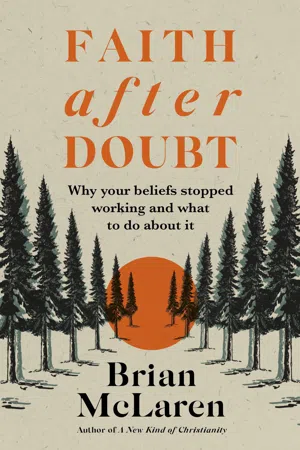
Faith after Doubt
Why Your Beliefs Stopped Working and What to Do About It
- 352 pages
- English
- ePUB (mobile friendly)
- Available on iOS & Android
eBook - ePub
About this book
Information
Topic
Theology & ReligionSubtopic
ReligionPART ONE
Your Descent into Doubt
CHAPTER 1
Doubt as Loss
There are recovery programs for people grieving the loss of a parent, sibling, or spouse. You can buy books on how to cope with the death of a beloved pet or work through the anguish of a miscarriage. We speak openly with one another about the bereavement that can accompany a layoff, a move, a diagnosis, or a dream deferred. But no one really teaches you how to grieve the loss of your faith. You’re on your own for that ... It became increasingly clear that my fellow Christians didn’t want to listen to me, or grieve with me, or walk down this frightening road with me. They wanted to fix me. They wanted to wind me up like an old-fashioned toy and send me back to the fold with a painted smile on my face and tiny cymbals in my hands.
– Rachel Held Evans, Searching for Sunday
From: Michael Walker
Subject: Greetings From South Florida
Date: 22 January 2019 at 9:53:35 PM
My name is Michael, and I am a minister for a fundamentalist congregation in Hendry County. Since Autumn of last year, I’ve been reading a lot of Rob Bell, Richard Rohr and Pete Enns. I’ve been listening to The Bible for Normal People, and I just got to your episode. I heard you mention Lee County, Florida, in your talk, and I just so happen to lead a study there on Tuesday nights each week for a house church. I understand that you are a county over, and I would love to get together with you sometime to talk about some of the things I’ve been studying recently. You put language to a lot of the things I’ve been thinking about.
I hope to hear from you soon.
Michael Walker
P.S. I’m part of the 81 per cent, but since last autumn, I have slowly evolved where that is concerned as well.
Over the years, I’ve received hundreds of emails like Michael’s: honest, direct, intelligent, polite and, underneath the surface, in real pain, if not a little desperate. I respond to some of them on my blog (being careful to protect the authors’ privacy), but I receive too many to respond to each one.
Something about Michael’s message motivated me to set up an in-person meeting. I suggested a wildlife preserve halfway between us. I’ve found that sensitive conversations of a spiritual nature often go best outdoors. Sure, coffee shops, living rooms, kitchens and offices work fine. But there’s something about the logic and mystery of wind and water, trees and birdsong, together with the unhurried pace of walking and resting, speaking and listening, that creates just the right setting for conversations about matters of ultimate concern.
So Michael’s story poured out under cypress trees and among painted buntings and snowy egrets. He was raised in a small, super-conservative Christian denomination in the Midwestern United States, and at a young age he was identified as an emerging leader. By nineteen he was preaching. By twenty he was a pastor. And by twenty-three, he had been fired and disfellowshipped (or excommunicated) by his congregation.
There had been no sexual misconduct or financial mismanagement, no secret drinking or drug problem, no unsteady work ethic or weakness in his preaching or pastoral care. Nor had Michael denied some central tenet of Christian faith. His fireable offence? He questioned the little church’s highly speculative doctrine of how the world will end.
If getting fired and disfellowshipped weren’t traumatic enough for a sensitive young man, those who fired and disfellowshipped him included his grandfather and his parents.
He was a newlywed at the time, working hard to finish his bachelor’s degree part-time while being employed as a pastor full time, albeit with a pathetically small part-time salary. Suddenly, he had no salary at all.
What could he do? Was his short ministry career already over?
An older pastor in Florida who was nearing retirement heard through a friend of a friend that a precocious young pastor was available. Soon Michael had an interview and a job offer, and he and his bride were moving south to a town a couple of hours north-east from where I live.
The small congregation began growing numerically. The people loved Michael and his wife. All was going well. Except for one thing. Week by week, when he studied the Bible in preparation for his sermons, new questions kept arising. Some things he read in the Bible seemed in tension with what he had always been taught. The more questions he asked, the more new questions arose.
Recent political developments brought additional intensity. Michael wondered if some of his members were more influenced by the Fox News of Rupert Murdoch than the good news of Jesus Christ. Michael only spoke to them during one hour on Sunday, but many of his members watched arch-conservative cable news pundits for three hours each weeknight, and during the day, they listened to radio talk shows with an identical slant. If Michael’s sermon disagreed with the monologue of a media pundit, the pastor, not the pundit, would be assumed to be wrong.
Perhaps if Michael could have suppressed his doubts he would have, but he couldn’t. Like a beach ball submerged in a swimming pool, his buoyant bubble of doubt kept popping up.
So he did what any number of budding critical thinkers before him have done: he secretly read books by authors that his tribe didn’t approve of. First he read Velvet Elvis by my friend Rob Bell, a book that acknowledges the inability of religious language to ever fully capture the depths and richness to which it points. Then he read a book by Richard Rohr, who writes about a spacious ‘alternative orthodoxy’ that seemed far more hospitable than Michael’s inherited system of belief. Not long after that, he started listening to a podcast by yet another friend, Pete Enns, a biblical scholar who helps ‘normal people’ have intelligent conversations about the Bible. Now, it wasn’t just one esoteric doctrine of the end of the world that Michael was coming to question. It felt like the system of beliefs that he had spent his whole life perfecting was wobbling and perhaps beginning to crumble.
To make matters worse, he was letting some of his questions slip out in his sermons. He couldn’t help it. Some people were relieved by his honesty; he was giving them permission to express their own questions and doubts. But predictably, others were suspicious. One fellow in particular seemed to be positioning himself as an antagonist.
What would happen if he lost another job? Could any young pastor survive two firings before the age of thirty? Far more serious, was he on a slippery slope that would land him in hot water (or some other deep or hot substance) with God as well as his congregation?
Only once did I see his eyes brim and only for the briefest moment. But I could tell that behind this young man’s clean-cut, well-controlled exterior, deep emotions churned. My heart went out to him.
Truth be told, I saw myself in him.
I too was a child of fundamentalism. I too became a pastor at an impossibly young age and without traditional training. I too faced traumatic early setbacks. And I too wanted nothing more than to grow from a good and faithful boy into a good and faithful man, to follow in the way of my father and mother, my grandfathers and grandmothers. But I too was plagued with a curious mind. When as a young teenager I dared to ask questions and received thoroughly unsatisfactory answers, I remember a terrifying yet liberating thought arising, unbeckoned, from somewhere deep within me: ‘I’m only fourteen. Four more years and I’ll be eighteen, and I can get out of here.’
However, not long after that I was ambushed by an unexpected spiritual experience that I’ll recount later in this book. In large part because of that experience, I found myself staying within the fold of the faithful. But I quickly moved to the margins of my traditional conservative evangelical/fundamentalist heritage. When I discovered the Jesus movement and the charismatic movement, I jumped in, a little timidly at first, then more fully, and they provided new spaces to grow. But by my final year in secondary school, I had questions for which I could find no answers.
It was an English teacher who helped me. He had formerly been a Jesuit priest, and I could tell that for him, questioning was a good thing. But I also knew that his form of open-minded, open-hearted Christianity would be considered liberal and dangerous by both my fundamentalist elders and my Jesus movement peers. ‘An open mind is like an open window,’ one of them warned me. ‘You need a good screen to keep the bugs out.’
By my first year of university, my faith crisis was intensifying. Every time I’d run into a Christian friend on campus and he or she would ask, ‘How are you?’ I felt I was plunged into a moral crisis. If I said, ‘I’m fine. How are you?’ I felt like a liar. But if I said, ‘To tell you the truth, I’m having serious questions about the Bible, about hell and, increasingly, about the existence of God, and I’m in deep inner turmoil,’ I knew that prayer groups around campus would soon be praying for me, and people would be ‘counseling’ me if not rebuking me, which would only make my situation worse. Neither option – hiding my truth or speaking it – seemed practical.
Thankfully, I had some friends, all a few years older than me, with whom I could speak freely about my doubts. They introduced me to a whole new library of books by smart writers for whom the phrase thinking Christian wasn’t an oxymoron. Francis Schaeffer and C. S. Lewis were chief among them. I devoured nearly everything they wrote. Buoyed by their good answers, like young Michael Walker, I was identified as a spiritually precocious young leader and helped lead a church while I was still a university student.
So as Michael’s story unfolded, I lis...
Table of contents
- Cover
- About the Author
- Also by Brian D. McLaren
- Title Page
- Contents
- Preface: Permission to Doubt
- Introduction: Moments of Terror
- PART ONE: Your Descent into Doubt
- 1 Doubt as Loss
- 2 Doubt as Loneliness
- 3 Doubt as Crisis
- 4 Doubt as Doorway
- 5 Doubt as Growth
- PART TWO: All in Doubt
- 6 Doubt as Descent
- 7 Doubt as Dissent
- 8 Doubt as Love
- 9 A Human Problem
- 10 Faith, Beliefs and Revolutionary Love
- PART THREE: Life After (and with) Doubt
- 11 Communities of Harmony
- 12 Theologies of Harmony
- 13 Spiritualities of Harmony for the Rising Generation
- 14 Harmony as a Survival Strategy
- 15 A Civilisation in Doubt
- Afterword: You’re Not Crazy and You’re Not Alone
- Acknowledgements
- Appendix I. The Four Stages of Faith
- Appendix II. Before Simplicity: Stage Zero
- Appendix III. Integration of Stage Theories
- Appendix IV. Resources for Doubters
- Appendix V. Spirituality Through the Stages
- Appendix VI. Guidelines for Groups and Classes
- Notes
- Endmatter page 1
- Imprint Page
Trusted by 375,005 students
Access to over 1.5 million titles for a fair monthly price.
Study more efficiently using our study tools.
Frequently asked questions
Yes, you can cancel anytime from the Subscription tab in your account settings on the Perlego website. Your subscription will stay active until the end of your current billing period. Learn how to cancel your subscription
No, books cannot be downloaded as external files, such as PDFs, for use outside of Perlego. However, you can download books within the Perlego app for offline reading on mobile or tablet. Learn how to download books offline
Perlego offers two plans: Essential and Complete
- Essential is ideal for learners and professionals who enjoy exploring a wide range of subjects. Access the Essential Library with 800,000+ trusted titles and best-sellers across business, personal growth, and the humanities. Includes unlimited reading time and Standard Read Aloud voice.
- Complete: Perfect for advanced learners and researchers needing full, unrestricted access. Unlock 1.5M+ books across hundreds of subjects, including academic and specialized titles. The Complete Plan also includes advanced features like Premium Read Aloud and Research Assistant.
We are an online textbook subscription service, where you can get access to an entire online library for less than the price of a single book per month. With over 1.5 million books across 990+ topics, we’ve got you covered! Learn about our mission
Look out for the read-aloud symbol on your next book to see if you can listen to it. The read-aloud tool reads text aloud for you, highlighting the text as it is being read. You can pause it, speed it up and slow it down. Learn more about Read Aloud
Yes! You can use the Perlego app on both iOS and Android devices to read anytime, anywhere — even offline. Perfect for commutes or when you’re on the go.
Please note we cannot support devices running on iOS 13 and Android 7 or earlier. Learn more about using the app
Please note we cannot support devices running on iOS 13 and Android 7 or earlier. Learn more about using the app
Yes, you can access Faith after Doubt by Brian D. McLaren in PDF and/or ePUB format, as well as other popular books in Theology & Religion & Religion. We have over 1.5 million books available in our catalogue for you to explore.