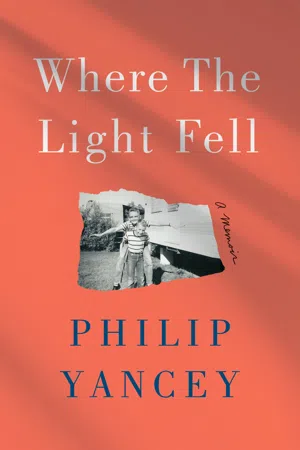
'Not until college days do I discover the shocking secret of my father's death.' With a journalist's background Philip Yancey is widely admired for taking on the more difficult and confusing aspects of faith. Now in Where the Light Fell he shares, for the first time, the painful details of his own origins - taking us on an evocative journey from the backwoods and Bible-belt pockets of the South to the bustling streets of Philadelphia; from trailer parks to church parking lots; from dark secrets and family oddballs to fire-and-brimstone preachers and interminable church services. Raised by their impoverished single mother, Philip and his brother Marshall struggle to comprehend her speeches about their dead father, an Old Testament Bible story, and sons sacrificed for a divine cause.This coming-of-age story is a slice of life, both intensely personal and broadly resonant, set against a turbulent time in post-WWII American history shaped by the racism and paranoia of fundamentalist Christianity and reshaped by the mounting pressures of the Civil Rights movement and 60s-era forces of social change. An unforgettable read, it is at once hugely funny, deeply disturbing and achingly poignant. A testament to the power of the human spirit, Where the Light Fell illuminates Yancey's ability to bring comfort to those bruised by the church, and hope to those who can't imagine ever finding a healthy faith.
- 320 pages
- English
- ePUB (mobile friendly)
- Available on iOS & Android
eBook - ePub
About this book
Information
Topic
Ciencias socialesSubtopic
Biografías de ciencias socialesPART ONE
THE FAMILY PLOT
There is no agony like bearing an untold story inside you.
—Zora Neale Hurston, Dust Tracks on a Road
CHAPTER 1
THE SECRET
Not until college do I discover the secret of my father’s death.
My girlfriend, who will later become my wife, is making her first visit to my home city of Atlanta, in early 1968. The two of us stop by my grandparents’ house with my mother, have a snack, and retire to the living room. My grandparents sit in matching recliners across from the upholstered couch where Janet and I are seated. A television plays softly in the background, tuned to the ever-boring Lawrence Welk Show.
Normally my eighty-year-old grandfather snores through the program, waking just in time to pronounce, “Swellest show I ever saw!” Tonight, though, everyone is wide-awake, fixing their attention on Janet. Philip’s never brought a girl over—this must be serious.
Conversation proceeds awkwardly until Janet says, “Tell me something about the Yancey family. I’m so sorry I’ll never get to meet Philip’s father.” Thrilled by her interest, my grandmother rummages in a closet to fetch some photo albums and family scrapbooks. As pages turn, Janet tries to keep straight all the names and faces flashing before her. This ancestor fought for the Confederacy in the Civil War. That distant cousin died of a black widow spider bite. Her father succumbed to the Spanish flu.
Suddenly a folded clipping from The Atlanta Constitution flutters from the album to the floor, newsprint yellowed with age. When I lean forward to retrieve it, a photo that I’ve never seen catches my eye.
A man lies on his back in a hospital bed, his body pitifully withered, his head propped up on pillows. Beside him, a smiling woman bends over to feed him with a spoon. Right away I recognize her as a slimmer, youthful version of my mother: the same prominent nose, the same mass of dark, curly hair, an early trace of the worry lines that now crease her forehead.
The photo caption stops me cold: “Polio Victim and Wife Spurn ‘Iron Lung.’ ” I hold the paper closer and block out the buzz of family chitchat. The printed words seem to enlarge as I read.
A 23-year-old Baptist minister, who was stricken with polio two months ago, has left the “iron lung” in which he was placed at Grady Hospital because, as he put it, “I believe the Lord wanted me to.”
The Rev. Marshall Yancey, of 436 Poole Creek Rd., Hapeville, said about 5,000 people from Georgia to California were praying for his recovery and he was confident he would be well “before too long.”
He signed his own release from Grady against medical advice.
Those three words, against medical advice, send a chill through my body, as though someone has poured ice water down my spine. Sensing the change, Janet looks at me quizzically, her left eyebrow arched so high that it touches her bangs. I slide the clipping over so that she, too, can read it.
The newspaper reporter quotes a Grady Memorial Hospital doctor, who warns that removal from the respirator “might do serious harm,” followed by a chiropractor who claims the patient is “definitely improving” and may begin walking in six weeks if he continues their course of treatment.
Then the article turns to my mother:
Mrs. Yancey, the minister’s young, blue-eyed wife, explained why her husband left Grady:
“We felt like he should be out of that iron lung. Lots of people who believe in faith healing are praying for him. We believe in doctors, but we believe God will answer our prayers and he will get well.”
I glance at the newspaper’s date: December 6, 1950. Nine days before my father’s death. I flush red.
Janet has finished reading. Why didn’t you tell me about this? she asks with her eyes. I mime surprise: Because I didn’t know!
Dozens, scores of times I have heard the saga of my father’s death, how a cruel disease struck down a talented young preacher in his prime, leaving a penniless widow with the noble task of wresting some meaning from the tragedy. My growing-up years were dominated, even straitjacketed, by a vow she made—that my brother and I would redeem that tragedy by taking on the mantle of our father’s life.
Never, though, have I heard the backstory of what led to his death. When I replace the clipping in the scrapbook, I find on the facing page a similar account from my mother’s hometown newspaper The Philadelphia Bulletin. Quite by accident I am discovering that this man whom I never knew, a saintly giant looming over me all these years, was a sort of holy fool. He convinced himself that God would heal him, and then gambled everything—his career, his wife, his two sons, his life—and lost.
I feel like one of Noah’s sons confronting his father’s nakedness. The faith that exalted my father and gained him thousands of supporters, I now grasp, also killed him.
As I lie in bed that night, memories and anecdotes from childhood flash before me, now appearing in a different light. A young widow lying on her husband’s grave, sobbing as she offers her two sons to God. That same widow, my mother, pausing to pray, “Lord, go ahead and take them unless . . .” before seeking help as her sons thrash convulsively on the floor. Her rage that erupts when my brother and I seem to stray from our appointed destiny.
An awful new realization hits me. My brother and I are the atonement to compensate for a fatal error in belief. No wonder our mother has such strange notions of parenting, and such fierce resistance to letting us go. We alone can justify our father’s death.
AFTER CHANCING UPON the newspaper article, I have many conversations with Mother. “That was no life for him—paralyzed, in that machine,” she says. “Imagine a grown man who can’t even swat a fly off his nose. He desperately wanted out of Grady Hospital. He begged me not to let anyone take him back there.” Her reasoning is sound, though unsatisfying.
“I get that,” I protest, “but why was I never told about the faith healing? The most important fact of my father’s death I learned by chance, from a scrapbook. You invited a reporter into the room, and a photographer. You told them the truth, but not my brother and me!”
Once exposed, the mystery of my father’s death acquires a new, compulsive power. When I start asking around, a family friend confides in me, “So many of us were dismayed at their decision, moving your father from a well-equipped hospital to a chiropractic center.”
I feel as if someone has twisted the kaleidoscope of our family myth, scattering the shards to form a wholly new design. I share the news with my renegade brother, who has incurred Mother’s wrath by joining Atlanta’s hippie counterculture. He immediately jumps to the conclusion that she deprived us of a father by “pulling the plug” on her own husband. A chasm opens in our little family that likely will never be bridged.
I don’t know what to think. I know only that I have been misled. The secret is now out, and I determine to investigate and write it down someday, as truthfully as I can.
Love in action is a harsh and dreadful thing compared with love in dreams.
—Fyodor Dostoevsky, The Brothers Karamazov
CHAPTER 2
THE GAMBLE
You would need to have lived in the middle of the twentieth century to appreciate the fear that polio once stirred up—the same degree of fear that pandemics such as HIV/AIDS and COVID-19 would later arouse. No one knew how polio spread. By air or water? Contaminated food? Paper money? Across the country, swimming pools closed as a precaution. When a rumor surfaced that cats might be carriers, New Yorkers killed seventy-two thousand of them.
To add to the terror, polio targeted mostly children. Parents used it as the ultimate threat—to keep their kids from playing too hard, using a public phone, getting dirty, or hanging out with the wrong crowd: “Do you want to spend the rest of your life in an iron lung?!” Newspapers ran daily tallies of the dead, along with photos of breathing machines lined up in rows, like giant sausage rolls with little heads poking out one end.
Not all victims were children. The world’s most famous polio patient, President Franklin Delano Roosevelt, contracted the disease at age thirty-nine.
My father fell ill earlier, at twenty-three. His symptoms mimicked the flu at first: a sore throat, headache, mild nausea, general weakness in his muscles. But on October 7, 1950, he awoke to find his legs paralyzed. Unable to move, even to get out of bed, he feared the worst.
When the ambulance came, Mother asked a neighbor to keep three-year-old Marshall Jr. away from the window, but my brother cried so hard that the neighbor gave in to his tears and let him watch. For weeks he had recurring nightmares of his father being carried out of the house, helpless and unmoving.
The ambulance sped to Georgia Baptist Hospital. Doctors gave the patient a quick exam, then abruptly sent him outside in a wheelchair, wearing only a hospital gown. “It’s polio,” they told my mother. “Get him over to Grady. They’re the only hospital around here equipped to treat polios.”
Sometime that week, Mother wrote an urgent letter to her home church in Philadelphia and the other congregations that had agreed to support them as missionaries. Her message was simple and direct: “Please pray!”
A SPRAWLING LANDMARK in downtown Atlanta, Grady Memorial was a charity hospital that accepted anybody. In 1950 locals referred to it as “the Gradies” because, like most hospitals in the South, Grady segregated the races, with a tunnel beneath the street joining the separate facilities for whites and “Coloreds.” Patients joked that Grady gave equal treatment to all races—equally bad treatment. No matter your race, you could sit for hours in the lobby waiting for your number to be called. Not if you had polio, though: orderlies immediately whisked my father down the hallways to an isolation ward.
We were living in Blair Village at the time, a government housing project built for veterans of World War II. Four or five concrete-block apartments, resembling army barracks, formed a horseshoe shape around a cul-de-sac. When my father got sick, a public health nurse posted a quarantine sign on our door, temporarily barring any visitors.
For the next two months my mother followed the same daily routine: Feed the kids breakfast, pack up their diapers and toys, and bundle them off to whichever neighbor had agreed to babysit that day. Then, because she had not yet learned to drive, she rode the public bus, with its dozens of stops, into the city. Often she was the only white passenger on a bus full of workers, sitting alone in the front section reserved for whites. At Grady she stayed by her husband’s side until dark, when she caught a bus home.
The nurses told her that only one in seventy-five adults with polio experienced paralysis. My father was the unlucky one. And because his paralysis included the diaphragm, Grady consigned him to the dreaded iron lung.
A large metal cylinder painted mustard yellow, the apparatus engulfed my father’s body except for his head, which rested on a cushioned table. A tight rubber collar around his neck prevented air from escaping. By pumping in air and then sucking it out to form a vacuum, the machine forced his lungs to expand and contract, something they could not do on their own. My father complained that the noise kept him from sleeping: the bellows made rhythmic whooshing sounds and metallic squeaks, like worn wiper blades scraping across a car windshield.
Few hospitals had TV sets then, and my father could not turn the pages of a book. All day and all night he lay still on his back. He stared at the ceiling, passing time by studying the pattern of holes in the acoustic tiles. By shifting his eyes, he could look in a mirror angled toward the doorway and see faces moving past a small window in the door.
From his vantage, anyone who approached him towered like a giant. A masked orderly would shove a spoonful of food in his direction and he would flinch. Access ports lined the side of the machine, and hospital staff reached through the portholes with gloved hands to insert a needle or replace a bedpan. They addressed his head, the only body part outside the machine, as if it led a separate existence from the parts inside.
He lost control over basic functions: going to the bathroom, sleeping, feeding himself. He couldn’t even choose when to take a breath; the artificial lung did that for him. The world shrank. Five years before, he had been sailing home on a warship, with all of life awaiting him. Now the iron lung defined his range. It became a kind of exoskeleton, like a cramped shell around a stuck crab.
Grady had strict rules about visitors. When my aunt Doris, a nurse at another hospital, showed up in uniform for a visit, the charge nurse at Grady decided she lacked the proper training for polio. “Honey, you don’t want to see how bad he is anyhow,” she said.
A few times his mother, my grandmother Yancey, appeared at the window with a mask on and waved. Only once did his father show up, with my brother and me in tow. A blacksmith, this strong man hoisted us onto his shoulders and held us at the window, so that my father could see his own sons, our images reversed in the mirror bolted to the machine.
The only visitor who braved the risk, the only person who touched him other than clinically, was my mother, his emotional lifeline. She read books to him, softly sang hymns, pestered the nurses and orderlies for better treatment, and offered what little encouragement she could—even as her own world collapsed around her.
She kept from him her inner fears, but recorded them in a diary: “Suffering terribly—out of mind most of the time. I asked God to take him home if he had to suffer so.”
DURING THE HOUR-LONG bus rides to and from Grady, and the occasions when her husband napped inside the iron lung, Mother had much time to review the whirlwind of the five years she had known him.
She met him in April 1945, when a group of sailors on weekend leave traveled to Philadelphia from their navy base in Norfolk, Virginia, hoping to see the city’s sights. He chose to spend Sunday morning at church, where a middle-aged couple responded to the pastor’s request to “invite a serviceman home for lunch.” There he first encountered Mildred Diem, my mother, who was staying with the couple as she recovered from a medical procedure.
The adventuresome sailor from Atlanta fell madly in love with timid, sheltered Milly, three years his senior. She had never had a boyfriend, and was charmed by his Southern accent and his gentlemanly style. She also marveled at his carefree spirit, exactly the opposite of her own repressed nature.
As they swapped stories about their upbringings, she learned that the young Marshall Yancey had a wild streak. He was something of a gambler, a kid who took risks. With no warning, at age fourteen Marshall ran away from home. His mother worried herself sick until, four days later, he called collect from St. Louis, Missouri. “I heard they had a great zoo, one of the best,” he explained. “So I came up to see it.”
Proud of his son...
Table of contents
- Cover
- Title Page
- Copyright
- Dedication
- Contents
- Part One: The Family Plot
- Part Two: Boyhood
- Part Three: Roots
- Part Four: Disorder
- Part Five: Graced
- Author’s Note
- Read more from Philip Yancey
Trusted by 375,005 students
Access to over 1.5 million titles for a fair monthly price.
Study more efficiently using our study tools.
Frequently asked questions
Yes, you can cancel anytime from the Subscription tab in your account settings on the Perlego website. Your subscription will stay active until the end of your current billing period. Learn how to cancel your subscription
No, books cannot be downloaded as external files, such as PDFs, for use outside of Perlego. However, you can download books within the Perlego app for offline reading on mobile or tablet. Learn how to download books offline
We are an online textbook subscription service, where you can get access to an entire online library for less than the price of a single book per month. With over 1.5 million books across 990+ topics, we’ve got you covered! Learn about our mission
Look out for the read-aloud symbol on your next book to see if you can listen to it. The read-aloud tool reads text aloud for you, highlighting the text as it is being read. You can pause it, speed it up and slow it down. Learn more about Read Aloud
Yes! You can use the Perlego app on both iOS and Android devices to read anytime, anywhere — even offline. Perfect for commutes or when you’re on the go.
Please note we cannot support devices running on iOS 13 and Android 7 or earlier. Learn more about using the app
Please note we cannot support devices running on iOS 13 and Android 7 or earlier. Learn more about using the app
Yes, you can access Where the Light Fell by Philip Yancey in PDF and/or ePUB format, as well as other popular books in Ciencias sociales & Biografías de ciencias sociales. We have over 1.5 million books available in our catalogue for you to explore.