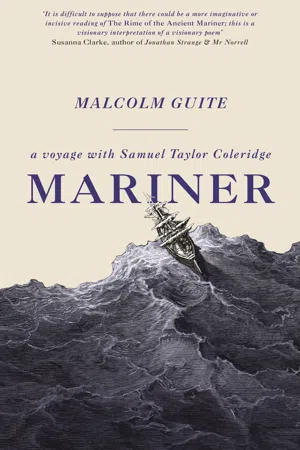
'The story of Coleridge's life does undoubtedly echo that of his poem; this is a book that provides rewarding rereadings of both' - The Sunday Times A new biography of Samuel Taylor Coleridge, shaped and structured around the story he himself tells in his most famous poem, 'The Rime of the Ancient Mariner'. Though the 'Mariner' was written in 1797 when Coleridge was only twenty-five, it was an astonishingly prescient poem. As Coleridge himself came to realise much later, this tale - of a journey that starts in high hopes and good spirits, but leads to a profound encounter with human fallibility, darkness, alienation, loneliness and dread, before coming home to a renewal of faith and vocation - was to be the shape of his own life. In this rich new biography, academic, priest and poet Malcolm Guite draws out how with an uncanny clarity, image after image and event after event in the poem became emblems of what Coleridge was later to suffer and discover. Of course 'The Rime of the Ancient Mariner' is more than just an individual's story: it is also a profound exploration of the human condition and, as Coleridge says in his gloss, our 'loneliness and fixedness'. But the poem also offers hope, release, and recovery; and Guite also draws out the continuing relevance of Coleridge's life and writing to our own time. 'Forcefully and convincingly argued' - The Telegraph
- 480 pages
- English
- ePUB (mobile friendly)
- Available on iOS & Android
eBook - ePub
About this book
Information
Chapter One
The Kirk, the Hill, the Lighthouse Top
The ship was cheered, the harbour cleared,
Merrily did we drop
Below the kirk, below the hill,
Below the light house top.
(Lines 21–4)
Coleridge describes his mariner setting out on the voyage and glancing back as, one by one, the kirk, the hill, the lighthouse top – the familiar landmarks of home – drop out of sight below the horizon, and he turns forwards to face the unknown. As we look at Coleridge’s life before he wrote The Ancient Mariner, these three familiar landmarks may, helpfully, stand as emblems for important aspects of that life. ‘The kirk’ may stand not only for the church itself, but also for the formative influence of its vicar, Coleridge’s father, and for Coleridge’s own first reading of the Bible and the Prayer Book, reading which never deserted him, and in the end deeply renewed him. ‘The hill’ may stand for his rich early experiences of nature, not only in climbing the hills of his Devon childhood, but more importantly following the streams he loved uphill towards their source. Finally, ‘the light-house top’ may stand for the light of reason, the beginnings of his education, and his early and lifelong delight in philosophy.
The Kirk
Coleridge was born in the small Devonshire town of Ottery St Mary on 21 October 1772, the youngest of the Reverend John Coleridge’s ten children. If we were trying to reconstruct the infancy and early childhood of anybody in Coleridge’s father’s generation or earlier, we would find it very difficult to do so, for the polished, decorous, guarded and Augustan culture of the early and mid-eighteenth century in which John Coleridge flourished placed little importance on childhood, and indeed dressed children as little adults and waited impatiently for them to grow up and be useful. It was Coleridge’s and Wordsworth’s generation, and indeed primarily these two very poets, who shifted the entire culture around them, and opened up that keen interest in the intense experience of childhood and that remarkable reverence for the insights of the child which still form part of our outlook now.
We have a rich source for understanding Coleridge’s childhood experience in the poet’s own writings. In his notebooks and letters and in his poetry itself he reached back to understand the forces that had shaped him for good and ill, and wrote about them with extraordinary intensity. Indeed, he would later define a poet as a person who retained a child’s capacity for intense vision and wonder: ‘In the Poet was comprehended the man who carries the feelings of Childhood onto the powers of Manhood, who with a soul unsubdued, unshackled by custom, can contemplate all things with the freshness, with the wonder of a child . . .’1
One of Coleridge’s earliest memories, a memory of listening to the church bells of Ottery St Mary’s, is preserved for us in a passage from Frost at Midnight, an important poem to which we will be returning later in more detail:
. . . oft
With unclosed lids, already had I dreamt
Of my sweet birth-place, and the old church-tower,
Whose bells, the poor man’s only music, rang
From morn to evening, all the hot Fair-day,
So sweetly, that they stirred and haunted me
With a wild pleasure, falling on mine ear
Most like articulate sounds of things to come!2
This would have been a vivid experience for the young child. In those days on feasts and ‘Fair-days’ the chimes of St Mary’s were sometimes rung for as long as twelve hours at a stretch, resonating from the two huge bell-towers which were part of the church’s substantial fourteenth-century foundation. Young Coleridge, released from other tasks on the hot Fair-day, and roaming upstream beside his beloved River Otter, would have heard the bells right up the valley.
There is a great deal to be learnt about Coleridge’s feelings and formation even in this brief passage: not simply that he was child of the vicarage, and that in a profound way, his mature theology would eventually return to the place where he began, the life of the Church of England, integrating sacred and secular in the rhythms and patterns of community life; but we glimpse also his instinctive empathy for ‘the poor man’ and his understanding that the poor and the marginalised need their music too. Indeed, his whole poetic, and to some degree political effort would be to take ‘high culture’ out of the drawing rooms of the well-off and give it back to the people, so that they might hear their own voice ‘with a clean new music in it’, in Seamus Heaney’s phrase. Finally, Coleridge seems to locate in this very early experience of hearing the bells an intensely personal apprehension which would mark the deepest character of his later writing: a sense of a ‘wild haunting’, a presentiment of things to come, a feeling that even apparently ‘senseless and inarticulate’ things are, could we but hear them, trembling on the brink of speech. The poet presents us with the image of the child haunted with wild pleasure by something which, though not articulate yet, would become articulate just as a listening child himself would one day speak to spellbound listeners.
Another great source of information on Coleridge’s early childhood comes in a series of autobiographical letters to his friend Tom Poole. These letters give us a picture of a wayward, precocious, sensitive and intense child, utterly open to the heights and depths of what life had to bring him.
The Ancient Mariner contains a line in which we are told the wedding guest listened like ‘a three years’ child’ but by the age of three Coleridge had become not only a listener but also a reader and a declaimer!
In the second of his autobiographical letters to Poole,3 when he was twenty-four and had just become Poole’s neighbour in Nether Stowey, Coleridge tells his friend that at the close of 1775 (when he was then aged three) ‘I could read a chapter in the Bible’! In the next letter, describing the years 1775–8, when he was between three and six, Coleridge opens cheerily, ‘These three years I continued at the reading school’, and even tells us a little of what he was reading for fun:
My Father’s Sister kept an every-thing Shop at Crediton – and there I read thro’ all the gilt-cover little books that could be had at that time, & likewise all the uncovered tales of Tom Hickathrift, Jack the Giant-killer, &c & &c &c &c – / – – and I used to lie by the wall, and mope – and my spirits used to come upon me suddenly, & in a flood – & then I was accustomed to run up and down the church-yard, and act over all I had been reading on the docks, the nettles, and the rank-grass. – At six years old I remember to have read Belisarius, Robinson Crusoe, & Philip Quarle [Quarll] – and then I found the Arabian Nights’ entertainments – one tale of which (the tale of a man who was compelled to seek for a pure virgin) made so deep an impression on me (I had read it in the evening while my mother was mending stockings) that I was haunted by spectres, whenever I was in the dark – and I distinctly remember the anxious & fearful eagerness, with which I used to watch the window, in which the books lay – & whenever the Sun lay upon them, I would seize it, carry it by the wall, & bask, & read –.4
The first thing to note about this passage is the active imagination with which Coleridge responded to his reading: ‘I was accustomed to run up and down the church-yard, and act over all I had been reading on the docks, the nettles, and the rank-grass.’ It is an extraordinary vision, this wonder-child acting out the great mythopoeic fairy-tales – Jack the Giant Killer and the tales of Arabian Nights – but enacting them on the sacred ground of the church. In a sense, that image beautifully embodies what would be his life’s mission: bringing together the active, shaping spirit of the imagination, on the one hand, and the traditions and mysteries of Christianity, on the other. Indeed, in another of his autobiographical letters to Poole he himself makes the link between his reading of fairy-tales and the opening of his mind to new ways of finding truth in faith and philosophy, and in this letter he anticipates a great deal of modern thinking about the right place of imagination and fairy-tale in the raising of children, when he makes a defence of stories of giants, magicians and genii:
For from my early reading of Faery Tales, & Genii &c &c – my mind had been habituated to the Vast -& I never regarded my senses in any way as the criteria of my belief. I regulated all my creeds by my conceptions not by my sight – even at that age. Should children be permitted to read Romances, & Relations of Giants & Magicians, & Genii? – I know all that has been said against it; but I have formed my faith in the affirmative. – I know no other way of giving the mind a love of ‘the Great’, & ‘the Whole’. – Those who have been led to the same truths step by step thro’ the constant testimony of their senses, seem to me to want a sense which I possess – They contemplate nothing but parts – and all parts are necessarily little – and the Universe to them is but a mass of little things. – It is true, that the mind may become credulous & prone to superstition by the former method – but are not the Experimentalists credulous even to madness in believing any absurdity, rather than believe the grandest truths, if they have not the testimony of their own senses in their favor? – I have known some who have been rationally educated, as it is styled. They were marked by a microscopic acuteness; but when they looked at great things, all became a blank & they saw nothing – and denied (very illogically) that any thing could be seen; and uniformly put the negation of a power for the possession of a power – & called the want of imagination Judgment . . .5
Coleridge wrote this letter at the age of twenty-four and it was already clear to him that the awakened imagination of the child can and should become a gift and power available to the adult. This passage also introduces one of the great themes of Coleridge’s life and work: his heroic resistance to the reductivism which had begun in his era, and has nearly choked and destroyed ours. By reductivism I mean the entire cast of mind that always presumes that everything apparently great or mysterious can be reduced to its smallest parts and ‘explained’, that is to say ‘explained away’. We see it in the aggressive ‘New Atheism’ of our own time; we see it in the kind of reductivism that relies on phrases like ‘just’ or ‘only’ or ‘merely’, the kind of thinking that wants to see the whole of human culture as merely the unwinding of a selfish gene. Coleridge not only saw this danger but also saw its essential absurdity, its philosophical shallowness, its blind obsession with parts and refusal to contemplate the whole. As we will see, these issues are raised with great force through the imaginative frame and...
Table of contents
- Cover
- About the Author
- Title Page
- Imprint Page
- Deciation
- Contents
- Introduction
- Prelude
- 1 The Kirk, the Hill, the Lighthouse Top
- 2 Jesus and the Dragoons
- 3 To Nether Stowey via Utopia
- 4 A Network of Friendships
- 5 A Visionary Landscape
- Part II
- 6 The Ship Was Cheered
- 7 Instead of the Cross, the Albatross
- 8 The Night-mare Life-in-Death
- 9 The Moving Moon
- 10 Nine Fathom Deep
- 11 The Two Voices
- 12 He Prayeth Best Who Loveth Best
- Epilogue
- Notes
- Bibliography
- Acknowledgements
- List of Illustrations
- Picture Section
Trusted by 375,005 students
Access to over 1.5 million titles for a fair monthly price.
Study more efficiently using our study tools.
Frequently asked questions
Yes, you can cancel anytime from the Subscription tab in your account settings on the Perlego website. Your subscription will stay active until the end of your current billing period. Learn how to cancel your subscription
No, books cannot be downloaded as external files, such as PDFs, for use outside of Perlego. However, you can download books within the Perlego app for offline reading on mobile or tablet. Learn how to download books offline
Perlego offers two plans: Essential and Complete
- Essential is ideal for learners and professionals who enjoy exploring a wide range of subjects. Access the Essential Library with 800,000+ trusted titles and best-sellers across business, personal growth, and the humanities. Includes unlimited reading time and Standard Read Aloud voice.
- Complete: Perfect for advanced learners and researchers needing full, unrestricted access. Unlock 1.5M+ books across hundreds of subjects, including academic and specialized titles. The Complete Plan also includes advanced features like Premium Read Aloud and Research Assistant.
We are an online textbook subscription service, where you can get access to an entire online library for less than the price of a single book per month. With over 1.5 million books across 990+ topics, we’ve got you covered! Learn about our mission
Look out for the read-aloud symbol on your next book to see if you can listen to it. The read-aloud tool reads text aloud for you, highlighting the text as it is being read. You can pause it, speed it up and slow it down. Learn more about Read Aloud
Yes! You can use the Perlego app on both iOS and Android devices to read anytime, anywhere — even offline. Perfect for commutes or when you’re on the go.
Please note we cannot support devices running on iOS 13 and Android 7 or earlier. Learn more about using the app
Please note we cannot support devices running on iOS 13 and Android 7 or earlier. Learn more about using the app
Yes, you can access Mariner by Malcolm Guite in PDF and/or ePUB format, as well as other popular books in Literature & Literary Biographies. We have over 1.5 million books available in our catalogue for you to explore.