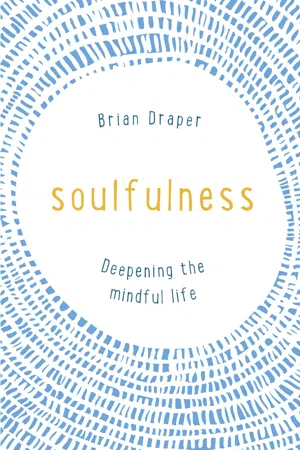
'Brian Draper is Britain's foremost popular spiritual thinker; he has no equals in linking the inner with the political and personal outer. This is a remarkably practical exploration of elusive yet core elements of our existence.' - Oliver James The beauty of mindfulness is that it's incredibly simple both to 'get' and to practise. And the results - increasingly backed by neuro-scientific evidence - are priceless: calmness and reduced stress, more creativity, greater awareness, compassion... And yet there's a danger that mindfulness can be used in a purely consumerist and self-serving way to help people to become better adapted cogs in a still-toxic model of work and life. Brian Draper challenges us to live not just mindfully but soul fully. Not merely to be less stressed, but to flourish, dynamically and creatively - to be present - through living intentionally and compassionately.
- 272 pages
- English
- ePUB (mobile friendly)
- Available on iOS & Android
eBook - ePub
About this book
Information
Part 1
What’s right with mindfulness? An appreciative enquiry
1
How do you drink your tea?
The great strength of mindfulness lies in its simplicity, clarity and effectiveness. We’ll touch on definitions shortly, but a helpful place to start is with its opposite. So ask yourself this: when was the last time you did something mindlessly?
Perhaps it was the way you ate breakfast this morning. It might have been a mad rush to get out of the door for work, or to get children ready for school or nursery. Perhaps you weren’t quite as hurried, but you found yourself tuning in, instead, to the morning news on the radio and getting lost in thought, or worrying about the day ahead.
The chances are, like so many of us, you hardly noticed what you were eating, let alone how you were eating it. What did your food taste like?
Even before that, how did you rise from bed? The alarm clock might have been an unholy shock to the system, and perhaps you shot up and out, full of adrenaline, fearing you were behind before you’d even begun. Or you might have felt so dead to the world that it was a struggle to move a muscle. Either way, it’s possible, or dare I say probable, that while you awoke physically (in the end!), you didn’t necessarily start the day fully awake to life itself – to the great gift of ‘being here’ that is given to us, new every morning, if we are willing to receive it.
How about the last cup of tea you made yourself, or the coffee you bought ‘to go’? Did you feel its warmth as you drank it and moved on? Were you able to savour it?
We perform many of the day’s routines, rituals and tasks so automatically that it’s easy to live much of our life ‘mindlessly’. And mindless doesn’t just mean marching through our days like zombies, unthinkingly (although we often do); an even greater challenge is that we can find it almost impossible to stop thinking – so that our restless and often anxious minds end up pulling us back into the past (as we re-live events, over and over) or pushing us forwards into the future (to pre-live them, often fretfully). As a consequence, we can end up caught in a maelstrom of conflicting thoughts and feelings, and it goes without saying that this has serious consequences for our ‘quality’ of life.
In particular, this has three profound effects:
we can miss out on being here, in the present moment;
we can live reactively at the constant demand of our ego;
and we can judge our life continually, with narrow and prematurely made-up minds.
Let’s take each one briefly in turn.
(1) We miss out on being here, in the present moment
Just occasionally, we manage to be so wonderfully absorbed in the present moment that all anxious thought subsides, and we relax into the sheer good news of being here, now.
Perhaps you can think of a time when this happened to you: when you were swimming on a hot day in a pool or river and it was truly enlivening; or you were playing sport, and were ‘in the zone’; or you were out for a walk and turned a corner to catch a truly awe-inspiring sight.
Those times are rare, though wonderful. And I’m sure our childhood memories are often so vivid because we were better then at being in the present moment without all that re-living or pre-living (in a sense, it’s only natural, as we had less to plan for or to worry about). So if we close our eyes to summon a positive childhood memory – try it now, if you like – it is usually one that involves being present.
For me, it’s playing cricket with my brother on a sunny day in the school summer holidays; or sledging in the woods on a dusky snow-filled late afternoon; or standing for what would seem like hours watching butterflies land on the purple blooms of buddleia in the back garden.
It might be building a den in the woods.
Or making sandcastles on a beach.
Or constructing a Lego palace.
* * *
If you are able to summon a similar memory of being present, why not pause for a moment, to give thanks for it, before you move on. Gratitude and appreciation are crucial ingredients when it comes to our own human flourishing.
* * *
The good news is that such vivid memories don’t have to stay locked away gathering dust, because the present is – by its very definition – forever here, ready and willing to enfold us again within this eternal flow of ‘now’. If we let it.
Perhaps we misunderstand nostalgia. It’s not just that we yearn for the good old days: something deep within our soul reminds us that the beauty of the present, which we enjoyed so vividly as children, is still within reach.
(2) We live reactively at the demand of our ego
When our mental chatter draws us away from the present moment, we can deprive ourselves of the chance to live intentionally. It’s like an internal monologue, which might tell us that we’re about to make a fool of ourselves in public, or that we don’t have what it takes, or that we need to look busy (or else!); whatever it’s saying, this voice can quickly and easily become our default setting, because it’s so all pervasive; and we can get so used to it that we end up living much of our life at its behest, without ever fully realising it, reacting unconsciously to its fears and insecurities.
We call this the voice of our ego. And if you want to identify it, just stop to notice when thoughts stream into your head that seem to be controlling, competing, or jealously comparing you to others. Your ego loves to make constant comparisons, so that you are driven to compete for, and to defend, your place in life. Often, too, you will experience a physiological reaction to the mental chatter, as stress rises within you, or you tense up.
* * *
(Pause to notice, for a few moments, whether you have any physical stress or tension in your body. It’s easy to go through much of the day with a furrowed brow or a clenched jaw without even realising it. If you locate some physical tension, spend a minute or two relaxing your body before you read on.)
* * *
The voice of our ego – which loves to replay the comments once made by those in authority over us, and to mix them in with our own insecurities – takes control and we can end up acting almost exclusively upon the information it supplies, instead of allowing our actions to be informed by, and to flow from, a deeper source within. Soul.
True, we may not be like those typically big, boastful personalities we associate with having ‘ego’; we may not feel forever driven to buy the flashier car or the bigger house. Yet our lives, nevertheless, are often just as affected by the ego’s subtly insecure messages, which can leave us feeling worried, jealous, in fear of missing out, useless, and the rest. The background noise is tiresome, too; it keeps us awake at night. So we might drink too much to quieten the chatter. Or keep talking, to drown it out. Or stay busy so that we don’t have to stop to consider it.
For as long as we act from our ego, then our life will, to a lesser or greater extent, involve controlling, competing and comparing; and, if we’re all doing it, the world can feel like an unsettling and dissatisfying and sometimes dangerous place in which to live.
All the while, the option remains: of moving beyond these self-imposed limitations, to cultivate a deeper awareness of who we really are and what we can truly offer the world around us.
(3) We judge our life continually, with narrow and prematurely made-up minds
Here is the great loss: that if our lives are predominantly informed by the restless chatter of our insecure minds and the feelings they provoke, then we can cease to see the world around us, or our role within it, with any sense of child-like wonder or curiosity. We can narrow the possibilities or potential of our life, pre-judging situations and second-guessing what others are thinking (especially about us).
The upshot is that we live reactively, by pushing things away or pulling them tightly towards us, according to what we believe about any given situation.
When I pick my children up from school, my natural inclination is to ask them, ‘How was your day?’ To which one usually replies, ‘Wonderful!’ and the other, ‘Awful.’ But in even asking them this question, I am already teaching them to judge what they experience according to whether they like it or not. A life- or business-coach, who is trained to ask incisive, open questions, might perhaps alternatively wonder: ‘What happened today? What did you learn? What did you notice? How did you grow?’
When we define each moment according to whether it’s good or bad, and whether we like it or not, it becomes harder to see life, and our place within it, with eyes wide open. With our unconscious thought patterns – what we repeatedly tell ourselves about the world and other people and about what’s coming next – we can thus diminish our sense of who we are and what we can bring of ourselves to the world, and we can end up facing much of life in the brace position, as if the plane is about to crash, instead.
Waking up
So it matters that we wake up to this, and try to stay more fully awake! Not just physically, at the start of each day, but to the gift of life that is ours to receive within every waking moment; and to the gift of being present, which we probably thought we’d left behind in childhood.
The positive alternative to mindlessness, then, is to become mindful. And the practice of mindfulness, which we’ll consider now, is important, as it...
Table of contents
- Cover
- Title Page
- Imprint Page
- Dedication
- Contents
- Epigraph
- Introduction
- Part 1 - What’s right with mindfulness?
- 1 How do you drink your tea?
- 2 How mindful practice can prepare us for the soulful life
- 3 Consciousness discipline – and the way the brain takes us deeper
- 4 Turning ‘time out’ into ‘time in’
- Interlude: Are you ready for adventure?
- Part 2 - Reaching in for soul
- 5 Awake, my soul!
- 6 Sensing the soulful life
- 7 Meeting your self, as if for the first time
- 8 Sharpening the focus on our uniqueness – some questions to ponder
- Part 3 - Reaching out with soul
- 9 Soul friendship
- 10 Connecting with God
- 11 To breathe the larger air: nature and the human soul
- 12 The space between us
- Part 4 - Living with soul
- 13 Fleshing out our unique, inner aliveness
- 14 Hygge – a warm and soulful embrace of the whole of life
- 15 Peace, wholeness and embracing paradox
- 16 Finding a soulful rhythm as natural as breathing
- 17 Soulful expression through our life’s work
- 18 Let the soul take the lead
- Epilogue: ‘It is well with my soul’
- If you were to do one thing
- A reminder of the exercises and suggestions contained within this book
- Acknowledgments
- Notes
Trusted by 375,005 students
Access to over 1.5 million titles for a fair monthly price.
Study more efficiently using our study tools.
Frequently asked questions
Yes, you can cancel anytime from the Subscription tab in your account settings on the Perlego website. Your subscription will stay active until the end of your current billing period. Learn how to cancel your subscription
No, books cannot be downloaded as external files, such as PDFs, for use outside of Perlego. However, you can download books within the Perlego app for offline reading on mobile or tablet. Learn how to download books offline
Perlego offers two plans: Essential and Complete
- Essential is ideal for learners and professionals who enjoy exploring a wide range of subjects. Access the Essential Library with 800,000+ trusted titles and best-sellers across business, personal growth, and the humanities. Includes unlimited reading time and Standard Read Aloud voice.
- Complete: Perfect for advanced learners and researchers needing full, unrestricted access. Unlock 1.5M+ books across hundreds of subjects, including academic and specialized titles. The Complete Plan also includes advanced features like Premium Read Aloud and Research Assistant.
We are an online textbook subscription service, where you can get access to an entire online library for less than the price of a single book per month. With over 1.5 million books across 990+ topics, we’ve got you covered! Learn about our mission
Look out for the read-aloud symbol on your next book to see if you can listen to it. The read-aloud tool reads text aloud for you, highlighting the text as it is being read. You can pause it, speed it up and slow it down. Learn more about Read Aloud
Yes! You can use the Perlego app on both iOS and Android devices to read anytime, anywhere — even offline. Perfect for commutes or when you’re on the go.
Please note we cannot support devices running on iOS 13 and Android 7 or earlier. Learn more about using the app
Please note we cannot support devices running on iOS 13 and Android 7 or earlier. Learn more about using the app
Yes, you can access Soulfulness by Brian Draper in PDF and/or ePUB format, as well as other popular books in Psychology & History & Theory in Psychology. We have over 1.5 million books available in our catalogue for you to explore.